Reports matching your filters
The mobile gaming landscape between July 2017 and June 2018 was characterized by a widening performance gap between elite titles and the market median. Analysis of over 60,000 games and 850 million monthly active players reveals that top-tier titles in the 15th percentile maintain Day 1 retention rates exceeding 35%, whereas Day 28 retention across the board rarely surpasses 6%. This retention decay underscores the difficulty of long-term player engagement, leading industry leaders like Voodoo to implement strict 50% Day 1 retention thresholds to identify potential hits early in the development cycle.
Monetization metrics further illustrate this disparity, with top-performing games generating three to four times more revenue per paying user than average titles. The Role Playing, Strategy, and Casino genres dominate financial benchmarks, with elite performers achieving an average revenue per paying user of up to $40. Furthermore, the average revenue per daily active user for top-tier games is six times higher than the median, a success largely attributed to sophisticated A/B testing of price points and the implementation of reactive in-game offers.
As mobile games are projected to account for 76% of global app revenue, the ability to convert and retain players remains the primary differentiator for commercial success. While average games struggle with low conversion rates, top-performing titles achieve conversion metrics triple those of the median. These findings suggest that data-driven development and aggressive optimization of monetization funnels are essential requirements for competing in a market where the majority of value is concentrated among a small percentage of high-performing titles.
The study aimed to gauge the penetration of video games among Spanish adults, map the demographic profile of adult gamers, explore attitudes and usage habits, compare adults with and without children, and assess purchase intentions for the 2015 holiday season. Conducted nationwide in November 2015, it surveyed 1,000 individuals aged 18 and over via telephone CATI interviews, yielding a margin of error of ±3.09 percent.
Overall, 38.9 percent of Spanish adults reported playing video games, while 61.1 percent did not. Play rates were highest among 18‑ to 29‑year‑olds, with three‑quarters engaging in gaming, and remained substantial for the 30‑44 age group at 54.3 percent. Men were more active than women (45.3 percent versus 32.8 percent), though women with children showed a higher participation rate (36.9 percent) than those without (30.1 percent), whereas the opposite pattern held for men. About 46.9 percent of gamers were occasional (at least monthly) and 41.5 percent habitual (weekly or daily), with habitual players being 60 percent male. Among habitual parents, 83.1 percent had children under nine, and 64.9 percent believed gaming strengthened parent‑child bonds, especially younger parents.
Education correlated with gaming intensity: 63.7 percent of habitual players held secondary or university qualifications. Consoles remained the dominant platform (61.1 percent), favored by men (66.2 percent), while women preferred smartphones (57.6 percent). Approximately 36.2
The computer and video game industry in the United States demonstrated significant economic strength in 2013, generating a total revenue of $21.53 billion. This financial performance underscores the sector's role as a major contributor to the national economy, driven by robust consumer demand for interactive entertainment across various platforms and delivery methods.
Consumer spending on game content accounted for $15.39 billion of the total industry revenue. A notable shift in purchasing behavior is evident in the 11 percent year-over-year growth of digital format sales. This trend highlights a transition toward digital distribution models, reflecting evolving consumer preferences for immediate access to content over traditional physical media.
These findings provide a snapshot of the domestic gaming market during the 2013 calendar year, focusing specifically on revenue generation and sales distribution. By tracking the growth of digital formats alongside total content expenditure, the data illustrates a maturing market that is increasingly reliant on digital infrastructure to sustain its financial trajectory. The industry maintains a strong foothold in the entertainment sector, characterized by consistent revenue streams and a clear movement toward digital-first consumption patterns.
The European Online Game Survey 2012 provides a comprehensive analysis of the European game development landscape, focusing on industry trends, technical infrastructure, and gamer behavior. Conducted by the European Games Developer Federation and i2 Media Research, the study utilizes quantitative data from 93 industry members and qualitative insights from 1,154 gamers across Germany, Spain, France, Finland, Denmark, and Norway. The primary objective is to evaluate the operational realities of European studios and identify opportunities for enhancing community-driven gaming experiences.
Key findings indicate that the industry is heavily invested in Massive Multiplayer Online Games (MMOGs), with 58% of surveyed studios having worked on an MMOG in their three most recent projects. Developers prioritize community interaction and user-generated content, viewing these as essential components of modern game design. To support these goals, the research highlights the development of peer-to-peer architectures and in-game graphical insertion technology, which allow for enhanced social features without requiring costly modifications to existing game code or central server infrastructure.
The survey also details the technical profiles of European studios, noting that the sector is dominated by small-to-medium enterprises, with nearly half of all studios employing fewer than 10 people. Production environments are characterized by a strong preference for high-performance hardware, with a clear trend toward prioritizing processing speed over cost. Furthermore, the research segments the gaming audience into distinct categories—ranging from casual players to community-minded fanatics—to help developers optimize product development and monetization strategies. Ultimately, the findings underscore a shift toward integrated, high-performance social gaming experiences that minimize technical friction for the end user.
The study evaluates the evolution of online piracy of paid cultural digital content in Spain, focusing on music, video games, films and books during the first half of 2011 and comparing the results with the same period in 2010. By measuring the gap between legal consumption and unauthorized copying, it aims to quantify the scale of the illicit market and track changes in user behavior.
Legal sales of digital content generated €1.538 billion, a modest 0.5 % decline from the previous year. The weighted average piracy rate rose to 77.3 %, up 0.4 % year‑on‑year, implying that pirated consumption was valued at €5.229 billion—almost four times the legal market size. Segment‑specific losses were most pronounced in music (€2.746 billion), followed by films (€1.402 billion), books (€0.793 billion) and video games (€0.288 billion). Overall, the legal market base for the analysis stood at €1.561 billion, reflecting a 1.4 % contraction.
The research covers the domestic Spanish consumer market, limited to online users aged 16 to 55, and excludes content that is freely available (e.g., broadcast TV, radio, free‑to‑play games, streaming services). Data were collected through a semi‑annual online survey of 3,000 respondents drawn from a panel of 72,000, with quotas ensuring representation by gender and autonomous community. The sample provides a 95 % confidence level with a 1.8 % margin of error, and the online user universe is defined by Nielsen Online measurements.
Findings highlight a persistent and growing piracy problem despite a slight dip in legal sales, suggesting significant untapped potential for a legitimate market if effective anti‑piracy measures and alternative business models are introduced.
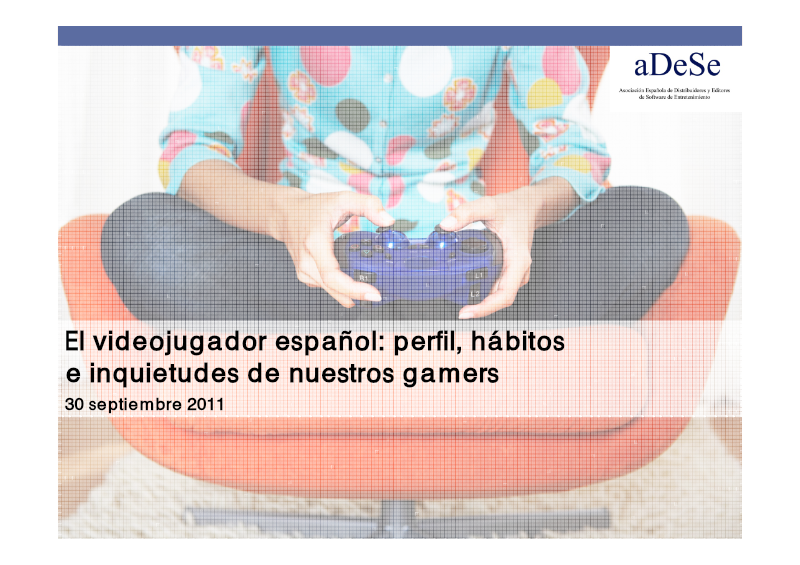
The study commissioned by the Spanish Association of Distributors and Publishers of Entertainment Software aims to map the profile, habits and concerns of Spanish video‑game players as of 2011, positioning Spain within the broader European market. Spain ranks as the fourth largest European video‑game market, with sales exceeding €1.245 billion in 2010, while the continent records a 25.4 % adult gaming penetration (79.2 million regular players). In Spain, 24 % of adults play regularly, and the most active segment is aged 7‑34, representing 45.3 % of the population.
The typical gamer is 32 years old, with women accounting for 40 % of players over 15 years. Over half are married or cohabiting, and 43 % devote between one and five hours per week to gaming. Lifestyle data show that 70 % of gamers frequently engage in outdoor activities such as walking, café visits or restaurant meals, while 61 % exercise regularly. Health awareness is high: 57 % prioritize nutritious food, and 75 % actively practice environmental stewardship through recycling and energy‑saving habits.
Values analysis reveals a predominance of hedonistic (≈25 %) and authentic (≈19 %) orientations, followed by social‑rational and aspirational profiles (each around 15 %). Expectations for the next decade are strong: 90 % foresee gaming becoming a universal pastime, with 55‑88 % anticipating virtual‑reality immersion, multisensory experiences and a shift toward educational, medical and professional applications. The research draws on GfK Emer Ad Hoc surveys conducted across Europe in 2009‑2010, combining sales figures, penetration rates and attitudinal questionnaires to deliver a comprehensive portrait of Spanish gamers.
The study quantifies the scale of digital‑content piracy in Spain during the first half of 2011 and demonstrates that illicit consumption far exceeds legitimate market activity. Pirated material was valued at €5.23 billion, representing roughly 77 % of the legal turnover of €1.54 billion and approaching four times the revenue generated by lawful sales. The incidence of piracy varies markedly across sectors: music reaches a 98.2 % piracy rate amounting to €2.75 billion, films register 73.9 % (€1.40 billion), and video games show 61.7 % of their market value being pirated, with books trailing behind the other categories.
The analysis draws on a statistically representative online panel of 3,000 Spanish adults aged 16‑55, balanced by gender (49 % men, 51 % women) and regional distribution. The sample achieves a ±1.8 % margin of error at the 95 % confidence level, with weighting and bias‑correction procedures applied through iterative proportional fitting and adjustments for demographic, capture‑probability, and source‑selection effects. Recruitment employed a multi‑partner random‑digit‑dialing telephone approach, and participants were incentivised to ensure high engagement, providing a robust foundation for assessing consumption and piracy behaviours.
Survey instruments captured device penetration, the split between peer‑to‑peer and direct‑download mechanisms, and detailed recall of download and streaming volumes for music, film, video‑games and books on a quarterly or bi‑weekly basis. Findings reveal pervasive use of both P2P networks and direct‑download sites, underscoring the breadth of illegal access across multiple device types. The high piracy ratios, especially in music and film, suggest that traditional revenue models are being undermined, prompting a need for revised industry strategies, stronger enforcement, and alternative distribution frameworks to align consumer habits with sustainable market growth.
The study commissioned by ADESE explores how video games are expected to evolve, focusing on technological, social and market dynamics and projecting scenarios up to 2025. It seeks to understand current player behaviours, perceived barriers to online play, and the aspirations of different user segments for future gaming experiences.
Research combined three perspectives—regular gamers, industry experts and parents—through focus groups organized by Buzz Research. Participants were grouped by age (16‑18, 19‑23 and 25‑35) and by playing profile, distinguishing hardcore players, casual players and an emerging “Cani” segment that blends moderate skill with regular play. Findings reveal that hardcore gamers dominate online activity but still rely heavily on offline play, while casual players show limited interest in online modes due to slow connections, language obstacles, trust issues and unfamiliar payment models. Parents mirror casual attitudes, valuing online interaction mainly for its social companionship.
Projected developments for the medium term (around 2015) include cloud‑based distribution, motion‑sensing controls, high‑definition 3D graphics and AI‑driven personalization, with an emphasis on cross‑device compatibility. Long‑term visions (2020‑2025) anticipate immersive virtual‑reality environments, multisensory holographic interfaces, voice‑controlled menus and highly customizable controllers, suggesting a shift toward fully online ecosystems and digital‑only delivery. Experts anticipate that 100 % of future games will be online, driven by anti‑piracy incentives, streamlined matchmaking, enhanced security and ubiquitous broadband.
Beyond entertainment, respondents agree that gaming technology will expand into education, senior‑care, professional training and therapeutic applications, leveraging interactive simulations for language learning, psychomotor skill development, conflict resolution and cognitive rehabilitation. The overall outlook combines cautious optimism about technological breakthroughs with recognition of current infrastructural and cultural hurdles that must be addressed for widespread adoption.
I’m ready to synthesize the material, but I need the remaining section summaries to produce a complete, accurate overview. Could you please provide the rest of the section-by-section information?