Report1 pages
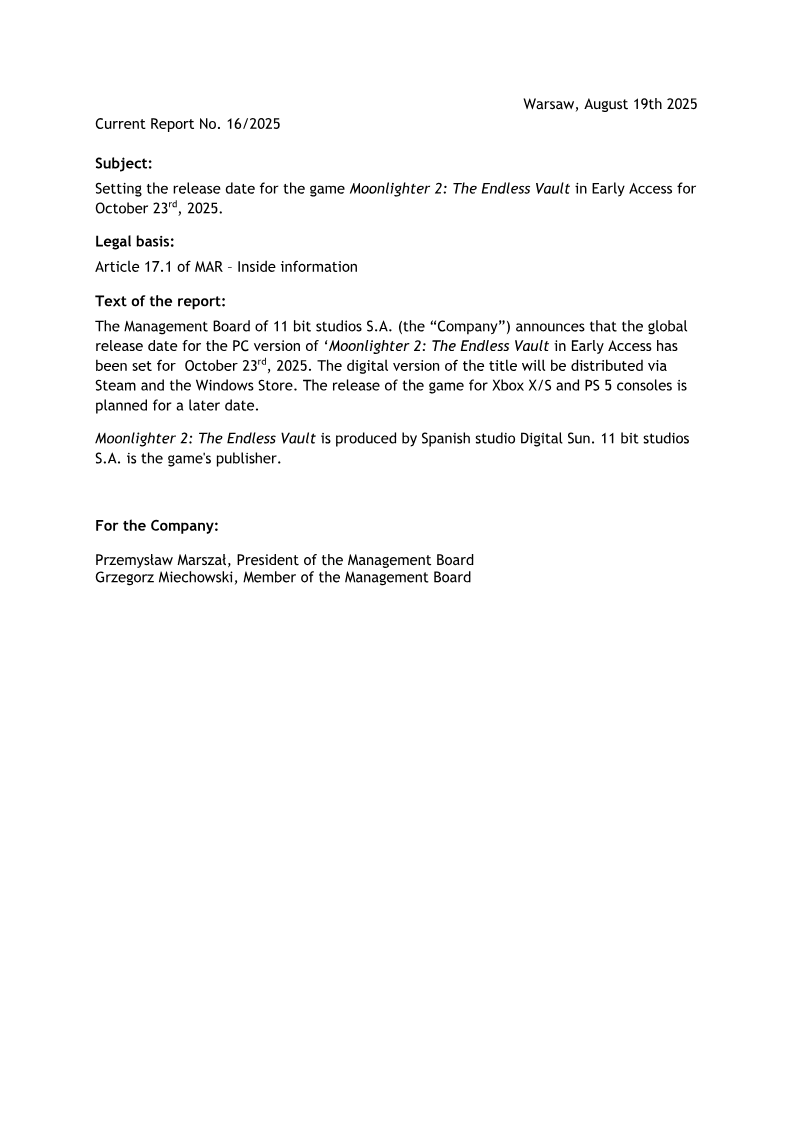
Current Report No. 16: Setting Release Date for Moonlighter 2: The Endless Vault
The announcement establishes the global early‑access release date for Moonlighter 2: The Endless Vault on PC as October 23, 2025. Distribution will occur through Steam and the Windows Store, while console releases for Xbox X/S and PlayStation 5 are deferred to a later date. The title is developed by Spanish studio Digital Sun, with 11 bit Studios S.A. acting as publisher.
The release schedule reflects a strategic focus on the PC market, leveraging major digital storefronts to maximize initial reach. By postponing console launches, the publisher can concentrate resources on polishing the PC experience and gathering player feedback during early access. The decision aligns with industry trends where developers use early‑access periods to iterate on gameplay, balance mechanics, and build community engagement before broader platform releases.
The communication is issued by the Management Board of 11 bit Studios, underscoring corporate governance and regulatory compliance. The statement cites Article 17.1 of MAR – Inside information as the legal basis, indicating that the release date is considered material information for investors. The brief does not provide additional data on sales projections, market analysis, or development milestones, focusing solely on the release timeline and distribution channels.
- Moonlighter 2: The Endless Vault will launch in early access on PC via Steam and the Windows Store on October 23, 2025.
- Console versions for PlayStation 5 and Xbox Series X/S are deferred to a later date to allow for a focused PC-first release strategy.
- The development is led by the Spanish studio Digital Sun, with 11 bit Studios S.A. serving as the publisher.
- The early-access period is intended to facilitate gameplay iteration, mechanical balancing, and community engagement prior to a wider platform rollout.
- 11 bit Studios issued this announcement as material information under Article 17.1 of the Market Abuse Regulation (MAR) to ensure regulatory compliance.
+2
11 bit studios
Report1 pages
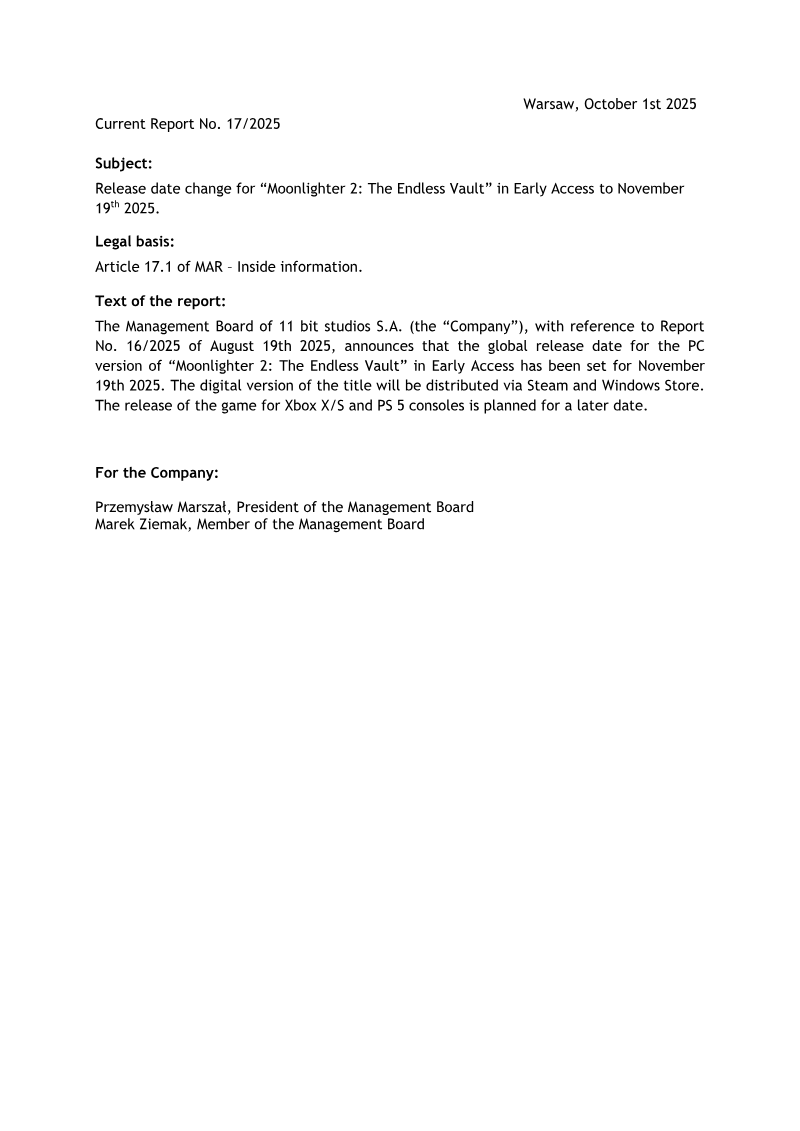
Current Report No. 17/2025: Release Date Change for Moonlighter 2
The release schedule for “Moonlighter 2: The Endless Vault” has been updated. 11 bit studios S.A. announced that the PC version will enter Early Access on November 19, 2025, with distribution through Steam and the Windows Store. The company indicated that console releases for Xbox X/S and PlayStation 5 will occur at a later, unspecified date. This change follows the earlier announcement in Report No. 16/2025 dated August 19, 2025, which set the initial release framework. The update is issued under Article 17.1 of MAR, classifying it as inside information that must be disclosed to the market. The announcement is signed by Przemysław Marszał, President of the Management Board, and Marek Ziemak, a board member. No additional data on sales projections, market impact, or development milestones are provided in the brief communication. The scope is limited to the PC Early Access launch, with no geographic restrictions noted beyond the global availability of digital distribution platforms. The report serves to inform investors and stakeholders of the revised launch timeline, ensuring compliance with regulatory disclosure requirements.
- 11 bit studios S.A. has scheduled the PC Early Access release of 'Moonlighter 2: The Endless Vault' for November 19, 2025.
- The PC version will be distributed globally via Steam and the Windows Store.
- Console releases for Xbox Series X/S and PlayStation 5 have been delayed to an unspecified date following the initial framework established in August 2025.
- This update constitutes regulated inside information under Article 17.1 of MAR, requiring formal disclosure to investors and stakeholders.
- The announcement was officially authorized by 11 bit studios board members Przemysław Marszał and Marek Ziemak.
+2
11 bit studios
Report1 pages
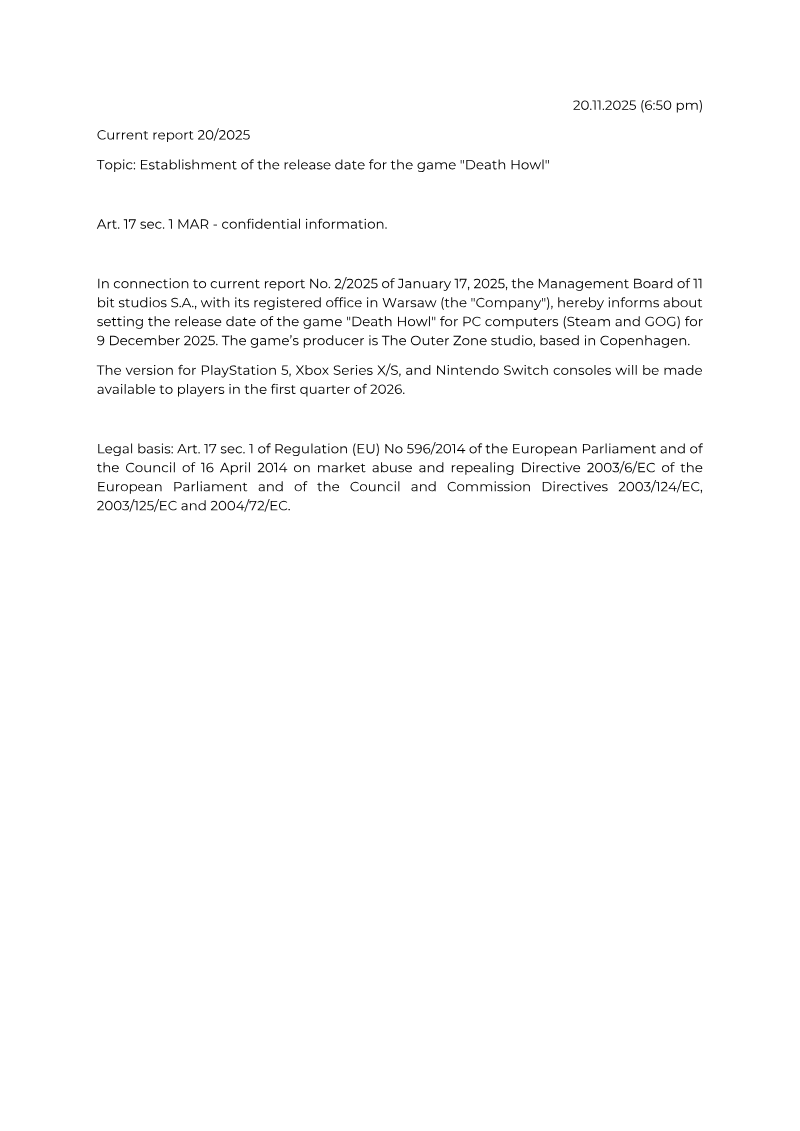
Establishment of the Release Date for the Game Death Howl
The release schedule for the upcoming title “Death Howl” has been formally announced by 11 bit studios S.A. The company, headquartered in Warsaw, confirmed that the PC version—available through Steam and GOG—will launch on 9 December 2025. Production is handled by The Outer Zone studio in Copenhagen, and the announcement follows a prior disclosure issued on 17 January 2025. Console editions for PlayStation 5, Xbox Series X/S, and Nintendo Switch are slated for release in the first quarter of 2026. The announcement is made under Article 17, Section 1 of the Market Abuse Regulation (EU) No 596/2014, ensuring compliance with EU market‑abuse legislation. The communication provides a clear timeline for both digital and console platforms, indicating that the PC release precedes console availability by several months. No additional data on sales projections or market analysis is included, and the scope remains limited to the release dates for the specified platforms without geographic expansion beyond the European market. The statement serves primarily as a regulatory disclosure rather than an analytical report, fulfilling legal obligations for public companies to inform shareholders of material events.
- 11 bit studios S.A. will release the PC version of 'Death Howl' on Steam and GOG on 9 December 2025.
- Console versions for PlayStation 5, Xbox Series X/S, and Nintendo Switch are scheduled for release in Q1 2026.
- Development of the title is being handled by The Outer Zone studio based in Copenhagen.
- The PC launch precedes the console release by a margin of several months.
- This announcement serves as a formal regulatory disclosure under Article 17, Section 1 of the EU Market Abuse Regulation (EU) No 596/2014.
+2
11 bit studios
Report1 pages
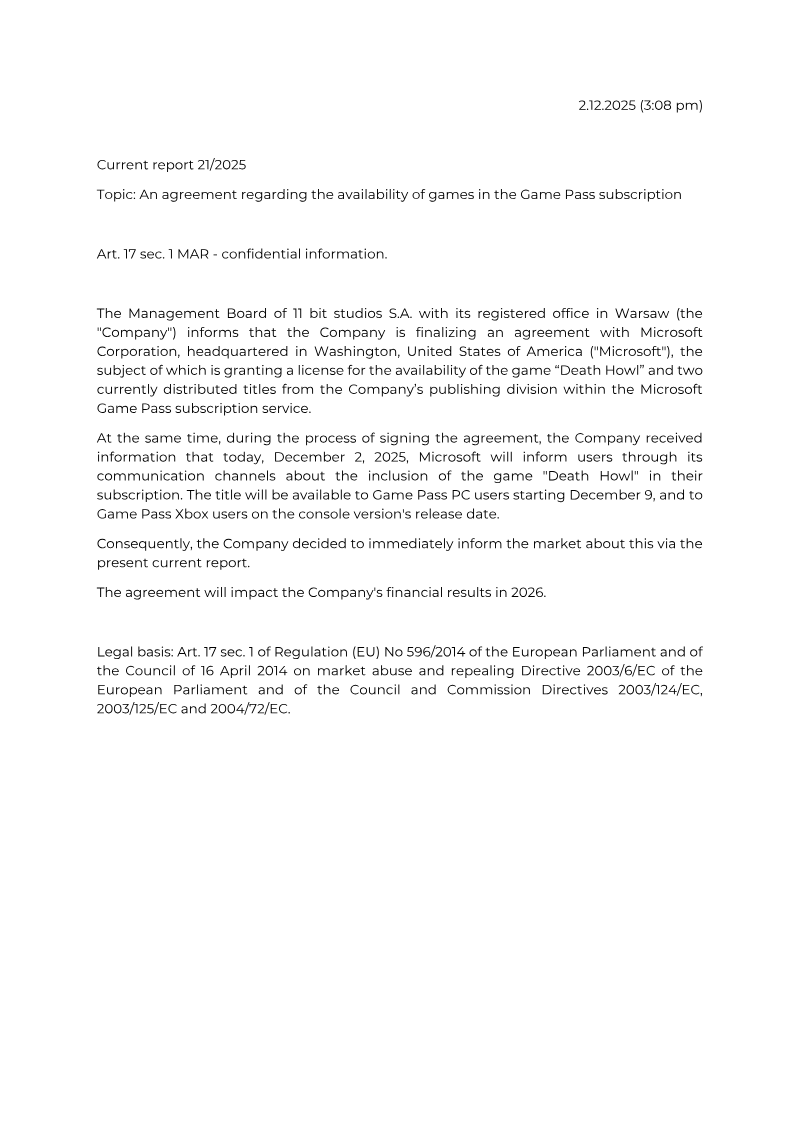
An Agreement Regarding the Availability of Games in the Game Pass Subscription
The announcement informs shareholders that 11 bit studios S.A. is finalizing a licensing agreement with Microsoft Corporation to make the game “Death Howl” and two other titles from its publishing division available on Microsoft Game Pass. The deal, governed by Article 17(1) of the EU Market Abuse Regulation, will become effective in 2026 and is expected to influence the company’s financial performance for that year. Microsoft has already communicated to users that “Death Howl” will join Game Pass for PC on December 9, 2025, with the Xbox version following upon its console release. The agreement covers both PC and Xbox platforms, expanding 11 bit’s distribution reach within the subscription service. The company’s management board deemed it necessary to disclose this development promptly, citing regulatory obligations and the potential impact on investor expectations. No specific financial figures or detailed terms of the license are disclosed, but the timing and platform scope suggest a strategic partnership aimed at increasing revenue streams through subscription-based access. The report is limited to the Polish market, with implications for European investors, and covers the period up to the end of 2025, outlining anticipated effects in the 2026 fiscal year.
- 11 bit studios S.A. has finalized a licensing agreement with Microsoft to bring 'Death Howl' and two additional publishing titles to the Game Pass subscription service.
- The 'Death Howl' PC version is scheduled to launch on Game Pass on December 9, 2025, with the Xbox console version to follow upon its release.
- The agreement covers both PC and Xbox platforms and is expected to materially influence 11 bit studios' financial performance in the 2026 fiscal year.
- The deal is officially governed by Article 17(1) of the EU Market Abuse Regulation, necessitating prompt disclosure to shareholders due to its potential impact on investor expectations.
- While specific financial terms remain undisclosed, the partnership represents a strategic move by 11 bit studios to diversify revenue streams through subscription-based distribution.
+2
11 bit studios
Report1 pages
Conclusion of an Agreement Concerning the Availability of Games within the Game Pass Program
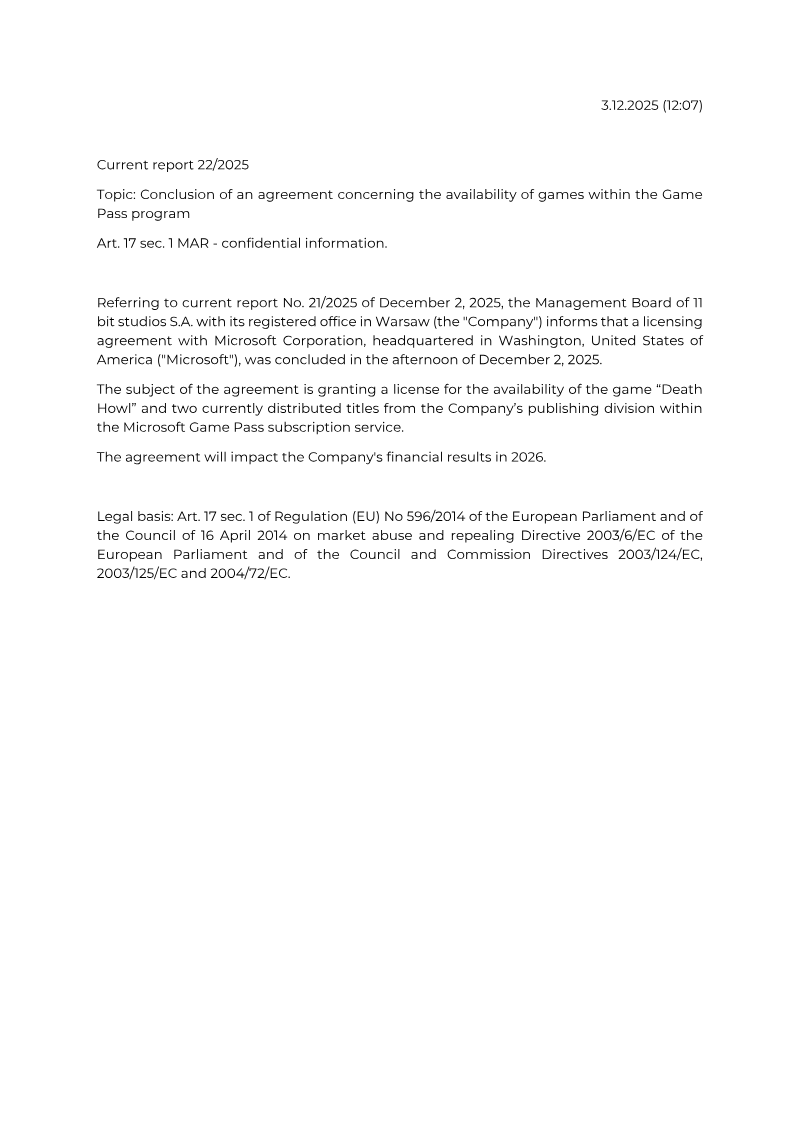
The agreement, finalized on December 2 2025 between 11 bit studios S.A. and Microsoft Corporation, grants Microsoft the right to host the game “Death Howl” and two additional titles from 11 bit’s publishing division on its Game Pass subscription platform. The licensing deal is expected to influence the company’s financial performance in 2026, as noted by the Management Board. The announcement follows a prior report issued on December 2 2025, and it is disclosed under Article 17(1) of Regulation (EU) No 596/2014, which governs market‑abuse disclosures. The agreement’s scope is limited to the specified titles and their availability on Microsoft’s Game Pass service, with no broader geographic or product implications indicated. No further details regarding revenue projections, user reach, or contractual terms are provided in the brief disclosure. The communication is directed at shareholders and market participants to ensure compliance with EU transparency requirements, emphasizing that the licensing arrangement will be reflected in the company’s 2026 financial statements.
- 11 bit studios S.A. signed an agreement with Microsoft Corporation on December 2, 2025, to include the game 'Death Howl' and two additional publishing titles in the Game Pass subscription service.
- The licensing deal is expected to impact 11 bit studios' financial performance during the 2026 fiscal year.
- The agreement is limited strictly to the three specified titles and their availability on the Game Pass platform, with no broader product or geographic scope.
- The disclosure was issued to comply with Article 17(1) of EU Regulation No 596/2014 regarding market-abuse transparency requirements.
- No specific financial terms, revenue projections, or user reach metrics were disclosed regarding the licensing arrangement.
+3
11 bit studios
Report3 pages
2019/20 Annual Sales Report
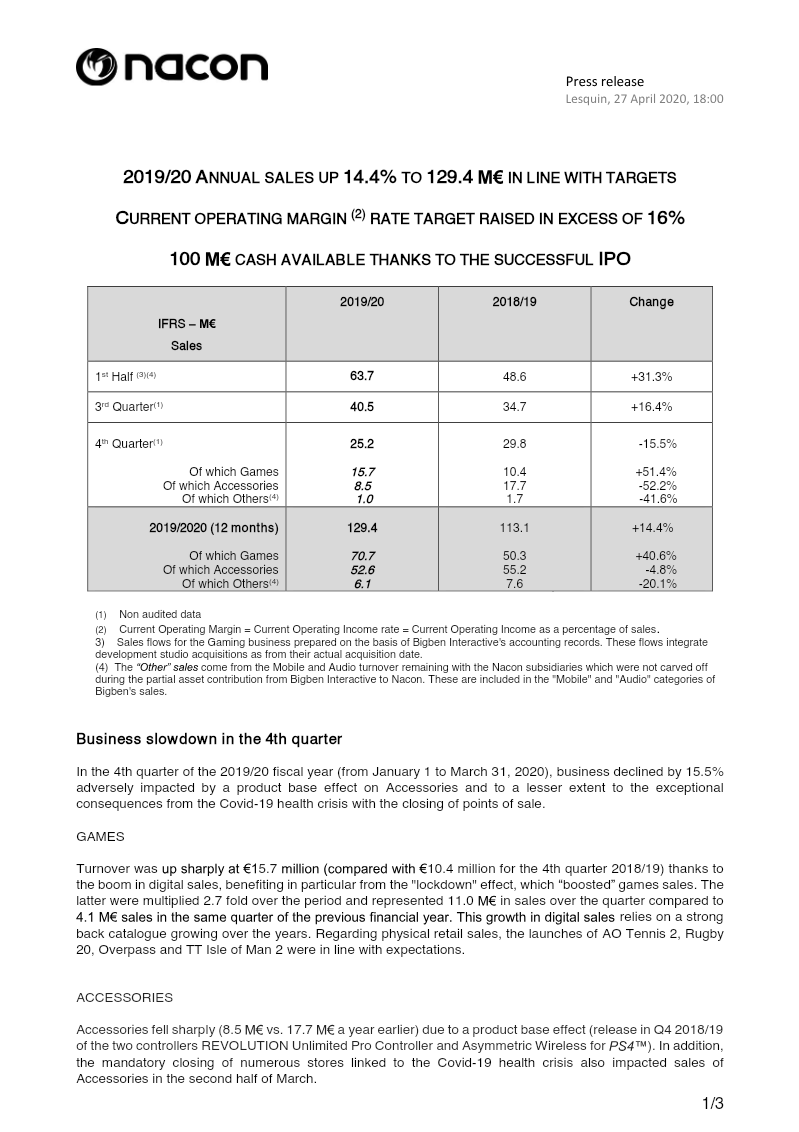
Nacon reported a 14.4 % increase in annual sales, reaching €129.4 million for the 2019/20 fiscal year, in line with its IPO guidance of €127–133 million. Total revenue rose from €113.1 million in 2018/19, driven largely by a 40.6 % jump in game sales to €70.7 million, while accessory revenue fell 4.8 % to €52.6 million and other categories declined 20.1 %. Digital game sales surged, accounting for 69 % of game revenue versus 41 % the previous year, a trend amplified by lockdown‑induced consumer behaviour. The fourth quarter saw a 15.5 % drop in overall sales, largely due to a product‑base effect on accessories and temporary store closures from the COVID‑19 crisis, though game sales remained robust.
Operating performance improved, with a current operating margin target of 16 % raised above expectations thanks to higher digital margins. Cash reserves stood at €100 million following a successful IPO that raised €109 million in March 2020, ensuring liquidity for the upcoming fiscal year. Nacon maintains its “NACON 2023” plan, targeting €180–200 million in sales and a margin above 20 % for FY 2022/23. The company projects continued momentum in Q1 2020/21, with new game releases and expanded headset distribution through a partnership with Poly (Plantronics Inc.). Operations have largely shifted to telework, and procurement has returned to normal levels. The company’s 16 subsidiaries operate across 100 countries, supporting a workforce of nearly 450 employees.
- Nacon reported a 14.4% increase in annual sales to €129.4 million for the 2019/20 fiscal year, meeting its IPO guidance range of €127–133 million.
- Game sales grew by 40.6% to €70.7 million, with digital channels accounting for 69% of that revenue compared to 41% in the previous year.
- Accessory revenue declined by 4.8% to €52.6 million, contributing to a 15.5% drop in overall Q4 sales due to store closures and product-base effects.
- The company raised its current operating margin target to 16% due to higher margins from digital game sales.
- Following a March 2020 IPO that raised €109 million, Nacon holds €100 million in cash reserves to ensure liquidity.
+4
Nacon
Report32 pages
Interim Financial Report: First Half 2020/21
INTERIM FINANCIAL REPORT FOR THE SIX MONTHS ENDED 30 SEPTEMBER 2020 – NACON SIX MONTHS ENDED 30 SEPTEMBER 2020 SIX MONTHS ENDED 30 SEPTEMBER 2020 TABLE OF CONTENTS 2 1. STATEMENT BY THE PERSON RESPONSIBLE 3 2.
- NACON's net income significantly increased by 46.7% to €9.6 million in the first half of 2020/21, up from €6.5 million in the first half of 2019/20.
- Recurring operating income for NACON rose by 47.4% to €15.7 million in the first half of 2020/21, compared to €10.7 million in the prior year, driven by increased revenue, reduced external expenses, and controlled personnel costs.
- Consolidated revenue for NACON grew by 35.9% to €86.6 million in the first half of 2020/21, with gaming accessories revenue more than doubling from €23.6 million to €51.6 million, now representing 60% of total revenue.
- NACON acquired 100% of Belgian development studio Neopica Srl on October 19, 2020, a studio known for developing around 60 games including Hunting Simulator 1 & 2 and FIA European Truck Racing Championship.
- NACON's EBITDA reached €30.4 million in the first half of 2020/21, representing 35.1% of revenue, up from €23.5 million (37.0% of revenue) in the first half of 2019/20.
+2
Nacon
Report2 pages
Q1 2020/21 Sales Results: 24.5% Sales Increase Despite a Strong Comparison Basis
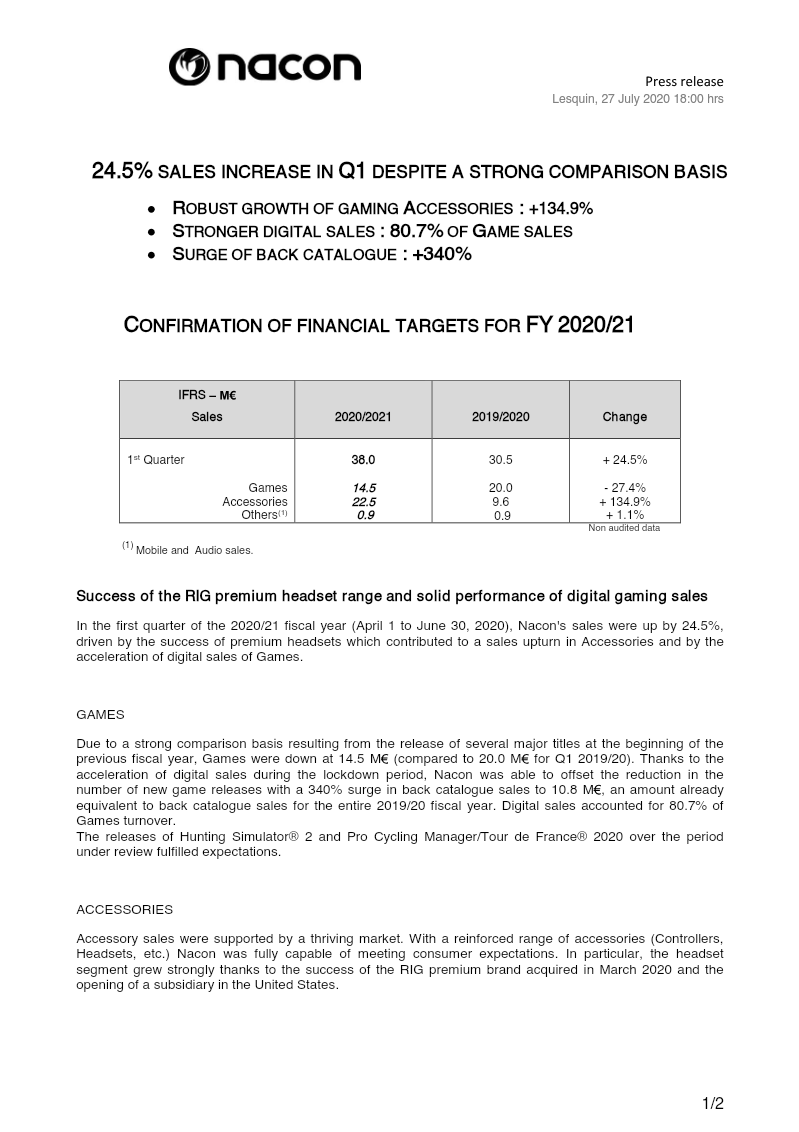
Nacon reported a 24.5 % rise in first‑quarter sales for FY 2020/21, reaching €38.0 million against €30.5 million in the same period a year earlier, confirming its annual financial targets. The growth was driven primarily by accessories and digital game sales. Accessories surged 134.9 % to €22.5 million, propelled by the launch of the RIG premium headset line and a new U.S. subsidiary. Digital game sales, which accounted for 80.7 % of total game revenue, offset a decline in new releases; back‑catalogue sales jumped 340 % to €10.8 million, matching the entire previous year’s back‑catalogue volume.
Game sales fell to €14.5 million from €20.0 million due to a strong comparison base of major titles released in the prior fiscal year, but the accelerated digital channel and successful releases such as Hunting Simulator 2 and Pro Cycling Manager/Tour de France 2020 mitigated the impact. Other revenue categories remained flat.
Geographically, Nacon operates through 16 subsidiaries and a distribution network spanning 100 countries, with recent expansion into the United States. The company’s outlook for Q2 and the remainder of FY 2020/21 remains positive, citing upcoming releases (WRC 9, Tennis World Tour 2, Monster Truck Championship), continued digital momentum, and a new partnership with Microsoft for console‑compatible controllers. Nacon projects FY 2020/21 sales between €140–€150 million and a 18 % operating margin, while maintaining its 2023 plan targets of €180–€200 million sales and over 20 % margin for FY 2022/23.
- Nacon achieved a 24.5% year-over-year sales increase in Q1 2020/21, reaching €38.0 million and confirming its annual revenue target of €140–€150 million.
- Accessory sales surged 134.9% to €22.5 million, driven by the launch of the RIG premium headset line and the establishment of a new U.S. subsidiary.
- Back-catalogue digital game sales grew 340% to €10.8 million, matching the total volume of the previous fiscal year and offsetting a decline in new game releases.
- Total game revenue fell to €14.5 million from €20.0 million due to a strong comparison base from the prior year, though digital channels accounted for 80.7% of this segment.
- The company maintains its 2023 strategic targets of €180–€200 million in sales and an operating margin exceeding 20%.
+3
Nacon
Report2 pages
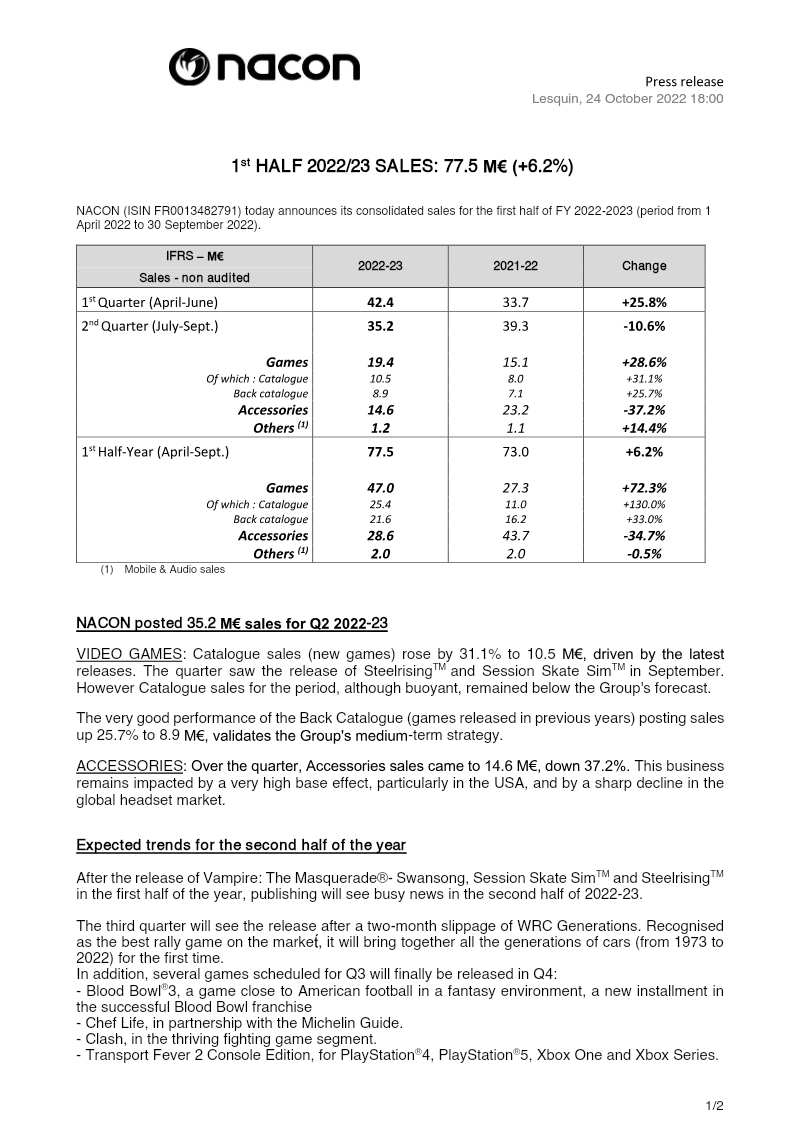
1st Half 2022/23 Sales
NACON reported first‑half sales of €77.5 million for FY 2022‑23, a 6.2 % increase over the same period in 2021‑22. Quarterly performance showed a strong 25.8 % rise in the first quarter (€42.4 million) followed by a 10.6 % decline in the second quarter (€35.2 million). Game sales dominated revenue, rising 72.3 % to €47.0 million; catalogue (new releases) grew 130 % to €25.4 million, while back‑catalogue sales increased 33 % to €21.6 million. Accessories revenue fell sharply by 34.7 % to €28.6 million, reflecting a high base effect and a global headset market downturn; mobile and audio sales remained flat.
Geographically, the decline in accessories was most pronounced in the United States. The company highlighted upcoming releases—WRC Generations, Blood Bowl 3, Chef Life, Clash, and Transport Fever 2 Console Edition—expected to bolster catalogue sales in the second half. Despite a shortfall against forecasted catalogue targets, NACON anticipates year‑end sales and operating income to rise relative to the prior year due to back‑catalogue strength, though it will miss FY 2022‑23 targets of €250 million in sales and €50 million in operating income.
Looking ahead to FY 2023‑24, NACON expects growth driven by late‑year releases feeding the back catalogue and a diversified publishing slate. The company maintains confidence in its medium‑term prospects, citing synergies from its 16 studios and a global distribution network of 23 subsidiaries.
- NACON will miss its FY 2022-23 targets of €250 million in sales and €50 million in operating income, despite anticipating year-end growth relative to the prior year.
- Total first-half sales reached €77.5 million, a 6.2% increase year-over-year, driven by a 72.3% surge in game revenue to €47.0 million.
- Accessories revenue dropped 34.7% to €28.6 million, primarily due to a global headset market downturn and a high base effect, particularly in the United States.
- New release catalogue sales grew 130% to €25.4 million, while back-catalogue sales increased 33% to €21.6 million.
- Quarterly performance was inconsistent, featuring a 25.8% rise in Q1 (€42.4 million) followed by a 10.6% decline in Q2 (€35.2 million).
+3
Nacon
Report2 pages
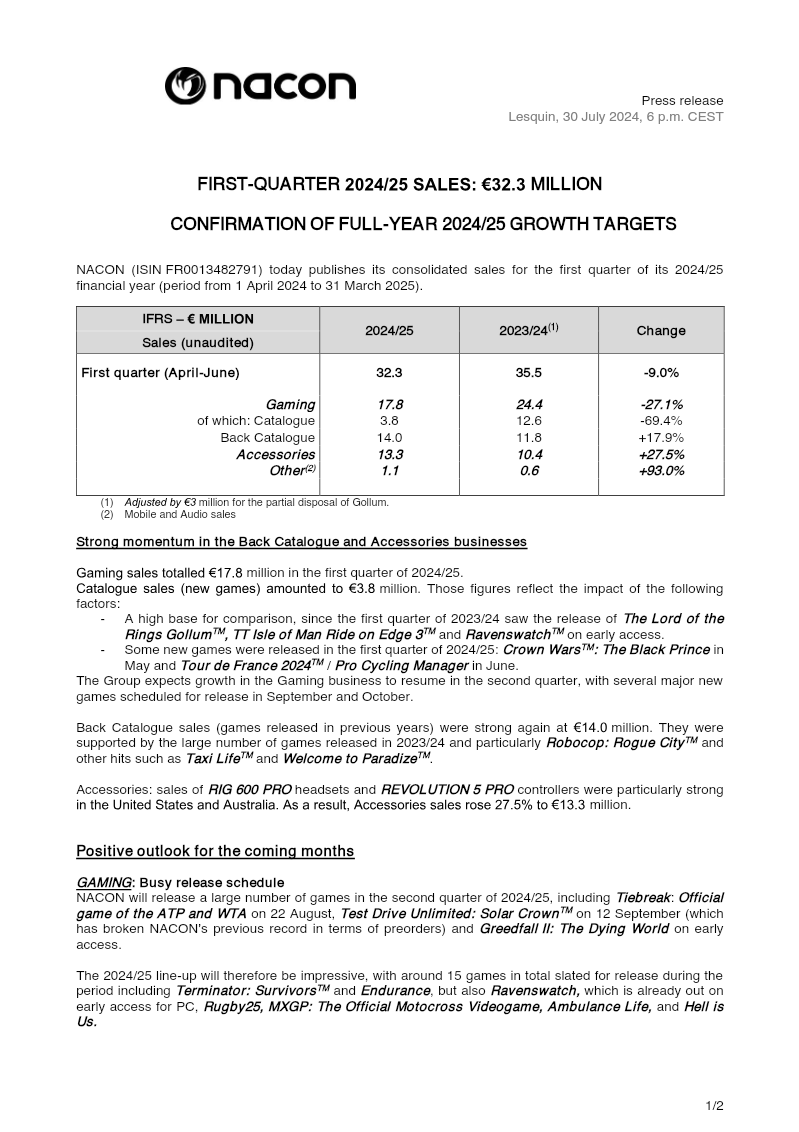
First Quarter 2024/25 Sales: Confirmation of Full-Year 2024/25 Growth Targets
NACON reported first‑quarter sales of €32.3 million for the 2024/25 financial year, a 9.0 % decline from €35.5 million in the same period of 2023/24 after adjusting for a partial disposal of Gollum. Gaming revenue fell sharply to €17.8 million, with new‑game catalogue sales dropping 69.4 % to €3.8 million due to a high base in the prior year, while back‑catalogue sales rose 17.9 % to €14.0 million, buoyed by titles such as Robocop: Rogue City and Taxi Life. Accessories sales increased 27.5 % to €13.3 million, driven by strong demand for RIG 600 PRO headsets and REVOLUTION 5 PRO controllers in the United States and Australia. Other mobile and audio sales grew 93 % to €1.1 million.
The company projects a rebound in gaming revenue in the second quarter, citing an aggressive release schedule that includes Tiebreak: Official Game of the ATP and WTA, Test Drive Unlimited: Solar Crown, and Greedfall II. The accessories division is expected to remain robust, supported by new premium products under the REVOSIM brand and a growing console installed base. NACON’s capital increase in July 2024 has reinforced its financial position, enabling further investment in the gaming pipeline. The next sales update is slated for 28 October 2024.
NACON operates globally with 23 subsidiaries and a distribution network covering 100 countries, employing over 1,000 staff across 16 development studios and a publishing arm that generated €20.9 million in operating income for 2023/24.
- NACON reported Q1 2024/25 sales of €32.3 million, representing a 9.0% year-over-year decline after adjusting for the partial disposal of Gollum.
- Gaming revenue fell to €17.8 million, driven by a 69.4% drop in new-game sales compared to a strong prior-year base, though back-catalogue sales grew 17.9% to €14.0 million.
- The accessories division performed strongly with a 27.5% revenue increase to €13.3 million, fueled by demand for RIG 600 PRO headsets and REVOLUTION 5 PRO controllers in the U.S. and Australia.
- Management projects a Q2 revenue rebound supported by an aggressive release schedule featuring Test Drive Unlimited: Solar Crown, Greedfall II, and Tiebreak: Official Game of the ATP and WTA.
- A July 2024 capital increase has strengthened the company's financial position, allowing for continued investment in its development pipeline across 16 internal studios.
+2
Nacon
Report2 pages
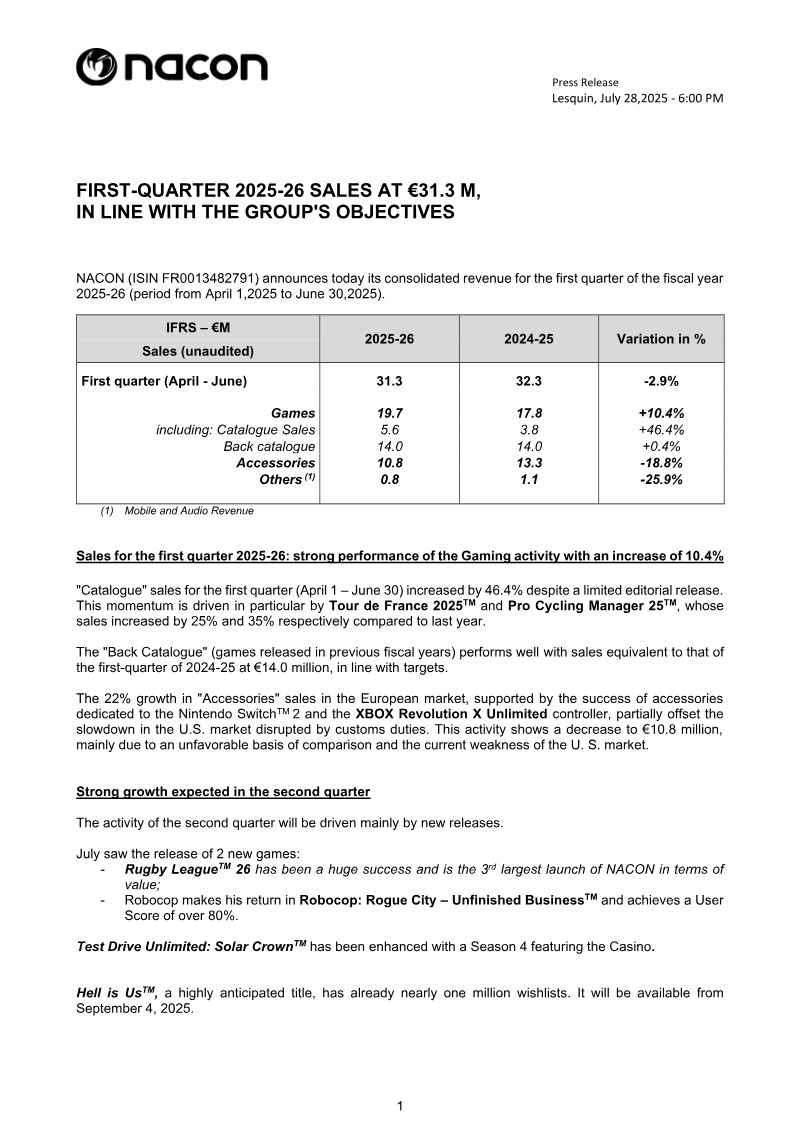
First-Quarter 2025-26 Sales: Nacon
Nacon reported consolidated revenue of €31.3 million for the first quarter of fiscal 2025‑26 (April 1–June 30), a slight decline of 2.9 % compared with the €32.3 million recorded in the same period of 2024‑25. Gaming sales, however, grew by 10.4 % to €19.7 million, driven largely by a 46.4 % jump in catalogue sales to €5.6 million, with key titles such as Tour de France 2025 and Pro Cycling Manager 25 contributing 25 % and 35 % sales increases respectively. Back‑catalogue performance remained flat at €14.0 million, meeting expectations. Accessories revenue fell to €10.8 million, a 18.8 % drop largely attributed to a weaker U.S. market and unfavorable year‑on‑year comparison, though European sales showed 22 % growth thanks to Nintendo Switch 2 and XBOX Revolution X Unlimited controller launches. Other revenue, including mobile and audio, decreased by 25.9 % to €0.8 million.
The company anticipates robust second‑quarter growth, citing new releases such as Rugby League 26 and Robocop: Rogue City – Unfinished Business, with additional titles slated for the second half of the year. Nacon maintains confidence in meeting its 2025‑26 fiscal targets, citing a strong dual‑business model and ongoing accessory innovation. The next quarterly update is scheduled for 27 October 2025.
- Nacon reported Q1 2025-26 consolidated revenue of €31.3 million, representing a 2.9% decline compared to the same period last year.
- Gaming segment revenue grew 10.4% to €19.7 million, bolstered by a 46.4% surge in catalogue sales driven by strong performances from 'Tour de France 2025' and 'Pro Cycling Manager 25'.
- Accessories revenue fell 18.8% to €10.8 million, primarily due to a weaker U.S. market and unfavorable year-on-year comparisons.
- Despite the overall decline in accessories, the European market saw 22% growth in this segment, supported by the launch of Nintendo Switch 2 and XBOX Revolution X Unlimited controllers.
- Back-catalogue sales remained stable at €14.0 million, meeting company expectations for the quarter.
+2
Nacon

Report94 pages
Annual Report and Accounts 2024
ANNUAL REPORT AND ACCOUNTS 2024 30 YEARS OF HEADLINES CONTENTS CREATIVITY, STRATEGIC REPORT See a summary of the headlines for FY24, 01 Headlines INNOVATION AND ...
- Frontier plans to release three self-published CMS (Creative Management Simulation) games in the next three consecutive financial years: Planet Coaster 2 in autumn 2024 (FY25), a new Jurassic World game in FY26, and a third unannounced CMS game in FY27.
- Frontier reported a loss before taxation of £28.425 million for the 12 months ending May 31, 2024, an increase from £26.509 million in the previous year.
- Net cashflows from operating activities decreased to £31.625 million in FY24 from £47.875 million in FY23, while net cashflows used in investing activities improved to (£27.868 million) from (£52.310 million).
- The company incurred £1.4 million in costs from an Organizational Review in FY24, primarily due to redundancy costs, compared to £nil in FY23.
- Frontier's total unrecognised tax losses increased to £109.5 million at May 31, 2024, from £80.2 million at May 31, 2023, with these losses having no expiry date.
+3
Frontier Developments
Report3 pages
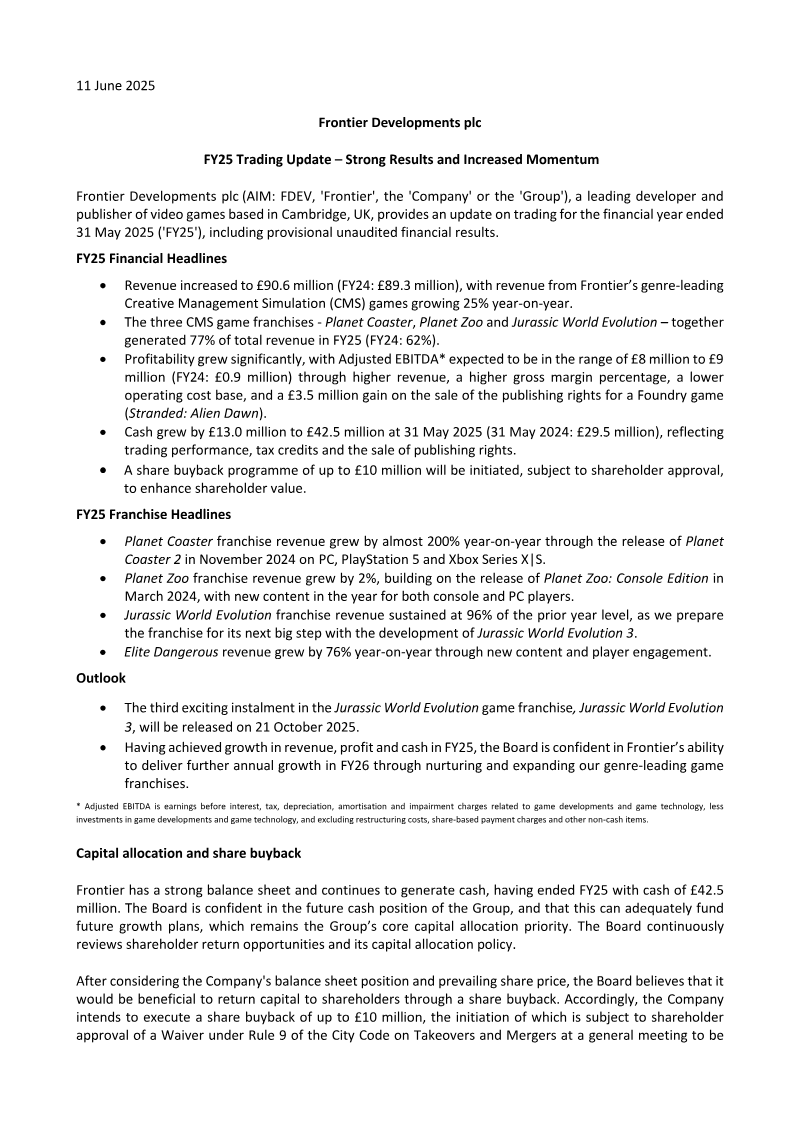
FY25 Trading Update: Strong Results and Increased Momentum
Frontier Developments plc reports a modest revenue rise to £90.6 million for FY25, up from £89.3 million in FY24, driven by a 25 % year‑on‑year increase in its Creative Management Simulation (CMS) titles. The three flagship CMS franchises—Planet Coaster, Planet Zoo and Jurassic World Evolution—accounted for 77 % of total revenue in FY25, a jump from 62 % the previous year. Planet Coaster alone grew almost 200 % following the launch of Planet Coaster 2, while Planet Zoo and Jurassic World Evolution maintained near‑stable sales levels.
Profitability improved sharply; Adjusted EBITDA is projected between £8 million and £9 million, compared with a £0.9 million profit in FY24, thanks to higher gross margins, reduced operating costs and a £3.5 million gain from selling publishing rights to Stranded: Alien Dawn. Adjusted Operating Profit, a new metric effective FY26 that incorporates tax credits and reliefs, is expected to reach £11 million‑£12 million in FY25.
Cash position strengthened, with cash on hand rising to £42.5 million from £29.5 million at the end of FY24, supporting a planned share buyback up to £10 million pending shareholder approval. The board also announced the creation of an Executive Board to streamline decision‑making and highlighted the upcoming release of Jurassic World Evolution 3 on 21 October 2025 as a key growth driver.
- Frontier Developments achieved a significant increase in profitability, with projected Adjusted EBITDA rising to £8–£9 million from £0.9 million in FY24.
- Revenue grew to £90.6 million, driven by a 25% year-on-year increase in Creative Management Simulation (CMS) titles, which now account for 77% of total revenue.
- The launch of Planet Coaster 2 catalyzed a nearly 200% revenue increase for the Planet Coaster franchise.
- The company’s cash position strengthened to £42.5 million, up from £29.5 million, enabling a proposed £10 million share buyback.
- Profitability was bolstered by a £3.5 million gain from the sale of publishing rights to Stranded: Alien Dawn, alongside reduced operating costs.
+4
Frontier Developments

Report92 pages
Annual Report and Accounts 2025
ANNUAL REPORT AND ACCOUNTS 2025 ANNUAL REPORT AND ACCOUNTS 2025 Frontier is a leading independent developer and CONTENTS publisher of video games for PC and consoles, HEADLINES STRATEGIC REPORT creating immersive and fun gameplay with high See a summary of the headlines for FY25, 01 Headlines production values.
- Frontier Developments PLC achieved significant profitability and cash generation uplift in FY25, driven by a sharpened focus on CMS (Content Management System) games and a sustainable cost base.
- Revenue increased year-on-year in FY25, and gross profit rose to £63.3 million (up from £61.3 million in FY24), with an improved gross margin of 70% (up from 69% in FY24) due to a greater share of own-IP game revenue.
- Elite Dangerous, a long-standing space exploration title outside the CMS portfolio, saw 76% year-on-year revenue growth in FY25, supported by new content and increased player engagement.
- Cash expenditure on CMS games represented 72% in FY25, a significant increase from 58% (£26.5 million) in FY24, reflecting a strategic refocus and reallocation of employees to capitalisable projects.
- Frontier will adopt Adjusted Operating Profit as its primary financial performance measure from FY26, replacing Adjusted EBITDA, to provide a more accurate reflection of Group performance.
+2
Frontier Developments
Report12 pages
Interim Results: H1 FY26
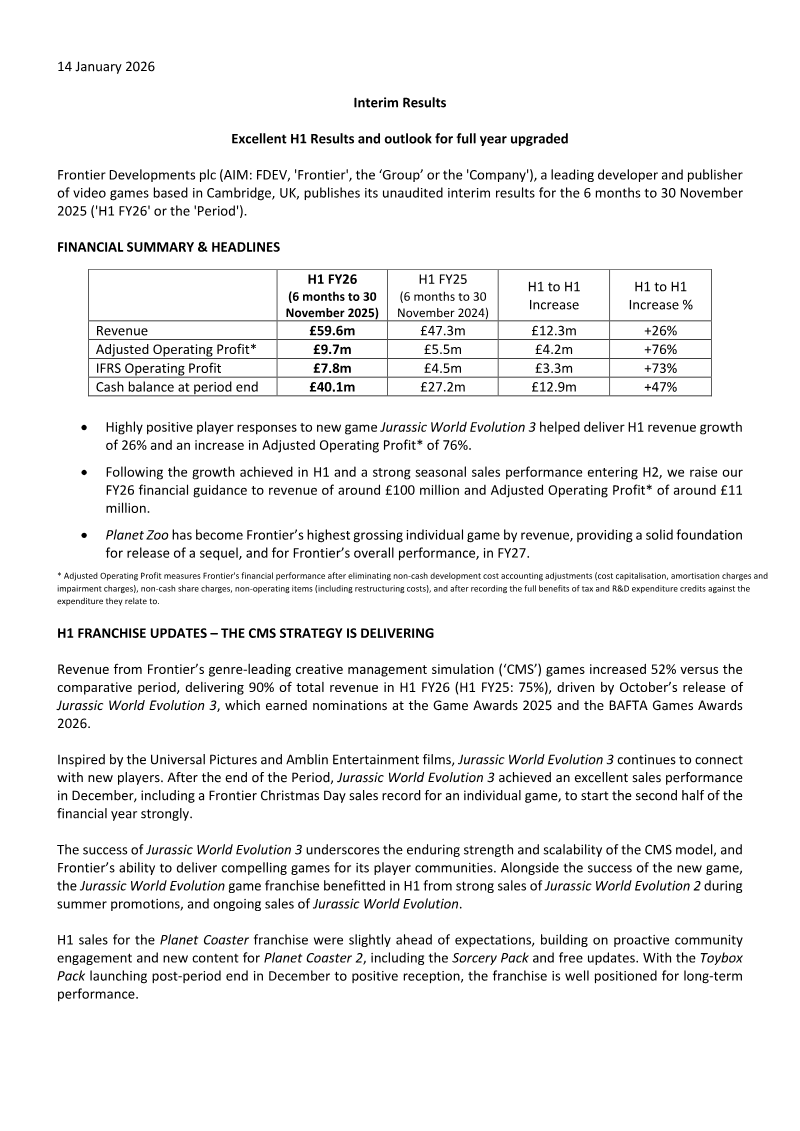
Frontier Developments plc reported unaudited interim results for the six months to 30 November 2025, showing a 26 % increase in revenue to £59.6 million and a 76 % rise in adjusted operating profit to £9.7 million compared with the same period in 2024. The growth was driven primarily by the launch of Jurassic World Evolution 3, which contributed 90 % of total revenue in H1 FY26 and earned nominations at the Game Awards 2025 and BAFTA Games Awards 2026. Other titles such as Planet Zoo, Planet Coaster 2 and Elite Dangerous also performed strongly, with Planet Zoo becoming the Group’s highest‑grossing individual game.
Cash profitability improved markedly; adjusted operating profit, which excludes non‑cash development capitalisation and includes tax and R&D credits, grew to £9.7 million from £5.5 million year‑on‑year. IFRS operating profit rose 73 % to £7.8 million. Gross margin fell to 64 % from 70 %, reflecting higher royalty‑bearing IP revenue. The Group’s cash balance increased to £40.1 million, up 47 % from the prior year, after a £10 million share buy‑back that raised earnings per share to 21.4 p.
The Board upgraded FY26 guidance, now targeting revenue of approximately £100 million and adjusted operating profit of around £11 million, citing strong seasonal sales momentum. CEO Jonny Watts stepped down on 1 January 2026, succeeded by Jo Cooke, with Watts remaining as Executive Director until 31 May 2026 to ensure a smooth transition. The Group remains debt‑free, with no significant liabilities beyond lease obligations, and maintains a robust pipeline of CMS titles slated for release in FY27–FY28.
- Frontier Developments reported a 26% revenue increase to £59.6 million and a 76% rise in adjusted operating profit to £9.7 million for H1 FY26, driven primarily by the launch of Jurassic World Evolution 3.
- Jurassic World Evolution 3 accounted for 90% of total revenue in H1 FY26, while Planet Zoo became the company's highest-grossing individual title.
- The Board upgraded full-year FY26 guidance to approximately £100 million in revenue and £11 million in adjusted operating profit, supported by strong seasonal sales momentum.
- Cash reserves grew 47% year-on-year to £40.1 million, even after executing a £10 million share buy-back that increased earnings per share to 21.4p.
- Gross margin declined from 70% to 64% due to a higher proportion of revenue generated from royalty-bearing intellectual property.
+4
Frontier Developments
Report17 pages
Omówienie Wyników Finansowych: Q2 2021
The presentation outlines PCF Group S.A.’s financial performance for the first half of 2021, emphasizing a significant growth trajectory across revenue, EBITDA, and workforce metrics. Total group revenues reached PLN 52.6 million in H1 2021, up 47 % from PLN 35.3 million in the same period of 2020, reflecting a compound annual growth rate of 34.4 % over 2017‑2020. EBITDA rose to PLN 28.8 million, a 36.5 % increase from PLN 21.1 million in H1 2020, and the adjusted EBITDA figure of PLN 27.6 million represents a 55.6 % jump from the prior year’s PLN 17.7 million, after accounting for IPO issuance costs and warrant amortisation.
Personnel expansion is notable: the group’s headcount grew to 252 employees, a 41.7 % rise, with significant additions in North America and Europe, including new studios in Chicago, New York, and Montreal. The People Can Fly division contributed PLN 21.1 million in revenue, while the Can Fly studio reported an EBITDA of PLN 28.8 million, underscoring its profitability.
Strategic initiatives highlighted include a partnership with Square Enix, confirming no royalty obligations for the Outriders title and progressing an investment agreement involving warrants. The group’s portfolio strategy aims to secure a leading position in new IP development, targeting annual releases of self‑published or publisher‑partnered titles by 2024.
Financial statements show a robust asset base of PLN 95.7 million, with equity at PLN 190.1 million and liabilities of PLN 272.8 million, yielding an equity‑to‑asset ratio of 185 %. Cash reserves increased to PLN 150.3 million, supporting ongoing development and expansion plans.
- PCF Group S.A. reported H1 2021 revenue of PLN 52.6 million, a 47% increase compared to the same period in 2020.
- Adjusted EBITDA rose by 55.6% to PLN 27.6 million in H1 2021, while total EBITDA reached PLN 28.8 million.
- The company expanded its global footprint by increasing headcount by 41.7% to 252 employees and establishing new studios in Chicago, New York, and Montreal.
- The group holds PLN 150.3 million in cash reserves to fund ongoing development and strategic expansion plans.
- The portfolio strategy targets a transition to annual releases of self-published or partner-published titles by 2024.
+2
PCF Group
Report22 pages
Omówienie Wyników Finansowych 2021
The presentation outlines PCF Group’s financial performance and strategic direction for fiscal year 2021, emphasizing a significant revenue surge of 73.7 % to PLN 103.8 million and EBITDA growth of 129.2 % to PLN 31.9 million, driven by the People Can Fly and Can Fly studios. Net profit rose 149.7 % to PLN 61.4 million, while employee count increased 90.4 %, reflecting accelerated expansion across North America and Europe. Capital structure improved markedly, with equity rising from PLN 259.5 million to PLN 239.2 million and total assets growing 230.9 % to PLN 316.7 million, largely through the acquisition of development assets and IP rights.
Strategically, PCF Group pursued a transformation agenda centered on agility, empowerment, and scalable self‑publishing. The adoption of OKR frameworks and the PCF Framework coupled with Unreal Engine 5 enabled rapid iteration and risk‑managed project delivery. M&A criteria focused on studios with IP, remote work capability, and complementary competencies, aiming to boost EBITDA through synergies. Portfolio expansion targets include new AAA‑compact titles and a planned annual release cadence from 2024 onward, with high‑profile projects such as Outriders: Worldslayer and Green Hell VR already generating strong market traction.
Geographically, the group’s footprint spans Warsaw (HQ), Chicago, Montreal, New York, and regional offices in Kraków and Toronto, supporting a global development network. Methodologically, financial figures are presented on an adjusted basis, with detailed breakdowns of revenue streams (game sales, outsourcing, warranties) and cost components across quarterly periods. The presentation underscores PCF Group’s commitment to sustainable growth, operational efficiency, and market leadership within the independent gaming sector.
- PCF Group achieved significant financial growth in 2021, with revenue increasing 73.7% to PLN 103.8 million and net profit rising 149.7% to PLN 61.4 million.
- EBITDA grew by 129.2% to PLN 31.9 million, supported by the performance of the People Can Fly and Can Fly studios.
- The company expanded its workforce by 90.4% and grew total assets by 230.9% to PLN 316.7 million, primarily through the acquisition of development assets and IP rights.
- Strategic operations are shifting toward a scalable self-publishing model, supported by the implementation of OKR frameworks and Unreal Engine 5 to facilitate rapid iteration.
- The group is targeting an annual release cadence starting in 2024, with a portfolio strategy focused on AAA-compact titles and high-profile projects like Outriders: Worldslayer and Green Hell VR.
+1
PCF Group
Report17 pages
Wyniki Finansowe 1H24: Polska
The presentation outlines PCF Group S.A.’s financial performance for the first half of 2024, focusing on revenue trends, profitability metrics, and portfolio developments. Revenue grew steadily from PLN 180.3 m in 2020 to PLN 171.5 m in the first quarter of 2024, with quarterly figures ranging between PLN 30.2 m and PLN 40.5 m, reflecting a modest year‑over‑year increase of roughly 3–4 %. Net income, however, remained negative throughout the period, with a cumulative loss of PLN 33.3 m in H1 2024 compared to PLN 13.1 m loss in H1 2023, largely attributed to a significant write‑down of the Gemini project and reduced earnings from the Bulletstorm VR title. EBITDA was similarly impacted, with a corrected figure of PLN –11.3 m in Q2 2024 due to revenue adjustments and project‑specific costs.
The group’s portfolio, managed by InCuvO, includes three core VR titles—Green Hell, Green Bulletstorm Bison, and People Can Fly—as well as additional projects such as VRowe. Green Hell VR is slated for release on Meta Quest+ in June 2024, while Bulletstorm Bison’s co‑op mode is targeted for Q4 2024. People Can Fly’s latest version 1.4, featuring a horde mode, is expected in September 2024.
Geographically, the company’s workforce remains concentrated in Warsaw (≈495 employees) with satellite offices in Montreal, New Castle, Dublin, and Katowice. The presentation emphasizes that the data are current as of 30 June 2024 and that future projections are subject to change.
- PCF Group S.A. reported a cumulative net loss of PLN 33.3 million for H1 2024, a significant increase from the PLN 13.1 million loss recorded in H1 2023.
- The company’s Q2 2024 EBITDA was negative at PLN -11.3 million, driven by project-specific costs and revenue adjustments.
- Financial performance was negatively impacted by a major write-down of the Gemini project and lower-than-expected earnings from the Bulletstorm VR title.
- Revenue growth remains modest, with year-over-year increases of approximately 3–4% and quarterly figures fluctuating between PLN 30.2 million and PLN 40.5 million.
- The VR portfolio managed by InCuvO includes upcoming milestones, such as the release of Green Hell VR on Meta Quest+ in June 2024 and the addition of a horde mode to People Can Fly version 1.4 in September 2024.
+1
PCF Group
Report15 pages
Wyniki Finansowe 3M24
The presentation outlines PCF Group S.A.’s financial performance for the first quarter of 2024, focusing on its gaming and VR portfolio. Revenues rose to PLN 180.3 million in Q1 2024, up from PLN 171.5 million in the same period a year earlier, driven by the launch of “Bulletstorm VR” and ongoing development of the AAA title “Maverick.” Net income for the quarter was a loss of PLN 0.9 million, reflecting higher operating costs associated with new project development and capitalisation of work‑for‑hire initiatives. EBITDA improved to PLN 11.0 million, a 3‑fold increase over Q1 2023, largely due to cost optimisation and the inclusion of amortisation from recent IP acquisitions. The group’s balance sheet shows total assets of PLN 277.6 million at 31 March 2024, up from PLN 159.4 million a year earlier, with equity rising to PLN 427.3 million. Cash and equivalents stood at PLN 112.7 million, indicating a solid liquidity position.
Geographically, the company operates studios in Warsaw, Montreal, Newcastle, Dublin, and Katowice, with a workforce of 756 employees in 2024 versus 763 in 2023. The portfolio includes two self‑published AAA titles and three VR projects, with “People Can Fly” and “Bison” slated for release in 2024–2026. The presentation also highlights ongoing work‑for‑hire projects such as “Green Hell VR” and “Bulletstorm VR,” which are expected to contribute additional revenue streams in the coming quarters. Overall, PCF Group S.A. demonstrates growth in revenue and EBITDA while managing increased costs associated with expanding its IP and development capabilities.
- PCF Group S.A. reported Q1 2024 revenue of PLN 180.3 million, an increase from PLN 171.5 million in Q1 2023, driven by the launch of 'Bulletstorm VR' and development of the 'Maverick' title.
- EBITDA tripled year-over-year to PLN 11.0 million, attributed to cost optimization and the inclusion of amortisation from recent IP acquisitions.
- The company recorded a net loss of PLN 0.9 million for Q1 2024, resulting from elevated operating costs tied to new project development and work-for-hire initiatives.
- Liquidity remains strong with PLN 112.7 million in cash and equivalents, while total assets grew significantly to PLN 277.6 million compared to PLN 159.4 million in the prior year.
- The development pipeline includes two self-published AAA titles and three VR projects, with 'People Can Fly' and 'Bison' scheduled for release between 2024 and 2026.
+2
PCF Group
Report17 pages
Wyniki Finansowe 1H25: Warszawa
The presentation outlines PCF Group S.A.’s financial performance for the first half of 2025, focusing on revenue trends, profit calculations, and portfolio developments across its global operations. Revenues have shown a gradual decline from 2021 to 2024, with cumulative figures falling from PLN 190.4 m in 2021 to PLN 171.5 m by the end of 2024, and quarterly revenue in Q1‑2025 recorded at PLN 58.5 m. EBITDA has been negatively impacted by lower sales on the Gemini project and a delayed Bulletstorm VR launch, resulting in an adjusted EBITDA loss of PLN 11.3 m for 2024 and a projected loss of PLN 33.3 m in 2025 after accounting for new projects such as Echo and Delta, as well as write‑downs related to the PCF Chicago subsidiary.
The group’s workforce is distributed across two continents, with 534 employees in Warsaw and additional teams in Montreal, Newcastle, Dublin, Katowice, and Rzeszów. Back‑office development is handled by Incuvo Studio Europe and North America, while publishing responsibilities are shared with the QA Gameon division.
Portfolio highlights include the upcoming co‑op release of Green Hell on Meta Quest platforms and a VR shoot‑to‑survive title slated for Q4 2025. The presentation emphasizes that these releases are the last VR titles to be published by PCF Group, signalling a strategic shift. Overall, the data suggest a contraction in revenue and profitability driven by project delays and market adjustments, with future performance hinging on the successful launch of new VR titles and cost management initiatives.
- PCF Group faces significant financial pressure with an adjusted EBITDA loss of PLN 11.3 million in 2024 and a projected loss of PLN 33.3 million for 2025.
- Annual revenue has trended downward from PLN 190.4 million in 2021 to PLN 171.5 million in 2024, with Q1 2025 revenue recorded at PLN 58.5 million.
- Profitability has been negatively impacted by lower sales for the Gemini project, the delayed launch of Bulletstorm VR, and asset write-downs related to the PCF Chicago subsidiary.
- The company is undergoing a strategic pivot, with the upcoming Green Hell Meta Quest release and a Q4 2025 VR title serving as the final VR projects to be published by the group.
- Future financial performance is contingent on the successful execution of new projects, specifically those codenamed Echo and Delta, alongside ongoing cost management initiatives.
+2
PCF Group