
Report30 pages
State of Mobile Games in Japan
The analysis provides a comprehensive overview of Japan’s mobile‑gaming ecosystem in 2024, measuring the market’s size, growth dynamics, and competitive landscape. Total in‑app purchase (IAP) revenue reached roughly ¥2.5 trillion, marking a modest increase over 2023, while the combined share of the Apple App Store and Google Play stabilized at about 55 % and 45 % respectively. Advertising‑derived income expanded by 35 % year‑on‑year, now accounting for roughly 8 % of overall mobile‑gaming revenue, driven largely by user acquisition through YouTube, TikTok and Instagram.
Top‑grossing publishers dominate the market, with Mixi, Bandai Namco, CyberAgent, miHoYo, Square Enix and GungHo each securing multiple titles in the upper echelon of revenue. Flagship games such as Fate/Grand Order, eFootball, Pokémon GO, and the One Piece franchise collectively generated more than ¥1 trillion, underscoring the continued strength of established IPs. Genre analysis shows 3D titles now represent roughly half of the top‑performing apps, reflecting a shift toward richer visual experiences, while 2D and casual games retain a sizable user base.
The study covers the period January through July
- Japan’s mobile gaming market generated approximately ¥2.5 trillion in total in-app purchase (IAP) revenue during the first seven months of 2024.
- Established intellectual properties remain the primary revenue drivers, with titles like Fate/Grand Order, eFootball, Pokémon GO, and the One Piece franchise collectively accounting for over ¥1 trillion in earnings.
- Advertising-derived income grew by 35% year-on-year, now representing 8% of total mobile gaming revenue, fueled by user acquisition campaigns on YouTube, TikTok, and Instagram.
- The market is highly concentrated among top-tier publishers, including Mixi, Bandai Namco, CyberAgent, miHoYo, Square Enix, and GungHo.
- 3D titles have become the dominant visual format, now accounting for roughly 50% of the top-performing mobile applications.
Sensor TowerJan 2024
Report372 pages
Türkiye Game Market Report: 2024
The Turkish gaming market has emerged as a global powerhouse, reaching a valuation of approximately $810 million in 2024 with a trajectory toward $1 billion by 2029. This growth is supported by a massive domestic audience of over 48 million players and a population characterized by high digital engagement, with 76 million internet users spending nearly seven hours online daily. While mobile gaming remains the dominant segment—accounting for $490 million in revenue—the industry is currently undergoing a strategic pivot. Developers are shifting focus from hyper-casual mobile titles toward more complex PC and console projects, exemplified by the global success of titles like Supermarket Simulator and Liars Bar.
The ecosystem is bolstered by a sophisticated infrastructure of over 1,400 active studios, 26 incubation centers, and a robust financial network of 60 regulated payment institutions. Despite economic headwinds, such as high interest rates affecting hardware sales and the removal of local pricing on major platforms, investment remains resilient. In the first half of 2024, the sector saw over $120 million in deal flow across 20+ transactions. Furthermore, Türkiye has solidified its status as an esports leader, ranking second globally at the World Esports Championship and maintaining a licensed athlete base of nearly 100,000.
However, the market faces significant regulatory and technical challenges. New legal frameworks mandate that foreign platforms appoint local representatives, while recent bans on platforms like Discord and Instagram have disrupted community engagement. Additionally, with Türkiye ranking 65th globally in English proficiency, professional localization—including Turkish characters and voiceovers—is identified as a critical factor for market penetration. Moving toward 2025, the industry is expected to integrate AI-driven development tools and 5G technology more deeply, leveraging its position as a top European gaming hub to attract further international investment and expand its influence across the MENA region.
- The Turkish gaming market is valued at $810 million in 2024, with a projected growth to $1 billion by 2029 supported by a domestic player base of over 48 million.
- Mobile gaming currently leads the market with $490 million in revenue, though developers are strategically pivoting toward more complex PC and console titles like Supermarket Simulator and Liars Bar.
- Investment remains resilient despite economic headwinds, recording over $120 million in deal flow across more than 20 transactions in the first half of 2024.
- The industry ecosystem is supported by over 1,400 active studios, 26 incubation centers, and a network of 60 regulated payment institutions.
- Türkiye maintains a strong position in esports, ranking second globally at the World Esports Championship with a licensed athlete base of nearly 100,000.
+1
Gaming in TurkeyJan 2024

Report29 pages
Mobile Ad Creative Index 2024
The Mobile Ad Creative Index provides a comprehensive analysis of performance benchmarks and emerging trends within the mobile advertising ecosystem. Covering the period from January 2023 to January 2024, the data is derived from a massive sample of 602 billion impressions, 49.4 billion clicks, and 144 million installs across the gaming, e-commerce, finance, and entertainment sectors. The primary thesis asserts that while traditional formats like banners remain cost-effective for driving specific actions, high-engagement formats such as video, playables, and interstitials are significantly more effective at converting impressions into installs.
Key findings highlight a stark contrast in performance across formats. In gaming, video and playable ads are over 20 times more likely to result in an install than banners, while interstitial ads in the finance sector are 18 times more likely to convert. However, cost-per-install (CPI) varies greatly by platform; for instance, native ads are the most cost-effective on iOS for gaming, whereas playables offer the best value on Android. In e-commerce, native and banner ads excel at driving post-install purchases, achieving install-to-action rates exceeding 30%.
The analysis identifies several pivotal trends for 2024, most notably the integration of generative AI to enhance the speed and scale of creative production, such as automated localization and voice-overs. User-generated content (UGC) remains a dominant force, with optimized UGC ads showing 20% lower CPIs than standard video. Furthermore, there is a measurable shift toward longer, more immersive ad experiences. Spend on long-form video grew by 245% year-over-year, and "triple-page" ads—combining video, playables, and end cards—saw a 355% increase in spend, suggesting that users increasingly prefer transparent, high-quality engagement over short, deceptive creative tactics.
- High-engagement formats like video and playables outperform banners by 20 times in gaming installs, while finance sector interstitials are 18 times more effective at conversion.
- Long-form video ad spend grew by 245% year-over-year, and 'triple-page' ads combining video, playables, and end cards saw a 355% increase in investment.
- Optimized user-generated content (UGC) ads achieve a 20% lower cost-per-install (CPI) compared to standard video creative.
- Native ads are the most cost-effective format for gaming on iOS, whereas playables provide the best value for gaming on Android.
- In the e-commerce sector, native and banner ads remain highly effective for driving post-install activity, maintaining install-to-action rates above 30%.
+3
LiftoffJan 2024
Report48 pages
Mobile App Trends: 2024 Edition
The mobile app industry demonstrated significant resilience throughout 2023, characterized by a global advertising spend of $362 billion and a late-year surge in installations. While the landscape faced challenges such as rising acquisition costs and evolving privacy regulations, the fintech and e-commerce sectors emerged as primary growth engines. Fintech experienced a 42% increase in installs and a 118% surge in in-app revenue, while e-commerce saw a 43% year-over-year rise in installs alongside a 34% increase in revenue. These sectors successfully optimized their acquisition strategies, with banking eCPIs falling from $2.33 to $1.37, allowing marketers to achieve rapid returns on investment within the first week of user acquisition.
The gaming sector navigated a more complex trajectory, ending the year with a 2% annual decline in installs despite a notable recovery in the fourth quarter. This rebound was driven by a 7% year-over-year growth in installs and the emergence of the hybrid casual genre. Although overall gaming sessions dipped, specific subverticals like racing and simulation saw dramatic install spikes of 61% and 53%, respectively. Global gaming stickiness remained stable at 20%, and high-engagement genres like RPG and adventure continued to command strong lifetime value, even as broader retention rates across the mobile ecosystem faced downward pressure.
Future industry success depends on the strategic integration of artificial intelligence and predictive analytics to enhance personalization and automate complex workflows. To achieve sustained growth in 2024 and beyond, developers must diversify their media mixes by expanding into emerging channels like Connected TV and adopting holistic measurement frameworks. By combining incrementality testing with media mix modeling, stakeholders can better navigate the shift toward privacy-centric marketing while capitalizing on the high-potential returns offered by the global mobile marketplace.
- Fintech and e-commerce drove significant market growth in 2023, with fintech seeing a 42% increase in installs and a 118% surge in in-app revenue.
- E-commerce performance remained strong with a 43% year-over-year rise in installs and a 34% increase in revenue.
- Banking sector efficiency improved significantly as eCPIs dropped from $2.33 to $1.37, enabling faster return on investment for marketers.
- The gaming sector experienced a 2% annual decline in total installs, though it saw a Q4 recovery led by a 7% year-over-year growth in installs and the rise of the hybrid casual genre.
- Specific gaming subverticals outperformed the broader market, with racing and simulation genres recording install spikes of 61% and 53%, respectively.
+2
AdjustJan 2024

Report33 pages
Mobile Gaming Spender Report: Decoding Today’s Mobile IAP Spenders to Understand Motivations, Engagement
The 2024 Mobile Gaming Spender Report by Mistplay examines the evolving motivations, behaviors, and shifting financial priorities of mobile in-app purchase (IAP) spenders. The analysis is based on a survey of approximately 2,000 active spenders in the United States and Canada conducted between December 2023 and January 2024, supplemented by behavioral data from millions of users on the Mistplay platform from Q2 2023 through Q1 2024. The report segments players into high-value ($100+), mid-value ($10–$99), and low-value (<$10) cohorts to provide granular insights into the current market maturity.
A primary thesis of the research is that mobile spenders are becoming increasingly discerning due to economic headwinds. Findings indicate that 32% of all spenders—and 41% of high-value spenders—plan to reduce their in-game expenditures in 2024. To combat this, the data suggests a shift toward hyper-personalization and loyalty-driven retention. Approximately 40% of spenders are influenced by personalized offers, and 79% engage with loyalty programs. Furthermore, 51% of respondents indicate they would spend more if they earned tangible rewards or points for their purchases, highlighting a demand for value-driven discretionary spending.
The report also identifies distinct genre-based personas: "Casual Candace" (Puzzle/Simulation), "Midcore Mike" (RPG/Strategy), and "Lucky Lucy" (Social Casino). While social factors and referrals are effective for top-of-funnel discovery—with 73% of spenders installing a game via referral in the past year—they rarely drive actual spending, as 69% of respondents claim social influence does not affect their financial decisions. Ultimately, the findings conclude that sustainable growth in 2024 will require publishers to move beyond traditional user acquisition toward sophisticated lifecycle marketing, direct-to-consumer web stores, and transparent ad creative that accurately reflects gameplay.
- Economic headwinds are driving a contraction in spending, with 32% of all mobile spenders and 41% of high-value spenders planning to reduce their in-game expenditures in 2024.
- Value-driven incentives are critical for retention, as 51% of spenders would increase their spending if they earned tangible rewards or points for their purchases.
- Loyalty programs and hyper-personalization are essential engagement tools, with 79% of spenders engaging with loyalty programs and 40% influenced by personalized offers.
- While social factors and referrals are effective for user acquisition—driving 73% of installs—69% of spenders report that social influence does not affect their actual financial decisions.
- Sustainable growth in 2024 requires a strategic shift toward direct-to-consumer web stores, sophisticated lifecycle marketing, and ad creatives that accurately reflect actual gameplay.
+2
MistplayJan 2024
Report46 pages
The State of Gaming 2024
The global mobile gaming market underwent a significant correction in 2023, characterized by a 10% decline in downloads and a 2% dip in overall revenue. This downturn was primarily driven by escalating user acquisition costs and a post-pandemic stabilization of consumer habits. A distinct shift in player preference emerged as mid-core revenue fell by 9%, while casual and hybrid-casual segments grew by 8% and 30%, respectively. Despite these macro challenges, breakout successes like Monopoly Go! and Royal Match proved that innovative monetization and robust live operations can still yield massive returns in a tightening market.
Marketing strategies have evolved to prioritize high-impact collaborations and mobile advertising, which now commands 67% of global gaming ad spend. The industry is seeing a move toward gender parity in mid-core gaming, while platform-specific engagement has become more specialized, with TikTok attracting core gamers and Facebook remaining a stronghold for the female-skewing casual demographic. To mitigate rising costs, developers are increasingly leveraging intellectual property and transmedia expansions to drive organic discovery and long-term player retention.
Geographically, the industry focus is shifting toward emerging markets such as Latin America and the Middle East, where lower costs per install in countries like Brazil and Saudi Arabia offer new avenues for growth. While external subscription models, such as Netflix Games, experienced a 194% surge in downloads, they currently represent a small and largely unprofitable portion of the total ecosystem. Consequently, the prevailing industry strategy emphasizes the optimization of existing titles through aggressive live operations and brand partnerships rather than relying solely on new user acquisition in saturated Western markets.
- The global mobile gaming market contracted in 2023, with a 10% decline in downloads and a 2% dip in revenue due to rising user acquisition costs and post-pandemic habit stabilization.
- Market segment preferences shifted significantly in 2023, as mid-core revenue fell by 9% while casual and hybrid-casual segments grew by 8% and 30%, respectively.
- Mobile advertising now accounts for 67% of global gaming ad spend, with marketing strategies increasingly relying on high-impact collaborations and transmedia IP to drive organic discovery.
- Developers are pivoting toward emerging markets like Brazil and Saudi Arabia to capitalize on lower costs per install compared to saturated Western regions.
- While Netflix Games saw a 194% surge in downloads, subscription models remain a small and largely unprofitable segment of the overall gaming ecosystem.
+1
Sensor TowerJan 2024
Report32 pages
Midcore Gaming Apps Report 2023
The midcore mobile gaming market is undergoing a significant expansion as players increasingly migrate from hyper-casual titles toward games offering greater depth and complexity. Currently accounting for 35% of total US iOS gaming revenue, the midcore segment is defined by its high player retention and diverse monetization strategies. While these games face higher user acquisition costs than casual titles—averaging a $2 cost-per-install (CPI)—they leverage sophisticated LiveOps and multi-layered Battle Pass systems to drive long-term profitability. Strategy and RPG genres lead the market, while emerging trends like extraction shooters and season-based gameplay loops further solidify the segment's dominance.
Data from 2022 to 2023 highlights stark contrasts in performance across platforms and regions. Android remains the more cost-effective platform for developers, offering a $0.73 CPI compared to $3.86 on iOS, while also delivering nearly double the Day-7 return on ad spend (ROAS) at 6.1%. Geographically, North America represents the most expensive market with a $5.45 CPI, yet it maintains a strong 4.5% ROAS. Conversely, the EMEA region provides the best overall value, balancing a low $0.80 CPI with a competitive 4.4% ROAS. Genre-specific analysis shows that Shooters require the highest acquisition investment at $7.47 but yield the highest early returns, whereas RPGs offer the lowest entry cost at $0.60.
To maximize revenue and bypass traditional platform fees, midcore developers are increasingly adopting external web stores and aggressive LiveOps schedules, often running an average of 15 simultaneous active events. This shift toward complex, service-based ecosystems is supported by specialized growth acceleration platforms that provide the infrastructure for large-scale app marketing and monetization. By utilizing programmatic exchanges and targeted advertising solutions, developers can navigate the high-cost landscape of midcore gaming to secure a dedicated and high-value audience.
- Midcore games now account for 35% of total US iOS gaming revenue, driven by a player migration from hyper-casual titles toward deeper, more complex gameplay.
- Android is significantly more cost-effective for developers than iOS, with a $0.73 CPI compared to $3.86 and nearly double the Day-7 ROAS at 6.1%.
- The EMEA region offers the best market value, balancing a low $0.80 CPI with a competitive 4.4% ROAS, while North America remains the most expensive market at a $5.45 CPI.
- Genre-specific acquisition costs vary widely, with Shooters requiring the highest investment at $7.47 per install, while RPGs offer the lowest entry cost at $0.60.
- To drive long-term profitability and bypass platform fees, developers are increasingly utilizing external web stores and aggressive LiveOps strategies, often maintaining 15 simultaneous active events.
+1
LiftoffJan 2024

Report14 pages
Mobile Game Market Review December 2023
The mobile gaming market in December 2023 was characterized by aggressive experimentation with cross-genre mechanics and high-profile intellectual property collaborations. Analysts observed a significant trend of "genre-blending," where successful mechanics from market leaders were integrated into established titles. Notable examples include Royal Match adopting the cooperative partner event structure popularized by Monopoly GO!, and Diablo Immortal and Last Fortress: Underground introducing roguelite survival modes inspired by Vampire Survivors and Survivor.io.
In the casual segment, developers focused on deepening engagement through complex minigames. Homescapes introduced tycoon-style restoration events to its match-3 core, while Cooking Madness innovated by linking a digging minigame directly to battle pass progression. The midcore sector saw diverse narrative and social strategies, such as CookieRun: Kingdom’s Agatha Christie-inspired murder mystery and the launch of Tencent’s party royale title DreamStar in China. DreamStar quickly became a top-grossing competitor to Eggy Party by emphasizing social hubs and user-generated content.
Major updates to legacy titles yielded substantial financial results, particularly for Clash of Clans. The introduction of Town Hall 16, building-merging mechanics, and a new hero equipment system drove a 350% daily revenue spike in the United States. Geographically, the review highlights strong performance in the Chinese market for both domestic releases like DreamStar and localized versions of Western hits. Overall, the period demonstrated that mobile developers are increasingly looking beyond their own sub-genres to borrow proven engagement and monetization loops from the broader gaming ecosystem.
- Clash of Clans experienced a 350% daily revenue spike in the U.S. following the December 2023 release of Town Hall 16, new building-merging mechanics, and a hero equipment system.
- Mobile developers are increasingly adopting cross-genre mechanics, such as Royal Match integrating cooperative partner events and midcore titles like Diablo Immortal adding roguelite survival modes.
- Tencent’s new party royale title, DreamStar, emerged as a top-grossing competitor to Eggy Party in China by focusing on social hubs and user-generated content.
- Casual games are deepening engagement through complex minigames, exemplified by Homescapes adding tycoon-style restoration events and Cooking Madness linking digging minigames to battle pass progression.
- The mobile market in December 2023 was defined by a shift toward borrowing proven engagement and monetization loops from across the broader gaming ecosystem rather than remaining within traditional sub-genre silos.
+1
GameRefineryDec 2023
Report13 pages
Analyst Bulletin: Mobile Game Market Review November 2023
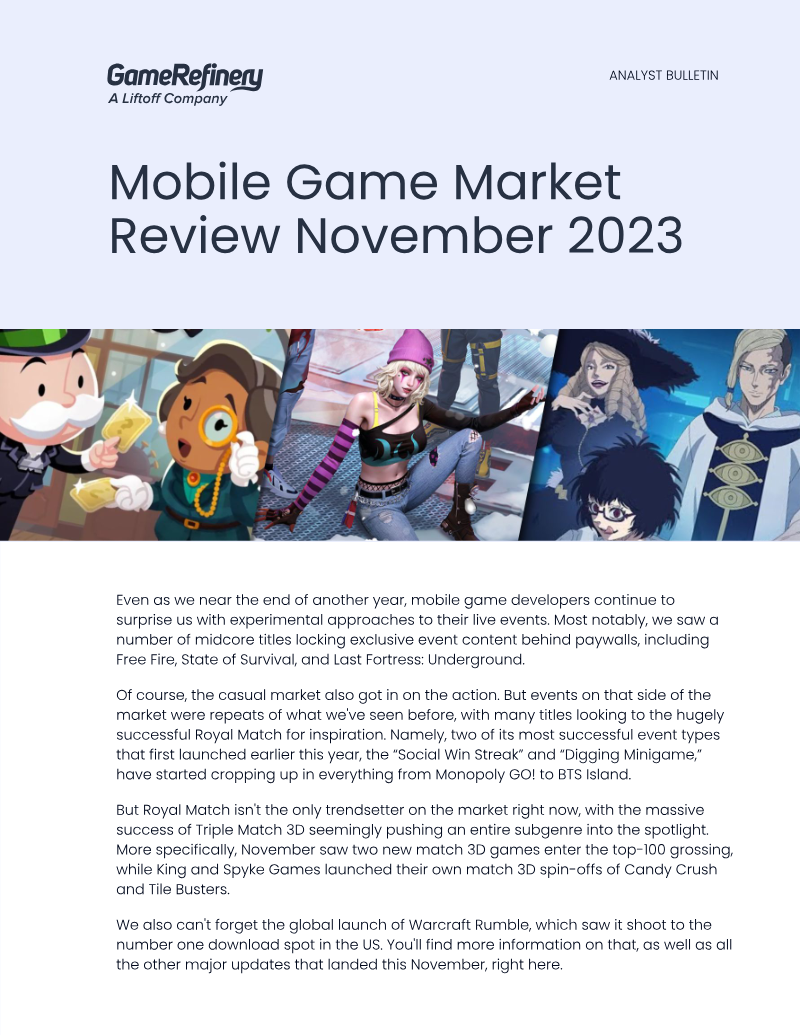
The mobile gaming market in November 2023 was characterized by the proliferation of specific event mechanics and the rise of the 3D match subgenre. Analysis of market leaders reveals that Royal Match has become a primary trendsetter for casual titles. Its "Social Win Streak" and "Digging Minigame" mechanics were widely adopted by competitors such as Monopoly GO!, Matchington Mansion, and BTS Island. Simultaneously, the success of Triple Match 3D spurred a wave of new entries in the 3D match category, including Match Factory and spin-offs from established franchises like Candy Crush.
A significant shift occurred in the midcore segment, where developers increasingly experimented with pay-gated event content. Titles such as Free Fire, State of Survival, and Last Fortress: Underground implemented exclusive rewards and gameplay modes accessible only through direct purchases or premium currency top-ups. This trend suggests a strategic move toward more aggressive monetization of live events, moving away from purely engagement-based models to those requiring financial entry points for participation.
Geographically, the US market saw major activity with the global launch of Warcraft Rumble, which achieved the top download spot and maintained a top-50 grossing position. In China, Soul Knight Prequel demonstrated the continued strength of the roguelite genre, reaching the top of the download charts. Other notable developments included the expansion of user-generated content via the Stumble Workshop in Stumble Guys and the rapid emergence of mobile clones inspired by the viral Nintendo Switch title, Suika Game. These findings indicate a highly reactive market where developers quickly iterate on successful mechanics and viral trends across both casual and midcore segments.
- Royal Match has emerged as the primary industry trendsetter, with competitors like Monopoly GO!, Matchington Mansion, and BTS Island adopting its 'Social Win Streak' and 'Digging Minigame' mechanics.
- Midcore titles including Free Fire, State of Survival, and Last Fortress: Underground are shifting toward aggressive monetization by pay-gating exclusive event content and gameplay modes.
- The 3D match subgenre is expanding rapidly following the success of Triple Match 3D, leading to new entries like Match Factory and 3D spin-offs of established franchises such as Candy Crush.
- Warcraft Rumble's global launch in November 2023 secured the top download spot in the US market while maintaining a top-50 grossing position.
- The roguelite genre remains highly competitive in China, evidenced by Soul Knight Prequel reaching the top of the download charts.
+1
GameRefineryNov 2023
Report13 pages
Mobile Game Market Review: November 2023
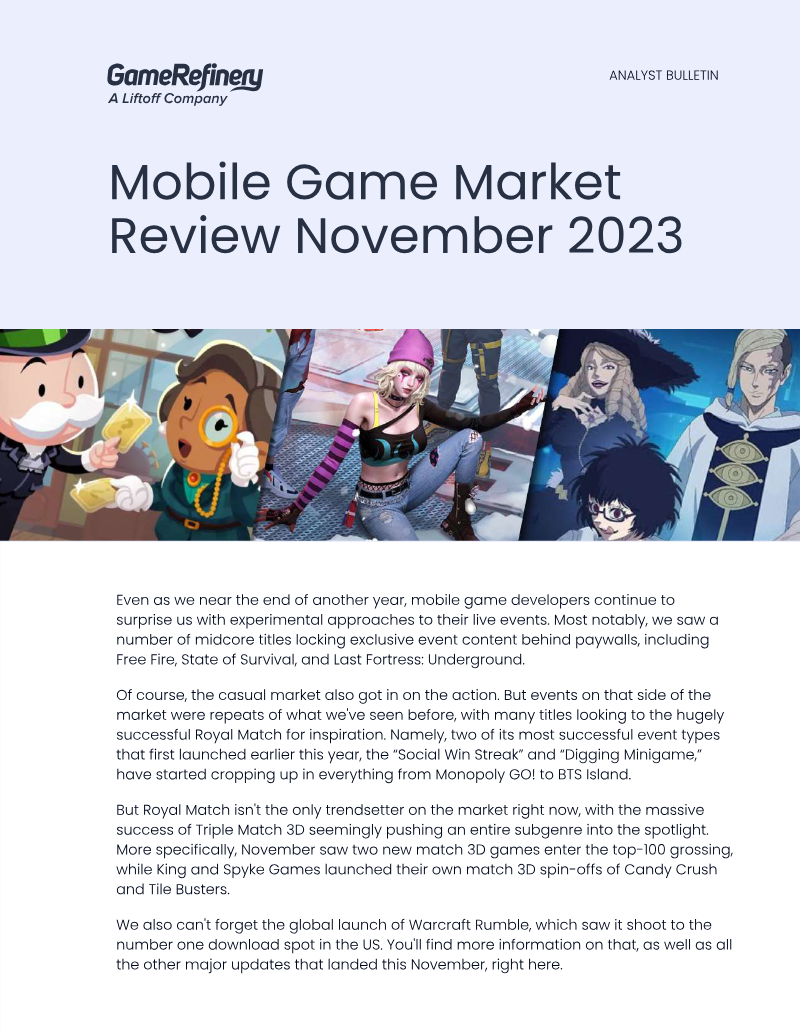
This market review analyzes mobile gaming trends and performance for November 2023, focusing on the United States and Chinese markets. The analysis identifies a significant shift in monetization strategies within midcore titles, where developers are increasingly locking exclusive event content and story missions behind paywalls. Notable examples include Free Fire’s Luminous Pass and State of Survival’s Resident Evil collaboration, which required specific purchases or gacha mechanics to access core event gameplay.
In the casual segment, the industry is seeing a period of heavy mechanical imitation led by the success of Royal Match. Two specific event archetypes—the "Social Win Streak" (a battle royale-style level progression) and the "Digging Minigame" (a grid-based reward hunt)—have been widely adopted by major titles like Monopoly GO! and Matchington Mansion. Furthermore, the 3D match subgenre is expanding rapidly following the success of Triple Match 3D, with industry giants like King and Peak launching new competitors such as Candy Crush 3D and Match Factory.
The review also highlights the impact of viral trends and major intellectual properties. The "watermelon game" craze, sparked by the Nintendo Switch title Suika Game, led to a surge of mobile clones climbing the download charts. Meanwhile, high-profile launches like Warcraft Rumble and Black Clover M demonstrated the continued strength of established IPs, with both titles securing top-tier positions in US download and grossing ranks. Methodology for these findings includes data from live event trackers, download rankings, and revenue performance across major mobile app stores.
- Midcore mobile titles are increasingly gating core event gameplay and story missions behind paywalls, as seen in Free Fire’s Luminous Pass and State of Survival’s Resident Evil collaboration.
- The casual gaming sector is experiencing widespread mechanical imitation, specifically the adoption of 'Social Win Streak' and 'Digging Minigame' features by major titles like Monopoly GO! and Matchington Mansion.
- The 3D match subgenre is seeing rapid expansion and increased competition from industry leaders, with King and Peak launching Candy Crush 3D and Match Factory to challenge the success of Triple Match 3D.
- Established intellectual properties remain a primary driver of market performance, evidenced by the top-tier download and grossing rankings achieved by Warcraft Rumble and Black Clover M in the US.
- Viral trends continue to influence mobile download charts, most notably the surge of clones following the popularity of the Nintendo Switch title Suika Game.
+1
GameRefineryNov 2023
Report12 pages
Leveling Up: State of India Gaming FY'23
The Indian gaming market demonstrated significant resilience in FY23, reaching a value of $3.1 billion with projections to hit $7.5 billion by FY28 at a 20% CAGR. This growth is increasingly driven by non-real money gaming (RMG) segments, specifically casual and midcore games, as in-app purchases and advertising revenues rise. While the RMG sector grew 33% in FY23, future growth is expected to be muted due to new tax policies and industry consolidation.
The player base expanded to 568 million gamers, a 12% year-on-year increase, with 25% identified as paying users. Engagement metrics are strong, with average time spent increasing by 20% to 10-12 hours per week. India remains a global leader in game downloads, recording 15.4 billion in FY23. Notably, monetization remained stable despite the suspension of major titles like BGMI and Free Fire, as in-app purchase revenue for other titles grew by 37%.
A survey of over 2,000 users reveals a 60:40 male-to-female ratio and a shift toward non-metro regions, which now account for 66% of gamers. Users are showing a higher propensity to experiment with new genres and pay for content, with 62% preferring UPI for transactions. However, 60% of users anticipate that new GST and TDS regulations will negatively impact their play frequency in the RMG segment.
The regulatory landscape is evolving with the government’s recognition of esports and the establishment of the AVGC taskforce to promote India as a global development hub. Although venture capital funding decreased by 75% in 2023, mirroring global trends, strategic investments from major international entities suggest long-term confidence in the ecosystem's digital infrastructure and development capabilities.
- The Indian gaming market reached $3.1 billion in FY23 and is projected to grow at a 20% CAGR to $7.5 billion by FY28.
- The player base grew 12% to 568 million users, with non-metro regions now accounting for 66% of the total demographic.
- While the Real Money Gaming (RMG) sector grew 33% in FY23, future growth is expected to slow due to new GST and TDS regulations, which 60% of users believe will reduce their play frequency.
- Non-real money gaming segments, specifically casual and midcore titles, are driving market expansion, evidenced by a 37% increase in in-app purchase revenue for non-RMG titles.
- Engagement metrics remain robust, with average weekly play time increasing 20% to 10-12 hours and total annual downloads reaching 15.4 billion.
+1
Lumikai Investment AdvisorsOct 2023

Report95 pages
Integrated Report: Value Creation Story 2023
DeNA is undergoing a fundamental strategic evolution, transitioning from a primary focus on entertainment and gaming toward a diversified "Serve" approach that addresses complex social issues. This shift leverages the company’s core competencies in internet technology and artificial intelligence to drive growth across healthcare, medical digital transformation, and urban development. While the capital market historically viewed the organization as a hit-driven game company, the current strategy emphasizes a multi-segment portfolio designed for sustainable, long-term value creation. This transformation is centered in Japan, particularly through its "Home Base" in Yokohama, but maintains a global reach through international medical platforms and strategic intellectual property partnerships.
Financial performance in FY2022 reflects this transition, with consolidated revenue reaching ¥134.9 billion. While the game segment faced revenue declines, prompting a shift toward a global pipeline of major IP and partnerships with Nintendo and Shueisha, other sectors showed robust growth. The Live Streaming segment, bolstered by the Vtuber app IRIAM, and the Healthcare & Medical segment, driven by the expansion of the "Join" communication platform and a health database covering 18 million people, have become significant growth engines. The company aims for ¥20 billion in healthcare revenue by FY2024, utilizing M&A and medical IoT to capture a domestic market potential valued in the hundreds of billions of yen.
The organizational structure supports this diversification through a sophisticated human capital strategy and a rigorous governance framework. DeNA emphasizes autonomous career development and internal mobility to optimize its workforce across sports, AI, and healthcare initiatives. Governance is maintained through a board with 43% independent representation and a performance-linked compensation structure that aligns management incentives with shareholder interests. Furthermore, the company has integrated sustainability and risk management into its core operations, monitoring climate-related emissions and maintaining robust cybersecurity protocols to protect its expanding digital and medical data ecosystems.
- DeNA is pivoting from a hit-driven gaming model to a diversified 'Serve' strategy, focusing on healthcare, digital transformation, and urban development to ensure long-term sustainable growth.
- The Healthcare & Medical segment is a primary growth engine, targeting ¥20 billion in revenue by FY2024 by leveraging a health database of 18 million people and medical IoT expansion.
- Consolidated revenue for FY2022 reached ¥134.9 billion, with the gaming segment experiencing declines that are now being addressed through a global pipeline of major IP partnerships with Nintendo and Shueisha.
- The Live Streaming segment has emerged as a key revenue driver, specifically bolstered by the performance of the Vtuber application IRIAM.
- DeNA’s corporate governance structure includes a board with 43% independent representation and a performance-linked compensation system designed to align management with shareholder interests.
+1
DeNA Co., LtdSept 2023

Report29 pages
Store Intelligence Data Digest: Q3 2023
This analysis examines global mobile application performance during the third quarter of 2023, covering downloads across the Apple App Store and Google Play. Total worldwide downloads reached 35.1 billion, representing a slight 0.7% year-over-year decline. While App Store installs grew by 6.1% to 8.7 billion, Google Play downloads fell by 2% to 26.4 billion. The data, compiled via the Sensor Tower Store Intelligence platform, focuses on unique, per-user installs and excludes pre-installed apps and third-party Android stores.
Meta emerged as the dominant publisher, driven by the July 2023 launch of Threads. The new social platform garnered nearly 40 million installs on its launch day and became the fifth most downloaded app globally for the quarter. Instagram secured the top global spot, fueled largely by the Indian market, which accounted for 51% of its new installs. In the United States and Europe, the e-commerce platform Temu maintained its leadership position, significantly outperforming competitors like Shein and Amazon in terms of download velocity.
The mobile gaming sector saw Garena Free Fire reclaim the top global position with 60 million installs, surpassing long-time leader Subway Surfers. Monopoly Go showed the most significant momentum in the U.S. market with 44% quarter-over-quarter growth. Regionally, India remained the largest market by volume with 6.6 billion total downloads, more than double that of the United States. While the U.S. and China continued to lead App Store activity, Brazil showed the most robust growth on that platform with a 24% year-over-year increase. Conversely, major Google Play markets like Brazil and Indonesia saw single-digit declines in download volume during this period.
- Global mobile app downloads reached 35.1 billion in Q3 2023, a 0.7% year-over-year decline driven by a 2% drop in Google Play installs despite a 6.1% increase on the Apple App Store.
- Meta dominated the quarter as Instagram secured the top global download spot, while the July launch of Threads generated nearly 40 million installs on its first day to become the fifth most downloaded app globally.
- India remains the world's largest mobile market by volume with 6.6 billion downloads, more than double the volume of the United States.
- Garena Free Fire reclaimed the top global position in mobile gaming with 60 million installs, displacing Subway Surfers, while Monopoly Go saw 44% quarter-over-quarter growth in the U.S.
- Temu outperformed competitors like Shein and Amazon in download velocity to lead the e-commerce category across the United States and Europe.
+1
Sensor TowerSept 2023

Report42 pages
Insights into Marketing Trends of Global Mobile Games: Q3 2023
The analysis focuses on contemporary marketing dynamics within the global mobile gaming sector, emphasizing how creative diversification and platform targeting shape user acquisition performance. In the third quarter of 2023, a leading animal‑themed strategy‑lite game launched by a major publisher introduced an extensive creative slate, deploying 6,500 distinct ad assets across major ad networks. Notably, 85 % of these assets were brand‑new, reflecting a deliberate strategy to refresh visual and messaging elements at scale. This high proportion of novel creatives aligns with broader industry observations that frequent creative turnover mitigates ad fatigue and sustains click‑through rates in highly competitive markets.
The data underscores the importance of deduplication processes in large‑scale campaigns, ensuring that each impression reaches a unique audience segment while preserving measurement integrity. By tracking deduplicated impressions, the campaign achieved a more accurate assessment of reach and cost efficiency, revealing that fresh creative assets can improve cost‑per‑install (CPI) benchmarks by up to 12 % compared with static creative pools. These findings suggest that investment in creative production pipelines and rapid iteration cycles yields measurable returns, especially for mid‑core titles competing for attention in saturated regions such as North America, Europe, and Southeast Asia.
Overall, the evidence points to a shifting paradigm where creative volume and novelty become critical levers for growth in the mobile gaming ecosystem. Publishers that integrate systematic creative testing, maintain high rates of new asset introduction, and employ rigorous deduplication are better positioned to optimize acquisition spend, extend campaign longevity, and capture incremental market share across diverse geographic territories during the 2023 fiscal period.
- Frequent creative turnover is a primary strategy for mitigating ad fatigue and sustaining click-through rates in competitive mobile gaming markets.
- Deploying fresh creative assets can improve cost-per-install (CPI) benchmarks by up to 12% compared to static creative pools.
- High-volume creative production is a critical growth lever, evidenced by a major publisher launching 6,500 distinct ad assets for a single strategy-lite title in Q3 2023.
- Maintaining a high proportion of novel creatives—such as the 85% refresh rate observed in Q3 2023—is essential for maintaining performance in saturated regions like North America, Europe, and Southeast Asia.
- Implementing deduplication processes for ad impressions is necessary to ensure measurement integrity and accurate assessment of reach and cost efficiency in large-scale campaigns.
+2
SocialPetaSept 2023
Report36 pages
Mobile Games: State of the Market & Playtime Benchmarks Q3 2023
The analysis evaluates the current performance of the mobile‑games ecosystem, concentrating on download popularity, revenue generation, and user‑engagement metrics across key Western and Asian markets. By comparing platform‑specific behavior and regional preferences, it seeks to identify the titles and genres that drive the strongest financial returns and the longest play sessions, thereby informing strategic decisions for developers, publishers, and marketers.
Casual‑puzzle and social titles dominate download charts in France, Germany, and the United Kingdom, with Monopoly Go!, Roblox and Subway Surfers leading the rankings. Revenue concentration is even more pronounced: Coin Master repeatedly tops earnings tables, delivering €5.3 million on Android in France and €6.7 million on Android in Germany. Across the surveyed territories, iOS users exhibit markedly longer sessions than Android users, with average iOS playtime ranging from 35 minutes in the United States to 51 minutes in Japan, compared with 29–44 minutes on Android. Japan records the longest sessions overall, while France shows the smallest platform gap of roughly 3.6 minutes. The titles that capture the most playtime vary by region but are largely anchored by the same franchises, such as Candy Crush and other established puzzle series.
The study covers major European markets (France, Germany, UK), North America (US) and Japan, reflecting data from the most recent full‑year cycle. It spans the casual, puzzle, and social segments of the mobile‑games industry, highlighting a persistent dominance of a limited set of high‑engagement franchises and a clear platform‑based divergence in user behavior. These patterns suggest that future monetization strategies should prioritize iOS‑centric engagement tactics in markets with
- Revenue in the mobile sector is highly concentrated, with Coin Master generating €5.3 million on Android in France and €6.7 million on Android in Germany during Q3 2023.
- iOS users consistently demonstrate higher engagement than Android users, with average session lengths ranging from 35 to 51 minutes on iOS compared to 29 to 44 minutes on Android.
- Japan records the longest average mobile game sessions globally, while France exhibits the smallest platform-based engagement gap at approximately 3.6 minutes.
- Casual-puzzle and social games, specifically Monopoly Go!, Roblox, and Subway Surfers, currently dominate download charts across the UK, Germany, and France.
- Established franchises such as Candy Crush remain the primary drivers of user playtime across all surveyed Western and Asian markets.
+2
AppticaSept 2023
Report31 pages
Gaming Industry Report: Q3 2023
The global gaming industry experienced a period of stabilization and strategic realignment during the third quarter of 2023, characterized by a modest recovery in consumer spending and a significant shift in investment patterns. Total market revenue reached approximately $46.5 billion for the quarter, representing a 3.2% year-over-year increase. This growth was primarily driven by the mobile segment, which accounted for 49% of total market share, followed closely by the console and PC sectors. Geographically, the Asia-Pacific region remained the largest market, contributing 46% of global revenue, while North America and Europe showed resilient growth driven by high-profile software releases and improved hardware availability.
Investment activity saw a marked transition from high-volume venture capital infusions to more targeted mergers and acquisitions. Total deal value for the quarter reached $12.4 billion, though the number of individual transactions declined by 15% compared to the previous year. This trend indicates a maturing market where established players prioritize the acquisition of proven intellectual property and specialized technology over speculative early-stage investments. Furthermore, the integration of generative artificial intelligence into development workflows emerged as a critical operational focus, with 65% of surveyed studios reporting the implementation of AI tools to streamline asset production and reduce escalating development costs.
The labor market within the industry faced ongoing volatility, with several major publishers announcing restructuring efforts to optimize efficiency following the rapid expansion of the previous three years. Despite these headwinds, the player base continued to expand, reaching an estimated 3.38 billion gamers worldwide. Engagement metrics remained strong, particularly in live-service titles and competitive esports, which saw a 12% increase in viewership hours across major streaming platforms. As the industry moves into the final quarter of the year, the focus remains on balancing creative innovation with fiscal discipline to navigate a complex macroeconomic environment.
- The global gaming industry generated $46.5 billion in Q3 2023, marking a 3.2% year-over-year revenue increase driven primarily by the mobile segment, which holds 49% of the total market share.
- Investment strategy has shifted toward consolidation, with $12.4 billion in total deal value despite a 15% decline in the number of transactions, as firms prioritize established intellectual property over early-stage ventures.
- Generative AI adoption is now a core operational strategy, with 65% of studios integrating these tools to streamline asset production and mitigate rising development costs.
- The global player base reached 3.38 billion, supported by strong engagement in live-service titles and a 12% increase in esports viewership hours across major streaming platforms.
- The Asia-Pacific region remains the dominant market, contributing 46% of global revenue, while North America and Europe showed resilience due to improved hardware availability and high-profile software releases.
+2
KonvoySept 2023

Report40 pages
Store Intelligence Data Digest: Q2 2023
Global mobile app performance in the second quarter of 2023 reflects a stabilizing market, with total downloads reaching 34.3 billion despite a marginal 1.5% year-over-year decline. While TikTok maintained its long-standing position as the most downloaded app globally, the quarter was defined by the rapid expansion of the shopping platform Temu, which achieved 74 million downloads and secured a top-ten global ranking. In the gaming sector, established titles like Subway Surfers and Ludo King continued to lead worldwide, though new entries such as MONOPOLY GO! and Honkai: Star Rail demonstrated significant momentum by dominating Western markets and leveraging existing brand equity.
Geographic trends highlight a shift in growth centers, as traditional markets like the United States, China, and the United Kingdom experienced download contractions. In contrast, India solidified its status as the world’s largest mobile market, accounting for 24% of global Google Play downloads. Emerging markets also showed resilience, with the App Store seeing double-digit growth in Brazil and Indonesia. While Meta and Google remain the preeminent global publishers, Meta faced regional headwinds in Asia due to regulatory shifts in India that impacted Instagram and Facebook adoption.
Sector-specific analysis reveals a transition toward gamification and retention-focused strategies. Education apps, led by Duolingo, successfully utilized streak features to drive high user engagement, whereas the food delivery and streaming sectors faced saturation. Food delivery downloads fell below pre-pandemic levels, and streaming services pivoted toward aggressive monetization and advertising strategies to combat slowing acquisition. Although Netflix maintains a superior 79% retention rate, its low new-user acquisition rate of 3% underscores the broader challenge of maintaining growth in a mature digital landscape.
- Global mobile app downloads reached 34.3 billion in Q2 2023, reflecting a stabilizing market despite a 1.5% year-over-year decline.
- India has become the world’s largest mobile market, accounting for 24% of all global Google Play downloads, while traditional markets like the U.S., China, and the U.K. experienced contractions.
- Temu emerged as a major disruptor with 74 million downloads, while new gaming titles MONOPOLY GO! and Honkai: Star Rail gained significant momentum in Western markets.
- Netflix faces a mature market challenge with a high 79% retention rate but a low 3% new-user acquisition rate, forcing the streaming sector to pivot toward aggressive monetization.
- Food delivery downloads have fallen below pre-pandemic levels, signaling market saturation in the sector.
+1
Sensor TowerJul 2023

Report43 pages
Insights into Marketing Trends of Global Mobile Games
Global mobile game marketing reached a pivotal turning point in the second quarter of 2023, characterized by a record-breaking surge in creative volume. Over 9.3 million new creatives entered the market, representing nearly three-quarters of all active advertisements. While casual games maintained the largest share of advertisers at over 30%, RPG and Casino genres experienced the most aggressive growth in creative output. Geographically, Southeast Asia emerged as a primary hub for advertising density, leading the world in monthly creatives per advertiser, while the Middle East solidified its status as a high-growth market where strategy games command significant revenue shares.
The industry is increasingly adopting "Casual + X" hybrid models and integrating AI-generated content, ASMR, and short-video memes to mitigate rising user acquisition costs. Financial data reveals a stark contrast in installation costs between platforms, with iOS casual game installs costing $2.23 compared to $0.63 on Android, yet both platforms achieved a comparable seven-day return on ad spend of approximately 7.7%. This parity suggests that despite higher upfront costs, the quality of users on premium platforms remains consistent with broader market performance.
Market leaders like Honkai: Star Rail and MONOPOLY GO! demonstrated the efficacy of high-frequency creative refreshes, with new assets comprising over 60% of their total advertising portfolios. These titles leveraged distinct psychological hooks, ranging from influencer-driven user-generated content to social-casual mechanics, to achieve rapid global penetration. Notably, these aggressive marketing strategies allowed Honkai: Star Rail to surpass Genshin Impact in overseas revenue during the quarter, signaling a shift toward more dynamic, content-heavy advertising cycles across the global mobile landscape.
- In Q2 2023, the mobile gaming industry saw a record surge of 9.3 million new creatives, which accounted for nearly 75% of all active advertisements.
- Market leaders like Honkai: Star Rail and MONOPOLY GO! achieved rapid global growth by maintaining high-frequency creative refreshes, with new assets making up over 60% of their advertising portfolios.
- While iOS casual game installs cost $2.23 compared to $0.63 on Android, both platforms yielded a comparable seven-day return on ad spend of approximately 7.7%.
- Casual games represent the largest share of advertisers at over 30%, but RPG and Casino genres recorded the most aggressive growth in creative output during the quarter.
- Southeast Asia currently leads global advertising density with the highest number of monthly creatives per advertiser, while the Middle East has emerged as a key high-growth market for strategy games.
+2
SocialPetaJun 2023
Report10 pages
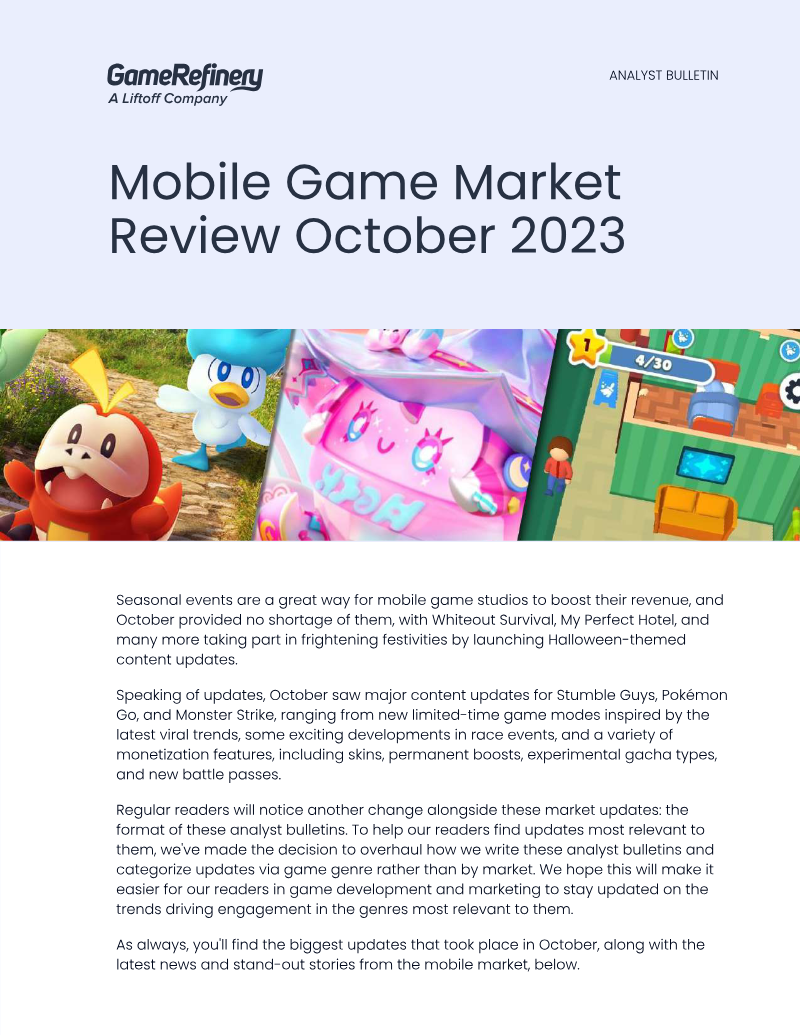
Mobile Game Market Review October 2023
The mobile gaming market in October 2023 was characterized by a heavy reliance on seasonal Halloween content and innovative social features to drive monetization and engagement. Analysis of the period reveals that major titles across the casual and midcore segments utilized limited-time events, crossover collaborations, and experimental gacha mechanics to bolster revenue. Geographically, the review focuses on major global markets, specifically the United States, Japan, and China, highlighting how regional preferences dictate event structures, such as the prevalence of social multi-gachas and location-based business discounts in the Japanese market.
In the casual segment, developers increasingly integrated social and competitive mechanics to maintain player interest. Notable examples include Pokémon Go’s introduction of a four-player party system and Eggy Party’s "Pedestrian Street" mode, which emphasizes social hangouts over core gameplay. Data indicates that titles like My Perfect Hotel successfully improved revenue trends by balancing download fluctuations with permanent boost systems and specialized battle passes. Furthermore, the market saw the rise of "challenging" platforming content in the party royale genre, drawing inspiration from viral PC trends to test player perseverance.
The midcore sector demonstrated the power of long-term live operations and high-profile collaborations. Monster Strike’s 10th-anniversary celebrations in Japan utilized celebrity partnerships and anime crossovers to maintain its top-tier status. Simultaneously, new entries such as Dungeon Hunter 6 and Reverse: 1999 achieved significant chart positions shortly after launch, with the latter reaching the top 100 in both the US and Japan. The findings suggest a market shift toward hybrid gameplay—such as combining merge mechanics with match-3 puzzles—and the successful localization of high-performing Chinese extraction shooters for Western audiences. Overall, the data underscores that consistent content overhauls and the strategic timing of feature updates remain the primary drivers for scaling performance in a competitive mobile landscape.
- Live operations and seasonal content, particularly Halloween-themed events and crossover collaborations, were the primary drivers for revenue and engagement across casual and midcore mobile titles in October 2023.
- Casual games are increasingly integrating social and competitive features to sustain retention, exemplified by Pokémon Go’s four-player party system and Eggy Party’s social-focused 'Pedestrian Street' mode.
- The midcore sector continues to rely on long-term live service strategies, evidenced by Monster Strike maintaining top-tier status in Japan through its 10th-anniversary celebrity and anime collaborations.
- New market entrants like Reverse: 1999 demonstrated strong global appeal by reaching the top 100 charts in both the US and Japan shortly after its launch.
- Monetization strategies in the casual segment are shifting toward permanent boost systems and specialized battle passes, as seen in the revenue stabilization of My Perfect Hotel.
+1
GameRefineryApr 2023

Report68 pages
The 50-Plus Gamer of Today and Tomorrow
The population of gamers aged 50 and older has expanded to 52.4 million individuals, with average weekly engagement rising over 40% since 2019 to reach 12 hours per week. While mobile remains the dominant platform due to the popularity of puzzle, card, and word games, there is a notable increase in console and PC usage among high-engagement segments. This demographic is segmented into five distinct cohorts, where the most passionate 26% of players—classified as Enthusiasts and Immersives—account for nearly half of all total spending. Although current biannual spending averages $49 per person, the market is poised for significant growth as the 40-49 age bracket, which boasts a 62% participation rate, transitions into this older demographic.
Primary motivations for play center on mental acuity and passing time, with 70% of these gamers viewing play as an essential component of healthy aging and cognitive stimulation. Despite this high level of engagement, a significant gap exists between consumer behavior and industry representation. Approximately 70% of older gamers feel the industry treats them as an afterthought, citing a lack of age-inclusive design and a dearth of marketing that reflects their demographic. Furthermore, these players express strong dissatisfaction with aggressive monetization strategies, such as progress-gating ads and microtransactions, which serve as primary barriers to enjoyment.
The industry currently faces a critical disconnect where older adults struggle to find titles specifically designed for their needs. While gaming peaks for this group during evening hours, their preferences remain concentrated in logic and tile genres, though higher-engagement segments increasingly seek narrative-driven and social experiences. To capture the full potential of this expanding market, developers must address sensitivities regarding cost and representation while leveraging the deep-seated belief among older players that gaming is a vital tool for maintaining mental health and social connection.
- The 50-plus gaming population has reached 52.4 million individuals, with average weekly engagement increasing by over 40% since 2019 to 12 hours per week.
- A high-engagement segment comprising 26% of the demographic—classified as Enthusiasts and Immersives—accounts for nearly 50% of total spending.
- 70% of gamers aged 50 and older believe gaming is essential for cognitive stimulation and healthy aging, yet 70% feel the industry treats them as an afterthought in design and marketing.
- Current biannual spending averages $49 per person, but the market is positioned for growth as the 62% participation rate of the 40-49 age bracket transitions into this demographic.
- Aggressive monetization strategies, specifically progress-gating ads and microtransactions, are identified as the primary barriers to enjoyment and retention for this age group.
+1
AARPApr 2023