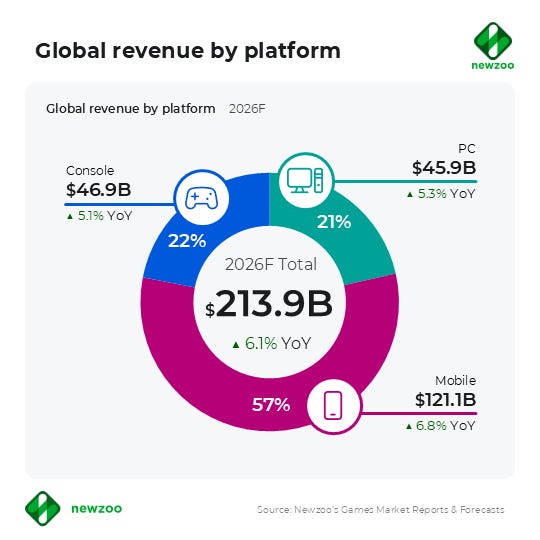
The global gaming market is projected to reach $189 billion in 2024, though the industry is currently undergoing a period of contraction characterized by over 3,500 layoffs in January alone, including significant workforce reductions at Riot Games.
Macroeconomic pressures, including high inflation and rising development costs, have ended the pandemic-era investment surge, forcing companies to pivot from rapid growth strategies toward long-term sustainability.
Cross-platform play is becoming a critical commercial standard, with 15 of the top 100 grossing games now offering full cross-platform functionality.
User-generated content platforms like Roblox and Fortnite Creative are fundamentally changing game discovery and development, increasingly leveraging social media channels like TikTok to reach audiences.
The industry is facing an era of increased global regulatory scrutiny, with a specific focus on app store competition and compliance with mandates like the UK’s Online Safety Act.
The current market state is defined by a transition toward a more mature, fragmented, and regulated landscape rather than an immediate post-pandemic recovery.
The Video Games Industry Memo from January 25, 2024, analyzes the current state of the global gaming market following the Pocket Gamer Connects conference in London. The primary thesis suggests that 2024 is a year of "reconfiguration and reconstruction" rather than immediate rebirth. The industry is currently grappling with a significant "hangover" from 2023, characterized by high inflation, rising development costs, and a cooling of the pandemic-era investment surge. These macroeconomic pressures have led to over 3,500 industry layoffs in early 2024 alone, including significant workforce reductions at Riot Games.
Three dominant trends are identified as central to the industry's evolution. First, a shift toward maturity is noted as businesses move away from rapid growth toward long-term sustainability and survival. Second, the blurring of boundaries is accelerating, both in terms of cross-platform play—with 15 of the top 100 grossing games now being fully cross-platform—and the rise of user-generated content (UGC) platforms like Roblox and Fortnite Creative. These platforms are democratizing development and changing how games are discovered via social media like TikTok. Third, there is an unprecedented focus on global regulation, specifically regarding app store competition and online safety laws such as the UK’s Online Safety Act.
The scope of the analysis is global, with specific focus on the UK, European, and Chinese markets. Data is drawn from conference panels, industry networking, and market intelligence from sources like Newzoo, which predicts the global games market will reach $189 billion in 2024. The tone is professionally analytical, concluding that while the sector faces immediate fragmentation and hardship, the move toward cross-platform accessibility and regulatory compliance signals a maturing industry preparing for a healthier long-term culture.