1 free read left. Create a free account for unlimited reading + AI research.
Create free accountArticle SocialPeta
1 free read left. Create a free account for unlimited reading + AI research.
Create free accountArticleSocialPeta
Lightweight puzzle games dominate downloads via ad-supported traffic, while strategy and match-3 titles capture most revenue through deep live-ops and monetization systems.
It's like free newspapers getting wide distribution, while premium magazines earn more from dedicated subscribers.
The mobile gaming landscape in May 2026 was characterized by a distinct divergence between high-volume download leaders and high-revenue earners. While lightweight puzzle games dominated the download charts through broad appeal and low-friction gameplay, the revenue rankings were commanded by strategy, match-3, and established live-ops titles that leveraged deep progression systems and loyal player bases. This analysis, based on SocialPeta’s monthly App Store and Google Play dataset, highlights that while user acquisition remains accessible, long-term monetization is increasingly dependent on sophisticated retention mechanics like alliances, seasonal content, and battle passes.
Revenue leaders were led by Last War: Survival, which generated $121.4 million, narrowly edging out Honor of Kings at $120.4 million. Last War demonstrated a broad geographic footprint across 12 of the 16 analyzed markets, while Honor of Kings maintained high revenue density primarily through the Chinese iOS market. Other top performers included Royal Match, which utilized a reliable content cadence to secure $102.4 million, and Kingshot, which successfully bridged the gap between high download volume and significant strategy-based monetization.
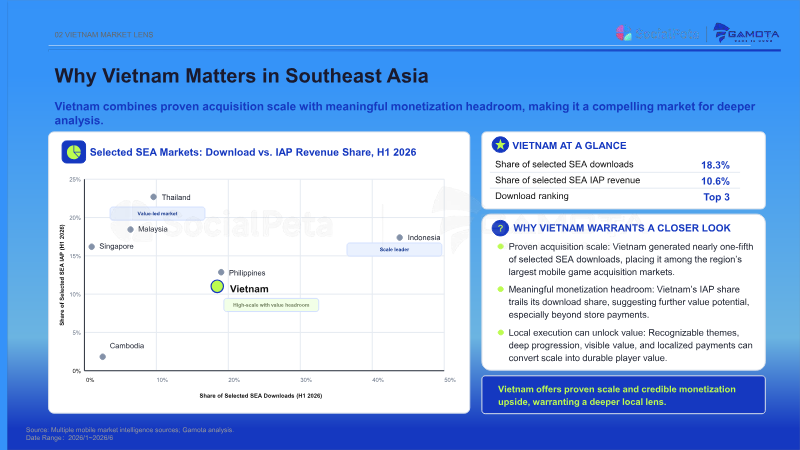
Conversely, the download charts were topped by Block Blast!, which recorded 25.73 million installs. Despite its massive reach, the title generated minimal in-app purchase revenue, functioning primarily as a distribution-focused product reliant on ad monetization. This trend underscores a broader industry shift where simple, accessible titles serve as entry points for traffic, while complex, mid-core titles capture the majority of consumer spending. Regional variations remained significant, with the United States and China showing high revenue concentration, while markets like India, Brazil, and Indonesia prioritized scale and download volume over immediate in-app purchase revenue.
SocialPeta · 2026
SocialPeta · 2026
SocialPeta · 2026
SocialPeta · 2026
SocialPeta · 2026
SocialPeta · 2026
SocialPeta · 2026
SocialPeta · 2026
SocialPeta · 2026

SocialPeta · 2026
SocialPeta · 2026
SocialPeta · 2026