1 free read left. Create a free account for unlimited reading + AI research.
Create free account
The Science of Mass Effect - Dark Energy and Worm Holes - Extra Credits
Key insights
6 takeaways- 01The franchise uses these astrophysical concepts to bridge the gap between theoretical physics and imaginative storytelling, encouraging engagement with scientific inquiry.
- 02The Mass Effect trilogy grounds its technology in the fictional element 'eezo,' which uses electrical currents to manipulate dark energy and simulate changes in mass.
- 03The series utilizes the 'bowling ball and trampoline' analogy to explain how mass curves space-time, aligning with Einstein’s mass-energy equivalence.
- 04The narrative incorporates dark energy—a real, scientifically recognized phenomenon responsible for the universe's accelerating expansion—to provide a layer of credibility to its world-building.
- 05By reducing a vessel's mass to negative values, the game's lore enables faster-than-light travel by allowing ships to surf the curvature of space-time.
- 06Mass relays in the game are depicted as stabilized wormholes, a theoretical concept used to connect distant points in space-time.
Ask AI about this video
Transcript
Mass Effect, the epic single-player space opera that positions the player as Commander Shepard, the savior of the galaxy, one hopes, over the course of a three-part series. It's also a pretty great alien dating sim, if that's your thing. How you doing, Tali? But one thing a lot of people may not realize is that the science that this sci-fi tale is rooted in is pretty solid. This episode is sponsored by In Search of Tomorrow, an upcoming epic documentary about the entire breadth of '80s sci-fi movies. And my god, it's full of stars. Excuse me. Learn more after the episode. Real quick up top, please welcome today's guest writer, astrophysicist, Star Trek science consultant, and writer of the Audible Original Series, The Science of Sci-Fi, Erin Macdonald. Thanks so much, Erin. Science fiction stories, by the nature of their namesake, of course, fall somewhere on the spectrum between science and fiction, which means scientists that are also sci-fi fans have to learn to let a
lot of stuff slide, scientifically speaking. And sometimes stories can get themselves into trouble when they try to explain too much. And this gets especially difficult when you're building an expansive story and world, such as the one in the Mass Effect trilogy, where players crave a detailed environment to explore and make their own. The Mass Effect universe we play in works as well as it does because a lot of the underlying principles of the in-game technology kind of make sense. Let's take, for example, element zero, or eezo for short, which is a fictional element unique to the Mass Effect universe. So, let's dig into this fictional element and the science behind it, something core to the game. Element zero contains a special property. If you run a positive current through eezo, it will channel dark energy to simulate an increase in mass. And if you run a negative current through it, it channels dark energy to simulate a decrease in mass. And this process results in the mass effect. Get it? Mind blown. If you're a fan of the series, you probably already knew that. But, let's explore this concept a little
more scientifically. In the four-dimensional fabric of our universe, also known as space-time, the presence of mass curves space-time, and that curvature tells mass how to move. A great way to envision this is the bowling ball on the trampoline analogy. The trampoline on its own represents flat space-time, and if you introduce a mass, such as a bowling ball, the trampoline will dip down from the weight. Then, if you were to flick a marble on the trampoline, depending on the speed and trajectory, it will either curve, start to orbit, or fall straight down. Now, if you imagine the marble as a planet and the bowling ball as our sun, you can start to see how this is a great analogy for mass and space-time. So, the presence of mass, the bowling ball, curves space-time. Great. Now, if you want to travel through space-time, both the mass of your ship and how much it's warping space-time will dictate how fast you can go. And the less mass you have, the easier it is to travel. Heck, if you have no mass like photons, you'll coast on the surface in a straight line at a fixed speed, which we call the speed of light, which in turn limits how
fast anything can go because there's always going to be some mass. Now, pausing the physics lesson for just a second and jumping back into Mass Effect, how does element zero channel dark energy to simulate an increase or decrease of mass? Well, if you don't have a mass, you could, in theory, use an equivalent amount of energy. Now, you may also have heard of Einstein's equation E = mc². That means all mass contains a huge amount of energy. For instance, the hydrogen bomb is the release of all the energy stored in only a teaspoon of matter. So, if you had a lot of energy, you could use that to simulate mass and warp space-time as if mass was there. And we can imagine that's exactly what Eezo does when a current run through it. It uses dark energy and further dips down space-time or lessens it. And using dark energy for this explanation in Mass Effect is pretty brilliant. Not only because it has the word energy in it, but also because it's probably the thing we know the least about in our universe. We know our universe is expanding. Everything is
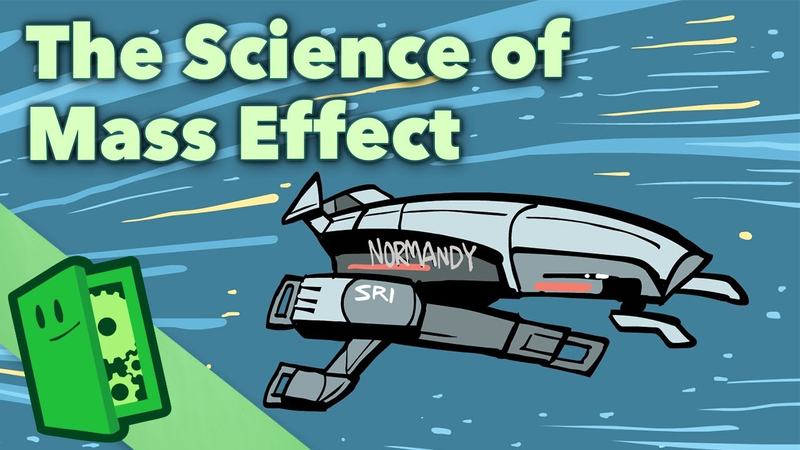
getting further apart from each other, kind of like raisins in raisin bread when the bread's expanding. But it's also accelerating. The expansion is getting faster. And the energy causing this has to come from somewhere, like blowing air in a balloon. So we call this energy pushing our universe apart dark energy. Oh, and a quick side note here. Dark energy and dark matter, totally different things. In fact, their only similarity is a lack of astrophysicist imagination when it comes to naming conventions. But you know what? They are unraveling the problems of our universe, so we'll let it slide. Now that we're primed on the science of mass and dark energy, and we do have a few more minutes before our dream date with Garrus, let's revisit the defining properties of eezo one more time. You run an electrical current through eezo and it channels dark energy to simulate an increase or decrease in mass. For science fiction, this actually makes pretty good sense because doing this is also a great source of artificial gravity. In the bowels of the Normandy, our beloved spaceship in the series, they have layers of eezo that make it
seem like there's a lot of mass at the bottom of the ship. So you can walk around normally. They even go so far to say that when you're on Mars, you're able to walk around like you're on Earth because your boots have small amounts of eezo in them that turn Mars's 0.3G's into feeling like Earth's 1G. Brilliant. Another great example of how Mass Effect uses actual science as a basis for its sci-fi is how the series deals with faster-than-light travel. In the real world, nothing can go faster than light because any mass an object has is going to slow it down. But Mass Effect uses two primary methods to get around this pesky reality. The first is the FTL drive in your spaceship/loveshack. The drive core in the ship is said to house a large amount of eezo. So to go faster than light, you just run a negative current through it to reduce the mass of the ship. And not just so it seems like there is no mass, but even further, so it seems to have negative mass. To picture this, let's go back to our bowling ball and trampoline, but this time, imagine the bowling ball is glued to the trampoline. As it seems to reduce its mass, the bowling ball will
lift up, and if it continues to lift up, the trampoline will start to look like a mountain. This would be how negative mass interacts with space-time. Instead of being limited by the speed of light, you now would surf space-time faster than its limit. And that's exactly how the FTL drive on the Normandy works. The second way for our romantic interests to travel faster than light in Mass Effect is the mass relays. In the lore of the game, humans discover that Pluto's companion Charon is an artificial device connecting two points in the galaxy. The ancient race known as the Protheans basically took two points in space-time and stapled them together to allow you a quick jump between. And this is essentially what we know today as a wormhole. Just, you know, way more stabilized through the magic of fun writing. Using science imaginatively in science fiction allows us to conscript that fiction to teach complex scientific ideas and also think about where our world could go. And even though in the really real world, we don't have Ezo, and when New Horizons flew past Charon in the summer of 2015, we didn't see any signs of a mass relay, we can still use
the extended concepts of the Mass Effect universe and all of their fantastical applications to help inspire the scientific research of tomorrow. Plus, you know, the dwarf planet in our asteroid belt series does have some weird reflections happening on the surface, so come on. I mean, Mass Effect got so much science right. One can only hope they were right about the Protheans, too. I'm just kidding. Unless um unless you can date them, in which case, yeah, I'm on board. Now, in case it hasn't yet been made entirely clear, I am a huge fan of science fiction. My particular poison being the sci-fi films of the 1980s. So, when a few weeks back, we were approached by the producers of the documentary In Search of Tomorrow to see if we'd like to be a part of their upcoming retrospective on all things 80s sci-fi film. Much in the way you should respond if anyone ever asks you if you're a god, we said yes. In Search of Tomorrow is slated to be the definitive retrospective of one of my absolute favorite times and genres of film. With behind-the-scenes stories from legendary creators like John Carpenter, Paul
Verhoeven, Jenette Goldstein, and Shane Black to interviews from James Rolfe, Chris Stuckmann, and even yours truly. Yeah, that's right. Where we break down how these films helped change culture and shape a generation of content creators. And right now, you can join the amazing community helping to bring this expansive cinematic love letter to life by visiting their Kickstarter at the link below. There, you'll not only be able to vote with your dollars, but also take part in watch parties, special guest Q&As, community discussions, and more. So, if that sounds up your alley, and you're keen on hearing me talk your ear off about 80s sci-fi films, check out the documentary's journey via the link below. Legendary thanks to Ahmed Ziad Turk, Alicia Bramble, Casey Newsja, Dominic Valenciana, Gunnar Clovis, Kyle Murgatroyd, El Mamoun Chikhaoui, and Orioles 1.
Stop getting started.
Summary
The Mass Effect trilogy is notable for grounding its expansive science fiction narrative in legitimate physical principles, specifically regarding the manipulation of space-time. The core of this world-building is the fictional element zero, or eezo, which serves as the catalyst for the series' namesake mass effect. By applying electrical currents to this material, characters can channel dark energy to simulate either an increase or decrease in mass. This mechanism provides a scientifically plausible framework for in-game phenomena, such as generating artificial gravity on ships or enabling faster-than-light travel by reducing a vessel's mass to negative values, effectively allowing it to surf the curvature of space-time.
The narrative utilizes the well-established bowling ball and trampoline analogy to explain how mass curves space-time. By invoking Einstein’s mass-energy equivalence, the series posits that if mass can be simulated through energy, space-time can be warped accordingly. The inclusion of dark energy—a real, albeit poorly understood, phenomenon responsible for the accelerating expansion of the universe—adds a layer of scientific credibility to the game's lore. Furthermore, the game’s mass relays are presented as stabilized wormholes, a theoretical concept that connects distant points in space-time, mirroring real-world scientific speculation about the structure of the universe.
While the series relies on fictional elements to drive its plot, it successfully uses these concepts to illustrate complex astrophysical ideas. By bridging the gap between theoretical physics and imaginative storytelling, the franchise encourages engagement with scientific inquiry. Ultimately, the series demonstrates how science fiction can serve as a creative vehicle to explore the potential future of human space exploration, even when the specific technologies depicted remain beyond current reach.























Comments