Updated Jun 1, 2026 by GWI
Report
Published by GWI
20 Deconstructing gameplay: Methodology what gamers are playing and why & definitions In this enhancing the gaming experience Figures in this report are primarily Throughout this report we refer to 44 Player 2 press start: drawn from GWI Gaming’s online indexes.
04 Introduction 06 Discover our data 08 Key insights 10 Choose your character: a guide to gaming audiences 20 Deconstructing gameplay: Methodology what gamers are playing and why & definitions 36 Bonus round: In this enhancing the gaming experience Figures in this report are primarily Throughout this report we refer to 44 Player 2 press start: drawn from GWI Gaming’s online indexes. Indexes are used to comresearch among 19,488 internet pare any given group against the report the gaming community online users, who are gamers, aged 16-64. average gamers (1.00), which unless 52 Well played: The survey is fielded in the following otherwise stated refers to the global 15 markets: Australia, Brazil, Canada, average gamer. For example, an the world of esports France, Germany, India, Indonesia, index of “1.20” means that a given Italy, Japan, Mexico, Philippines, group is 20% above the global aver- 68 Appendix Spain, Thailand, UK, and USA. age, and an index of “0.80” means that an audience is 20% below the 70 Notes on methodology We only interview respondents aged global average. 16-64 and our figures are represent- 74 More from GWI ative of the online populations of When reading this report, please note each market, not its total popula- that we use a mixture of data from tion. Note that in many markets in our GWI Gaming dataset fielded in Latin America, Asia-Pacific, and the Q4 2020 across 15 markets, our GWI Middle-East and Africa, low inter- Core dataset which is fielded across net penetration rates can mean 47 markets, and Zeitgeist data from online populations are more young, the past 6 months which has been affluent and educated. conducted in the U.S.
fic, and the Q4 2020 across 15 markets, our GWI Middle-East and Africa, low inter- Core dataset which is fielded across net penetration rates can mean 47 markets, and Zeitgeist data from online populations are more young, the past 6 months which has been affluent and educated. conducted in the U.S. and UK only.
Introduction If it wasn’t apparent before the us a 360 degree view into gamers’ COVID-19 pandemic, few could now lives both on and offline, it offers an deny what a juggernaut the gaming unparalleled depth of insight into the industry is – which is set to exceed modern-day gamer. $200 bn in revenue in 2023. As we will cover in this report, the But for all the attention on gaming “gaming audience” is something of as a market, the profiles of individ a misnomer. Gaming comprises an This report focuses on: ual gamers themselves have been ecosystem of varying subgroups and less explored. identities. There are people who play games, and they do so on different Profiling gamers by the device they devices. Then there are people who use to play is one way of defining consume gaming content, who may the audience – but often the most not play games themselves. Then meaningful changes come when there is esports, which is another A look at different you analyze by franchise or genre. thing entirely. revenue models – which Fundamentally, each group has to goes far beyond the Analysis of what be understood on its own terms. Whether you’re a brand looking to physical game. From different gaming crack into gaming, an agency looking understanding buyers audiences look like, A deep-dive into the This report uses our new dataset, to refine your expertise at targeting of DLC and based on the device world of esports, GWI Gaming, to fill in some of the gamers, or a publisher looking for sactions, to the potential they use, the genres/ understanding what The lay of the land in the blanks.
o the This report uses our new dataset, to refine your expertise at targeting of DLC and based on the device world of esports, GWI Gaming, to fill in some of the gamers, or a publisher looking for sactions, to the potential they use, the genres/ understanding what The lay of the land in the blanks. With research gathered intel on how your players think and of persistent virtual franchises they play, and matters to its audience console marketplace, across 15 countries, and making use behave, this report aims to provide worlds in franchises like their engagement with and the opportunities for and the potential of of our recontact methodology to give you with the tools you need. Fortnite and Roblox. other gaming content. brands and investors. subscription services.
Discover the Each of the graphs is data on our numbered More information can be found in the Appendix platform section at the end of this report Each chart from our ongo- GWI. Crosstabs dCharts Audiences ing global research in this report contains a hyper- ← New Audience 7 May 2020 12:33 link that will bring you Data set GWi Core Waves Q2 2020 straight to the relevant Sneak question on our Platform, of iew where you can investigate ev new lude people with All of these 2 attributes pr platform V all data by demographics, our er > Male over time, and among your own audiences. OR Gender > Female Just click this icon + Add attribute GWlCharts to explore the data AND Charts Audiences Crosstabs on the platform ← New Chart 6 Feb 2020 12:33 Save changes Save as new Export Unsoved gg Include people with All of these 2 attributes Data set GWi Core Waves Q2 2020 Locations UK Source Information Click the dots Age (Groups) > 16 to 24 Base oudience: Audience: Base about the source to navigate OR Age (Groups) > 35 to 44 All internet users Employment: Stud...: Fashionistas Female 16-24 Work life Children in HH: 2> + Segment by Sort by Metrice Chart view and base . + Add attribute + Add an attribute Dato point % Inclex Responaes Audience % 10 20 30 46 Doto point % Universe Indlex Responses 50 af Someane in my household has a mantal 100 16.7K 84.0M 47% B0 : 15.7K 84.9M 100 8 health issue
Key Video games insights are the initial hook – in-app Esports purchases continues to Family units and add-ons Gamers grab gamers’ make for keep them with an interest and There are multi-console there active social investment more gamers owners Microtransactions and DLCs have presence will dollars emerged as prominent sources of rev help spread around than enue in recent years. Many free-to-play With exclusive franchises found on games like Fortnite and League of the word As engagement with esports grows, you might different games consoles, multi-con Legends have made serious bucks off so do the opportunities for brands. in-app purchases. But for any publisher But to play in this space, it’s crucial to think sole adoption is becoming more looking to land with these more premium firstly understand the esports audience. commonplace; gamers don’t want gamers, they firstly need a grasp on Gaming is a highly communal activity, They’re far more diverse than you might to be limited in the games they play. who’s buying what. Did you know that even among the most casual gamers expect; extremely community-oriented; Console gamers with children, how female gamers purchase more micro (those playing less than once a month) and want brands to make them feel The pandemic didn’t create a legion of ever, are 24% more likely to own 2 or transactions than other add-ons? This 31% say they did any of the involved. The good news for brands new gamers; it made us appreciate just more consoles, showing the appeal of is likely due in part to their interest in related actions we track.
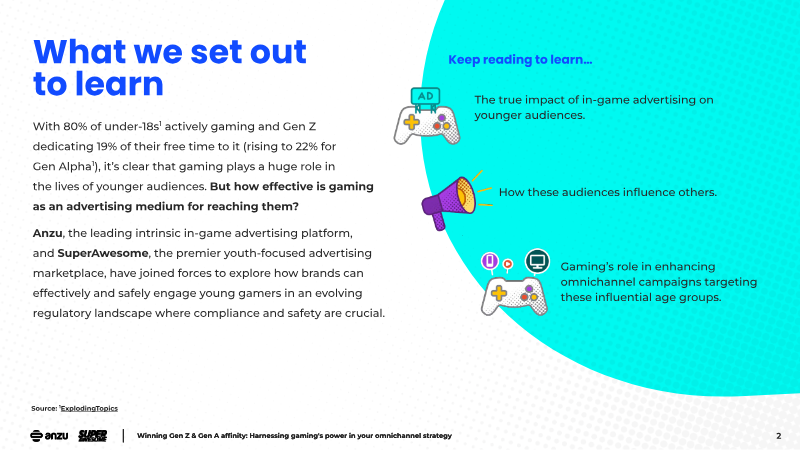
What we set out Keep reading to learn... to learn AD Keep reading to learn… The true impact of in-game advertising on The true impact of in-game advertising on With 8o% of under-18s' actively gaming and Gen Z younger audiences.
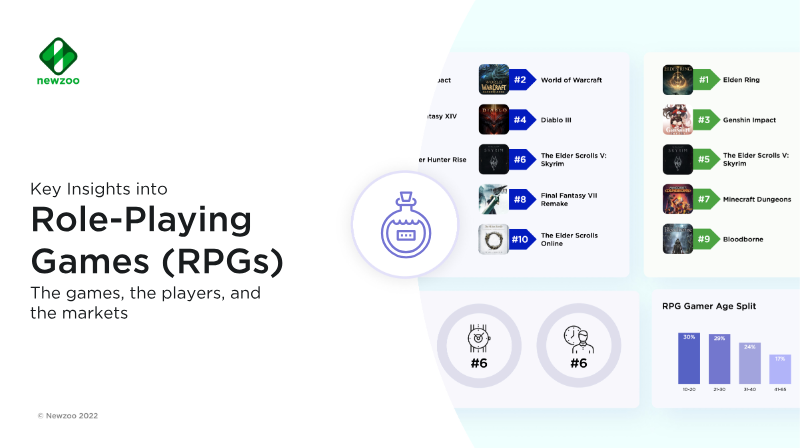
Role-Playing Games (RPGs) represent the highest-revenue genre in the global gaming market as of 2022. The genre is characterized by deep character development, party-based mechanics, and progression systems centered on quests and combat. While RPGs are played across all platforms, they maintain a strong presence on PC and console, where they consistently rank among the top genres for monthly active users. The demographic profile of the RPG audience is predominantly male, accounting for 58% of players, and skews toward younger age groups, with 59% of the player base falling between the ages of 10 and 30. Engagement patterns reveal that RPG players are highly active, averaging 18.8 sessions per month. The genre also demonstrates significant cross-genre appeal, with high player overlap in the adventure, shooter, and battle royale categories. High magical fantasy remains the most popular thematic element, utilized by 63% of the player base, while skill and talent trees serve as the most prevalent gameplay mechanic. Monetization within the RPG space is dominated by pay-to-play models, which reach 97% of the player base, followed closely by in-app purchases at 90%. Geographically, the United States and Japan lead in monthly active users on PC and console. The genre also maintains a robust live-streaming presence, generating 205 million hours watched across platforms like Twitch and Facebook Gaming in June 2022. These insights are derived from data covering 37 markets, excluding China and India, and utilize proprietary gamer segmentation to analyze player motivations, viewing habits, and engagement metrics across the broader gaming ecosystem.
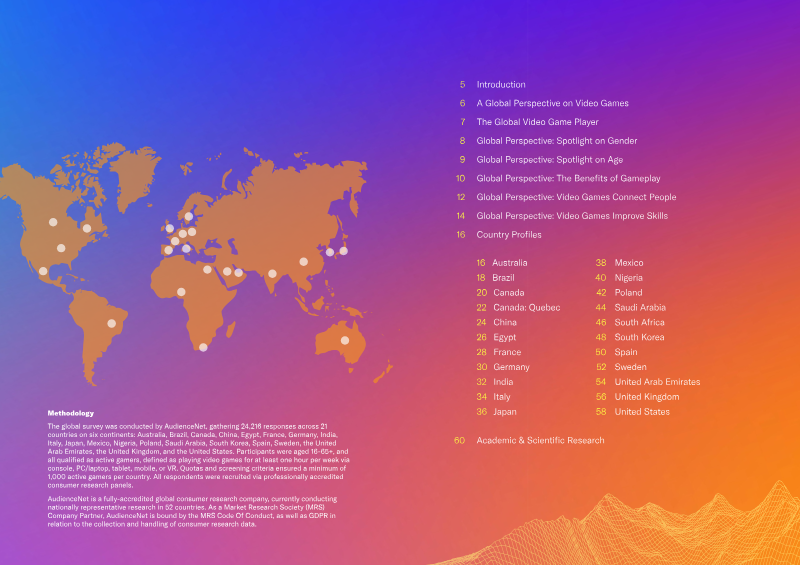
Across more than twenty national markets, the majority of gamers report that playing video games reduces stress and enhances happiness, with 70‑90 % indicating lower stress levels and 57‑91 % feeling happier. Respondents also cite diminished anxiety and isolation, while parents observe a positive shift in relationships with their children, ranging from roughly one‑third in Sweden to nearly four‑fifths in Nigeria. Mobile devices dominate the landscape, accounting for 60‑96 % of play sessions, and online multiplayer emerges as the most prevalent social mode. In the United Arab Emirates, United Kingdom and United States, surveys of roughly three thousand gamers reveal consistent benefits: about 70‑80 % experience reduced stress and increased well‑being, and roughly two‑thirds of parents note improved parent‑child interaction. Genre preferences diverge, with UAE players favoring teamwork, collaboration and creativity, whereas UK and US gamers gravitate toward problem‑solving, critical‑thinking and cognitive‑skill development. Approximately half to sixty percent of participants perceive gaming as supportive of career‑related or hobby pursuits, and a similar share report enhancements in professional competencies. Research spanning multiple sectors demonstrates that video‑game‑based training yields measurable gains in cognition, decision‑making speed and technical performance. Gamers outperform non‑gamers in robotic‑surgery simulations, emergency‑response drills and retail‑seasonal‑sales scenarios, with meta‑analyses confirming statistically significant improvements in perception, attentional control and procedural accuracy. These outcomes translate into higher job performance, reduced error rates and stronger return on investment, prompting organizations such as NASA, the U.S. Air Force and elite sports teams to integrate game‑based platforms into their training pipelines.
Global PC and console revenues are expected to grow modestly through 2027, with consoles driving the majority of expansion at an estimated +13 % CAGR while PC revenue rises only in single digits. 2024 saw a plateau for PCs, dominated by free‑to‑play and in‑game monetisation, whereas console sales are set to rebound from 2025 thanks to strong releases such as GTA VI and the launch of Nintendo Switch 2. Player growth remains incremental, with PC players increasing at +2.3 % annually and console players at +3.5 %, driven largely by established franchises rather than breakthrough innovation. Playtime data confirm that 2024 experienced a 6 % YoY increase, with Pay‑to‑Play titles (e.g., Call of Duty) and free‑to‑play hits (Fortnite, Roblox) accounting for most of the lift. New releases captured only about 9 % of total playtime, underscoring that long‑running series dominate the market. Console audiences remain heavily slate‑dependent: 67 % of new‑release hours come from annual franchises, while PC players show a higher share of non‑annual titles. In the US and Western Europe, non‑annual franchise games contribute a smaller slice of console revenue (≈8–22 %) compared to annual franchises, which drive the bulk of earnings. Engagement patterns reveal a sharp decline in title diversity on PC and Xbox, with the average number of titles played per player falling 27 % on Steam in the US and up to 34 % in Russia and Brazil. PlayStation, by contrast, shows modest growth in title engagement. Genre preferences are shifting away from Battle Royale toward Adventure and Role‑Playing, reflecting a broader industry trend toward narrative‑rich, long‑form gameplay. Nostalgia and free‑to‑play models continue to sustain short‑term spikes, but long‑term retention hinges on continuous content updates and robust live‑service strategies. New IPs must prioritize originality, polished gameplay loops, and community‑first discovery to overcome the legacy brand advantage and achieve lasting commercial success.