Loading the document
Key insights
6 slides
Methodology
A hierarchical load testing architecture simulated large-scale user activity.
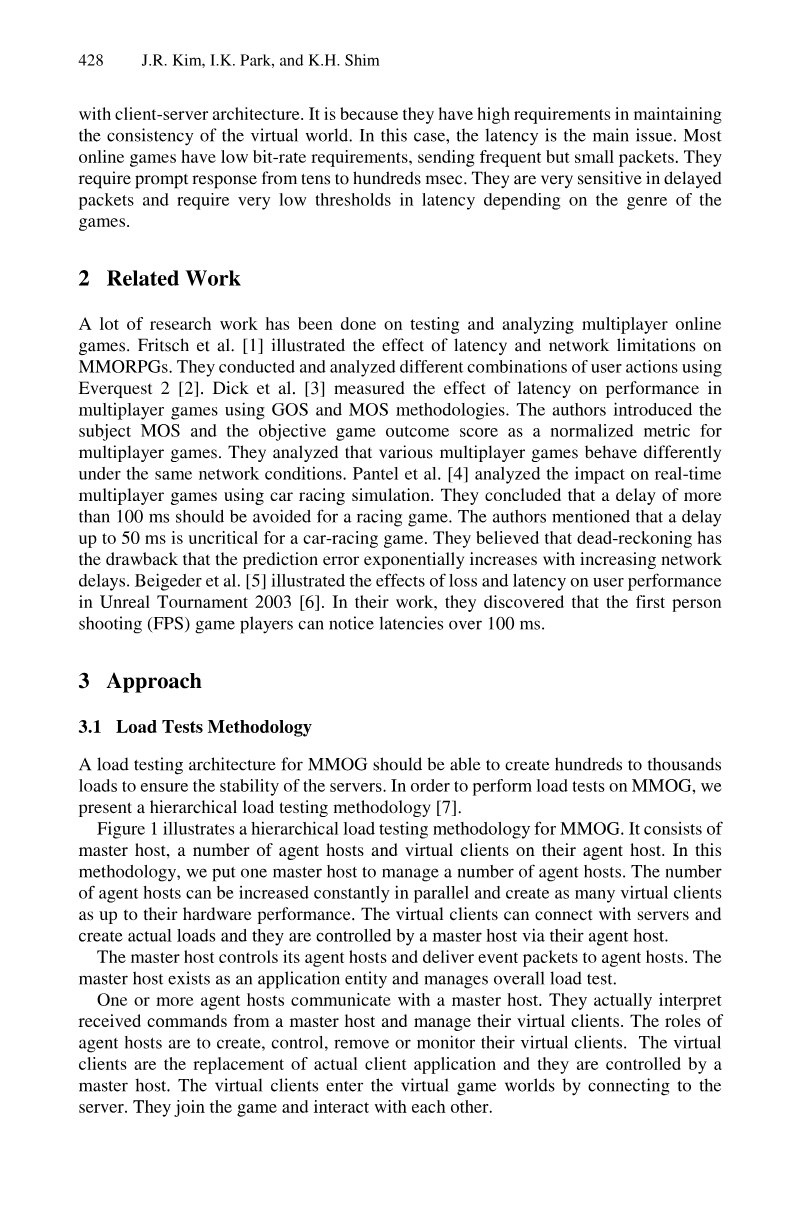
The study used a master host to manage multiple agent hosts and virtual clients, evaluating server performance under increasing loads from 500 to 3,000 virtual clients.
Testing approach. The study utilized a hierarchical load testing architecture with a master host managing multiple agent hosts to simulate concurrent user activity for performance benchmarking.
1 / 6
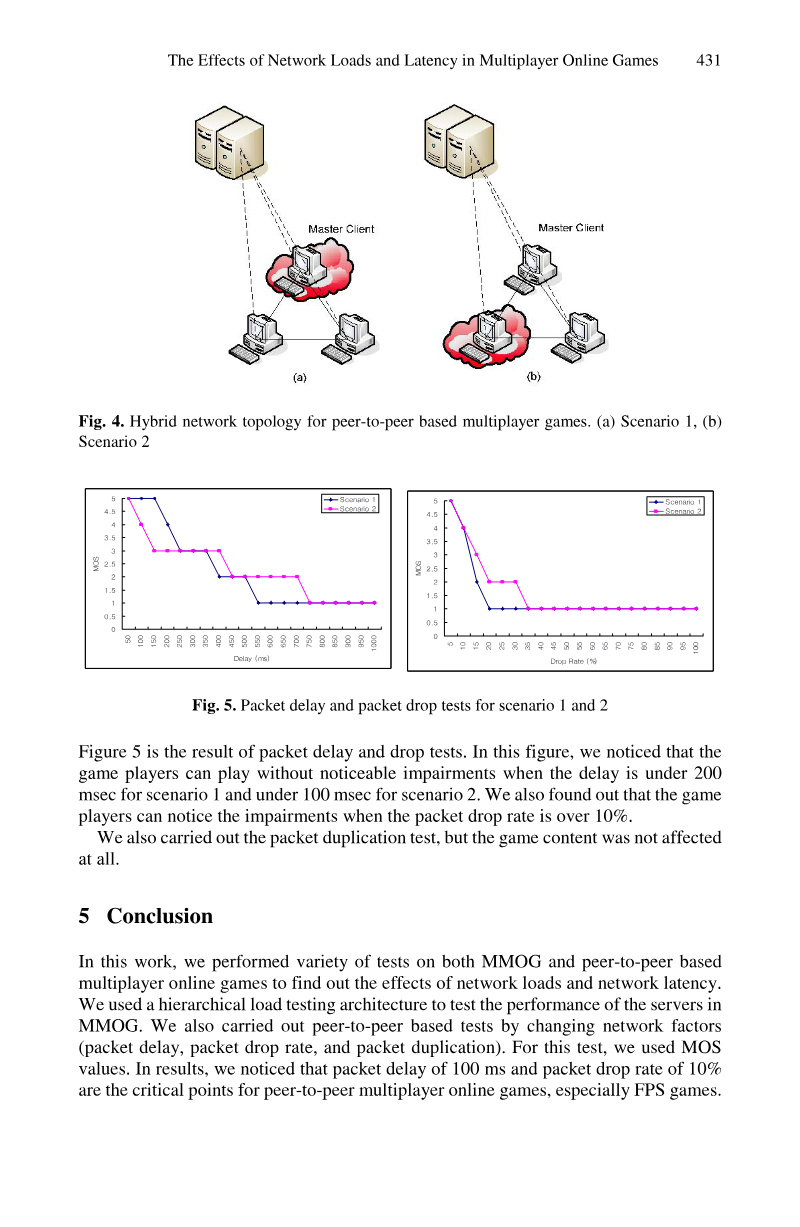
- 01In FPS games, network latency exceeding 100 ms and packet loss rates above 10% cause significant, noticeable degradation to the player experience.See it on page 2
- 02MMOG server round-trip delay increases linearly as the number of concurrent virtual clients scales from 500 to 3,000, creating substantial CPU and network resource strain.See it on page 1
- 03Packet duplication has no measurable impact on game content or user-perceived quality in multiplayer environments.See it on page 5
- 04Effective management of high-density traffic in distributed virtual environments requires robust server-side architecture to mitigate the linear performance decline observed under load.See it on page 1
- 05The study utilized a hierarchical load testing architecture with a master host managing multiple agent hosts to simulate concurrent user activity for performance benchmarking.See it on page 6
Ask AI about this report
Summary
This analysis examines the impact of network loads and latency on multiplayer online games, specifically focusing on Massively Multiplayer Online Games (MMOGs) and peer-to-peer (P2P) architectures. The primary objective is to identify server bottlenecks and determine the thresholds at which network degradation—such as packet delay, loss, duplication, and reordering—negatively affects player experience.
The methodology employs a hierarchical load testing architecture to simulate large-scale concurrent user activity. By utilizing a master host to manage multiple agent hosts and virtual clients, the study evaluates server performance under increasing loads, ranging from 500 to 3,000 virtual clients. For P2P environments, the research utilizes the Mean Opinion Score (MOS) to quantify user-perceived quality, testing various network impairment scenarios in a first-person shooter (FPS) context.
Key findings indicate that in MMOG server environments, round-trip delay increases linearly as the number of concurrent virtual clients grows, placing significant strain on CPU and network resources. In P2P configurations, the research establishes critical performance thresholds: for FPS games, network latency exceeding 100 ms and packet loss rates surpassing 10% result in clearly noticeable impairments to the gaming experience. Conversely, packet duplication was found to have no measurable impact on game content. These results underscore the sensitivity of real-time interactive games to network instability and highlight the necessity of robust server-side architecture to manage high-density traffic in distributed virtual environments.