Updated Jun 1, 2026 by Ten Square Games
Financial
Published by Ten Square Games
TSG’s Portfolio Transformation Strong execution across all segments: from rebuilding core titles to scaling new growth engines Growing Trophy Hunter Wings of Heroes Rebuilding Core Titles expanding content and executing Other games 80.0 marketing strategy ahead targeted advancing the complex rebuild process of Fishing of Q4 seasonality Clash and Hunting Clash PLN 100.0 M NAN 60.0 52.3 ...
Q3 2025: Advancing TSG’s Portfolio Transformation Strong execution across all segments: from rebuilding core titles to scaling new growth engines Growing Trophy Hunter Wings of Heroes Rebuilding Core Titles expanding content and executing Other games 80.0 marketing strategy ahead targeted advancing the complex rebuild process of Fishing of Q4 seasonality Clash and Hunting Clash PLN 100.0 M NAN 60.0 52.3 paid out in the form of 40.0 27.3 27.4 dividend on June 20.0 Scaling Wings of Heroes Developing New Projects 27th, 2025 0.0 increased marketing investment based on new Global launch of Real Combat Simulator and creation benchmarks – record-high quarter for UA spend in 2022 of a new prototype: expanding the innovation pipeline game’s history DividendBuyback ne AI *TSG became publicly listed company in May 2o18. Presented profit distribution does not include dividends paid out before TSG became listed compan 3 M|
the Performance Shaped by ISHINH process of strategic overhaul CLASH UNTING PLN 485 SHHN HUNTF Bookings and marketing expense CLASH CLASH & CLASH (PLN M) 70 61.2 59.6 62.2 59.6 25 22.1 23.0 21.4 60 52.6 48.7 47.1 20 18.6 The process of strategic overhaul aimed 50 15.2 14.6 at stabilizing long-term performance in M PLN 15 progress 30 Fishing Clash Hunting Clash 10 7.7 20 15.3 Wings of Heroes Trophy Hunter Evergreen 11.2 10.5 11.4 8.2 5 4.4 2.8 Teams focused on A/B testing and iterative 10 Real Combat Simulator Other games Shared Services 2.7 Other teams 80.0 72.6 tuning rather than introducing new features Q3 Q1 2024 Q2 2024 Q3 2024 Q4 2024 Q1 2025 Q2 2025 Q2 2025 Q3 Q1 2024 Q2 2024 Q3 2024 Q4 2024 Q1 2025 Q2 2025 Q3 2025 Bookings Marketing expenditure Bookings Marketing expenditure Key areas of attention in Q3: 2025 PLN 47.1 M PLN 6.5M 2025 PLN 14.6M PLN 2.7M ■ FTUE (First Time User Experience) -3.2% q-o-q -13.8% q-o-q -4.3% q-o-q -3.4% q-o-q ■ Segmentation and in-game economy 40.0 27.3 27.4 dividend on June 20.0 Key focus in Q4 2025 Positive impact observed from actions targeting lapsed player reactivation & matchmaking improvements 0.0 FTUE: 2019 economy 2021 improvements 2023 visual 2024 2025 Marketing spend at low levels (aligned with the first stage of players’ of the games in matchmaking overhaul to the strategic overhaul phase and test-driven journey in the games to improve to improve improve UX approach), in both titles throughout 2025 to improve retention monetization engagement impacting games’ results
evels (aligned with the first stage of players’ of the games in matchmaking overhaul to the strategic overhaul phase and test-driven journey in the games to improve to improve improve UX approach), in both titles throughout 2025 to improve retention monetization engagement impacting games’ results AI *TSG became publicly listed company in May 2o18. Presented profit distribution does not include dividends paid out before TSG became listed compan October booking higher vs September in 5 both titles. M|
Wings of Heroes WINGS HEROES Effective Scaling Driven by Product Development and increased Marketing Bookings and marketing expenses (PLN M) 8.4 Growth in bookings by 33.4% q-o-q supported by higher & effective UA 9.0 ■ Growth in bookings by 33.4% q-o-q supported by higher & effective UA 8.0 7.1 7.3 6.3 investment of PLN 4.7 (up by 118.9% q-o-q) 7.0 5.6 ■ Bookings growth driven by both record-high marketing expenditure and 6.0 4.7 strong in-game initiatives improving engagement and monetization 5.0 3.5 3.0 3.3 3.0 M PLN4.0 2.9 2.2 ■ Key actions impacting performance: 3.0 1.1 2.0 0.8 ■ Launch of Formations – new cooperative feature enhancing the social 1.0 layer, engagement, and session length 0.0 1Q 2024 2Q 2024 3Q 2024 4Q 2024 1 2025 2Q 2025 3Q 2025 Fishing Clash Hunting Clash Wings of Heroes ■ Expansion of LiveOps events, boosting activity and in-game spending Bookings Marketing expenses Introduction of dedicated support for high-spending players 80.0 Real Combat Simulator 72.6Other games ■ Increased ad visibility leading to higher ad revenue PLN 100.0 M ■ NAN ■ In October 2025 bookings amounted to PLN 3.2M - the highest monthly Average MAU (M) and monthly ABPU* (PLN) 52.3 result in game’s history priorities for Q4 2025 Average MAU in the form of 40.0 27.4 dividend on June 1.0 ABPU 27.3 8.3 8.7 7.4 9 27th, 2025 Users in M 20.0 6.3 6.3 ■ New monetization feature: Hangar Workshop 0.5 0.0 4.6 6 PLN ■ Improvements in previously introduced features: 2.9 2019 2020 2021 2022 2023 ■ Formations 2025
riorities for Q4 2025 Average MAU in the form of 40.0 27.4 dividend on June 1.0 ABPU 27.3 8.3 8.7 7.4 9 27th, 2025 Users in M 20.0 6.3 6.3 ■ New monetization feature: Hangar Workshop 0.5 0.0 4.6 6 PLN ■ Improvements in previously introduced features: 2.9 2019 2020 2021 2022 2023 ■ Formations 2025 0.3 0.3 0.3 0.3 0.3 0.4 3 0.0 0.2 DividendBuyback ■ Wheel of Fortune 1Q 20242Q 2024 1Q 2025 2Q 2025 3Q 2025 0 ■ Battle Pass 3Q 2024 4Q 2024 AI *TSG became publicly listed company in May 2o18. Presented profit distribution does not include dividends paid out before TSG became listed compan 6 M|
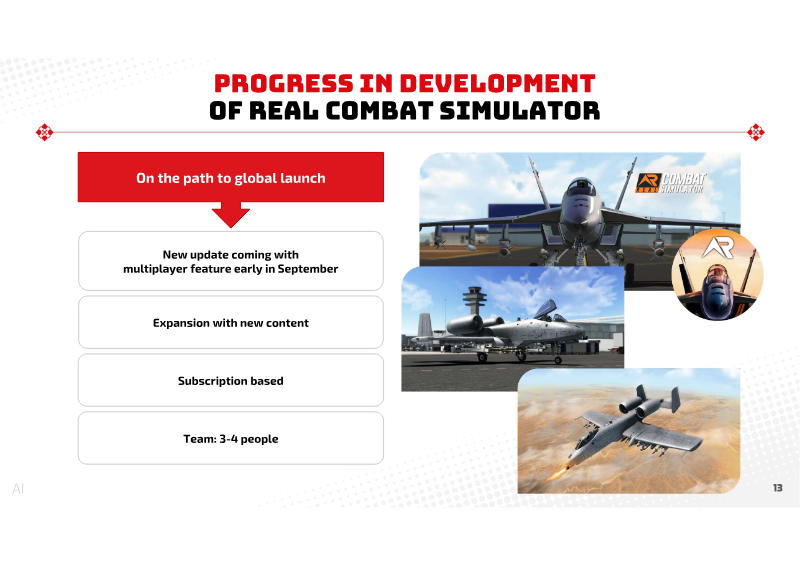
Trophy Hunter: Q3 2O25 ADJUSTED EBITDA RESULT IMPACTED BY HIGHEST QUARTERLY Sustained Growth & Strong Scaling Momentum Robust growth of bookings since global launch ■ Trophy Hunter continues to scale effectively with high KPIs (PLN M) real combat and rising contribution to Group bookings PLN 3.2M 2.7 simulator ■ The game generated PLN 3.2 m in revenue in Q3 2025 in Q3 2025 supported by PLN 6.1 m in marketing spend maintained growth dynamics and good KPls in Q4 2025 TROPHY ■ maintained growth dynamics and good KPIs in Q4 2025 1.4 HUNTER Game’s performance supported by 0.8 ONE SHOT KILL 1 High marketing spend, reflecting: ■ strong monetization and retention metrics vs. existing titles August September ■ favorable seasonal timing ahead of Q4 advertising cost July October 994 increase and market unpredictability Strong investment inmarketing in Q3 2025 OUNE SHIOT KIELLY Dynamic product development: Marketing spend 0157 2 ■ 4 new arenas expanding gameplay depth Marketing spend PERFECT SHOTS ■ friend invitation system enhancing community and 8 competition & asynchronous 1v1 duels introducing new Bookings 6.1 competitive layer 6 0.0 Bookings ■ Progression plan for Arenas 1–9 2019 2020 2021 2022 2023 2024 Q4 2025 priority 4 3.2 2025 DividendBuyback 2 Maintain the growth momentum ■ new big social feature FCE ■ 3 new arenas AI *TSG became publicly listed company in May 2o18. Presented profit distribution does not include dividends paid out before TSG became listed compan 8 M|
The interim filing presents the fourth‑quarter 2025 financial results for a midcore‑casual gaming group, emphasizing a record‑setting revenue run and the successful execution of a transformation agenda that includes the integration of the Plarium acquisition and the rollout of a new district structure in early 2026. Revenue reached SEK 3,123 million, reflecting 108 % organic growth year‑on‑year and a 25 % increase on a constant‑currency basis, while adjusted EBITDA rose to SEK 717 million, delivering a 23 % margin that matches the full‑year figure. Unlevered free cash flow amounted to SEK 878 million, with a cash‑conversion rate of 66 % and a leverage ratio of five times EBITDA, underscoring robust liquidity and disciplined capital management. User‑acquisition spending accelerated, representing 38 % of quarterly revenue—up from 37 % in the prior quarter—and grew 76 % on a reported basis, driven by heightened investment in original studios, new casual titles, and the racing franchise. The direct‑to‑consumer channel expanded by 600 basis points to 32 % of total revenue, reflecting a strategic shift toward higher‑margin in‑app purchases. Across the fiscal year, the company posted a 9 % organic revenue increase, with word‑games, racing, and RAID franchises delivering the strongest quarter‑end performance. Operating cash flow for the quarter stood at SEK 840 million, while adjusted net income was SEK 1,390 million, translating to an adjusted EPS of SEK 11.33. The financial outcomes exceed guidance and position the firm to meet its medium‑term outlook, with a pre‑IPO study for PlaySimple concluded and the midcore transformation progressing as planned.
A well‑designed in‑game offer system is presented as the most potent driver of lifetime value and average revenue per paying user. By integrating a limited set of synergistic offer types—login bonuses, triggered prompts, endless streams, “1 + X” bundles, battle‑passes, stamp‑cards, and curated bundles—and optimizing their frequency, timing, pricing, segmentation, and economic balance, developers can achieve conversion rates as high as ninety‑six percent on login offers and lift repeat‑purchase value by roughly twenty percent through endless offers. Conversion is shown to be a function of repeated exposure rather than a single impression; players typically require about seven viewings before taking action. The most effective moments to surface offers are at login, during “out‑of‑currency” events, after level failures, or in high‑momentum gameplay phases. A dynamic, tiered pricing ladder that escalates after each purchase and regresses after periods of inactivity—exemplified by a seven‑tier structure ranging from under one dollar to ninety‑nine dollars—enables precise alignment with player spend propensity while avoiding both under‑monetization of high‑potential users and alienation of low‑spenders. Segmentation must extend beyond basic recency and frequency metrics to incorporate geographic tier, acquisition source quality, and player progression. Lower‑tier regions demand adjusted price ladders and reduced offer frequency, whereas high‑quality acquisition channels justify more complex bundles. Early‑game players respond best to inexpensive, simple offers, while mid‑ and late‑game users can be presented with higher‑value packages. Anchoring the entire shop around a stable, low‑priced entry pack establishes a reference point that shapes perceived value across all offers. Collectively, these principles apply to mobile and casual games operating globally, reflecting current industry practices and data from recent case studies. Implementing the outlined framework promises measurable improvements in monetization efficiency, player satisfaction, and overall revenue performance.
The gaming industry was enjoying rapid growth—then a postpandemic GLOBAL GAMING REVENUE BY TYPE ($BILLIONS) +1% CAGR, 2017–2023 (%) +13% 197 211 204 214 Ads in mobile games 26 163 13 17 1 20 1 24 1 131 150 9 11 33 36 36 ...
G5 Entertainment’s 2024 performance reflects a strategic pivot toward operational efficiency and margin expansion within the global mobile gaming sector. Despite a 14% year-over-year revenue decline to SEK 1,135 million, the company achieved a 5% increase in operating profit, reaching SEK 116.8 million. This improvement is attributed to a disciplined focus on its core demographic—women aged 35 and older—and the expansion of its proprietary direct-to-consumer G5 Store, which now accounts for 16.1% of total revenue. By leveraging AI-driven development and a rigorous funnel of five to six soft launches annually, the company aims to sustain its position in the evergreen Hidden Object, Match-3, and Mahjong genres. The company maintains a robust financial foundation, characterized by SEK 276 million in available cash and an equity/asset ratio of 83%. Financial stability is further supported by a conservative approach to capital, with no external debt and a portfolio where the top ten titles generate 98% of intangible asset value. While the business remains sensitive to market volatility, currency fluctuations, and reliance on major third-party distribution platforms, auditors have provided an unqualified opinion on the financial statements, confirming that the valuation of capitalized development costs remains within reasonable parameters. Beyond financial metrics, the organization emphasizes a structured approach to corporate governance and human capital. With a gender-balanced workforce and a commitment to ethical business conduct, G5 integrates comprehensive labor policies and 360-degree performance assessments to drive organizational health. While the company has implemented energy-efficient practices, it currently lacks formal climate mitigation plans and EU taxonomy-aligned sustainability metrics. Moving forward, the board remains focused on balancing organic growth with shareholder returns, as evidenced by the proposed dividend of SEK 8.0 per share and a continued emphasis on performance-based executive remuneration.