Transcript
Hello and welcome to the Game Discovery Co. Show. Your place to learn all about game discovery, what's going on in the video game business, and a whole bunch of other stuff, too. I am your co-host, Chris Plant, and I'm joined as always by my co-host, Simon Carlos. How you doing today, Simon?
I'm doing good, thanks. It's a exciting new week. There's all the stuff going on in video game discovery and platform stuff, and we're willing to bring it to you. So, that's awesome, right? I love it. So, here's how it goes for newcomers. We go through a series of smaller news stories followed by one big meaty one and we leave you with a clear understanding of what went on in the past week of game discovery and what is coming up this week so you can seem like some sort of wizard or magician who knows things far ahead of time. And by far ahead, I mean about four to seven days.
Yeah. Really far ahead. Yeah.
Yeah. It's Hey, you know what? If I had
that and I could go to a casino, I would feel really good.
Good.
Um, let's dive right into the very first story and get things going. Number one, Hell Divers 2 has been added to the PlayStation Plus game catalog two and a half years after its original debut. How normal or not normal is this timeline for a game like this being added to PlayStation's catalog?
Yeah, I just thought this was interesting story to talk about because obviously Xbox over the past, you know, a seven or eight years has made a big thing of Day One being the thing. And all along PlayStation has been very much like we're not sure this is a good idea. And [laughter] in hindsight, yeah, it it it does seem like the fact that certainly Xbox has taken Call of Duty out of Day One again now, for example, shows that it doesn't appear that this approach really worked. So, it's interesting to see. Um, I'll answer your question more directly. Like
I a lot of the time I think it's been like a year to a year and a half sess uh before sort of first party titles made it onto Game Catalog. And just as a reminder to everyone, game catalog is the slightly more expensive part of PlayStation Plus. There is a cheaper start cheaper part where you just get PlayStation Plus uh PlayStation Plus essential games and there's and there's less of those. But yeah, I think they've generally been waiting at least while they were dealing with Xbox as a competitor for like a year to a year and a half. And that's also for third party games as well. like there's very very few there's a handful um of third party games that will appear on uh PlayStation Plus in any form straight away nowadays but but in in most cases I wait but yeah holdovers 2 is even longer than some other first party titles I've seen
maybe I am shortselling the audience here but how is anybody supposed to know the difference between what is a pay game what is a free-to-play game and
what is an included with um subscription game like I'm not entirely sure what the the business model is here anymore for a game like Hell Divers 2 and how somebody maps it out from the beginning.
Yeah. I mean if if this wasn't if this was a third party then they would know in this case it obviously all feeds into revenue that Sony is getting anyway. But if this is a third party, then they would build in whatever they get. Like maybe big third party games have been getting an extra $10 million from uh Sony to be on on PlayStation Plus at a particular time. Obviously indies get far less than that. And that's sort of a a number I don't know for sure. But in the end, I think, yeah, people are building that in because they're like, "Well, at this point, our game is already 50% off and we're selling, you know, and and there's definitely people who are interested, but we don't think all those people have the higher tier of PlayStation Plus. So, it's fine. We're we're just we're just going to put it in the higher tier of
PlayStation Plus, get that lump sum." And just a reminder that lump sum is net which is quite exciting because otherwise uh you know like if it's gross then you're going to have to have the 30% platform cut and maybe some refunds as well. But if you're getting $10 million uh to be in PlayStation Plus you're getting actually $10 million. So that's the other reason why people like these uh subscription services.
Yeah. I I mean it feels a little bit like trying to create some version of a longtail like what the film studio had decades ago before streaming of first you're in a movie theater then you are home video rental then direct sales home video then cable TV and and so on and so forth in terms of Sony knowing when to put it here I was trying to figure out if this is a reflection of like a game's success versus its eventual player to player decline. And I was checking on Steam DB, which is not a perfect one to one here
because these are the Steam numbers versus the PlayStation numbers, but they're still valuable. And Hell Divers 2 had its second lowest month of all time in July, which sounds like
that is a sign that things are going down. Time for a boost. But it wasn't actually so different from the baseline that the game has had for a year between major updates. um and its increase in August aligns with basically the same player spike that we saw in February. So is it hey the players are declining and we want to boost it? Is it it just time for another marketing cycle? Like what is inspiring a decision like this? I I mean I think it's very much the argument that there's parallel audiences and the parallel audiences for example uh being in humble monthly like if you're in humble humble monthly and you put your steam key in there the argument which I think is relatively sound is this is an audience that might not of often doesn't know about your game certainly wasn't so interested in it that it was going to go
seek it out and buy it even maybe at 50% off. So, at that point, this is just another parallel audience to tap. And I think I think the argument is definitely um for these games, you know, being in PlayStation Plus game catalog is just an audience that you haven't accessed yet. And all finding those audiences is is good. But I do think um my main takeaway from this, what was interesting is I think PlayStation is going to feel much freer about lengthening its first party times before they put stuff into PlayStation Plus. Because before I do feel like they were pressured by Xbox and I think the pressure is kind of off on that side of things and I think it it it does mean if they're going to be like, you know, like Wolverine, like when are they going to put Wolverine in in PlayStation Plus? Like when Xbox was talking everything's day one, they were probably pressured to put it in a year after, but maybe they'll wait even longer now because the economics make sense to do that.
Yeah. I mean, even with the Wolverine comparison, what I find so unusual about Hell Divers 2 and was the problem that
Xbox seemed to run into is a game like Hell Divers, one of these forever games, feels antithetical to a try a little of everything approach that in theory is the point of these subscription services that you're playing a lot of different games. Um, and it it it seems weird to have a game that is counter to I guess the on paper reason that you would want to subscribe to a thing like PlayStation Plus. But maybe that is the idea of these are gamers who are only going to dip in and they are not the hardcore gamers who are going to be playing just this and only this.
Yeah. And I also think there there's going to be pressure to keep up their PlayStation Plus uh levels of subscription and and games big games [clears throat] like this are always churn reducers, I suspect, because people are kind of like, well, I'm not going to churn out because um you know, there's this $60 game that I was kind of interested in that's only been $30 up to now is now available. So I I I do think
the idea of churn reduction, you sort of have to put something [laughter] in in in game catalog every month. But I agree with you. It is diff I agree with basically all what you said. If you try and apply business logic to when things should go in and out of subscriptions, it's actually very difficult.
Yeah. Um uh I want to get to the next two stories which I can only describe as uh the siren songs sung in harmony and that they seem to be appealing to a lot of people and also um are making my ears bleed when I hear them. um they are make me extremely anxious on the consumer end, but I'm curious about where your head is at on the business end. And this will start with paid mods. Mod.io is making a bigger push into this space. Do you want to give kind of a a top level summary of what's going on here?
Yeah, I mean basically like there's there's a couple of new school companies who do um mo like mod tools for people
and mod.io IO uh is is is one of the leading ones. Um, and historically they've done a really good job of sort of hosting hosting people's mods, uh, like devs mods and players mods, and they have a pretty robust catalog, but obviously, you know, they've been VC funded. And I think, you know, the the end point of this is they do need to generate, I think, some long-term value. And, uh, and the idea of paid mods, which has been, I think, is both intriguing and controversial, is something they're dipping back into now. And they have noted, you know, they have a BM a more casual BMX game called BMX Streets, and they're noting that it has a um a a $10 average revenue per paying user for folks who are willing to dip into the paid mods right now. And and you know, and I think paid mods for BMX games, for example, where there's like new tracks and stuff kind of kind of makes sense, but there's obviously been a rich history of a lot of content being free and then maybe monetized other ways like Patreons and and I think it is still difficult to work out what the
right angle is where you're not going to get backlash given the rich history of backlash against paid bots. Yes, I I want to get into that backlash in just a second and kind of my queasiness while also recognizing like people should get paid for things that they make if they would like to do that. But first, how much bigger of a story is this than just Modio? Because we've seen the power of obviously Roblox allowing amateurs to sell media to sell effectively mods if you would want to call that. I don't know. The difference between a mod and a Game Maker tool is tricky here. We've also heard Tim Sweeney talk about making these transferable media between games and bringing users into that environment to be able to make things and then make money. Is this what video game execs are starting to see as the future? Games becoming the storefronts themselves?
Yes. Yes and no. I mean, I think um there is a lot more. The rise of UGC is
definitely happening and definitely, you know, obviously Roblox, Roblox never had any games made by Roblox. Roblox was always almost always 100% UGC. Uh I I and I think people are interested in it. I think the problem has been in the PC and console market where games are sort of predominantly paid by revenue perhaps. There's big freeto-play revenue, but the freeto play is concentrated in very specific set of games. So, if you're trying to make new stuff, a lot of people are making it in the um yeah, in in the paid upfront space. And in general, consumers have paid up front are willing to pay for DLC, but they've been nervous of paying for user created DLC, especially because there's these, you know, Steam Workshop has been around for a long time and they're kind and they are kind of like, well, people are giving this to me for free. uh why am I gonna give you know the game publishers or developers a cut of it in addition to uh you know the the the creator I guess and also
trying to introduce mod uh paid mods where there would have been a rich history of free mods
can be complicated. I I don't think it's an outlandish idea but there's a lot of there there's a lot of kind of like chatter about it I think.
Yeah. Yeah. I mean, whenever trends like this come around, I always fear being old man yelling at cloud. And I definitely recognize the emphasis on mod culture not making money of it being like a communal thing is a very Gen X maybe elder millennial way of seeing things that is anti, you know, selling out. Do Gen Z gamers see things this way at all or have being raised on Roblox and UGC in that format? Is this just kind of the norm for them?
I mean, I think what's really happening, if I think about it, is uh younger gamers are buying cheap games that are standalone and are sort of UGC like in
some cases. You know, the rise of Friends, right? Friends, you you you could argue friends could be, you know, it's really a series of $7 standalone games using popular engines that are kind of like mods on ideas of stuff. Anyway, so I suspect I suspect what's happening is um that that that that's happening and people are just comfortable with playing smaller amounts of money for bite-sized chunks of stuff, but they're actually most comfortable with doing that as standalone games. So, I think it is difficult to leverage in sometimes if a game is normally $20 or $30 and it's got a slightly older audience kind of levering in that page UGGC can be tricky. But I also think I I I don't think it's I mean I don't think Mod.io is silly to want to approach this because there's plenty of games that have you know like Rim World is a great example of a game that has a lot of very nice first party first party uh DLC that conceivably could be made by modders. So, there's no conceptual reason why Rim
World couldn't have multiple $10 or $20 mods made by third parties. Uh, it just Yeah, it's just h how do you I think creating the creating the marketplace, the open marketplace is sort of the bit where then people start going, you know, like the more the older gamers go, "Oh, hang on. What's going on here?" Right.
Yeah. Yeah. I I I I also apologize when you said friend slop. Uh my uh desk weight fell on my foot and it looked like I was really offended by the very idea of friendlop. I want to be clear. Love friends. And I don't even mind the name that much. I I do have one last question on this, which is like what you're talking about with the marketplace coming around and people starting to get suspicious, which is I'm just going to give you like the the the worst conspiracy theory of all of this, which is are we going to see more game publishers prioritizing UGC tools and distribution
as a way to avoid hiring professional labor? I do not think so because I think that um frankly the amount of UGC that's actually going to be successful that is paid is is relatively low at this point. Uh and I I'm I'm not 100% convinced this is this is going to work. I think, you know, it's going to be interesting, right? The Sims is doing this right now. And The Sims, since The Sims is free to play nowadays, The Sims is well positioned to do this. And so, and so The Sims 4 has started uh this sort of new new marketplace thing. And so, I think looking at games like The Sims 4 and seeing how it goes, also has a more casual audience, I think, who are listening a little little bit less sometimes to uh apocalyptic [laughter] discussion.
Yes.
So, so yeah. So, so I I think I think The Sims 4 will be be a good idea, but I don't see I don't personally see EA saying, "Oh, well, there's so much good,
you know, pages you see now. We're we're going to slim down the Sims team." But, you know, I guess I guess you never know. But, I think the game industry has has far greater issues for with other reasons to slim down dev teams that are not related to GC, I guess, is what I'd say.
That's totally fair. Uh I want to get into the last of the the smaller stories which is uh this is a story from Doug Shapiro. It's a trends piece on why quote in recent years almost all the value created in media has accred to those who distribute content not create or package it. But AI may partially uncouple distribution and coordination in media by introducing a new intermediary layer. That might sound like a lot of jargon when spoken out loud, but is pretty substantial. Can you can you put this in lay person terms?
Yeah, I mean this guy that Doug Shapiro who's an ex kind of uh media I think strategy guy is like the biggest big
brain guy that I know on this stuff and so I definitely recommend people read his Substack. He he has a Substack and some of it is paid, some of it is free, but you can get a chunk of it before it goes paid. And I also had trouble. This is so big brain that I had some trouble myself on this. But I think basically what it's saying is at least um you know let's take streaming services as an example. Like like what's obviously been happening is uh the you know certainly streaming services have been making more money than people making programs is sort of is argument. Certainly profit-wise certainly Netflix is a great example of that. And then obviously what's been happening in general is people go on Netflix and they're like what what am I going to watch on Netflix? But his argument I think is maybe over time uh people are going to think about what they want to watch by asking something else like their AI tools and then their AI tool. So that means that AI tools are going to be in charge essentially of directing them to services where they will watch things or listen to things and um you know and I
think that's actually not I mean this is not a short-term thing but I think this is not outlandish especially in let's say the um you know like the the streaming TV and movie space and YouTube but I I think that's a reasonable thing to suggest. And so I think his question is, you know, what happens if if if AI companies do have, you know, control over where they're suggesting people go? And this is also an issue for games. Obviously,
I am immensely skeptical of this, but I I I want to I want to kind of talk it through with you because yes, I I I agree this idea. the core premise that the tech companies have succeeded by being both distributor and kind of presenter or curator spot on like that's the Google effect. That is Netflix saying we don't really need to market our movies. Our goal is actually for you just to feel like you have to turn on Netflix and go looking for something to watch. That it's valuable for them to capture you in the scroll as much it is
it is to have you watching movies. That's all spot on. But the idea that AI will be able to interfere relies on that premise that people will have such a positive experience and a rewarding experience with AI guiding them into what they should watch that they will no longer feel like they need to Netflix scroll. And that would be incredible if possible, but it would mean that it would need to be better than all human written content that has been trying to do that at every major publication for the last 20 years, which is possible. Though I will say if you Google what should I watch tonight, you will get some real AI fake brain hallucinations quite regularly. Um, but the other thing that I think it's competing against that I don't think I saw in the article is the fact that Apple has been trying to do this for as long as the Apple TV has existed. The Apple TV's hope was that
they could interfere and that they would have all of your um streaming services feeding into a single curation platform and that they that the Apple TV would itself become that um that curation layer not just the the means of distribution not just the pipes and they it is completely failed like that is not Apple's great success. So, it's not that this isn't possible, but I think it would mean that AI would have to achieve things that one of the biggest tech companies has itself not been able to achieve up until this point, throwing massive amounts of money and resources at it, and all of media has not been able to achieve up until this point. But please correct me if you think I'm totally wrong.
Yeah. I mean, one comment I'd have is that he did say partially uncouple. So, I do not think he's claiming this will be a complete change. I also think that
I also think in games I'm not convinced this will have a massive effect even if it it does happen because in the end
we sort of have one PC platform and it's Steam and the sort of the consoles and then the mobile platform is based on what phone you have generally you know is it iPhone or is it and well I mean there's some variant on Android stores but yeah I but what I do think is
I I I do think the concept I don't think this is going to be a um to be clear a hey AI what should I watch today and I think everyone's going to be doing that but I but I do think the idea that AI recommendations make their way into maybe some kind of central platform like maybe in a few years maybe your open Google and your Google homepage which many of us will search on Google will have some AI recommendated there some AI recommended things for hey here's some games you should check out here's some movies you should check out um and so um you So, and I think particularly in the
movie space, like I don't know if you find this, I try to watch um I try to watch specific movies sometimes, and it it drives me crazy to work out which which streaming service are available on, particularly because Netflix has fake pages set up for most movies people want to search for when it is in fact not available. So, I I think there is uh some kind of I think there is sort of a problem in search of a solution here. Um I I I don't think it applies much for games. Uh but I actually think it's really interesting to discuss because um you know I I don't I don't think to be clear I don't think AI in the future maybe AI just looks like extreme personalization in the end. Uh but but I think there are some problems about how how people find content and the idea that these large AI companies could be a layer where people find content. I mean I'm already seeing uh to games discover co in my Google referrals
uh I am seeing some some chat GPT. So it it's it's it's clear to me that there is a small amount of this stuff happening
already. So I think that's just something something to think about. I do have agree with you that um the idea that you would just wholesale say hey uh you know what should I watch today? I I I don't think people are going to do that on like a daily basis.
Yeah, I I I do agree with you also that like it is unquestionably a problem. Like the Netflix scroll is a thing. It's more of um I wonder how much the problem like the solutions are having to compete with the fact that the distributors want that problem to persist that they benefit from you scrolling forever the kind of like dating app effect. But there's one other thing that I I I I want to pick at here and then I I promise we'll get into the big story. But how did we get here? And by by here I mean the other part of the story was people who made things used to make money. And the like very top level idea
of this big brain piece is that most money is going into the giants, right? That the distribution has it. And it just feels like the the future that we're now predicting is not a return to creators making money, but will one giant now have to fight a new other giant? And is that is like that what we're heading towards? Is there a scenario where creators are making money or is it like keep hoping for like direct payment and Patreon to be kind of an alternate to the reality and the reality is Godzilla and you know Mecca Godzilla are going to destroy the city.
Yeah. I mean I try not to get too dystopian in my newsletter or this podcast but but but but you make you [laughter] you you make you make a fair a fair point here which is um yeah I mean it's absolutely an issue. Like the issue is I I was just watching YouTube yesterday and some some guy who runs like a machine shop for farm implements in in
in the middle of America had a I was recommended a very interesting video by him that has like 700,000 views in like 4 days and he is not a professional creator. I think he's been getting some new uh some he's he's been getting new orders because of it. But it's just it we are in this stage where like yeah instant global distribution of anything you film or make is a thing and it means that yeah the the algorithms are deciding a lot of the time uh whether it's popular and it doesn't really this doesn't really acrue to people who do it professionally. I mean I think you know I I I quietly coined the depressionization of games but never talked about it a lot and then some other people talked about it and everyone was like ah but um but yeah I mean I think I think certainly the depressionalization of this thing means anyone can make anything it also means if you can to your point if you can build up a fan base and you have direct monetization then maybe you'll be in
good shape. I see a lot of YouTubers nowadays and I w I watch their videos and they and they will get ad money or subscription money for me because of it because I have YouTube I have the paid bit of uh YouTube.
Um but in addition I go check out their Patreons quite often and that and they do have like they make decent money on their Patreon but they're only putting out a video uh once every couple of months and you know it's not uh you know no one's retiring rich but it's you know I mean it it works. So I think the answer is um yes we are at the stage where just very giant giant corporate platforms are fighting over who gets to direct the mass of people unfortunately but I I do think there's ways if you're realistic you can you can [clears throat] you can scale your your business or your passion so it makes sense for you. I guess that's always my I always have I was on a a podcast with Ramy Ishmael and Mike Rose the the other day and Ramy that was Ramy's final question to me very similar you know are
we you know are we doomed to be unsustainable and and I tend to take the glass half full view which is you can you can make things work but yeah it isn't necessarily you know based on these kind of trends games is not going to be you know sign up for a job in an office for the next 40 years it's going to be a bit more hard scrabble than Yes. Well, I thank you for giving me a space to have therapy for this week. Um, also I I the goal was to, you know, I got to bring everybody low so I can build them back up. Apparently, I sound very abusive right now. Um, but I I I do want to build I want to build up. I I think there actually is good things happening and I think there are people working hard to solve the things that we were actually just talking about which is how do we make people aware of what is out there? How do we uh claw back some of our control over the curation if not outright the distribution of games?
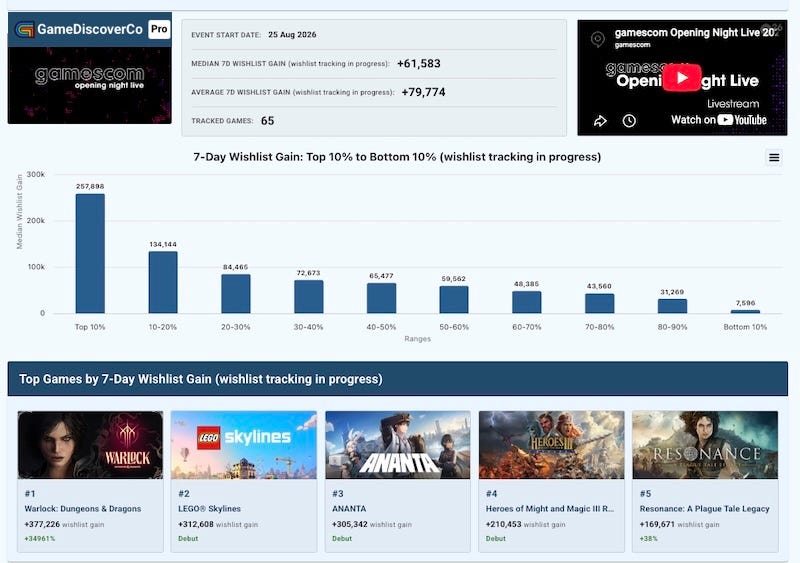
And one of the answers is showcases and that is our big story this week. This is about all of the all the big showcases. You have some great data and and rankings. Fair to say rankings of what are the most popular, the most successful, the most viable uh gaming showcases out there. And before we get into what those are, you have five points on what makes an event successful for a game announcement promote or a a promotion. How did you come up with those?
Yeah, I mean I've [clears throat] been looking at showcases for a while and and part of the reason we did this newsletter is um there is within Game Discover Co Pro, we just rolled out something where we have a few hundred showcases and we sort of map it to people's pre-release wish list. So you can see if you were in a showcase, did it have any effect? But but while I've been gathering this data, I've sort of noticed some interesting I think things
that really if if you're a dev and you want to be in a showcase, what should you be asking people? And just very briefly those things are how many games are are there in the showcase? What's the situation around co-streaming i.e. getting other Twitch or YouTube folks to also stream the showcase? Uh how many how many reveals are planned and how many are the of the of this trailer as a sort of like fourth trailer from a game you might you might have already seen. What's the cost? Obviously the cost varies uh immensely. And how long is the showcase? Because I think this is also really important.
Yes. So, I don't think it will surprise people that the Game Awards is the top of the list and that Summer GameFest comes right after that. The Triple Eye Initiative coming after those two is is not certainly what I would have guessed if I was making a bet. What about it stands out? Why is it so high on the list?
Yeah, it's interesting. Yeah, we basically looked at everything I think in the last year and uh and and the
triple I initiative which is which is put together by some um some some folks who are kind of indies indies themselves um has ended up doing quite well like well I'd say I I described them as scrappy in the newsletter and they were just kind of they were kind of like what does scrappy mean and I I just sort of meant that they're not unlike Jeff Keley will go to Japan and he'll go and visit Sega and they'll talk about which massive Sega IP they can reveal the triple eye is not like that that They basically know a lot of I'd say newer sort of um yeah newer kind of maybe slightly less expensive but really interesting high hook idea comp you know companies publishers developers so they're very much looking around and they're very you know also the difference with Triple I is you know that a number of people in there do pay money and it is you know I think not inexpensive to be in there but they've also
handpicked I think a bunch of kind of buzzy games that they have not been revealed before so they had quite a lot of debuts in in in this years they had um you know and they had a lot of kind
of I think interesting games. So I think that's why they've done a a good job of sort of being higher up the rankings. Their their me their median number of wish listes added in the last seven days was actually I'd say three times what a lot of the regular showcases are. Uh um although I will tell you some other people who do those regular showcases uh approached me afterwards and were pointing out that there's all kinds of things about some some of these have pre-shows. So should you include the pre-show games in the main showcase numbers even though it's a slightly different name. So I think we'll we'll do some we'll do some tweaking on some of these numbers. But I I I would say yeah I think I has been impressive also partly because it's once a year so far. I they may or may not be thinking about more I think but like because it's once a year they can really stack it and um I think almost everyone else who does showcases even Jeff Keley obviously I mean Jeff really has three showcases at this point and then then folks like PC gaming show or future uh have a lot more than that so if you have one per year
you can kind of stack a lot more interesting stuff into it see
there's one other one that I want to dig into because I was a little surprised to see it as hive which is at number four is the Xbox games showcase and Xbox like my Kansas City Royals are going through what I would call rebuild. Um, so I was a little surprised to see them so high. They're above Gamescom. They're above the PlayStation State of Plays. What is making that showcase work?
Well, it does have a few less games than the others. I think it has less than 30, so there may be some big hit of first party stuff in there as well. So, that probably helps. Um, the other thing to note though is it is in the June time frame and I think does what does happen is and remember if you're coming out on Xbox as well like Xbox is not charging money for these. So, so if you're kind of like, we really need to be in a June showcase, um, and you're a big company, then I think Xbox and PlayStation do sometimes get your attention for some of your games because that it's a marketing
expense for Xbox and PlayStation if you're going to appear on their console, whereas obviously if you're appearing in um in another showcase, you will have to pay pay for it sometimes sometimes quite a bit of money. So, I think I think some big I think some big publishers will spread their bets at that point. So, I suspect what's happening is I haven't looked at a lot of detail. There's a bunch of first party stuff in there. There's not much small stuff. And and the stuff that does exist is is often, you know, parcled out from some of the biggest publishers. They want to put one of their games maybe in Xbox, one in PlayStation, and one one in a in in a Jeff Key event or something. So So I I think that's what's really happening. But I I do think, you know, with there only being 28 games in there, I don't think there was much smaller stuff at all. And and so that that probably helps it numbers. The ranking that you have I think is interesting like because it's like it is fun to rank things but you yourself have said you know there's more to think about for a developer when they're deciding what to go what what showcase to pursue. So how how should developers
be thinking about events depending on the size of their game or the size of their budget or their window till release? Like what can they see in this data that's going to help them? Yeah, I I did say specifically like don't be I just want to be in the one with the highest show with the highest median wish list increase on Steam because it may not suit your game. I think and and there was a bit of a self-fulfilling prophecy thing here, you know, like Jeff Keley doesn't put stuff in his showcases that he doesn't think people are going to be super excited by. So, so I think yeah, you know, I think I think that's definitely true. I do think looking at vibes is important and I sort of throw that out. I don't know if there's a there's an easy way to gauge vibes necessarily besides just looking at a bunch of the games, but there's some obvious ones like there's there's, you know, the Wholesome Direct and if you're a cozy game, Wholesome Direct has got to be a long way up your list. And um you know, Triple I, if I was sort of like maybe a high hook friend adjacent game or something that has a really interesting idea in it, I'd be looking at Triple I. You know, I think PC gaming
show is really good. But I think if you have a core PC game, I definitely feel like, you know, I'm stereotyping, but you know, PC Gamer readers are quite core kind of kind of PC and so that makes sense. Future Game Show has a good set of um yeah, I think all all kinds of games fit well in that. And um and and there's and there's and there's also the mix which is tied up with physical showcases. So if you want to be at a physical digital showcase, then I I think the Mix is good for that. Uh there's a show called Galaxies, which I think is a bit more up and coming, but uses Twitch co-streaming heavily. So if you feel like Twitch is sort of your your uh Uber, you think you're getting very popular on Twitch, you might want to look at Galaxies. Um so I don't know. I mean, I it's quite vibe based and I I've also need to be need to be quite careful because in the past I I try not to rank stuff too much now because I feel like [laughter]
all the people who do the showcases come to me and are like, "Are you sure about that ranking?" So, I I think let's think of this less as ranked and more as vibes. And you want to pick you want to
pick the showcase that fits your vibe as a game the best.
The the way that I walked away from reading it was it's a lot like uh picking a college or a university, which is everybody would love to go to Harvard. Sure, it's great. Not everybody, but a a lot of people would. It seems to guarantee or at least promise a certain level of success. things can go wrong, but uh the odds are high after college, right? But depending on what you want to achieve and what your interests are, a very small university with a program focused on what you do could be a far better fit and it could be a lot cheaper and it could like set you up to be where you need to be. And once I started to think about it like that, it was a lot easier for me to see why I wouldn't necessarily want to be in the biggest thing possible because it is just so tempting to think that the biggest thing is the best thing.
Yeah. And and obviously let's not forget you can be in three or four or five showcases and so there's really no reason not to be in showcases uh as long as they're not pivotively expensive and you can show something interesting. My only final comment is you do have to watch like I do get when showcases get long. There was one famously that was three and a half hours long but it was a bit of an experiment I think uh uh that then people will tune out and people will start to curse showcases especially if it's like the fourth trailer for a game that you've seen already. And so I I I do think that both trailer makers and people need to think about not overusing these because it will degrade their whole potency over time.
Yes. Yes. Yes. Well, that wraps up the big story. I do want to get into our final bits. Let's talk about last week in games. This week in games, catch me up. What What happened last week? How's how's the industry doing? It's still alive.
Yeah, it was actually a fairly busy week. I was noting here there were quite a lot of games. I mean, for me,
launching on Steam with more than 2,000 concurrents is quite good. It probably means you're going to sell like,
you know, 40 or 50,000 copies in your first week and eventually sell more than that. And there were like 15 games that did that. But at the very top, there were three games I wanted to mention. And those were Hell Let Loose Vietnam is the latest in the Hell Let Loose series. Pretty pretty serious, you know, slightly more expensive. Uh, you know, tactical shooter. It's it's it's doing pretty good. Yeah, it went out to 30,000 cc and it's selling. I I looked at our console numbers for it and it's selling on console as well. So, it's it's pretty well executed. There were some complaints at launch over like servers and some other stuff, but I think it's well executed. Um, Servant of the Lake is is the latest from the Rusty Lake folks who do these really interesting puzzle games, sort of 2D puzzle adventure games, which they're very they have a very odd niche, but people really love them. And at 28,000 CCU at 97% positive. So, uh, that's that's wonderful, especially because it's a short game. So, so yeah. So, so people really love that and they'll keep doing
their thing. Um, and then there's a game called Sandustry, which is uh sort of like an automation-y sandboxy kind of game, which has really basic 2D art. Um, I think I did say it wasn't it wasn't the prettiest baby was what was sort of my quote on there, but but but people but people love those that these games that are uh really detailed and sort of very it's got pixely physicsy kind of automation-y stuff going on. And I think people, you know, people forget games like that can do great. and it's almost almost at 10,000 CCU and people have been really enjoying it. So, those are the three three key ones from last week I think I want to talk about
for this upcoming week. We're going to play a little bit of a game which is I'm going to see if a single game you mention is on the uh Steam calendar, the personalized calendar that it has for me based off of my interest and see just how much of a bubble I live in. I'm going to remove one game up top because I do think it will be there. I think Mortal Shell 2 will be a game that you have loaded up, but let's see if I am
right on this.
Yes, it is in fact the top game and uh we had it about 900,000 wish lists and it's actually now in in advance access. So, if you want to pay an extra 10 bucks and get some random skins, but play it early, then people are doing that. And um and actually someone uh someone donated I think the publisher donated a key to Steam DB so we can see basically Steam DB and us can't see its concurrent users unless someone donates a key during advanced access. And so someone did and it's about 18,000 CCU already. So uh so we're going to track it when it comes out properly. But yeah, it's it's clearly doing very well. Uh so yeah, that's number one. The other stuff I have is Stein's Gate reboot, which is um is that on your list? I'm guessing not.
It's not. And I'm actually confused why it's not because that sounds very much like my and I didn't know that it was coming out.
Oh, really? Yeah, cuz it's like cuz it's like a visual novel like like like reboot thing. Anyhow, 450k. I think it's got a lot of Asian wish list though, so that's probably why I think I think it's less noticeed in the west. And then
there's a game called The Sinking City, The Lantern of the Laughless Saint, Vacation Cafe Simulator, Hearth and Hamlet were the other ones that I had just listed in here, but I don't know. Do you have any of those? This is a perfect example of how strange curation is in that the stuff that I'm being recommended. I got Entropy. I got Slayblade, which looks like a B whatever that game was that people younger than me played.
Oh, it is a Beyblade. Yeah, I' I've talked about that before. Yeah. Yeah. Slayighblade is like it's like a Beyblade rogike, I think, or something.
Yeah, it looks it looks cool. But the fact that Sinking City isn't even on here, which is a game that I'm also excited for and was reminded is coming out because the reviews just hit. Um, it just shows how hard it is to curate these dang [laughter] things. And yet, there's a lot here that is curated for me, like the therapods. It looks sick. So, it's not like I'm I'm wanting for games. There's even a game coming out called Brigador Killers that has some Crusader No Remorse vibes, which truly,
you know, retro is back in every way when you have people uh tackling that corner of old school PC gaming. I think that's a sequel to to Brig that's probably the sequel to Brigador and Brigador was a game that I think famously did kind of badly and then and then the dev talked about how upset he was that it did badly but then that meant it did quite well because everyone was like, "Oh, this game's actually good." So that that that is the classic uh the uh the classic thing you can do or you used to be able to do. I don't know maybe too many games do badly now that you can't do it, but this was a while ago. But yeah. Yeah.
Well, I I I do want to wrap things up. This is where I get to ask my question uh totally unknown to you, which is this week, what is going on with the rise of what I can only describe as tidy up games or organization games? And also, has the the line between um homage and outright
stealing just completely dissolved? Uh you're particularly talking about these like uh the these like librarian games where you have to tidy up like 4,000 books in a particular area. Um yeah. So yeah. So basically what happened was there was that big breakout for this uh what was it? Librarian tidy up the arcane library or something. Um and uh basically I think what happened is people making first person job simulators realized that this is now a genre. And so we're now we're getting a string of tidy up the X in in in different themes. Here's why it makes sense to me because that that tidy up game is extremely finite. You tidy it up and you're done. Or or maybe you get like four hours and tidy up and you're like, I've tidied it up enough. So in terms of people wanting to spend another eight or 10 bucks to do that again, actually that's really interesting to people. So yeah, I mean this is the question about uh how much is it a ripoff if you just do that? I mean, for me, I don't really have a problem with it. I just think it's like a genre at
this point. I know someone just invented it, but now there's the and there have been other I mean, clearly there's been um you know, cleanup simulator stuff. You know, Power Wash Sim is pretty obvious and there was a game called Visera Cleanup Simulator from a very long time ago that was famous as well. Um but this particular tidy up, which is there's a lot of random objects all over a 3D space and you have to sort of manually arrange them. Um yeah, I I just think it's a sub genre now. uh for better or worse. And I think people don't I mean this obviously uh this this question of how homagey can you get and it and feel ethical came up in our uh in our newsletter um on on Friday about Iron Nest because Iron Nest has just done very well and I sort of had to talk about at the end of it. it was made after um PVKK uh was revealed and the the devs were basically like we really like PVKK we're going to do something quite similar but a bit different and that you know there is a question I guess of
I don't know ethics or whether you think
that's a fair thing to do and I've sort of come to the conclusion that
it's probably okay I don't know if I would personally do it but um I I don't I it's not there's far worse things out there on the internet
it is where like I I also land on like the generational thing of like we talked about this a lot of expectations being different for a new group of game designers and players and just on I'm looking at on August 14th we got TV archive tidy up together where you are uh tidying up looks like VHS tapes and Blu-rays and tid tidy up together normal I I guess this is a different one which is a multiplayer tidy up game but what this reminds me more of is trends that you would see on Roblox where like a thing pops and then you just see a ton of them immediately um that are just you know like here's the Peter Griffin version because that's what you're looking for. So it it does feel like a a bit of a trendbreaking
containment here a little bit. Um not necessarily a bad way. It's just Yeah, it's just a little strange and new. And I'm impressed how fast people have moved on it because it has even compared to maybe the v the vampire crawlers trend, it feels like this one has moved it at at just absolutely lightning crack speed.
Yeah. I mean I mean part of it is barrier to entries issues, right? You don't see a lot of really complex automation games getting cloned because they're really freaking difficult to make. And this one has a has one of the lowest barriers to entry you could possibly have. So So I I think that's why you see see people jumping on this. I do think it's also cultural. I was, you know, I I I did some we did GDC China in China for a while and I was really interested. The Chinese culturally uh see I think copies of things as a homage to them. That's like a cultural thing. And it is seen far less negatively like emperors of China would do uh things that were
contemporary and copies of things that were hund you know hundreds of years before and it was considered largely very positive. So so I I I do think I mean I'm not saying I I you know that's that's a regional cultural thing but I I think you're right. I think uh people are saying this is okay and and also the conclusion I came to uh you know on PVKK and Iron Nest was I looked around in the comments a lot like no one no one is saying those Iron guys like what are they doing but partly because PBKK's been kind of a bit delayed. So I I think I think people are happy to pay something in the meantime but people are very happy to lap up additional stuff in in that what I believe is now a subg genre. So, I think we just all have to get more okay with it being okay.
Yeah, I know. I I agree with that. The only note that I would say uh my guidance as somebody in the press would be like maybe don't show your game uh too early because the other example of this that I think of is body cam firsterson shooters.
Wow.
And the game that launched that sub genre still isn't out. Um, but a whole bunch of other ones are and have kind of like I don't know. I feel like we've almost run a course through through that entire subgenre at this point.
Yeah, I I and I did say that in the newsletter. I thought I think PVKK in the end would probably conclude that they revealed it a little bit early, but it actually took two years for Iron Left to come out after PVKK revealed. So, that was not a fast follow. That was a slow follow.
Yeah. Yeah. Yeah. I I also wonder with Big Walk and how much of Friendsoft was inspired by those early trailers. I think
it is definitely a thing that is happening of the agile can get to market the fastest. Um, cool. Well, I think that is it. That's a full meaty episode. Thank you all for listening. As always, if you enjoy the show, recommend it to a friend. That goes a long way in making it more widely available and keeping it
going. Until next time, I am Chris Plant and Simon. Do you want to take us out?
Yeah. Uh, have a nice week and we'll speak to you again soon. Bye.
Auto-generated captions from YouTube — names and numbers may be misheard.
Key insights
6 takeaways · ~2 min read- 01Sony added Helldivers 2 to the PlayStation Plus Game Catalog approximately 2.5 years after its initial release, serving as a churn-reduction strategy for the subscription service.
- 02Large third-party games can receive payments of roughly $10 million for inclusion in PlayStation Plus, though compensation varies significantly based on the title's scale and developer status.
- 03The paid user-generated content (UGC) market is expanding, with platforms like Mod.io reporting an average revenue per paying user (ARPPU) of $10 for titles such as BMX Streets.
- 04Game showcases should be selected based on thematic alignment—such as Wholesome Direct for cozy games or the Triple-I Initiative for high-hook titles—rather than solely on median wishlist growth.
- 05AI-driven discovery layers may eventually uncouple content distribution from traditional curation, potentially shifting how players find and engage with media in the future.
- 06Developers can participate in multiple game showcases to maximize exposure, but they should avoid over-exposure and long, repetitive event formats that risk degrading viewer interest.
Ask AI about this video
Cite this video
Citation
Generating citation…













Comments