Transcript
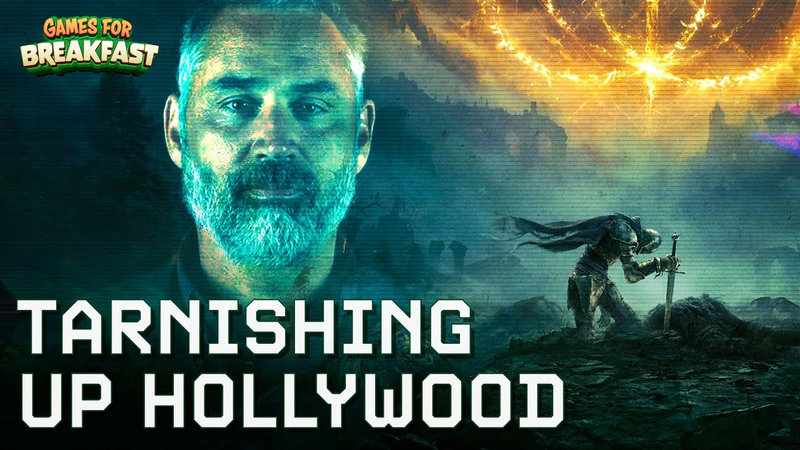
You know, it's kind of hard to believe that there was skepticism surrounding Miyazaki and his development team's ability to create an openw world Dark Souls game, but there was. And honestly, I get skeptical, too, when a franchise becomes [music] so massive and so successful that it looks to Hollywood for help. I mean, the renowned studio responsible for the Dark Souls series, it had earned its reputation for delivering these intricately designed, challenging, and linear experiences. But now it was looking for help from [music] George RR Martin, the man who created one of the most beloved but ultimately maybe most hated TV shows, at least the final season. Additionally, even if George RR Martin could ultimately craft a story worthy of the Dark Souls universe, could the mechanics of a Dark Souls game even work with these new confines or lack thereof in an open world? Fast forward $200 million later in development cost? Believe it or not, Miyazaki himself was skeptical as to whether the game was actually any good.
In an interview with Edge magazine, he was asked about his state of mind as launch was approaching. He said, "It's not a pretty state of mind. I will tell you that this is a tough point in development for any game, not just Elden Ring." At this point, this is when I really start to have regrets and doubts about releasing the game into the wild and seeing what everybody thinks. I start thinking, I could have maybe done this better. I could have maybe approached this in a different way. There's a lot of these thoughts that build up just on the cusp of a game's release that are involuntary and they plague your mind a little bit as you're finishing off work on the project. So, it is quite tough. It's a tough time and it doesn't get easier with experience. The developers at From Software would face numerous challenges during Elden Ring's development. And one of these challenges was what would be the inspiration they would use to draw from in order to create this new Elden Ring world. Being a fan of George RR Martin's work on A Song of Ice and Fire and Feverdream, Miyazaki hoped to enlist his help to create the story's backdrop. Now, considering George RR Martin's insane popularity and busy schedule, it
might be very unlikely that he would even have the opportunity to sit down and pitch the idea. Rather than having him write the main story, all Miyazaki wanted Martin to do was just write the Elden Ring mythology. Storytelling in video games, at least the way we do it at From Software, comes with a lot of restrictions for the writer, and I didn't think it was a good idea to have Martin write within those restrictions. By having him write about the time the player isn't directly involved in, he's free to unleash his creativity in the way he likes. Furthermore, at From Software, we didn't want to create a more linear and story-driven experience for Elden Ring. Both issues could be solved by having Martin write about the world's history instead. Just like any of us, Miyazaki fully expected to be turned down. After all, Martin was the writer for one of the most popular TV shows in history. But to Miyazaki's surprise, Martin was already familiar with the Dark Souls franchise and actually agreed to meet to discuss the [music] project. Basically, they wanted a world created to set the game in. They wanted uh world
building as a big factor in in fantasy and science fiction. You're not only talking about the characters and the plot, but you the setting is almost as important as everything else. Tolken's [music] Middle Earth, Roberty Howard's Hiboreian age, uh the foundation universe of Isaac Azimald. I worked up a you know fairly detailed uh background for them and then they took it there from there. The next challenge from the from software team is how do you make an open world game while also staying true to the Soulslike formula? The transition to an openw world game with Elden Ring raised a lot of concerns about whether you can even successfully adapt that signature gameplay into a sprawling interconnected world. Can you maintain the same level of detail and attention and environmental storytelling that had become well the hallmark of a Soulslike game? I guess the same can be true of the Zelda franchise, right? Going from a more linear experience like Ocarina of Time or Wind Waker to Breath of the
Wild, which is more of an openw world experience is kind of going to lead to skepticism because frankly they're almost two totally different genres. Specifically, the main characteristic of a Dark Souls game is the level of difficulty and Elder Ring needed to continue in this tradition if it was going to be deserving of that Soulslike badge. In an interview with PlayStation blog, Miyazaki explained this. We understand that Soulslike games are regularly associated with impossible levels of difficulty with high barriers of entry, but we tried to design the games to make the cycle of repeatedly trying to overcome these challenges enjoyable in and of itself. So, we hope that with Elden Ring and the new options it provides, it will be a success in that [music] respect. And if you've played Elder Ring, you know that it's safe to say that the From Software team were successful in still capturing this classic level of difficulty in this openw world environment. [screaming] Miyazaki went on to say, "In Elden Ring, we have not intentionally
tried to lower the game's difficulty, but I think more players will finish it this time. the player's level of freedom to progress through the world or return to challenges later are all elements that I feel will help people get through the game at a more leisurely pace. Ultimately, the level of difficulty was maintained in Elden Ring, but in this case, the player gets to choose [music] in this open world when that difficulty occurs. The third challenge for Miyazaki and From Software would prove the most difficult to overcome. And this was how to create a vast open world for this new Soulslike title as opposed to what they're used to, which is confined dungeons and linear gameplay [music] in a traditional Dark Souls game. This, after all, was a completely new venture for the team, but this didn't stop Miyazaki. Sure, that's what they're used to, but ultimately he wanted Elden Ring to be massive. So purely from a scope perspective, how on earth do we make a massive world with the [music] assets that Miyazaki's team is used to creating? How does a team that typically creates more linear games create assets
for an openw world game? We managed to explore some new systemic procedures as well that allowed us to fill out the world in ways that didn't require people to always be hands-on and do it manually. A simple example would be the creation of something that exists in vast quantities in the world, such as trees or vegetation. A lot of this we could just employ using a more procedural system for vegetation to generate trees and handle their placement. And that accounted for about 80% of the task. And then our artists would actually go in and sort of add the finishing touches by hand. Additionally, From Software reused enemies. They reused buildings, reused props, and other assets throughout Elden Ring. And that sparked some discussion among developers across the industry. At the end of the day, we all want to play this game, but somehow the community is at each other's throats for pointing out some undeniable facts. I called it reused assets. We are looking at animations, sounds, map elements, and much more. that is without question taken from existing games of Fromoft. But in a Games Radar article, Austin
Wood writes, "Asset reuse is too often treated as a dirty word or mislabeled as a copout when in reality, as Elden Ring and many other games demonstrate, it's a common and valuable technique which can enable more ambitious games and [music] trim development times." Elden Ring's release date would go on to be surprise surprise delayed several times. But finally, the game was completed and all that was left was to release the game and wait for the response from gamers around the world. Would Elden Ring prove to be a success or would it be a flop? Was the skepticism real? Did Miyazaki and From Software succeed in their goal to create a worthy evolution of the Dark [music] Souls lineup? Elden Ring was released on February 25th, 2022. It became not only From Software's biggest success to date, but it would go on to dwarf the success of all previous Dark Souls games. Elden Ring success upon its release was nothing short of spectacular, setting a new high bar, even compared to From Software's previous titles. The game garnered
widespread critical acclaim for its openw world design, rich lore, and of course, the challenging gameplay and breathtaking world building with the help of George RR Martin. Despite the skepticism, Miyazaki and Martin had an incredible collaboration with Miyazaki's incredible game design perspective and Martin's world building. The game's commercial success was equally remarkable with record-breaking sales and a dedicated player base, cementing Elden Ring as a milestone in the action RPG genre and affirming From Software's ability to evolve and expand their formula while still maintaining that core identity. And this is a rare thing in the video [music] game industry. Elden Ring won numerous game of the year awards and rad in over 20.5 million units in sales as of this year. Game of the year winner is Elder Ring. [cheering] I would like to share this great appreciation with our entire Aerending
team members, everybody at From Software, our partner Banda and Amco, all collaborators, and last not least, Mr. George RR Martin who created the great mythos for this game. We have faced so many difficulties while developing this game. So, as a dire elector, I'm really relieved. And this might not be the, you know, light thing to say at the, you know, the on the occasion of the, um, receiving the Goatei award, but I haven't made up my mind to create even more interesting games than this
Auto-generated captions from YouTube — names and numbers may be misheard.
Key insights
6 takeaways · ~2 min read- 01Elden Ring became FromSoftware's most successful title to date, selling over 20.5 million units and winning numerous Game of the Year awards following its February 25, 2022, release.
- 02To maintain the signature difficulty of the Soulslike formula within an open-world structure, developers provided players with more freedom to choose their own progression path and return to difficult challenges later.
- 03George R.R. Martin was brought in specifically to write the game's mythology and world history, allowing him creative freedom while avoiding the narrative restrictions inherent in FromSoftware's linear storytelling style.
- 04To manage the massive scope of an open world, the development team utilized procedural generation for approximately 80% of environmental assets like vegetation, with artists manually refining the final 20%.
- 05FromSoftware strategically utilized asset reuse—including animations, sounds, and map elements from previous titles—as a standard industry technique to enable greater project ambition and optimize development timelines.
- 06Despite the game's eventual success, director Hidetaka Miyazaki experienced significant pre-launch anxiety and self-doubt, noting that such feelings are a common and difficult part of the final stages of game development.
Ask AI about this video
Cite this video
Citation
Generating citation…





















Comments