1 free read left. Create a free account for unlimited reading + AI research.
Create free account
How Disney Inspired a Generation of Designers
Key insights
5 takeaways- 01The use of a long, linear entrance path acts as a controlled transition space, mirroring the tutorial-to-open-world progression common in game design.
- 02Disneyland’s hub-and-spoke layout serves as a foundational architectural model for modern open-world games, enabling efficient navigation and structured quest distribution.
- 03Designers utilize a central landmark, such as Sleeping Beauty’s Castle, as a persistent visual anchor to facilitate player orientation and exploration without reliance on in-game maps.
- 04Thematic consistency and distinct signposting at the entrance of zones are critical for maintaining immersion and signaling the specific experiences available within an area.
- 05The integration of newer park additions like Galaxy’s Edge demonstrates the difficulty of incorporating supplemental content, reflecting the common game design challenge of ensuring DLC feels cohesive rather than disconnected from the base world.
Ask AI about this video
Transcript
Before GTA or Assassin's Creed, before The Elder Scrolls or Fallout, before even Shenmue, Ultima, or Zelda, there was an open world which many designers drew from. It was a world you could walk through, touch, and look at from all angles. An open world that had an enormous impact on many early game designers in their youth, and to this day expresses many of the fundamental principles of open world design. So, as silly as it sounds, it's time to take a trip to the house of the mouse and talk about how Disneyland's design influenced the open world games we love. Thanks so much to GiveWell for not only helping everyone find highly effective charities, but also making sure that our donation dollars go further. Okay, first let's unroll this map at Disneyland here. Take a look at it for a minute because a lot of game designers have been influenced by this thing. Before we had other games to look at, this is where we went to learn, especially with so much of the industry being based in California. Whole companies would make
pilgrimages to the Magic Kingdom for both fun and study. So, why was it so influential and what can Disneyland teach us about open world design today? Well, let's start at the beginning. See this area here outlined in red? When you first enter Disneyland, it starts with this long linear pathway before it unfolds into a true open world so as not to overwhelm the guests. Seems familiar, right? I mean, how many times have you started in an open world game in a dungeon or a prison or a vault before actually getting into the big open world itself? It's basically a staple of the genre at this point, and that began right here. The folks at Disney understood that they need to give people a directed experience, you know, time to adjust and simply look around, and of course, in Disney's case, time to buy things before they could turn them loose on the park proper. But, the truly important part of that linear section is what's at the end of it here. That is Sleeping Beauty's Castle, and it's absolutely massive. It towers over the rest of the park. Anywhere you go in Disneyland, you can see the spires of Beauty's Castle. And this sort of
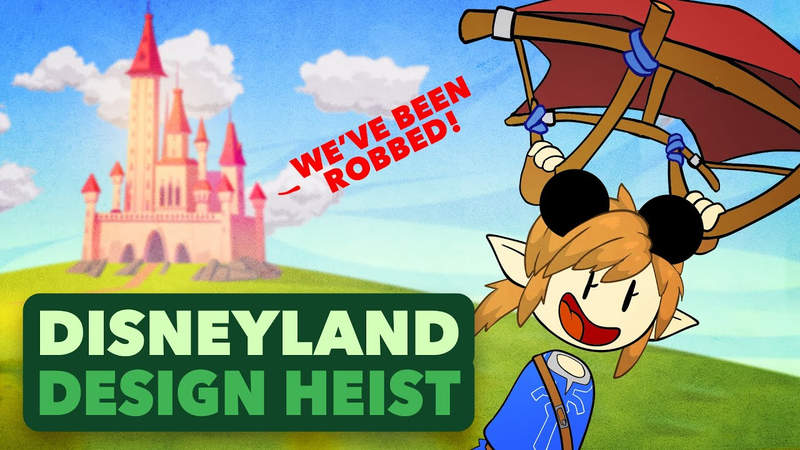
landmarking has also become essential to open world design. How many times in an open world game have you been drawn to something larger looming ahead of you, and then used it as a reference point for your adventures thereafter? Quite a few, I'm betting. Any good open world liberally scatters around these sorts of landmarks as they pique our curiosity and help us orient ourselves without having to continuously open up a map. And often, they're at key inflection points in the world. They're cities or dungeons that you're going to spend a lot of time on, or they're spaces that serve as jumping off points to possible adventures around them. Which brings us to the space right in front of Beauty's Castle. See how this area here serves as a sort of hub area from which you can go to any other part of the park. And see how each area of the park radiates out from it like spokes on a wheel. Ignoring Galaxy's Edge and Toontown, of course, because, you know, they're DLC. This sort of hub design has become standard for open world games. Now, of course, today, because our open world games cover far more virtual territory than Disneyland ever could, we often use this sort of design within a single zone.
Those of you who played World of Warcraft, like myself, will vividly remember zones that had a little town area in the center with roads leading off of it in every direction and quests that took you down each of them and back again to that central hub. Next, we should look at the outer park design. See how each of the areas are laid out in an oval or circular shape with attractions, i.e. things to do, running along the inner and outer rim. This is also become standard design in open world creation. It gives the guests a sense of freedom that they can wander anywhere they want, but also leads them from attraction to attraction in a loop before guiding them back to the hub with a minimal amount of backtracking or retraced steps. You'll also notice that subregions in Disneyland have their own tall landmarks to orient guests so they don't get turned around. And these sorts of landmarks also serve as excellent rallying points. A great place for a group of friends to gather IRL. Oh, let's meet at the rockets at two so we can ride Space Mountain together. Or before going off in an in-game adventure. Group up at the main gate of
Ironforge and we'll take Gnomeregan together. 37th time's the charm. And many early MMO designers learned that trick right here, including our own studio director Jeff, who was a designer on the original EverQuest. In addition, it's worth noting that each zone in Disneyland is hard themed. It's a little bit difficult to show on the map, but there really is no bleed between the areas. Fantasyland and Frontierland, for instance, are distinct and you know the moment that you cross the border from one into the other. Plus, everything in them, right down to the trash cans, are also themed to give the guests that feeling they're in a new and distinct area. To offer promise that what you're about to explore is in fact different from what you explored before. But you know what is easy to show on the map are the landmarks for these areas. Each zone, excepting Adventureland, which if we're going to be honest is a little worse designed than the rest of the major areas, has a large landmark near its entrance. And that landmark, like the rest of the zone, is right in theme. This serves as both a signpost and guide. Not only does the rocket spinner at the front of Tomorrowland tell you
where Tomorrowland is, it also clearly communicates the promise of Tomorrowland. You want rockets and robots instead of log rides and haunted mansions? Well, step right this way. And we'll often use landmarks this way in our open world games. As you're exploring one area or zone, we'll lead you, often through quests, to an area where you see something cool or weird or new in the distance and you say to yourself, "Whoa, what is that?" And then trek off to find out. This both gives the player agency because you saw something that interested you and you decide to go find it. And also allows us as designers to gently guide players around our worlds. Which sort of leads us to the last point I want to talk about, Toontown and Galaxy's Edge. Because I wasn't really joking when I said they were DLC. These sections of the park were built much later than the rest, and as a result, you can see that they have the same problem that most open-world DLC has. They're scrunched to the edge of the map without any real way of interacting with the rest of the park, as well as the other zones do. They function more like tiny open worlds
amongst themselves, pocketed off, rather than a larger part of the open world as a whole. And since Disneyland was so influential in open-world design in games, and they didn't have a good solution for this, it sort of remained a problem for designers when implementing DLC in their own games. You either put your new world out on the edge, and {slash} or you're going to need a literal magic portal that teleports you to that distant realm, utterly unconnected with the rest of the game. Ooh, on that note, as a quick aside, and this episode's own little DLC I suppose, the best answer we seem to have found is to use your DLC to give context to the rest of your world or the characters in it. Bloodborne's The Old Hunters and much of The Witcher 3's DLC furthered our understanding of a larger game world and of its characters we loved. And perhaps, most importantly, they got us thinking about characters, places, and moments that we experienced when we first hacked and slashed our way through those worlds, sometimes in a whole new way. You know, kind of like how multiple rides and attractions have been refreshed over Disneyland's 67 years of operation to give a new perspective on
them. And yes, I understand that analogy was a bit of a stretch, so I'll swing us back from our DLC detour. You can see that the design principles of Disneyland have had a major impact on how the open-world video games we love are crafted. But, what do you all think? Did we miss any elements of the park's design that you've noticed in your open-world gaming adventures? Or are there other places IRL that you've seen designers take inspiration from when crafting their own open-worlds? Let us know in the comments below, and we'll read them while we're waiting in line for Rise of the Resistance. Well, my fluffy little friend, because that's a game mechanic I hate more than the passion of a thousand fiery suns. Guess that's a different episode. But, I'm not going to dwell on that, because right now, I get to talk about something I absolutely love. Givewell. Okay, let me ask you a question. When you give to a charity, how do you know how much impact your donations are really going to have? Look, I know that can be hard, if not impossible, to answer, because you could do weeks of research to find charities and figure out what they do, how effective they are, and how the charity might use additional money. Or, you could visit
givewell.org and find free research and recommendations about the charities that can save or improve the most lives per dollar given. Yeah, we are sciencing the heck out of goodwill right now. Seriously, GiveWell is changing how people think about charities. They spend 40,000 hours each year researching charitable organizations and then direct funding toward a few of the highest impact evidence-based opportunities that they find. Currently, over 100,000 donors have trusted GiveWell's research, and rigorous evidence suggests that their donations will save over 150,000 lives and improve the lives of millions more. But, of course, there's still a lot of work to be done, and here is how you can help. Since GiveWell wants donors to make informed decisions about high-impact giving, they make using their research absolutely free. So, you can go to their site and see all of their research and recommendations, no sign-up required. Not to mention, they'll allocate your tax-deductible donation to the charity or fund you choose without taking a cut. Case in point, this holiday season, I used GiveWell to donate to the Malaria
Consortium, because I don't know how else to put this, but malaria is a truly nightmarish disease that kills something like 600,000 people annually, mostly kids, and it always needs our support to help combat. And with GiveWell's research and stats, I was truly confident that the charity I chose would use what I could give to deliver high-impact, life-saving results. For real, I actually never felt so confident giving to a charity before, and that's a really awesome feeling. And here's a really cool part. If you've actually never donated to a GiveWell recommended charity before, you can have your donation matched up to $100 before the end of the year or as long as matching funds last. So, to claim that match before it runs out, go to givewell.org and right before checkout, pick YouTube from the how did you hear about us drop down menu and then enter extra credits, which will lock in your match. Then you can feel doubly good that your donation dollars went as far as possible to help those in need. And honestly, if that's not giving well, I really don't know what is. It's like truth in advertising. Anyway, thank you so much for your time and kindness, everybody. Happy holidays.
You know who's just the best? Ahmadzia Turk and Sheila Valenciana, Arclight Games, Casey Mustin, Dominic Valenciana, Joseph Blake, and Skyler Holmes. Thanks so much for your support, all.
Summary
Disneyland serves as a foundational blueprint for modern open-world game design, providing a physical template that has influenced the industry for decades. Early game designers, particularly those based in California, frequently studied the park’s layout to understand how to manage player immersion, navigation, and pacing. The core thesis is that the park’s spatial organization—specifically its use of linear entryways, central hubs, and distinct, themed zones—directly informs the structural architecture of many iconic open-world titles.
The park’s design employs several key strategies that have become industry standards. A long, linear entrance path is used to transition guests into the environment, mirroring the common gaming trope of starting players in a controlled, tutorial-like space before releasing them into a larger world. Sleeping Beauty’s Castle functions as a primary landmark, visible from multiple vantage points to aid orientation without relying on maps, a technique widely replicated in open-world games to guide player exploration. Furthermore, the park’s hub-and-spoke layout, where distinct zones radiate from a central point, provides a model for efficient world navigation and quest distribution.
The analysis also highlights the importance of thematic consistency and "signposting." Each zone in the park is strictly themed, ensuring that transitions between areas are clear and immersive. Large, thematic landmarks at the entrance of these zones serve as both navigational aids and promises of the specific experiences contained within. Conversely, the park’s later additions, such as Galaxy’s Edge, illustrate the challenges of integrating downloadable content (DLC). These areas often feel disconnected from the main map, a recurring issue in game design where supplemental content struggles to integrate seamlessly with the base game world. These principles remain essential for creating cohesive, navigable, and engaging virtual environments.

















Comments