1 free read left. Create a free account for unlimited reading + AI research.
Create free accountFinancial report G5 Entertainment AB
1 free read left. Create a free account for unlimited reading + AI research.
Create free accountFinancial reportG5 Entertainment AB
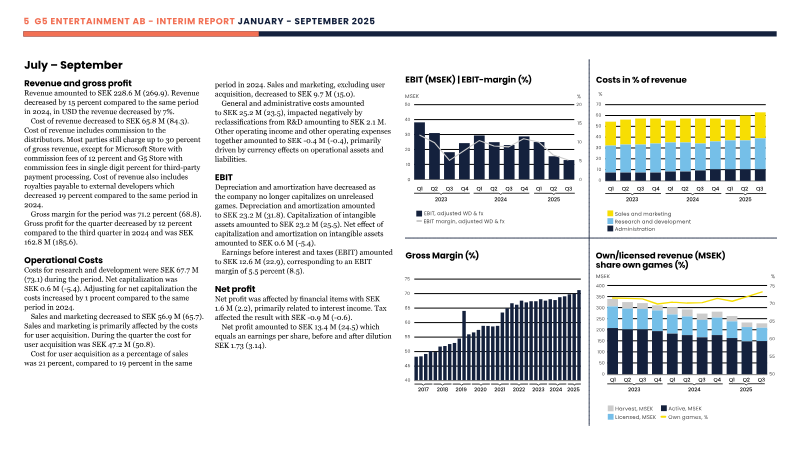
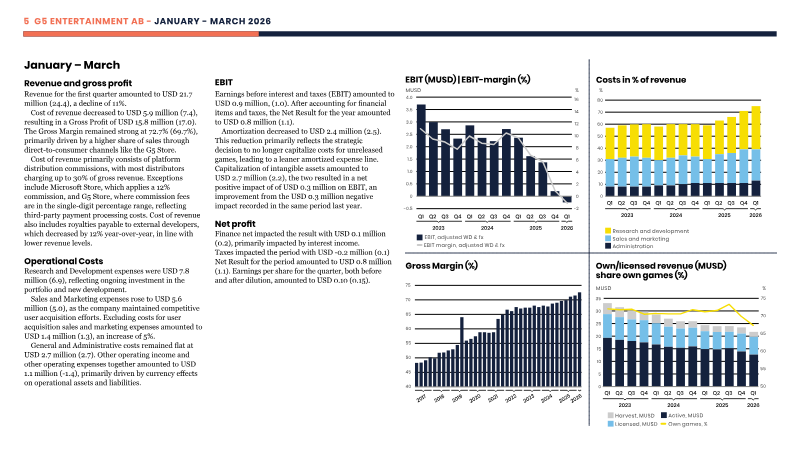
G5 Entertainment’s 2025 fiscal year was defined by significant financial contraction, with revenue falling 17% to SEK 942 million and EBIT declining 80% to SEK 23 million. Despite these headwinds, the company successfully stabilized its core portfolio of "evergreen" casual puzzle games—specifically Hidden Object, Match-3, and Mahjong Solitaire—which target a loyal, financially independent female demographic aged 35 and older. A strategic highlight of the year was the expansion of the proprietary G5 Store, which grew to represent 23.4% of gross revenue by year-end. This direct-to-consumer channel is central to the company’s long-term strategy to improve margins, reduce dependency on third-party platforms like Apple and Google, and retain greater control over the user experience.
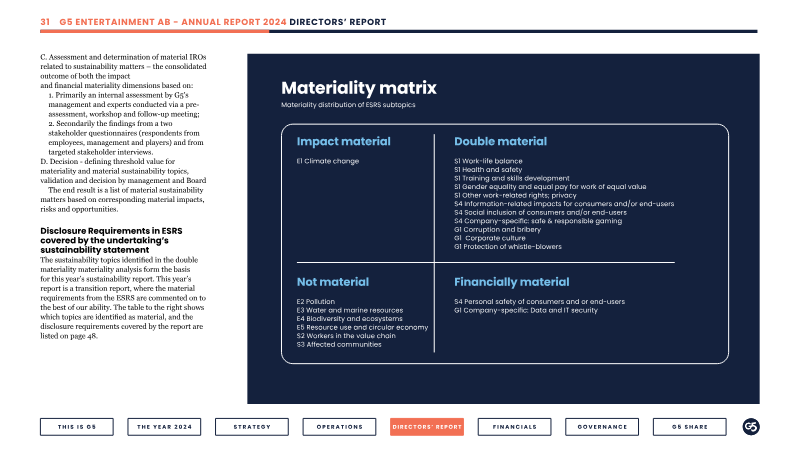
The company maintains an asset-light, remote-first business model that is inherently resilient to climate-related risks, leading to the conclusion that environmental factors are not currently material to its financial position. Consequently, G5 has omitted several environmental disclosures, focusing instead on governance and social matters such as corporate culture, data security, and anti-corruption. While the company has not yet established formal climate transition plans or quantitative greenhouse gas reduction targets, it continues to refine its sustainability reporting in accordance with European standards. Workforce management remains a priority, with the company leveraging AI-driven HR tools to maintain a meritocratic culture and high employee satisfaction despite the operational complexities of managing a global, decentralized team.
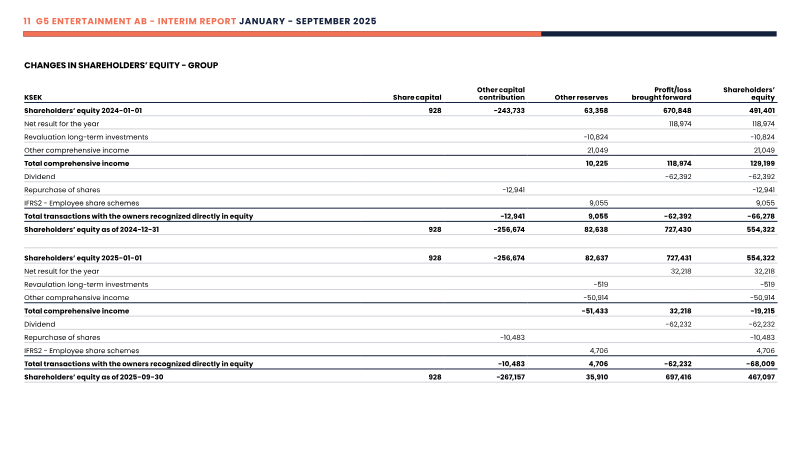
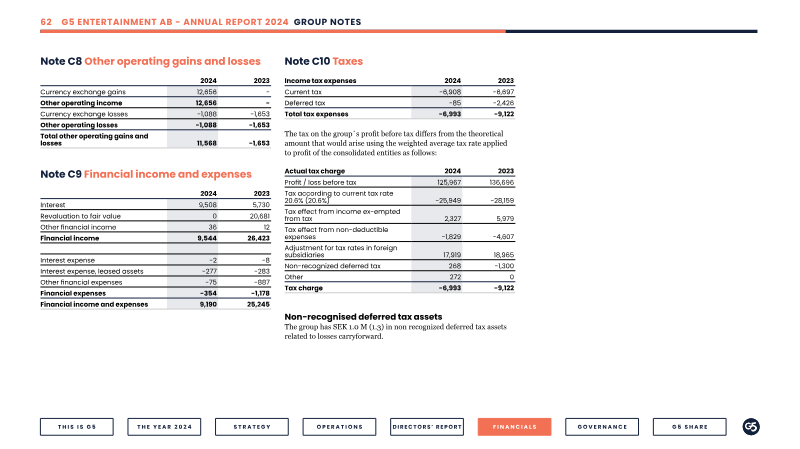
Financially, G5 remains in a stable position with no external debt and a solid cash reserve of SEK 216.2 million. While earnings per share dropped significantly to 3.87 SEK, the Board has proposed a dividend of SEK 2.0 per share, signaling confidence in the company’s ongoing transition toward a more direct-to-consumer distribution model. Moving forward, the company plans to focus on organic growth through disciplined product development and continued optimization of its F2P portfolio, while preparing for future regulatory shifts such as the implementation of IFRS 18.
G5 Entertainment AB · 2025


G5 Entertainment AB · 2025
G5 Entertainment AB · 2024
G5 Entertainment AB
G5 Entertainment AB


G5 Entertainment AB