1 free read left. Create a free account for unlimited reading + AI research.
Create free accountFUN vs MOTIVATION ?!? - Psychology and Gamification - (Must Watch!)
Key insights
6 takeaways- 01Fun and motivation are distinct concepts; an activity can be inherently fun without being motivating, or highly motivating without being inherently fun.
- 02The Octalysis framework identifies eight core drives—meaning, empowerment, social influence, unpredictability, avoidance, scarcity, ownership, and accomplishment—that serve as the foundation for building robust motivational structures.
- 03Fun is primarily generated through the state of flow, which requires a precise balance between a player's skill level and the challenge of the task, supported by constant feedback.
- 04Effective long-term retention requires moving beyond superficial gamification elements like badges or high scores in favor of deeper motivational tools such as narrative, social influence, and clear goal-setting.
- 05Motivation is the primary driver of user action and is more critical than fun, as it is the necessary force that compels a player to initiate engagement with a product.
- 06Relying solely on fun is a high-risk design strategy because players cannot experience the enjoyment of a game until they are first motivated to begin playing.
Ask AI about this video
Transcript
here's something every game designer and every game developer out there should think about what makes something fun what makes something motivating which of the two is more important and how are they connected with each other let's start with something that is relatively obvious but give you time we'll get there just because something is fun does not mean that it is motivating and just because something is motivating does not mean that this activity is fun as an example let's take doing push-ups because I'm motivated to do that but it's not fun it's not enjoyable then writing stories and making music are things I really enjoy and I really like once I get into it but I don't feel motivated to do it pretty interesting huh and I'm pretty sure you know those kinds of activities as well sometimes you just don't want to do something even though you know exactly that you would enjoy it once you get into it that's just something you absolutely need to understand fun and motivation are not the same things and they do not come in a package automatically that being said I know there's a connection and this was driving me absolutely crazy because I couldn't figure out how those two were connected if something is more fun chances are it's also gonna be pretty
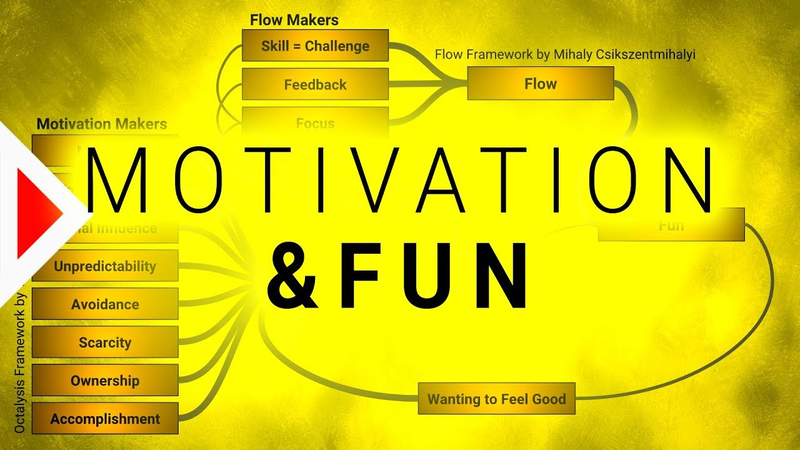
motivating and if something is motivating chances are it's also gonna be pretty fun of course but you cannot rely on that connection it's not a solid connection there are a lot of exceptions to this rule so why are there things that are motivating but not fun and why other things are fun but not motivating I recently finished reading the book flow by Mihai csikszentmihalyi and I'm currently reading a book about gamification by youkai Qiu and those two books finally helped me to figure it out I guess because guess what one of them is about fun and one of them is about motivation so once again how our fun and motivation connected to each other I think the key questions are how do we create fun and how do we create motivation maybe if we answer those two questions we can solve the mystery and let's be honest if you're into game design game development or psychology those are questions you should be pretty interested in anyway let's start with fun how do you create fun how do you design for fun how do you make your games more fun hmm so here's my framework that's supposed to explain all of this as I've said it's a mixture of my own thoughts then the
octal assess framework by you katchoo and the flow framework by Mihai Csikszentmihalyi and I think fun consists of two things and by far the most important one is flow if you want your game to be fun it needs to have flow well or is this other thing we'll talk about soon but flow is the king in case you want to learn more about flow I made an entire video about it but here's the short version flow is the state of optimal experience it's when you're completely forgetting about time and you become one with the thing you're doing at the moment you're just focused on that and that feels super enjoyable and satisfying or in another word fun the three main conditions for flow to emerge are your skill needs to match the challenge ahead of you there needs to be a constant feedback loop you need to get constant feedback as quickly as possible and you need to be focused your entire attention needs to be focused on one thing there's probably a little more to it but if you nail those three things chances are pretty high you're gonna get yourself or your players into the flow
state and therefore the activity will feel fun so that is one way to make something fun but what is the other way tada surprise I think it's motivation just the simple fact that you're motivated to do something can make it more enjoyable once again let's take push ups as an example because that is not really a flow activity it's not something inherently fun yeah sure you could turn it into a flow activity but let's just assume it's not okay now if I'm really motivated to do push ups of course I'm gonna have more fun than if somebody forces me to do it even though I'm not really enjoying the activity itself it can still become kind of fun because I know I'm doing it for myself I'm doing it for my own good and I'm working towards a goal that being health and fitness so yeah motivation often provides you with a goal they are for giving you feedback because you can tell how far or how close you are to that goal motivation also helps you to focus because guess what if you're more motivated you're more motivated to pay attention and to focus yeah I know pretty obvious but it's totally true and last but not least if you're not quite
skilled enough if you're not quite good enough to match the challenge ahead of you motivation can give you the energy and the power to push through and to get to that point where your skill actually matches the challenge so yeah I'm not really that sure if motivation impacts the fun you have with something directly or if motivation just helps you with achieving flow and therefore makes activities more enjoyable and more fun so that's the first interesting connection motivation has a positive impact on your ability to achieve the flow stage and maybe it even has a relatively direct impact on fun and enjoyment cool motivation impacts fun but what about the other way around well yeah you guessed it there's a connection as well because one thing that can really motivate you is the next dopamine kick you want to have positive feelings fun is a positive feeling so wanting to have fun is a big motivation sauce if you had fun with a game once then what motivates you to come back exactly you want that next dopamine kick you want to have fun again motivation has a positive impact on fan and fan has a positive impact on motivation but oh
we're not quite done yet because we still haven't answered our main question why can fun occur without motivation and why can motivation occur without fun and how does all of this help us to design better video games well let's take a breath for a second fun is clearly not the only thing that can motivate you there are a lot of things that can motivate you and there are a lot of different frameworks and models that try to explain human motivation but for now let's use the octal assess framework by you chi-chu which was designed for gamification and game design so that's something that's probably very useful to us the art Ellis's framework names eight core motivations meaning empowerment social influence and predictability avoidance scarcity ownership and accomplishment honestly it's a really cool model and the only thing I have to add to this is that you're motivated to experience cool things and positive feelings like fun listen to music look at beautiful pictures and images just stimulating
your senses and enjoying yourself and yep you need to get the next kick off that is definitely a motivation as well I think that is mentioned in the book as a hidden core drive but I'm not that far into the book so I can't really tell anyway here's the entire picture here's the entire framework of how I think motivation and fun are connected with each other you can probably see that fun and motivation are pretty interlinked so how can it be possible that fun occurs without motivation and how can it be possible that motivation occurs without fun well easy look at my graph some connections are stronger than let's just name those three things right here flow makers because they create flow and let's name those eight things here motivation makers because they create motivation now let's just assume we have really good flow makers and really bad motivation makers that will result in good flow and bad motivation and yes the bad motivation has definitely an impact on the flow but it's not strong enough to drag it down now what is more important to create fun flow or motivation as you can see the
arrow from flow to fun is much bigger than from motivation to fun so that's the deciding factor here and we end up with something that is fun but not motivating the same concept still works when you apply the other way around let's assume we have really good motivation makers and really bad flow makers ever Allah you end up with something that is really motivating but not fun cool but we're still not done because there's still more questions to answer which of the two from a game designer perspective from a game developer perspective which one of the two is more important fun or motivation what would you say hmm for me this is absolutely a no-brainer I think motivation is much more important because without motivation people will not play your game you don't want to be one of those games that people really enjoy when they actually play it but they never want to play it and yeah I know exactly what you're thinking right now I'll just focus on thumb because if my game is fun then people will come back and want to play more and I mean yes of course we talked about this in this video obviously this works fun is also a motivation source but look there are a ton of games that I
know are really fun and that I know I enjoy but I still don't feel motivated to play them and that's why I don't play them for example nuclear throne Infini Factory League of Legends now go and do your head and think about an activity or a game that you haven't played in ages but you know you would enjoy if you picked it up right now in many cases fun alone is just not enough to get you motivated and what's even worse is that if you want to sell your game people don't know if your game is fun so yeah sure fun can be a good way to get players back to your game after they played it a couple of times but for getting new players you just need different motivation sources than fun okay I guess fun kind of works if you can convince your customers that your games fun okay but yo I don't know about you but for me just feels like a giant gamble just to focus on fun because fun is not what drives action motivation is what drives action and there are a lot more tools you can use to motivate people nope I'm not talking about adding high
scores or stems and batches and achievements to absolutely everything that's just lazy design I'm talking about using meaning narrative social influence empowerment I feel like those things are just way more suitable to acquire new players and also to keep your current players but then once again what do I know I have never published a successful video game I am NOT an expert but I'm currently giving it my first real shot I'm currently developing a video game on this YouTube channel and I'm documenting absolutely everything there are more videos like this if you're interested in this check it out I will wait before you leave I have a couple more questions for you because I don't want to give you just my blah blah I also want to know what you think there are some really smart people in my viewership and on the Internet in general let's figure this out together let's solve these mysteries once and for all for Humanity and for all the game designers out there let's unite and hear other questions what do you think is the correlation between fun and motivation which of the two is more important in which kind of project is fun really as
efficient motivation source nowadays then in case you're a game developer and you make games which tricks and techniques do you use to make your games fun and motivating what are the most motivating games for you what are the most fun games for you are they the same games is there a right and a wrong way to create motivation what about daily log and bonuses and stuff like that and the last question is a hypothetical one but I think it's a really interesting one as well if you could choose between never experiencing fun ever again and never experiencing motivation ever again in your entire life which one of the two would you choose very curious to you answers to that one you don't have to answer all of those questions I'm completely happy if you answer just one of them and contribute to the discussion and the community in this way if you don't have anything to add don't worry either but I'd be really interested this is a YouTube channel about game design and making video games if you're interested in that have a look other than that I hope we can have an amazing discussion in the comments as as game designers as game developers these questions are just so important to understand have a nice day I hope this
was interesting make the world your playground and see you in the next one peace
Summary
The relationship between fun and motivation is a central concern for game designers, as these two concepts are distinct yet deeply interconnected. While fun is often equated with enjoyment and satisfaction, motivation is the primary driver of action. An activity can be fun without being motivating, and conversely, an activity can be motivating without being inherently fun. Understanding this distinction is critical for developers aiming to create engaging experiences that both attract new players and ensure long-term retention.
Fun is primarily generated through the state of flow, which occurs when a player’s skill level is perfectly balanced with the challenge of the task, supported by a constant feedback loop and deep focus. Motivation, however, is broader and can be analyzed through frameworks like Octalysis, which identifies eight core drives: meaning, empowerment, social influence, unpredictability, avoidance, scarcity, ownership, and accomplishment. While fun can serve as a source of motivation by providing a positive "dopamine kick" that encourages repeat play, it is often insufficient on its own to initiate action.
From a design perspective, motivation is arguably more critical than fun because it is the force that compels a user to engage with a product in the first place. Relying solely on fun is a risky strategy, as potential players cannot experience the enjoyment of a game until they are first motivated to play it. Effective game design requires leveraging diverse motivational tools—such as narrative, social influence, and clear goal-setting—to acquire and retain players, rather than relying exclusively on superficial gamification elements like badges or high scores. Ultimately, while flow creates the enjoyable experience that keeps players engaged, robust motivational structures are necessary to drive the initial and sustained participation required for a successful game.