1 free read left. Create a free account for unlimited reading + AI research.
Create free account
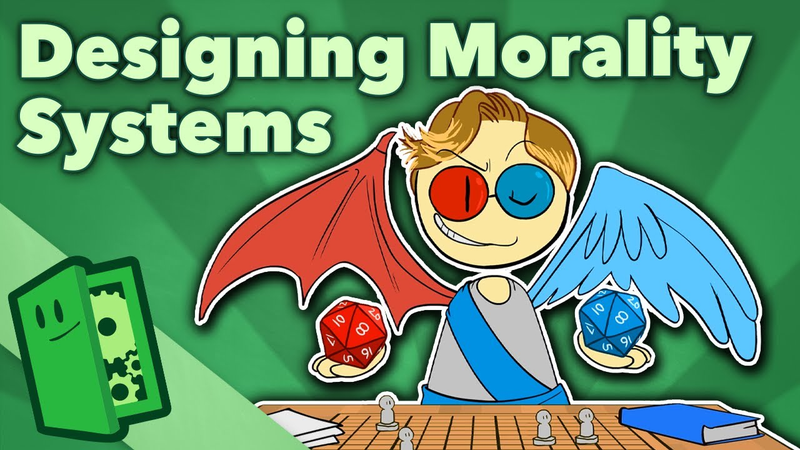
Designing Morality Systems - World Building and Morality in Gaming - Extra Credits - Game Design
Key insights
6 takeaways- 01Restrictive morality systems use external codes or rules to limit character behavior, creating conflict when those mandates clash with immediate situational needs.
- 02Cumulative morality allows a character’s identity to emerge organically through a history of past decisions, causing the game world to react and adapt to the player's specific trajectory.
- 03Effective moral design requires moving beyond binary choices to create ambiguous scenarios where every option carries both significant benefits and downsides.
- 04The primary goal of a morality system is to foster hesitation and ensure that ethical boundaries remain a subject of debate rather than guiding the player toward a single 'correct' path.
- 05Designers should work backward from desired moral conflicts, establishing rules that are proven helpful before introducing scenarios that challenge or create exceptions to those norms.
- 06Contradictory morality forces players to prioritize one virtuous tenet over another, as the system presents multiple positive values that cannot be upheld simultaneously.
Ask AI about this video
Transcript
You know, I just wrapped up a marathon session of piloting Commander Shepard and Co through the galaxy again and dang, some of the moral quandaries in the Mass Effect game get me every time. They're doozies. But this time around the Paragon Renegade merry-go-round, it got me thinking more broadly about morality systems in games. Specifically, how they're structured in some of my favorite tabletop RPGs. So once again, we reached out to Eddie, who has created a few fictional belief systems in his day, and asked him to share some of the best practices for designing effective and interesting moral systems. Thanks so much to World Anvil for helping us boost our world building game. Before we dive in proper, please note that this episode isn't going to touch on any real-world beliefs or ethical codes. Rather, we're going to focus entirely on fictional moral codes. For instance, like the ones emulated by the alignment system in Dungeons and Dragons. And you know what? That's actually a great place to start. D&D has a matrix of moral alignments ranging from lawful good to chaotic evil. Now, over the years, what each alignment
entails has changed, but the core concept has stayed the same. It's a game mechanic that helps determine where your character's morality comfortably sits and prescribes what actions they would consider unethical. Eddie calls this kind of mechanic restrictive morality because it limits your character's options towards a goal as if they're portraying someone locked into a specific moral code. Then character conflicts come from situations that are either ambiguous in terms of how they {quote} should be addressed or put the character's moral stance into question. Lots of media properties use restrictive morality to create interesting conflicts. Take both of the Treks and the Wars in the Stars for example. Star Trek has the Prime Directive, which states that Starfleet is prohibited from interfering with the internal and natural development of alien civilizations. Sounds good on the surface, right? But what if, say, Starfleet has the medical technology to cure a terrible alien disease? Engage conflict with a well-meaning moral stance number one. Meanwhile, in the Star Wars department, the restrictive morality is more personal. The light side of the force advocates
selflessness, requiring practitioners to put aside anger and hate. But, what about anger towards things like injustice? Maybe even within the Jedi order? Yeah, at times seeming selfless can feel like being selfish, and the moral grayness between the stark black and white natures of the two sides of the force can and have been used for interesting dramatic effect. But, conflicts with fictional moral systems don't have to come from external forces. Really compelling codes of behavior can have internal contradictions as well. A game mechanic that forces characters to prioritize one aspect of their morality over another. Eddie refers to these systems as contradictory morality, because it becomes impossible to uphold every aspect of a character's moral code simultaneously. In fact, his own game Pugmire is a great example of this. The dogs in his world have created a code of man, compiled from various things they believe humanity wanted from dogs over millennia. And the first and most important tenant is, be a good dog. But, other beliefs can make that hard to uphold. For instance, another tenant is obey the master. But, what if the dog's
master orders the dog to perform a terrible act? It also encourages dogs to stay loyal to those who are true. But, what if that loyalty causes a dog to work against their leaders? Each idea in isolation seems like a good and moral thing to do, but situations may cause characters to violate one in order to preserve another, which makes for wonderful dramatic effect. Finally, while games such as Mass Effect don't present a specific moral code, they do have a mechanic that presents a picture of what kind of character you're playing based on past decisions. And Eddie refers to this design as cumulative morality, where the character's moral code is discovered or even changes over time based on past actions. In this system, your character isn't restricted by any external moral code enshrined in either the universe of the game, like the code of man, or as a meta game mechanic, like D&D alignment, but instead, the game and universe react to past moral decisions, using them to shape current and future ones. Whether a game has restrictive, contradictory, or cumulative morality, as a designer, your
goal isn't to give a super clear set of moral guidelines that characters can easily fulfill, because such a design could lead players feeling like their choices aren't actually meaningful, as the game would simply push them into one clear way to play. Most times, it's a lot more interesting to intentionally introduce ambiguity and contradictions, so players can find those moral choices to be meaningful. Because let's be real, you want that moment where the player of your video game sets down the controller and just stares at the choice in front of them, not sure what to do. Or that instance where players in a tabletop game you've made debate the ethical boundaries of the conflict in front of them. That is the good stuff. The kinds of things people remember and talk about long after they're done playing your game. So, how do you do that? Well, one way is to make each action or tenant interesting or viable in isolation, and then tweak them until they introduce a potential conflict. For example, Eddie originally started with the code of man just as be a good dog, believing that people would find their own understanding of what good is and allow
those personal assumptions to draw characters into conflict. But he soon realized that he needed something to frame what each kind of good dog could be. There are protective good dogs, empathetic good dogs, loyal good dogs, and so on. From there, he drafted a series of statements that would encourage characters to do something as opposed to a restrictive morality, which keeps them from doing something. That way, characters can do a variety of things, but sometimes what should be done will still draw them into conflict. Another way to do this is to work from the external moral conflicts you want a character to experience. Like if you want to make a game about a starship captain who has to make hard decisions, first figure out some examples of hard decisions you want players to explore. Then you can work backwards from there, introducing regulations that restrict the captain's decision-making. Though, just be sure to create some early circumstances in your game to illustrate why those regulations might be good ideas, as it's easy for players to ignore rules that seem pointless, but a little harder to ignore rules that have proven previously helpful. Or, you could
make a list of what kind of actions you want to restrict, and then construct a restrictive morality around those. For example, many RPGs allow characters to wander into people's homes and take whatever's lying around, right? But many of them also add feedback telling the player that they may suffer potential in-game consequences. Now, if your goal is a purely restrictive morality, then that's kind of all you need to do. But if you want to introduce contradictory or cumulative morality, you can use the list you created of ostensibly unethical actions and slowly introduce case-by-case exceptions for conflict, such as a character needing to steal a vital item to save a village. No matter what route you take, the key thing to remember when constructing an in-game morality system is to make sure the players feel like they have compelling options. Choosing to take a hard action can be exciting and challenging, but only if the player has a clear idea of the benefits and consequences of their choice, particularly if all the available choices have a downside. And by using some of the tenets of restrictive or contradictory or cumulative morality systems, those
moments of, "Oh, which choice is best for me, or my party, or the world?" have the potential to have your players talking about your game for years afterward. Which reminds me, I think it's time for me to get back to the Normandy and follow my own moral code. WWGD. What would Garrus do? I mean, it's kind of perfect in its simplicity. But you know, a fictional morality system isn't going to mean diddly if the world it affects isn't an interesting one. You know, if only there was a tool that could help you organize all your story and world-building cleanly, easily, and oh, Hey World Anvil, perfect timing as always. As you know by now, a lot of us here at Extra Credits have been crafting our own imaginary worlds for years. Be they video games, RPGs, or novels. And I'm not going to lie, it is a ton of work keeping all of the disparate elements of our projects organized. That is of course until we found World Anvil. World Anvil is an award-winning tool set used by millions of world builders, writers, and gamers that helps you create, store, and organize your world setting. You can use it to craft entire RPG campaigns, tracking timelines, family trees, and diplomatic relationships, create
interactive maps to help bring your world to life. And once you're ready, you can easily share what you've built with your players, patrons, readers, or whoever. AKA precisely the tool set that saves me a ton of time and lets me focus on the fun of world building. And with over 25 stunning visual themes at your disposal, it's perfect for all genres, from sci-fi to fantasy, historical fiction, and space opera. Which I got to be honest is super helpful for me because remember that Rifts Gungeon 17th century rom-com mashup campaign I mentioned last time? Yeah, they just got access to a stargate. So, I'm going to need all the assets I can get. So, if you want to up your world building game and have a really good time doing it, you can check out World Anvil absolutely free. Or for a limited time, you can receive 40% off any annual membership by using the code Extra Credits. Then, not only will the awesome worlds you dream up come to life faster, but you'll also be helping out us in the process. Once again, that's code Extra Credits for 40% off any annual membership. Thanks so much for your support and we can't wait to see what you build. A huge thanks to our legendary patrons,
Oreals One, Kyle Mergatroid, Joseph Blame, Dominic Valenciana, Casey Nustja, Alicia Bramble, and Ahmed Ziad Turk.
Summary
Effective game design relies on the intentional construction of moral systems that force players to engage with difficult, ambiguous choices. Rather than providing clear-cut paths, designers should aim to create moments of hesitation where players must weigh the consequences of their actions. The primary goal is to move beyond simple binary choices, ensuring that every available option carries both potential benefits and significant downsides, thereby making the player’s decision feel meaningful and memorable.
Three distinct frameworks for designing these systems are identified: restrictive, contradictory, and cumulative morality. Restrictive morality utilizes external codes—such as the alignment systems in tabletop games or the Prime Directive in science fiction—to limit character behavior and create conflict when those rules clash with situational needs. Contradictory morality introduces internal tension by presenting multiple, individually virtuous tenets that cannot all be upheld simultaneously, forcing characters to prioritize one moral value over another. Finally, cumulative morality allows a character’s moral identity to emerge organically through a history of past decisions, with the game world reacting to and shaping the character’s trajectory based on those precedents.
To implement these systems successfully, designers should work backward from the specific types of moral conflicts they wish to explore. By crafting scenarios where rules are proven helpful before being challenged, or by creating exceptions to established norms, designers can deepen player investment. Ultimately, the most effective moral systems are those that avoid guiding the player toward a single "correct" way to play, instead fostering an environment where ethical boundaries are debated and the weight of choice remains a central, lingering experience for the player.



















Comments