Classic Game Postmortem: 'Q*bert'
10 May 202261 min video
Transcript
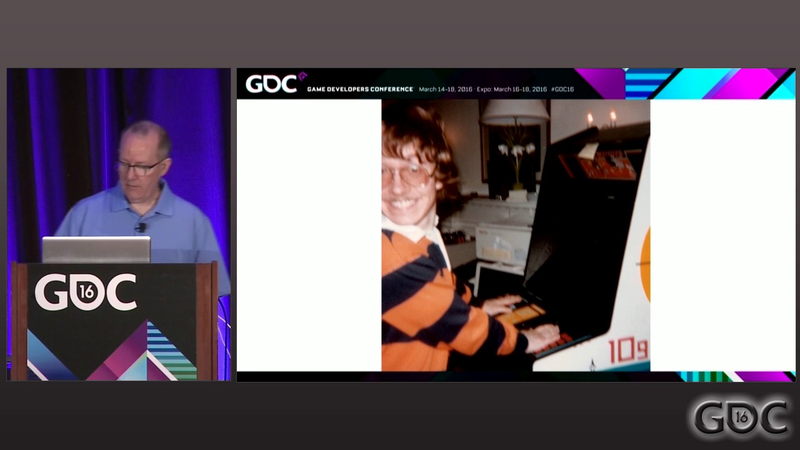
Hello. Hello all. Thank you for coming. Um my name is Warren Davis and um 40 years ago this year I made a little game with some help called Qbert. Uh and that is what I'm here to talk about. It's it's very uh especially uh lovely for me to be here at the 40th anniversary. Uh and if you don't know that much about me um which is very likely. Uh I'm going to go through a little bit of my career uh in the world of video games. Uh after Qbert was my first game. Uh after Qbert I did a laser disc game for the same company Gottlieb called us versus them. Uh I moved to Williams uh and while I was there I worked on Joust 2. Uh also did a redemption game as a consultant
called Lotto Fun which I'm sure you've never heard of unless maybe you grew up on the Jersey Shore and then you might have. Uh I worked for Premier Technology which was an offshoot of Gottlieb after Gottlieb closed. Uh that and they decided to make a video game and so uh that turned into a an arcade game called Exterminator. Uh which I could probably do a whole hour on in itself. Fans of Exterminator? Hard to believe. Uh I bet Uh back at uh Williams uh and I worked on I was on the teams that did Terminator 2 and Revolution X featuring Aerosmith. Um Don't laugh. They were really in it. Um and then uh my The other thing that I'm sort of known for is I I created the digitizing system that allowed actors to be digitized and put into all of the Williams Bally Midway games of the '90s. Uh and uh then I left the arcade industry and uh I worked for Disney Interactive for a while. I was a an Imagineer for 4
months. Uh I worked on the ill-fated and that's putting it kindly uh Spyro uh Enter the Dragonfly. Another That's probably a more interesting story than than anything. Uh uh I worked on a edutainment product called the Lunar Explorer which allowed you to circle and land on the moon using actual topographic data. Uh I worked for ILM for a while uh actually here in San Francisco although I was based in Los Angeles but I I came up here every every now and then. Um and I'm currently a consultant uh still a little bit working in the uh games industry. But we are here to not to talk about that. We're to talk about Qbert. Shown here in its original Wow. That's a I I will speak on his behalf and say he is honored. Uh so the original arcade and next to it the cocktail version which a lot of
people don't realize there was a cocktail version. Uh I don't even know uh how many there were. Uh but let's talk a little bit about it. The development of the game began in the spring of 1982. So you know 40 years ago. Um It uh ended in the fall. The production uh began in October. That's when they started rolling off the production line. And uh you know uh I am told cuz I really didn't know. I had no interest back in the day of of things like this. I was just amazed that the game got made at all. And uh but there were about 25,000 and and I'm getting that from Wikipedia so it is suspect. But uh I have no idea um how many cocktails were built. I I do know that there are a few still floating around. Anyway Um before we get into the actual making of Qbert a little bit of backstory uh about Gottlieb which is the company that I worked for. So Gottlieb one of the original um
pinball manufacturers from the early 1900s uh Gottlieb Amusement Games is what they were known as when I worked there. Originally known as D. Gottlieb and Company. It was a family-owned maker of pinball machines since 1927. Uh it was purchased by Columbia Pictures in 1976. The family sold sold the business. Uh it was also the last of the major pinball manufacturers to get into video games. Uh I'm not sure why that is but you know other companies like Stern and Williams they they were they they sort of saw that video games were a thing and I think Gottlieb Gottlieb held back and thought video games that's bad. It's not going to last. Uh But eventually they realized they had to get in the business and so they licensed two Japanese games in the very late uh 1970s. Uh they were called No Man's Land
and New York New York. Has anybody ever heard of these games? Oh my god. Well you are special and you know that. But uh So other than Van nobody else has heard of these games. But uh they it did get their feet wet and I think they started realize management started to realize we got to get into this. We got to get into this business. So um they decided to start a video department and uh they put two guys in charge. And the two guys they put in charge were Howie Rubin VP of business development and Ron Waxman VP of engineering. Here's a picture of Howie. This was taken actually in 2018 uh at the Pinball Expo in Illinois. Here's picture of Ron Waxman. Of course it's not actually him. Uh but I don't have a picture of Ron. I have never seen a picture of Ron Waxman. Um just adds to his mystery. But uh this
picture is actually taken from a marquee in which Ron Waxman was the featured character but we'll talk about that. Anyway uh Upper management at Gottlieb decided well we don't want to start this department in our plant at Northlake where they make all the pinball machines. Much to the dismay of all the pinball designers who really thought they were going to get the chance but they didn't. They opened it up in Bensenville about 8 miles away and they hired somebody who had a track record in video games. Uh this guy. He is Tim Skelly. Uh Tim uh was renowned Thank you. He was renowned as the designer of games like Star Castle Rip Off Armor Attack. Uh he was the rockstar guru who came and uh he was going to show Gottlieb how to make video games. He became sort of the de facto mentor to the department just because of his track record and the fact that nobody else
really had one and had never made a game. He also would later give Qbert the nickname Noser. Um but uh for now this is him sitting upon his his game Reactor. So uh Reactor was the first game that Gottlieb produced in house designed by Tim. So uh how do I Here's you know how do I come in the picture? The question is how do you get a job making video games in 1982? And the answer is you look in the newspaper in the want ads. I'm I'm hoping I don't have to explain to this crowd what a newspaper is. But um and I won't go into the circumstances of why I was looking for a job in uh in the around Christmas of 1981 but I was and I I came in the Chicago Tribune I came upon this ad This is the literally the actual ad. I hunted it down a couple years ago. Um Gottlieb was looking for hardware software engineers to make video games and I I couldn't believe it honestly. I I always thought you had to
be some kind of special person or you had to know people. Uh I just couldn't believe this was right in front of me. So I actually sent in a cover letter and a resume and I got a response almost immediately. So this happened right around Christmas uh 1981. I think I went in for my interview on January 2nd of 1982. Uh and this is the building. Uh this was the building. It's a this is of course a modern photo so it's no longer uh Gottlieb but it really hasn't changed very much. The I think it was more of a drab gray back then but essentially the same building. As I was walking in for my interview I I this guy was was sort of coming outside. It was a very like a round large round rotund man with a very gruff voice and as I'm going in he goes are you here for an interview? And I said well yeah. He goes watch out for that Waxman guy. He's a real So uh you know I I took that with a
grain of salt. I was a little odd going in. Uh and I was shown around. I was shown the department uh by a very lovely gentleman named Bill Jacobs who was a middle manager there. I met the met the crew. Met the people. Um Uh they were working on two different games at the time other than Tim who was working on Reactor. They were working on a pinball video hybrid called Caveman. And um they were also work They had like an Apple II based game called Quasimodo. Uh Caveman was released. Uh it was a basically a pinball machine with a video monitor embedded. Probably the first time that happened. Uh anyway so uh I was hired. Oh actually let me tell you this. So when I finally got to the interview part where I had to meet Waxman I go into this conference room and the guy comes in Waxman comes in and it Waxman is the guy who said to me out in the parking lot look out for that Waxman guy. He's a Almost forgot the punchline of the story.
But that that interview was really um it was really interesting cuz he was very he's very gruff. Like he sits there and he just and he smokes a cigar. He's always had a cigar in his mouth. And he says things like uh what makes you think you can design a video game? I I don't know. I've never tried it before. Uh you have a computer at home? This is 1982. Not a lot of people had computers at home. Uh I go no, I use them at work. So I don't didn't see a need to have one at home. And all the questions were kind of like that. They they were sort of presupposed that I had no right to be there. So I left that interview thinking for sure I I'm not getting this job. So much to my surprise, I was offered a job and I took it and it turned out Ron Waxman was not that gruff guy at all. It's just his persona and I I just think he did that to mess with people. But he was uh really a very warm-hearted person once you got to know him. Uh anyway, so here I am. I'm working for Gottlieb and
uh we have a hardware. They have developed hardware. The uh engineer who developed this board is called the his name Jun Jun Yum. And um this was our major board. Uh it had um well, let me go through the specs of it. So it it was based on an Intel uh 8088 CPU, 64 kilobytes of program memory. Now you got to realize we programmed everything in assembler. So you know, we had to make things tight uh but uh still everything was assembler was pretty tight anyway. So 64 kilobytes pretty standard at the time. Screen resolution of 256 by 240 pixels. Um we had uh 64 foreground sprites and a sprite was 16 by 16 pixels. The hardware took care of the display. So as a programmer, it was very easy to put up you know, you had sprites in your memory. They were indexed. So you just wrote into a a
foreground register this index at this X and this Y and the hardware just put it there. Uh very easy to to write code for it. The background uh was uh basically 8 by 8 pixel blocks. Uh so you had 32 by 30 blocks to fill the background uh and a 16 color palette. So you had 16 colors and each of those colors could be one of 32,768 which is basically five bits of red, green and blue. 15-bit color. Um and again, I think that was pretty standard for the arcade industry at the time. Uh as far as coding uh you know, for programmers out there, we there was no operating system really. We had a main loop. That was it. So you you ran you did everything you needed to do that you wanted to get done in a 60th of a second and then you called a V blank wait. So you just waited for the screen to refresh. If if you could get all of that in there. If you had too much going on,
the screen missed the V blank and you had to wait till the next frame which you didn't want. Anyway, uh So we the same pinball sound board was used for our video games and we'll get we'll talk a little bit more about that later. Had dip switches on the board. The dip switches used for things like free play on and off. Uh cocktail remember I was talking about the cocktail table. The cocktail table was interesting. Players sit head to head. So between turns, the screen has to flip vertically. So that was a dip switch setting. Um the attract mode had sound uh but you could turn it off. A lot of operators uh they didn't want the attract mode making noise for whatever reason. So that was a dip switch and in Q*bert later on, the knocker was put on a dip switch. So operators could turn that off. So but what did we use as a development uh system? Oh, wait. Oh, dip switch. Oh yeah, I wanted to talk about the foreground and background switching. So there was a mechanism in
the hardware that if you set a bit on a certain memory location, it would flip the foreground and background. Why you ask? What use could this possibly be? We didn't know. They put it in there and we tried to see if we could make use of it. And as it turned out, we did. Uh and then um finally, what does that say? Oh, upside down. Yeah, upside down. That's cocktail. That's how we did the cocktail enabled on the um dip switch and then programmed it software. So uh here's what we here this was our development system. It's called an MDS-80. Uh we called it the blue box I think for obvious reasons. Um it was uh based on an in-circuit emulator. So there was a a ribbon cable that came out and the socket plugged into our board where the processor would normally go. And uh and that's what we would use and we had three of those when I started. So we we didn't have a lot of people. It was a small team. Maybe I want to say
like 12 people actually, you know, hardware engineers, sound artists. Not a lot of people. Um and we only had three of these to share uh at first. Um We did have some art tools that that had been programmed and uh basically, they were so simple. It was like a grid. Like for foreground, you'd have a 16 by 16 grid. You'd have a palette. You could pick your colors and then literally plop squares in the grid. And that's how artists would create the art. Uh they were called fogus for foreground and bogus for background. I did not name them. Uh so what was I doing? So that you know, basically they said to me when I was hired, uh you got to learn the system and uh we got a guy who's making a game. His name was Tom Alanowski. He was making a superhero game. Uh and he asked they asked me to help him out. Sort of learn the ropes, get my feet wet which I did. Uh in this
particular So basically it's a game based on Superman uh Superman II with Superman battling the three Kryptonian villains. Of course, we didn't get the license for that cuz that would cost money. So it was just some generic superhero. Um My contribution here was that you could knock the villains into the buildings and some rubble would spew out and land on the ground. So I programmed the rubble. And and then when the rubble accumulated, we needed a way to get rid of it. So uh I programmed the bulldozer at the bottom of the screen that came this you know. Anyway, I mean I had to do something. But uh the funny thing about this game was never released. It it it went through many iterations, went through many names. Uh for some reason, every time they changed something on it, they put it out on test with a different name. So it was Protector. It was Video Man then it was Guardian. Inexplicably to me then the fourth one was Argus. And it just kept going out and not testing well and so for me, I just
started calling it Pro Vid Guard Argus and to this day, that's what I call it. But ironically, they they released it. Jeff Lee uh the artist and Tom Alanowski found some old ROMs and a couple of years ago, they actually released it. Uh so you can play this game in an arcade cabinet at the Galloping Ghost in Illinois. Uh oh, and then the other name I forgot to mention was Waxman because at one point, they decided to replace the main character with a version of Ron Waxman. And I'm not joking. That actually happened. But it still uh did not test well. All right. So now what? Uh I got my feet wet. I know the system. Uh basically, management when I say management, I mean Ron and Howie said to me, make a game. That was literally all I was told. Um All right. Well, I was walking down the office one day. We had a big open area. We didn't have like individual offices. We had a like just take work tables in a
big room. And like I said, we shared those uh blue boxes that we only had three of and uh I was walking by and this one programmer named Kon Yabumoto who is pretty much known for his game Mad Planets if you've ever heard of that. But Kon was working he was actually playing with that foreground background switching bit. He just he had a background image uh that looked like this. So Jeff Lee created I think it was literally six background blocks that you could repeat and fill the screen to make this thing. And I I was walking by and Kon this of course is background but Kon was using it as a foreground and then removing blocks to reveal the background or reveal a foreground behind it. To what purpose I don't know. But I saw it and I just thought to myself this is interesting because if something fell on on a cube on a single cube, it would have one of two ways to bounce, right? It would bounce down to the right, down to the left. And
that's binary. Zero or one. And with seven rows of uh of those cubes which is what could fit on one of our screens, you could put the entire path of a ball in one byte. So that's what occurred to me. So I set about taking that full screen, shaping it like this. And then I went to Jeff and I asked him for a little ball a bouncing ball so I could Basically, all I was looking to do was pro program randomness and gravity. Just to learn how to do that. The rubble in the previous game had no gravity. If it fell, it could just fell at a linear rate which was very bizarre. But I I didn't know how to do gravity at the time. It was not too hard. But uh anyway, so it was just a programming exercise. That's literally all it was. Well, you know, once you've got that, then, you know, the question is what what do you want to do next? Um and it it occurred to me
it's Oh, I should mention also, and I'll show you this later, but the random number generator I used I got from Tim Skelly. But we'll we'll talk about that in a minute. Uh the third thing, obviously, well, if this is working and people are looking at it and they're saying this is pretty cool, the balls bouncing down, uh maybe I should have a player character that jumps over over the screen. So, that was my next thing. So, I went to Jeff. I said, "Do you have some art some character I can use?" And he put a bunch of characters up on the screen on his development system. And uh you know, they I think they were pretty much the characters that ultimately went into Q*bert, but they just were uh random characters at the time. And I saw this round one, long nose, looked kind of pathetic. And I thought, "That's That's the one I want." So, I I asked him to give me all the angles I needed, looking up, looking down, jumping, and all that stuff. And uh he gave me that. So, the next thing was I had uh I had a player character jumping around the pyramid. Uh now, Jeff designed that character with a long nose
because his intention was he would shoot stuff out of his nose. But that was way too complicated. This is my first game. I really wasn't interested in that. So, I sort of nixed that idea and I was just like, "Let me just get the guy jumping." Uh so, I did. Uh after that, you know, kind of things just started happening uh just naturally, I want to say. Uh I've always said that the uh design of Q*bert was uh evolutionary in that I programmed something, and then I sort of decided, "What do I want to program next?" Nothing was really thought about in advance. Everything happened one step at a time. So, uh you know, I thought, "Okay, well, the player's jumping around the pyramid. There are balls. He needs to collide with the balls. The balls need to be dangerous, you know?" And then the whole thing about having him fall off, that was a little bit of a controversial issue. Uh I It seemed natural to me that the player should avoid jumping off the pyramid.
Um some people said, "No, it makes it too hard." And I sort of stuck to my guns on that. But the nice thing about the jumping off the pyramid, I don't know if you've ever noticed this, but what happens when he jumps off the pyramid is I use that bit and I switch the foreground and background. So, he actually falls behind the pyramid. And yay, that thing was of use. Um Okay, so uh it's still not a game though. It's just, you know, it's a guy jumping around a pyramid and balls. He's trying to avoid balls. So, one night uh I'm working late and I'm just sort of jumping around just looking for some kind of inspiration or think of what I might want to do next. And Waxman had this habit of sitting like in the room in our workroom while we were working. And sometimes he'd like sit behind you. And it was very unnerving because, you know, you're there, you're working, you're trying to do whatever you're trying to do. He's just sitting behind you smoking his cigar.
You know, you can hear him breathing. He's like Darth Vader or somebody. And I'm jumping around just sort of playing the game. And and out of nowhere he just says, "Oh, what if the cubes change color when he lands on them?" I thought, "Yeah, that's a great idea." You know, and and I will say this about Q*bert, you know, it was my first game. I I I was not so arrogant as to think I had all the answers. Uh I was happy to listen to anybody's suggestions. And believe me, people gave me a lot of suggestions that I did not take. But I was the one who had to implement them. So, if if somebody gave me a suggestion and it sounded right, I was like, "Awesome." So, that was a great suggestion. I took it. And that's when it became a game. Uh and honestly, the the the rest of it sort of happened fairly quickly. In fact, there's a story that Howie Rubin likes to tell where he didn't know
anything about what was going on. And he went to Japan for a business trip. He came back 2 weeks later and the game was completely done. That's what In his mind, that's what happens. Like it didn't exist and then 2 weeks later it was completely done. Not quite true. But uh um anyway, you know, my goal, because it was my first game, was to keep it simple. Uh but, you know, all of these things happened pretty much uh in succession. So, we need a bad guy. We need somebody to chase him. We uh you know, he needs a way to jump off the pyramid and not die, you know? Uh Slick and Sam, these characters who fall down and just thwart his goal. That just seemed again like a pretty obvious thing. Ugg and Wrongway, okay, these guys come up with a different uh axis of gravity. This was Jeff Lee's idea. And I hated it. I I and I hated it because I couldn't figure out how to do it. Uh and I I you know, I said, "No, I can't. It's too hard. It's, you know, Remember
that, you know, we're in an environment where, you know, speed is important, tightness of code is important. It's all in assembler. We have no floating point arithmetic. It's all integer arithmetic. Uh I didn't know how I was going to do that." And I said no. And then it just nodded me uh for like days and days and days. And eventually I figured it out. I just like came to me and I thought, "Wait a minute, I think I can do that." So, Ugg and Wrongway got in the game. Uh and of course, the green ball is another feature. Um it was an interesting dynamic of the way we worked together. Uh Jeff was uh the only artist working on the game. He was my constant uh sounding board. Uh he contributed so many ideas. Uh I consider him a co-creator. Uh it was my responsibility to make the game. That was just the way Gottlieb worked. So, at Gottlieb the the programmers were considered the designers because they programmed it. And if they didn't
program something, it didn't go in. So, but uh Jeff was, you know, incredibly valuable and um and had fantastic ideas. And we were very simpatico. We sort of had the same sensibilities. Um anyway, uh programming concerns. What we, you know, so there were some programming concerns going into this. And uh you know, the first one is memory limitation. I said we only had 64 kilobytes of program memory. But this really wasn't a problem because I I I didn't find myself bloating my code. I I I was a pretty good tight programmer anyway. So, um that was something I had to be cautious about, but it didn't really become a problem. But speed, that was a that was a problem. You know, we really couldn't do th- even things like square root. Um so, like let's let's talk about collision detection a little bit. Well, fir- okay, first let's talk about random number generation. This is a This is a sample to talk about cycle counting cuz that's something we used to do. We knew how many cycles, machine cycles, every
instruction would take. And so, when we made a loop or something or we had any routine, we had to literally count the cycles to make sure it was as small and tight as it could possibly be. So, this is a random number generator. And basically what's happening is you're taking a seed, actually pseudo random. You're taking a seed, you are uh doing some shifts. Uh and whether you're shifting you're shifting a bit around, but whether it's a one or a zero depends on what a couple of other bits are when you XOR them together. Uh I think. I don't remember. Anyway, but it was a it was a it was a really interesting thing. And I got this from Tim Skelly cuz that Tim was I can't say enough about Tim. He was uh he was just the most generous guy. It wasn't his job to be our mentor uh at all. His job to make a game. But he uh he did. He was just very kind and generous with with all of us. Um Yeah, so then the other thing the other uh concern, I guess, collision detection. It's not obvious how you're
going to make these things collide because it is a pseudo 3D space, but in reality, it is a 2D space. So, you know, you've got this you've got a ball and you've got Q*bert. And they really, you know, they're just 2D sprites. Now, our hardware did have a sort of a Z uh component. So, based on which register uh a foreground image was in, it would appear on top of or behind another image. But in order to, you know, really do the uh collision detection, right now, you know, the simplest thing and the fastest thing is just do a distance check. And you don't even do the square root. You just do x² + y². And you figure out r², what, you know, how close they can be without colliding. But what I figured out to do in this case was I had to take into account the velocity that they were moving at if they were moving. So, for example, if the ball the ball would jump up and down. So, based on whether it was going up if it was going up and Q*bert
was going up, they were even if they overlapped, it wasn't a collision. So, that's the kind of thing, you know, if um if if they were coming at each other, yes, that would be a collision. You get the idea. So, that was that was really a challenge to work out. And when Ugg and Wrongway came into the picture, that was even more of a challenge to make it cuz you, you know, it's really important to make it seem fair. You don't want these collisions to feel unfair. That would be extremely bad. Um and I haven't looked at the code in years to see what I did to handle the Ugg and Wrongway problem because I'm afraid to. Um so, in the middle So, here we are in Bensonville. And by the way, Bensonville has a manufacturing plant. It's a massive manufacturing plant which has been completely empty because until they started making reactor, which was months after I got hired, there was nothing to produce. So, we had a huge empty plant in the middle of the day, Howie Rubin would come into the
offices and go, "Everybody stop working. We're going into the plant to play football." And we had to stop working and go in the plant and play. And we wanted to work. It was like we were not we were not football players, but um Uh and then for some reason upper management decided about halfway through the development of Q*bert that they wanted to move the video department into the main plant in Northlake, Illinois. Uh and they kind of botched it because there were you know, they didn't they didn't get us together. There was no mixer. There were no introductions. Literally one day we just showed up at this new place and we all we had a beautiful big area. We all had our own cubicles. Some people had offices around the rim and you know, and then we loved pinball and we thought the pinball guys were amazing, you know, the designers. We we admired them tremendously, but you know, they uh they did not admire us. So, you know, we came to work one day
and got all these like stink eye, you know, it's like why are those guys why do they hate us? Um Anyway, but we did move in and we you know, we had offices at the main plant and this is this thing here is the only picture that I have from those days. And and I will say this uh I don't think any of us thought what we were doing meant anything. We thought what we were making was disposable entertainment. Six months later it'd be off to the next game. People would forget this game. So, I did not document anything I did because I just didn't see the importance of it, but this is the only photograph that I have of myself while I was developing Q*bert. Um so, interesting things to say. Here's the blue you can see the blue box there behind me. Uh ribbon cable the hardware is just sitting out. This thing is interesting here. This is a Tupperware bucket that is upside down
with a joystick mounted on it. And I I can't stress the amount of grief I got for that joystick. Now, I mean, if you look at the play field, it seems absolutely obvious to me that you only have four possible directions to go and they are diagonal. But people would walk up and straighten out that bucket so that it was up down left right and then they'd be like, "I don't understand why I'm dying. I don't understand why it's not working." Well, you have to be at 45° angle. What? They they they could not handle it. I got a lot of pressure to make it up down left right. Just strangely. Let's see. What what else is interesting in here? Um Oh, right. So, eventually around this time all of our development systems were replaced with an IBM PC, the original IBM PC which I don't know if you are aware the original IBM PC had no hard disk. It had a floppy disk These had 8-in floppy
disks. The IBM PC had 5 and 1/4 in and they held a whopping 180 K. And then they came out with double-sided ones that had 360 K. And then eventually we got our first 1 megabyte hard drive. And oh my god, we thought yeah, we never need any storage again. 1 megabyte. How How are you ever going to fill 1 megabyte? All right, you're laughing, but that that was that's what it was. Anyway, this is a picture that was a picture of me. Here's a picture of Jeff Lee. That is Jeff Lee, although I've obviously it's a comic or cartoon version. This is taken from a the flyer for Us vs. Them which is actually the second game that I did for Gottlieb. But this is the actual Jeff Lee back in the day taken from a video. It's a still from a video. I I shot some behind the scenes video which I would show except it's horribly embarrassing and so I don't show it, but
uh when I'm when I'm gone somebody will unearth it. Anyway, interesting interesting thing here is on on the thing Chris Brewer was one of our programmers and also did art as well, very talented. And he made a calendar. He made a Q*bert calendar. He also made a thing called the Q*bert coloring book which had different characters like Jacques Cousteau with Q's, you know, every Anyway, um Yeah. Let's move on. So, moving on uh sound. So, so basically you've met me, you've met Jeff. But the third member of our team is the guy who did all of the sound and the speech and that is Dave Field. Here's a picture of Dave Field. This was taken in the late '80s at a trade show and I'm sure he would kill me if he knew I was showing this. Now, Dave was and again not as active a member of the
team, but indispensable and because again I you know, I was not arrogant about the game design, I gave him much free reign as I did Jeff to be creative and come up with things. So, I do remember asking him for one particular sound and that is when Q*bert jumps off the pyramid. I did ask him for that which he delivered, but everything else was his invention and the thing of course he's most known for is Q*bert's speech. Um so, how did that come about? Well, this is the pinball sound board that we used. And you see where that arrow is that yellow arrow is pointing to a chip called a Votrax chip. This was a chip that produces human phonemes. Human like you know, phoneme everybody knows what a phoneme is, right? B V, you know, and you string them together and you can get speech. Well, it's horribly
monotonous and you know, robot-like and does not sound good at all and Dave just hated this chip and he hated using it. He had to get thing for pinball machines he had to use it to get say things like bonus and he just sounded like bogus all the time. So, he he hated this but he had the genius idea to throw random numbers at that chip. And that is Q*bert's speech. It's literally random phonemes. So, people say all the time, you know, is Q*bert cursing? And I go, he might be cuz you you put two you put the right two phonemes together and he is cursing, but it's not programmed at all. It's just random. Um the only things that Q*bert says actual English is when you turn the power switch on, he says, "Hello, I'm turned on." And then when you put your initials in the high score table, thank you very much. Put your initials in the high score table, he says, "Bye-bye." Um
So, yeah. Anyway, that's that's how the that's the story of the sounds. Now, naming him. I mean, all the way through this I did not give the character a name. I did not give any character's name. Keep in mind, I'm just trying to make a game. I don't even know what I'm doing. Um this is some code. This is code from the original game and I don't know if you can see it maybe you can't see, but you will not see the name Q*bert anywhere. You will not see anybody's names because they didn't exist. The player was called P L Y R, player. That's the only reference. The game itself is called cubes. Everything just says cubes. Um Coily was called chaser, C H S R in the code because I had no names. Well, obviously we need the game needed a name and the character needed a name and I think everybody everybody agreed that the character name should be the name of the game. That was just something everybody just had a feeling that's what
it should be. So, um actually, let me go to the next slide. So, this is I think this is from and I don't again I don't know if you can see it or not. This is from Faster, Harder, More Challenging Q*bert and I can't even see it from here. But you'll see that there are there are references to Coily and Q*bert in there cuz it was that was after the original game. But So, Jeff was really good at naming things. So, I let Jeff come up with names. So, he came up with names like Ugg and Wrongway and Slick and Sam which was a twist on and Span. And and I was just happy. I was thrilled because I did not want that burden of having to name these characters. But when it came to the main character, the player character, it was like, "What are we going to do?" And Howie had an idea. Howie Rubin, our head of business development, had a a great idea. He was like, "Let's call it the swearing balloon." And we were like, "What?"
He's like, "Yeah, let's call it that." Well, Howie, how are you going to pronounce that? Well, you know what? If this game is as good as I think it is, people will find a way. And we were like, "Howie, you're insane." But Howie insisted on putting the game out on test with these marquees and there was a handful you well, might have all seen them, but back in the day there were I think like a dozen of these marquees made for the game to be out on test with it and we just thought he was nuts, but you know, I think he eventually realized the error of his ways. It was probably not a smart idea. So, what are we going to do? Well, I went around the office with a pad of paper you know, notepad, and and I pulled everybody in the office. Got any ideas for the name of the game? I took everybody's suggestions. I had a sheet of about 50 names, and they were all terrible. I didn't like any of them. Uh I only remember one from that. I wish I had that list, but I only remember
one. It was Arnie Aardvark. I'm like, "Eh, no." Anyway, uh How Howie also had an idea of calling the game Why Me? You know. But you know what? We needed a name for the character. So, we had a meeting, and I will never forget this meeting. It was at least 2 hours, but felt like an entire day. There were probably about 10 people sitting around the conference room. Middle managers, it was me, Jeff Lee, Ron Howie, Rich Tracy was the art director for Gottlieb. There were some middle managers. All just sitting around trying to figure out what are we going to call this. And it just went on and on, and we're getting nowhere. And you know, we it's exhausting. It's exhausting to be in a meeting where you're just feeling like this is never going to work. And then you know, we're all ready to give up. And I somebody, I don't remember who it was. Somebody walks up to the whiteboard and writes Hubert.
And we're like, "Hubert? What's like why? What's Hubert got to do with anything?" It's like, "I don't know. You know, you got anything better?" It's a cute name. And then somebody goes, "Wait a minute. Wait a minute." And he somebody else went up, and they erased the H. And they and they put a C. It's like, "Wait a minute. Cuz cubes. It's got cube in it." Ooh, wait a minute. And everybody, you could feel like an energy start in the room. You know, it's like it's like electric. And then then somebody else goes up, and they put a Q instead of the C. You were like, I mean, it's like everybody's giddy. It's like you know, it's like everybody's like 2 years old or something. And then and then I think I think it was Jeff Lee, but it might have been Rich Tracy. He goes up, and they change the dash to an asterisk. And everybody just leaps out of their seats. And they're like, "Yes! Yes! We found it!" Actually, that may not have happened. I may be exaggerating. But it felt that way. It felt that way. And and but seriously, that's how it
happened. It was just that we were in a meeting, and and we had that we we finally came to that name. And every And literally though, it is true. Everybody just agreed on. It was like everybody knew it was right. Uh the knocker. So, the knocker is a really interesting feature. Um sorry. I want to just curious how I'm doing on time here. Am I good? Okay. The knocker is an interesting feature. People love this feature, and so do I. But there's a little caveat to it in that I know that it could have been much better than it was, and I'll explain. The knocker, if if you aren't aware, it's a little device that you find in pinball machines. It's actually just it's a piston. It just knocks the wood on the side of the machine to make a make a knock sound. Uh And one of our engineering technicians came to me one day and said, "You know, what do you think of the idea of having a knocker in the cabinet so when he falls off the pyramid, it's like he lands on the bottom?" And I said, "That's genius. I love that." So, we tried it. We put it in.
But um you know, the knock seemed wrong. It's like you know, if a body lands in the bottom of a cabinet, it should be a thud, right? It shouldn't be a knock. So, we sort of brainstormed, tried a few things, and and what we came up with we came up with a solution where if you took a little piece of foam where the the piston hits the wood, just to soften that sound a little bit. Uh it it just worked perfectly. I mean, it literally sounded like a thud, something like a sack of potatoes hitting the bottom of the cabinet. So, we went to management. We told them about this is what we want, and they were like, "Well, we could put the knocker in, but the foam it's going to cost like an extra $15 per cabinet just in labor to get somebody to go in and position it and glue it. Like, we're not going to do that." So, they put the knocker in, but I know how much better it could have been. And I do recommend for people to do that if you have a Q*bert cabinet at home. Uh all right. So, the game started to
feel complete. We're getting on into the late summer of 1982, and all the features were in I thought needed. And it really was just about tuning at this point. And of course, I have no experience. So, I don't know what I'm doing, and I I've been listening to the people in the office um because basically there are three ways that that you do testing or and tuning. Oops, here we go. Here we go. So, in-house testing, which is basically when the people you work with come by and play. So, that's been happening all along. But people have been telling me it's too hard from the get-go. So, I've been slowing it down. I've been trying to make it easier. Just so, you know, to satisfy the people in the office. Uh the second thing is location testing, which is something in the arcade industry we would do. We would take the cabinets, we'd put them into the arcades. We usually had an agreement with a particular arcade, and then they would collect the money. They'd report their coin earnings to us.
Uh and then um and they would you know, maintain it for us. Now, the reason that was important was because See, we're manufacturer. Gottlieb made the games. They made their money off of selling the actual games. They didn't make money if people put quarters in. But the people we sold to, distributors, they made their money based on people putting quarters in. So, it was it behooved us to have coin data that let them know this was going to earn money. So, that's pretty much how it worked. And you know, Q*bert went out into local arcades, and it did well. It earned money. It was very successful that regard. But I would watch people play. You know, I'd go to the arcade, and I'll never forget there was this little girl. She might have been 12. She came up to the Q*bert cabinet. She put her quarter in it, and she immediately just jumps right off the pyramid. Like, "All right, give her a second. She might get it." Second life, boom, jumps right off the pyramid. Third life, boom, jumps right off the pyramid. I'm like, "Okay, this is this is not good."
Uh and she walks away. And then you know, other people are coming by. But later she came back, and she watched other people play it. And she went back to it, and this time she didn't fall off the pyramid. So, I was a little heartened by that, but I was very very nervous. Um I really you know, thought I had you know, made some huge error. Um anyway, the third way that we got information was focus groups. You know, you'd go to the mall, and you'd say, "Hey, I'll give you 20 bucks if you come to this thing and try this video game out." And you know, we were behind the one-way glass watching. And the thing I learned about focus groups, and I've done this number of time throughout my career, not only for arcade games, but for home games. Uh what people say and the way they behave while they're playing two completely different things. You know, you could see people playing, and they're really and they're getting into it. And you they really look like they're enjoying it. And then you ask them about it after, and they're like, "Yeah, man, it's okay."
So, I've always learned to really actions speak louder than words. I I would recommend that. Uh But I did I have to say, I did tune it easier. Management sort of pressured me. They just felt it was too hard. It was too challenging. A lot of people couldn't wrap their brains around it. But fall of 1982, October of 1982, Q*bert started rolling off the production line. Uh the first public real exposure to Q*bert was at the trade show. We had an industry trade show in the fall in November of 1982 called the AMOA. Big big trade show for the coin-op industry, and Gottlieb went there, brought Q*bert there. It was a big big deal. Um got a lot of press. So, this is one of the trade magazines that covered the press. This is the following January. All these pictures came out. But here's what's interesting about this one picture. I think it's hysterical. This Gottlieb's
new Q*bert game is the center of attraction as from left, designer Jon Yum. Well, he was the hardware designer. Wasn't the game designer. Then Gottlieb president Boyd Brown. Of course, they got him right. He's the president of the company. Uh and programmers Warren Davis and Howard Rubin. Howie was not a programmer. Howie's the VP of business. So, you know, I learned again early in my career that don't trust everything you read because they get it wrong. But here's something they didn't get wrong. Um people judged Q*bert, and they made a list of their picks of the show, and a lot of people put Q*bert at the top of their list. It was it was really felt like it was going to be a huge hit, and it was. I think what's most interesting about this is Popeye is number two. I don't Does anybody remember the Popeye arcade game? I mean, I you don't hear about it that much, but it was also, you know, Anyway, um
On to the next thing. So, post-release problems. So, it wasn't too long after the game was out that I started to get reports back. Isolated reports that people were playing for a very long time on a single quarter. And that's you know, you don't want that. You don't want somebody to be on the machine cuz then other people aren't playing it, and they're not Thank you. They're they're not you know, the operators of the arcades aren't happy. The distributors aren't happy. So, I started to doubt that the game was tuned well, and I immediately set out to rectify that. So, and and also, by the way, I should mention that there's a little secret in the tuning of the original Q*bert. If you notice, there are nine levels. There's a single digit level. Every four rounds is a new level. And it goes from one through nine, then it stays at nine. The secret is the tuning does not change after level five. So, levels five, six, seven, eight, and nine are literally the exact same tuning
tables. Because I never imagined that anybody would get that far. I couldn't get that far. Nobody in the office could get that far. That's why I was so freaked out when people were getting that far. So, what were the problems? The problems were it's too slow. The very beginning Even today, when I play the original Q*bert, I feel like he's floating from cube to cube. It just feels very slow to me. Um it's too easy. Again, that's just my thought. People were picking it up. And it's not challenging enough. So, how do you rectify that? Well, it's it's really very simple. You make it faster, harder, and more challenging. So, that's what I set out to do. And then, like 2 months later, I had Faster, Harder, More Challenging Q*bert. So, this game was it it it was different from the original Q*bert. I didn't want to call it Super Q*bert or Q*bert 2. And it really wasn't a radical change. It was more of a, you know,
restructuring and a re-leveling. If you I don't Has anybody here ever played it? No. Oh, a few people. It's The thing is, it was never released. Because they put it out on test right next to the original Q*bert when people were still learning Q*bert. So, obviously, it did not test well. My thought was they'd hold on to it. Maybe a few months down the road, they'd release it, but they did not. Uh and it stayed unreleased for many years until 1997, when I was working at Disney and I met people who were involved in the main project. And they had emulated Gottlieb's hardware, so I just released the ROMs to them. And it's been out in the public eye since 1997. Anyway, um you might notice here that it says Mylstar instead of Gottlieb. And that's because there was a point uh after Q*bert actually was released, that Gottlieb decided to change their names. Like, Gottlieb was owned by Columbia. Columbia was bought by Coca-Cola. So, we had this big corporate overlord. And I
remember the day they came in with a big cardboard sign that was covered with a sheet. It was all hands meeting. President of the company, Boyd Brown, is so proud. He comes over and he he goes, "I want to announce the new name of our company." And he pulls the sheet down, and there's the logo, Mylstar Electronics. And the first thing I said out loud, I don't think I knew I was saying it out loud, I said, "Does anybody know that's Ratslim spelled backwards?" And uh Boyd Brown was not amused. Um but that's a true story. And uh cuz they paid some consultant like $200,000 to come up with some cool name. It's like, didn't even think of what it spells backwards? Come on. Uh Faster, Harder, More Challenging Q*bert had some things like it had a bonus round where like a million Slicks and Sams fall, and you just got to grab as many as you can. The levels were completely re-tuned. So, when you jump on squares, rather than
every level to change to get harder, every round it gets harder. And there's a whole lot of other things like that. But let's talk about the aftermath of Q*bert. So, Q*bert came out. It turns out it was a success. Who knew? Uh it was actually incredibly popular. Uh there was an article in Video Games magazine from a guy named Neil Tesser, where he covered Joust and Q*bert. And the interesting thing was Joust was a Williams game. John Newcomer designed it. Bill Pfutzenreuter was the programmer. But they named John Newcomer, Bill Pfutzenreuter, uh uh Eugene Jarvis got named. But they wouldn't name us. So, I was designer. That was me. I had a code name. Because Gottlieb would not let them use my name. Jeff was artist. That was Jeff Very punny, huh? And then Dave Thiel was J. Walkman. So, I don't know where that came from. But uh
after that, we sort of pressured Gottlieb to ease up uh on their secrecy. You know, obviously, they were we knew why. The there was a lot of poaching going on in the industry. They didn't want us to be known. Uh but they relented, and Faster, Harder, More Challenging Q*bert actually has a credits page. So, we are credited. Um and I didn't credit myself as designer, even though that was technically my role, because I really felt like it it was a team effort. We all of us owned that game. So, um let's see. A little A little just a I'm going to very quickly run through a lot of this. Some of the press that Q*bert got, cuz it really was everywhere in 1983. In trade magazines. This is USA Today. That kind of blew me away, mainstream kind of stuff. Of course, Video Game magazines is on the cover. Uh John Cougar John Cougar Mellencamp hanging out on a Q*bert. My god, you know. There's a Japanese
flyer. The New Yorker. The New Yorker magazine talking about Q*bert. And Glamour. Glamour magazine. So, yeah, I was like stunned. Of course, I was completely anonymous. You know, I I I I didn't even know how to uh handle what I was seeing. But I was just very content to sort of like be in the background and watch the success of the game. Then there were contests where they gave away Q*bert cabinets. This is kind of interesting because the marketing department really jumped on the licensing. Um there were Q*bert products everywhere. You can see here uh Yeah, I mean, I could just go on and on. There was a special version that management asked us to make uh that featured Mello Yello. So, we actually had a Mello Yello can. And I don't know if you remember the slide from the bonus round of Faster, Harder, More Challenging Q*bert, we basically turned that cup into a
Mello Yello can. Uh and somebody won this version. I think I I heard from that person. But really interesting. And of course, there was a Saturday morning cartoon. Does anybody remember this? Wow. You can bring it down, yeah. Um yeah, this this astonished us. I think Jeff uh Jeff Lee and I, you know, we got a lot of what are those guys smoking comments when Q*bert came out. But when this came out, I was like, what are those guys smoking? But what do you know? Listen, it is what it is. All right, I'm just going to finish up here. All right. You know, this is where the ports came out. Uh And of course, Q*bert moved on. They asked me if I wanted to do a sequel uh after Faster, Harder, More Challenging Q*bert. I didn't. I wanted to move on and do other things in my life. But a guy named Neil Burnstein came to me and said, "I've got this idea for a Q*bert sequel. Do you
mind?" And I said, "No, please, have at it." So, he made a game called Q*bert's Cubes. That was an arcade game that Gottlieb actually released. There was a pinball game called Q*bert's Quest. Uh and Q*bert didn't quite go away. There was a little bit of a lull. But then Q*bert 3 came out for the Super Nintendo, Game Boy. Um Um again, in the '90s. There's another little story. Ironically involving the GDC. I was at a GDC here. I was working for Disney Interactive at the time. But I was at a GDC in the late '90s. I think it was '97, '98. Uh and I ran into people from Sony. Sony, obviously, I shouldn't say obviously. Sony Okay, so Gottlieb was bought by Columbia Pictures, which was bought by Coca-Cola. Coca-Cola got rid of Gottlieb and shut it down. Columbia Pictures was the owner. Columbia was bought by Sony. So, in the '90s, Sony owned the rights to Q*bert.
And I ran into some guys from Sony Computer Entertainment of America, the games division. I said, "You know, there's a lot of nostalgia coming up in the '90s here." There was a lot of nostalgia for old video games. How come you're not doing anything with Q*bert?" Cuz they owned the rights. I never made any money off of it or anything. But they, you know, how come you're not doing anything? They said, "What do you mean?" And I said, "Well, you own the rights to Q*bert." They were like, "We own the rights to Q*bert?" And they're like writing notes down, and they're calling people on the phone. Like like they didn't know that they owned the rights to Q*bert. Which, you know, until recently, I thought the same thing was going on in recent years. But um Anyway, a year later, Hasbro Interactive came out with this version of of Q*bert. So, and then in in Oops, wait. I went backwards, sorry. In in more recent times, you've got this Q*bert reboot. It was a few years ago. And uh
And then, of course, you got the movies, Wreck-It Ralph and Pixels. I'm very astonished and sad that his nose has become flaccid. I know he is getting old, but uh And I did talk a little bit about Mylstar. They went on, had some success, but they closed their doors uh eventually. And then, this is a picture of the three of us, the Q*bert team. Uh this was in 2016, I believe. We The first time the three of us had gotten together. And it was a surprise. Jeff, I flew into Chicago and Dave Thiel was there, but he didn't know I was coming and Jeff drove me up and we we had a little reunion. And then a couple of years later, we actually were on a stage together for the first time in 30-some-odd years at the Pinball Expo 2018, I think it was. I just want to make very very quickly, I have written a book. If you enjoy these stories, I have many other stories that about my entire arcade game career.
It's available wherever finer books are sold online. And this is a cool thing. These cabinets you're looking at are 11 inches tall. New Wave Toys makes these amazing replicas of games. And the thing is, this one over here is a perfect replica of the Q*bert cabinet I have. I'm told I'm out of time. I'm going to leave you with this one final image to horrify your nightmares. Thank you. Thank you so so much for coming. I had a wonderful time. Thank you, everybody.
Auto-generated captions from YouTube — names and numbers may be misheard.
Key insights
Distilling the key insights…
Ask AI about this video
Cite this video
Citation
Generating citation…





















Comments