1 free read left. Create a free account for unlimited reading + AI research.
Create free account
Choice Paralysis - Too Much of a Good Thing - Extra Credits
Key insights
5 takeaways- 01Choice paralysis occurs when an overwhelming volume of options causes players to abandon a game, distinct from analysis paralysis which involves the difficulty of calculating optimal outcomes.
- 02The primary goal of interface design is to empower players to make choices rather than paralyzing them with the total scope of the system.
- 03Designers should mitigate cognitive overload by offering default or prefab options that allow players to bypass complex decision-making during initial setup.
- 04Breaking down large, intimidating interfaces into sequential, manageable tasks prevents players from feeling discouraged before they have begun to play.
- 05Layering information by presenting high-level statistics first while hiding granular data in sub-menus maintains game depth without sacrificing accessibility.
Ask AI about this video
Transcript
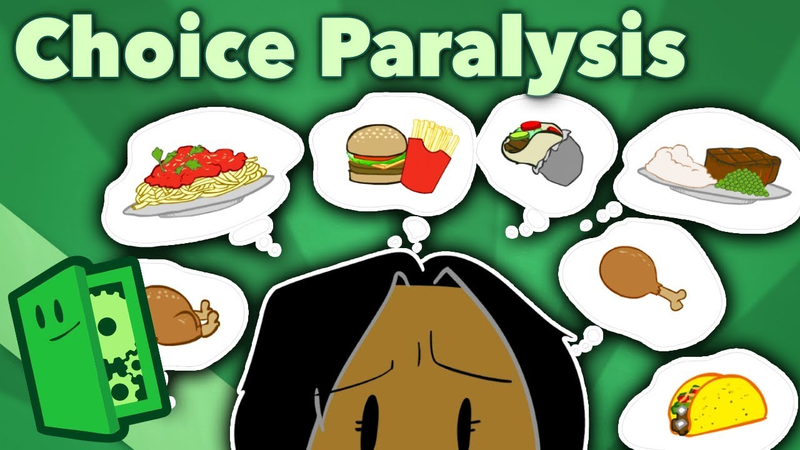
You ever go out to eat and when you look at the menu, there's just too much stuff? You can't even decide what you want. This should be an easy decision. I mean, it's not even something that matters really, but it's not easy. Well, avoiding that very dilemma is a huge challenge for game designers. In games, it's often tempting to give players a whole lot of options to choose from, to allow them to customize their experience down to the tiniest detail. And this is a good thing to offer, except when it's not. You see, as human beings, there's a fairly well-documented psychological tick that we have that's usually called by the rather hackneyed name analysis paralysis. Admittedly, it is quite fun to say. Analysis paralysis just means that when we try to assess too many options at once, we sort of short circuit and get stuck, not really coming to any real conclusion about any of the options we've been presented. And that experience of analysis paralysis
happens all the time in games. We have all had that moment where we knew we could do a million different things, where there were a thousand different strategies we could try, but instead of doing any of them, we got overwhelmed by the sheer number of possibilities, and in trying to figure out what to do, we sort of let the opportunity to do any of them pass. This can happen in the span of an instant in a shooter or last for entire minutes as a chess clock ticks down. But whenever it happens, it tends to create a sub-par experience for the player. As designers, we know that the more choices the player has, the more varied they are, and the harder they are to calculate, the more likely this paralysis is to occur. So, we often try to find ways to segment a player's choices, to limit their scope, or to help the player establish goals that make on-the-fly decision-making easier. StarCraft is a great example of this. In the beginning of the game, the designers massively limit the scope of the player's choices. You simply can't build most things early on. Your choices are
segmented. Rather than just choosing which of a hundred units you want to build first, you build one of a dozen or so buildings. And then within that one building, you are given access to maybe four units, which is a much easier choice to tackle. And as you develop your base, you start to formulate an overall strategy that allows you to make decisions faster. If you're going for an aerial assault strategy, you don't have to spend much time thinking about all the upgrades available for tanks. But analysis paralysis isn't the only form of overload that designers face. There's another problem that's less well documented, but that any designer worth their salt will tell you exists. And that is simply choice paralysis. Analysis paralysis comes from trying to analyze too many possible options, from trying to make the best choice within a complex data set. Choice paralysis comes a step before that, where the mere act of making a choice seems daunting or overwhelming even before the player tries to analyze it. This gets back to
our restaurant menu from the beginning. Choosing off of a big menu board isn't difficult. You're not overwhelmed by trying to assess the best possibility. In fact, it's a choice that you may not even care about that much. And yet, you stand there trying to decide, or you pick something at random just to get the decision over with. Or worse still, maybe you walk away and you go eat somewhere you're used to, where it's easier to make up your mind. This happens not because of any calculus your brain is trying to do, but simply because the menu board is so big and filled with stuff that it feels overwhelming. And this same phenomenon happens in games. The classic example is character creation. If you go back to a lot of your 80s or 90s CRPGs, you'll see that they begin with a character creation screen filled with all sorts of stat choices, abilities to select, sometimes even starting gear to pick. We have stopped doing that. Why? Because a lot of players never got past that screen. We've talked before about how these types of poorly designed character
creation screens force players to make totally uninformed choices. After all, how are you supposed to know which stats you care about before even playing the game? But they're also bad design because they can lead to choice paralysis. Very often, new players would boot up the game, eager for something to play, get to that character creation screen and feel totally overwhelmed, unable to make a choice. So, what would they do? Well, they'd say, "You know what? I'm tired. I'm going to come back to this tomorrow when I can learn all these stats." Or they would say, "Hmm, I think I'll go play something else for now while I'm thinking all of these choices over." And the player would go play something else, and just like being overwhelmed by a restaurant menu and then going to eat somewhere more comforting and familiar, many players just never ended up coming back to that first game. So, does this mean that we simply have to make our games less complex? Well, that might be a good idea for a lot of other reasons, but choice paralysis isn't necessarily about complexity. It's not about the choices themselves, it's about the way those
choices are presented. So, how do we make our choices seem less overwhelming? Well, first, you can always offer the players default or prefab options presented front and center, so that if they feel overwhelmed, they'll have a simple go-to option that they can pick to skip having to make all those overwhelming choices without having to skip the entire game. Segmenting is also a good option here. Sometimes you can allow players to make three small choices rather than one large one. Or, equally powerful, sometimes you can let players make three choices at three different times rather than having them make those three choices on one screen filled with a million options. Going back to character creation, instead of having a bunch of stats on the one screen for the player to choose from, having a succession of simpler screens where they have to answer multiple choice questions like would you rather be swift, strong, or smart? That can reduce the paralysis-inducing number of options down to something easily consumable. Segmenting can also be done
systematically. Here, it's all about how you create your progression scheme. If every time the player goes to equip a new weapon or get a new skill, they find themselves choosing between two or three options, that's really interesting and engaging. But if they've got to pick one of a million options from a giant skill tree or sift through 40 slightly different weapons to choose a favorite, that can be overwhelming. Layering is also a good option. If you were making a shooter, there are probably dozens of stats that go into creating each gun. Even just the scatter on the bullets could be broken down into a bunch of different sub stats. Base scatter, aim down sight scatter, crouch scatter, prone scatter, walk scatter, run scatter, and so on. But if you were to show the player all of that information, they would probably get overwhelmed right away and just go back to what they were using before. Or they would say, uh screw it. I am just going to play around with this thing and see how it feels, I guess. But instead, if you just show them a single scatter stat, that number, even though it's a simplification, is
going to feel way more straightforward and the player will be able to more easily use it to make a choice. And if you want, you can then put in a mouse over or a sub menu where the player can see the more detailed stats. Providing your players with all the tools they need to understand your game at a very deep level without presenting an overwhelming mass of information up front. So, if you ever find yourself presented with an in-game menu and you find you simply can't make the choice being asked of you, especially if you don't even feel like taking a crack at making that choice, don't worry, that's probably not on you. Now, before we go, I do have one quick little announcement. I am going to be stepping away from the channel and moving on soon. As will Carrie, the channel's editor and producer. In fact, this is going to be my last Extra Credits episode. Uh you'll still be hearing me in Extra History episodes for a little while, and also one other short run of videos that just hasn't started yet. But in short, we are moving on to our next adventure. And actually, we're not even going very far.
Not only are we still going to be making stuff for the Extra Play channel, which is probably going to get renamed soon, but I'm also planning to take that Extra Frames animation series that I've been doing here, and relaunching it as it's own new channel. It'll probably be a little while before that part happens, but we'll make some sort of announcement here when it does. I'm really excited about it. For now, I just wanted to say thanks so much to all of you for watching all of these years, and making this such a wonderful thing to get to do. It has meant the world to me to know that so many people care about this thing I started doing as a college project. Leaving this behind is very very hard, but I'm looking forward to what comes next, and I hope all of you will, too. And don't worry, we are leaving this lectern in some very good hands. This is Matt. Say hello, Matt. Matt is going to be taking over for us, and although he may not be a Dan, he is still a very good fellow. So, everybody be nice. I was originally planning to use this outro music for the series finale, but what the heck, let's just use it now. Thanks again, everybody, for
everything, and I hope I'll see you around.
Summary
Game design often suffers from the psychological phenomenon of choice paralysis, where an overwhelming volume of options prevents players from making decisions, ultimately leading to disengagement. While analysis paralysis involves the difficulty of calculating the best outcome among complex variables, choice paralysis occurs when the mere presentation of too many options feels daunting, causing players to abandon the experience entirely. This issue is particularly prevalent in character creation screens or complex menu systems where players are forced to make uninformed decisions before they have even begun to play.
To mitigate these effects, designers should focus on how information is presented rather than simply reducing game complexity. Effective strategies include providing default or prefab options that allow players to bypass complex decision-making, as well as segmenting choices into smaller, manageable tasks. By breaking down large, intimidating screens into a series of simpler, sequential questions, designers can guide players through the process without causing cognitive overload.
Furthermore, layering information is a critical design technique. By presenting high-level, simplified statistics to the player while hiding granular data in sub-menus or tooltips, designers can maintain depth without sacrificing accessibility. This approach ensures that players are not discouraged by an initial mass of data, yet still retain the ability to engage with the game’s deeper mechanics as they become more comfortable. Ultimately, the goal is to structure the user experience so that players feel empowered to make choices rather than paralyzed by the scope of the interface.















Comments