Updated Mar 21, 2026 by Renova
Financial
Published by Renova
Briefing on Financial Results for the Fiscal Year This document has been prepared to provide corporate information and other details about RENOVA, Inc (“RENOVA,” hereafter) and the RENOVA Group, and does not constitute solicitation to acquire shares or other securities issued by RENOVA, whether in Japan or Information listed herein concerning industry and market trends, the economic climate and so on has been prepared based on currently available information.
This document has been prepared to provide corporate information and other details about RENOVA, Inc (“RENOVA,” hereafter) and the RENOVA Group, and does not constitute solicitation to acquire shares or other securities issued by RENOVA, whether in Japan or overseas. Information listed herein concerning industry and market trends, the economic climate and so on has been prepared based on currently available information. RENOVA does not guarantee the veracity, accuracy, reasonableness or completeness of the information and assumes no obligation to update the particulars of any information. Moreover, RENOVA Group plans, forecasts, estimates, predictions and other forward-looking information described herein represent only the current determinations or ideas of RENOVA. Actual RENOVA Group operating results, financial status and other outcomes may diverge considerably from the details described herein and the estimates made on that basis due to a variety of factors including trends in energy policy, legislation, schemes, markets and other institutions in Japan and overseas, the status of licenses and permits required for RENOVA Group projects, success or failure in the acquisition and development of land and power generating facilities, etc., along with fluctuations in weather, climate and the natural environment. As a general rule and unless indicated otherwise, consolidated figures are used for the monetary amounts listed in this document. As amounts less than one million yen are rounded off, totals in each column may not match.
c., along with fluctuations in weather, climate and the natural environment. As a general rule and unless indicated otherwise, consolidated figures are used for the monetary amounts listed in this document. As amounts less than one million yen are rounded off, totals in each column may not match. For inquiries about this document: IR Office, RENOVA, Inc. Telephone: +81-3-3516-6263 Email: [email protected] IR website: https://www.renovainc.com/en/ir
Part 1 Briefing on Financial Results 03 Part 2 Medium-term Management Plan 2030 (excerpted version) 25
In February 2025, FID was finalized for all three BESS projects (215MW 1 In February 2025, FID was finalized for all three BESS projects (215MW in total) that were selected in the Long-Term Decarbonization Power Source Auction in April 2024. 2 20-year offtake agreement<sup>*1</sup> with Tokyo Gas Co., Ltd is expected to be finalized shortly for a BESS project (30MW). 3 Omaezakikou Biomass started operation in January 2025 and was consolidated in February 2025. consolidated in February 2025. 4 Participated in a 150MW Solar PV + 150MW BESS project in the US 4 through a joint venture with Pathway Power, alliance partner in US. through a joint venture with Pathway Power, alliance partner in US. *1 A long-term fixed price agreement where theofftakerpays fixed usage fees to the BESS in exchange for obtaining the right to operate it.
◼ Revenue notably increased compared to the previous fiscal year due to stable operation of Sendai Gamo Biomass and Ishinomaki Hibarino Biomass, which reached COD in the previous fiscal year. ◼ EBITDA significantly increased compared to the previous fiscal year due to an increase in revenue, despite the elimination of the one-time gain from the liquidated damages of construction at Tokushima Tsuda Biomass recognized in the previous fiscal year. (Unit: Million yen) Revenue (Actual) EBITDA<sup>*1</sup> (Actual) 80,000 70,246 30,000 23,307 44,748 16,712 40,000 15,000 2,633 Liquidated 14,079 damages of construction at Tokushima TsudaBiomass 0 FY 3/2024 FY 3/2025 0 FY 3/2024 FY 3/2025 *1 EBITDA= Revenue-Fuel expenses-Outsourcing expenses-Payroll and related personnel expenses + Share of profit (loss) ofinvestments accounted for using the equity method + Other income and expenses. EBITDA is subject to neither
◼ With all 7 biomass plants in operation, this business is expected to account for approx. 60% of total EBITDA of FY2025. ◼ Stable operation of biomass plants will become more important as a core business. Biomass Power Plants in Operation and Under Construction Business Portfolio as of end of FY 3/2026<sup>*1</sup> Onshore Wind Kanda Total Capacity Akita 1<sub>%</sub> Solar PV 445<sub>MW</sub> 34<sub>%</sub> 75MW 74.8MW Jun. 2021~ Jul. 2016~ Power Generation etc. Karatsu z IshinomakiHibarino Business Karatsu Ishinomaki Hibarino EBITDA C.¥35.7bn 49.9MW 75MW Under 75MW Construction Mar. 2024~ Tokushima Tsuda Omaezakikou Sendai Gamo Biomass Omaezakikou Sendai Tokushima Tsuda Omaezakikou SendaiGamo 64<sub>%</sub> 75MW 75MW 75MW Dec. 2023~ Jan. 2025~ Nov. 2023~ *1 The figures represent the total for the Renewable Energy Power Generation etc. Businesssegment under the earnings current outlook. The figure of Solar PV includes that of Non-FIT Solar PV.
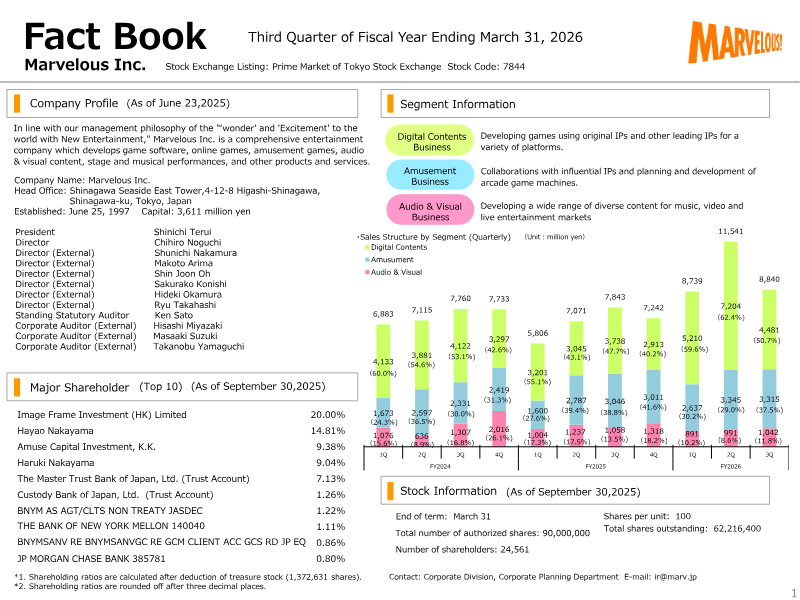
Capcom achieved a historic peak in FY26/3, reporting net sales of ¥1.95 billion and operating profit of ¥752 million—both up 15% year‑over‑year. The surge was driven by strong new‑title releases and catalog sales, particularly through digital channels, and marked the company’s highest cumulative unit sales at 5.9 million. Retail expansion reached 61 stores, including the first overseas Capcom Store in Taipei, underscoring a growing global footprint. Looking ahead to FY27/3, Capcom targets more than 10% operating‑profit growth and ¥2.1 billion in sales, underpinned by a steady pipeline of new IP launches such as *Pragma* and an expanded catalog strategy. The company plans to release one new machine per quarter, aiming for 53 000 units across four titles—including Biohazard RE:3 and Resident Evil 7—while projecting net sales of ¥209 million and operating profit of ¥104 million. A key focus is deepening IP monetisation through e‑sports, media tie‑ins, and mobile extensions, with an expected 18% year‑over‑year increase in pachislo volume and intensified expansion into emerging markets. The FY26/3 earnings report also highlights significant workforce growth, with an annual addition of over 100 developers and the integration of AI tools to enhance efficiency. Financially, net sales rose 14% YoY to ¥1,259 bn and operating profit increased 18% to ¥508 bn, while maintaining a strong cash position that balances shareholder returns, employee compensation, and reinvestment. Diversity metrics improved, with female core‑role representation at 15.7% and paternity leave utilization at 79.7%, reflecting a broader talent strategy aimed at sustaining long‑term innovation and market leadership.
Fiscal year 2026 ended with a 13 % rise in sales to ¥487.5 bn, yet operating income swung from a ¥48.1 bn profit in FY2025 to a ¥5.7 bn loss, driven by significant goodwill impairments on Rovio and Stakelogic and a widening deficit in the Gaming segment. Adjusted EBITDA fell to ¥16.6 bn, reflecting heavy upfront development costs and impairment charges, while net equity contracted by ¥48.7 bn as cash balances were depleted following the acquisitions of GAN and Stakelogic. Within Entertainment Contents, sales edged up to ¥326.6 bn from ¥321.5 bn, but operating income declined from ¥40.8 bn to ¥32.4 bn because new Full‑Game and F2P titles underperformed, despite steady growth in licensing revenue. Forecasts for FY2027 project sales of ¥357 bn and operating income of ¥42.5 bn, contingent on successful new IP launches, repeat sales, and a planned lift in licensing income. Margin erosion from title underperformance remains a key risk. Capital allocation for FY2026/3 was restructured to focus on ¥190 bn of cumulative investment over FY2025–FY2027, allocating ¥80 bn to development, ¥120 bn to strategic acquisitions, and planning ¥70 bn in share buybacks while pausing large‑scale M&A. Shareholder returns are expected to rise sharply, with FY2026/3 projected at ¥31.5 bn (≈¥11.7 bn in dividends) and FY2027/3 potentially reaching ¥16.2 bn under a 50 % total‑return ratio applied to projected net income. Pachislot sales showed modest growth, buoyed by new titles and strong first‑week performance of flagship IPs such as “Hokuto No Ken” and “Kabaneri of the Iron Fortress.” Pachinko sales declined as the temporary lift from Lucky Trigger 3.0 Plus faded and hall utilization softened. The group plans to introduce reel‑exchangeable cabinets, expected to account for roughly 20 % of pachislot revenue, and is positioning the gaming business for a J‑curve bottom in FY2027 through intensive lease sales and B2B platform upgrades. The release schedule for FY2026/3 emphasizes a concentrated push of multi‑platform titles, including the Nintendo Switch 2 launch in March 2026 and a slate of global releases across consoles, PC, and mobile from late 2025 to mid‑2026. Key animation properties such as *Detective Conan* and *Lupin the Third* are slated for April–June 2025, with several new IPs and Netflix exclusives planned for early 2026. Pachislot and pachinko product launches are detailed with projected unit sales ranging from 8,000 to 49,000 units across varying gambling‑specification tiers.
Sony Group’s FY2025 consolidated results demonstrate modest revenue growth and a mixed profitability profile across its core business units. Total sales increased 4 % to ¥12.48 trn, largely driven by higher operating income in the Imaging & Sensing Solutions (I&SS) and Music segments. Operating income rose 13 % to ¥1.45 trn, while net income attributable to shareholders fell 3 % to ¥1.03 trn because of a larger equity‑method loss in the Financial Services arm and higher impairment charges. Operating cash flow remained flat at ¥1.97 trn, and the spin‑off of Sony Financial Group was treated as a discontinued operation from Q1 FY25 onward. Within the Music division, sales climbed 15 % to ¥277.5 billion, propelled by growth in Recorded Music and Music Publishing streaming revenues (+9 % and +14 % respectively), live‑event income, and a strong contribution from the Demon Slayer franchise. Operating income in this segment surged 25 % to ¥89.7 billion, reaching a record high even after excluding one‑time items. Sony projects flat sales for FY2026, with operating income expected to decline 11 % to ¥47 billion as streaming gains are offset by the loss of Demon Slayer’s impact. The company consolidates its Pictures and Music results on a U.S. dollar basis, translating foreign‑currency sales and costs using weighted average exchange rates while accounting for hedging transactions. Foreign‑exchange fluctuations affect both sales and operating income, with I&SS hedging gains or losses incorporated into these calculations. These disclosures supplement, but do not replace, Sony’s IFRS‑compliant consolidated financial statements.
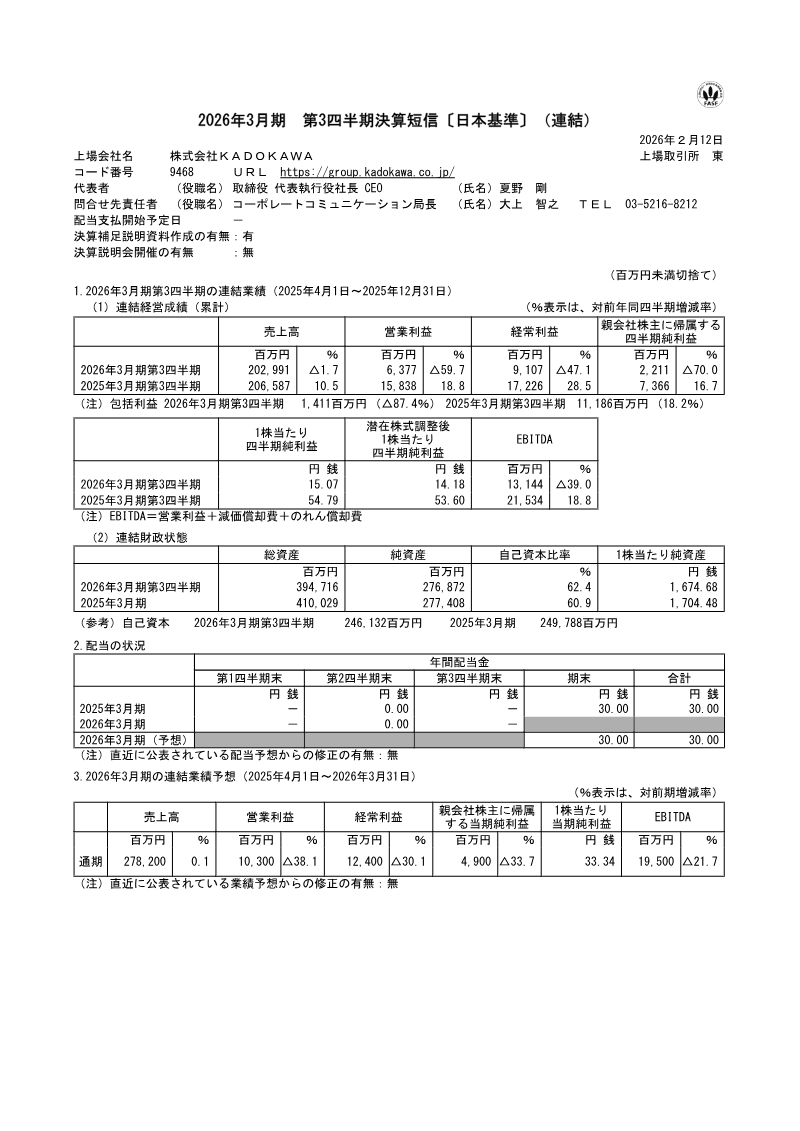
France Bed Holdings Co., Ltd. released its consolidated financial results for the six-month period ending September 30, 2025, prepared in accordance with Japanese GAAP. The report details the company’s operating performance, financial position, and cash flow status, while maintaining its previously announced earnings forecasts for the full fiscal year ending March 31, 2026. During the first half of the fiscal year, the company reported net sales of 29,259 million yen, remaining essentially flat compared to the same period in the previous year. However, profitability metrics experienced a decline, with operating profit falling 16.0% to 1,782 million yen and ordinary profit decreasing 17.7% to 1,765 million yen. Profit attributable to owners of the parent reached 1,047 million yen, representing a 20.9% year-on-year decline. Basic earnings per share for the period were 31.20 yen, down from 38.36 yen in the prior year. The company’s financial position as of September 30, 2025, shows total assets of 67,084 million yen and net assets of 39,158 million yen, resulting in an equity-to-asset ratio of 58.3%. Cash flows from operating activities provided 2,541 million yen, while investing and financing activities reflected ongoing capital allocation, including the purchase of treasury shares and continued investment in property, plant, and equipment. Looking ahead to the full fiscal year ending March 31, 2026, the company maintains its forecast of 62,300 million yen in net sales and 4,750 million yen in operating profit. These projections reflect a modest growth expectation of 2.8% in sales and 1.1% in operating profit compared to the previous fiscal year. The company continues to operate under stable accounting policies with no significant changes in the scope of consolidation.