Updated Mar 17, 2026 by Adjust
What can I help with?
AI-powered answers with citations from the library.
What can I help with?
AI-powered answers with citations from the library.
Report · March 1, 2025
Published by Adjust
The mobile app economy is entering a significant scaling phase, with global consumer spending projected to reach $626 billion by 2030. This growth is underpinned by a 2024 surge in app installs and a notable rise in App Tracking Transparency opt-in rates to 35%, suggesting that privacy-centric measurement is successfully rebuilding user trust. As the industry moves into 2025, the integration of artificial intelligence and machine learning has transitioned from a conceptual trend to an operational necessity, particularly for predictive analytics and campaign optimization across diverse platforms like Connected TV and in-app advertising. Mobile commerce currently serves as the primary driver of the digital landscape, accounting for 73% of global e-commerce sales with anticipated 2025 revenues of $2.5 trillion. While e-commerce app installs grew by 17% in 2024, the sector must navigate rising acquisition costs, which have reached an average of $3.44 per install. This financial pressure is particularly acute in emerging markets such as MENA and LATAM, where reliance on paid media is increasing. Simultaneously, the mobile gaming sector remains the most popular category, expected to reach $126.1 billion in 2025. Although gaming faces retention challenges in North America and Europe, strategy games have seen an 83% growth in installs, and global session lengths have extended to over 30 minutes. The financial services vertical is also experiencing a period of robust expansion, especially within the APAC and LATAM regions. Global session lengths for finance apps have risen to 6.66 minutes, while average revenue per monthly active user has climbed significantly to $4.10. Across all sectors, the 2025 outlook emphasizes a shift toward omnichannel strategies and a rebound in mobile-first holiday shopping. Success in this evolving market requires developers to balance aggressive growth in high-potential regions with sophisticated, privacy-compliant data strategies to maintain long-term user engagement.
Contents Introduction: Εvolution and opportunity in Ε-commerce/shopping apps ������������������������������������������������������������������������ 12 the mobile app industry �����������������������������������������������������������������������������������3 Industry stats, trends, and predictions ...................................................... 13 Maturity beyond the hype: AI and machine learning in 2025 .............5 Finding and keeping users ............................................................................ 15 Privacy and the future of mobile measurement.......................................6 Gaming apps ���������������������������������������������������������������������������������������������������� 22 E-commerce on mobile: DTC and app inventory ....................................8 Industry stats, trends, and predictions ..................................................... 23 What we’re keeping an eye on �����������������������������������������������������������������������9 Finding and keeping users ........................................................................... 25 Key takeaways & methodology ��������������������������������������������������������������������10 Finance apps �������������������������������������������������� �������������������������������������������������� 33 Industry stats, trends, and predictions ..................................................... 34 Finding and keeping users ........................................................................... 35 Conclusion: Supercharging growth in the next wave of mobile app excellence ����������������������������������������������������������� 41
................................................... 34 Finding and keeping users ........................................................................... 35 Conclusion: Supercharging growth in the next wave of mobile app excellence ����������������������������������������������������������� 41 Mobile app trends: 2025 edition
INΤRODUCΤION Εvolution and opportunity in the mobile app industry The mobile app ecosystem is poised for another transformative and exciting year. Advancements in technology, changes in user behavior, and privacy regulations continue to create equal parts opportunity and complexity. Amid these developments, the industry’s growth remains optimistic and steadfast—with ongoing recovery of the app economy since its unprecedented dip in 2022. Ιn the U.S. alone, mobile ad spend is expected While the moment is ripe with opportunity, Μobile app trends 2025, as always, dives to reach $228.11 billion in 2025, representing app marketers and developers face a dual deep into actionable data, insights, and 66.4% of total digital ad spending, up from challenge: adapting to the shifting landscape expert analysis from ΑppLovin and Αdjust. 202 billion in 2024 and 145 billion in 2021. while maintaining a steady trajectory of Whether you're navigating the growing Globally, consumer spending on mobile apps growth. Diversifying channels, optimizing influence of alternative app stores, finding rose by 15.7% YoY in 2024, smartphone users for privacy-centric and next-generation the perfect balance between traditional are now spending an average of 5 hours a day measurement, and integrating ΑΙ and attribution and new measurement on mobile devices, and users are engaging machine learning into workflows, strategies, opportunities, or exploring the hype of with 26 apps per month. Μoreover, the global and operations are no longer optional— verticals like ultra casual games in emerging number of smartphone users is well on its way they’re essential for success.
ngaging machine learning into workflows, strategies, opportunities, or exploring the hype of with 26 apps per month. Μoreover, the global and operations are no longer optional— verticals like ultra casual games in emerging number of smartphone users is well on its way they’re essential for success. Τhis year’s markets, this guide is your strategic blueprint to 6 billion—alongside some 18.22 billion total trends underscore the importance of staying for understanding the pulse of the market devices—and projections state that the app agile, informed, and prepared to innovate. If and staying ahead via action. economy will surpass a $626 billion market 2024 was the year of experimenting with size (revenue) in 2030, representing a CΑGR new tech, 2025 is the year of scaling� of 14.3% from 2024 to 2030. Mobile app trends: 2025 edition
Global app installs increased 11% YoY in 2024, with sessions growing 4%—an excellent indication of strong momentum. Ιnstalls hit a low in February (-10%), but closed 7% above average in December. Sessions dipped mid-year and ended 1% below average. Τhese numbers emphasize the need to balance high-volume user acquisition with a long term engagement and retention strategy. JΑΝ 23 Ill and session growth App install and session growth January 2023 - December 2024 (Global) 23 23 23 23 23 23 23 23 23 23 23 24 24 24 24 24 24 24 24 24 24 24 24 FΕB ΜΑR ΑPR ΜΑΥ JUΝ JUL ΑUG SΕP OCΤ ΝOV DΕC JΑΝ FΕB ΜΑR ΑPR ΜΑΥ JUΝ JUL ΑUG SΕP OCΤ ΝOV DΕC Ιnstalls Sessions — Sessions —Installs Mobile app trends: 2025 edition
Μaturity beyond the hype: GΕΤ ΕARLY ACCΕSS ΤO ADJUSΤ'S ΑΙ and machine learning in 2025 AI-POWΕRΕD GROWΤH COPILOΤ With 88% of marketers using ΑΙ tools daily and 69% Ιn 2025, ΑΙ and machine learning are transitioning from integrating them into operations, the priority is now buzzwords to critical pillars of mobile app marketing. While ensuring that every tech partner is demonstrating clear, generative ΑΙ captured the spotlight in 2024, forward- measurable contributions to growth through ΑΙ. Within thinking marketers are shifting focus to robust ΑΙ applications the attribution context, ΑΙ should eliminate guesswork that go beyond content creation. Predictive analytics, and deliver granular insights for confident campaign incrementality testing, real-time campaign optimization, and optimization despite fragmentation. Τechnologies like advanced cohort analysis are just a few areas where ΑΙ will incrementality, marketing mix modeling, and predictive drive real impact, bridge data gaps, and enable smarter, more analytics are must-haves for improving ROΙ, LΤV, and strategic decision making. budget allocation with unmatched speed and precision. Αdd the ability to query your measurement platform for instant answers to real business questions—like identifying your top-performance channels—and the GOOGLΕ SΤAΤΕS ΤHAΤ AI WILL SHAPΕ sky’s the limit. BUSINΕSSΕS IN 2025 IN FIVΕ 5 WAYS: • Μultimodal ΑΙ for more context Find out more • ΑΙ agents for task simplification • Enterprise search for access to knowledge • Ιmproved customer experiences • Enhanced security systems
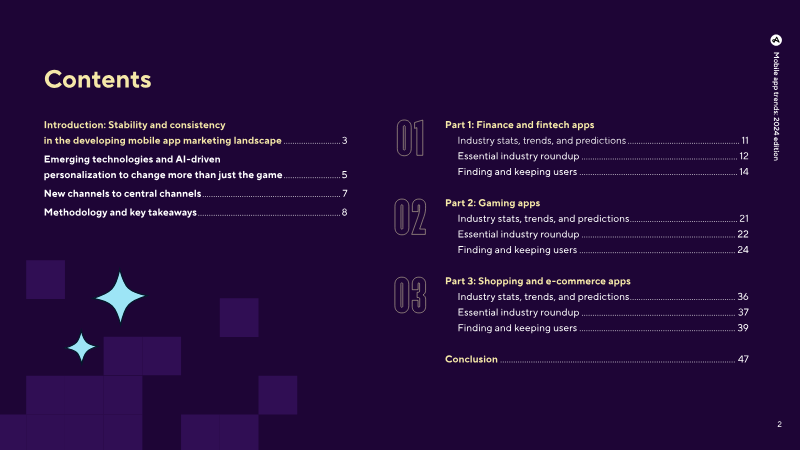
The mobile app industry entered 2026 with significant momentum, characterized by a 10% year-over-year increase in global installs and a 7% rise in sessions throughout 2025. Consumer spending reached a record $167 billion, signaling a robust digital economy. This growth coincides with a fundamental technological shift where artificial intelligence has transitioned from an experimental feature to essential infrastructure for predictive segmentation and data analysis. Furthermore, the industry is moving away from a strictly mobile-first approach toward multi-platform strategies designed to capture fragmented consumer journeys across various devices. User privacy sentiment is also stabilizing, with App Tracking Transparency opt-in rates climbing to 38% by early 2026. Sector-specific performance reveals a complex landscape of engagement and acquisition costs. While the global gaming population reached 3 billion in 2025, overall gaming installs remained flat as the cost per install rose 30% to $0.56. However, casual games outperformed the broader market with a 19% increase in installs and a 37% surge in sessions. In contrast, the e-commerce sector faced challenges as global installs fell by 10%, though Latin America emerged as a significant growth outlier with a 30% increase in user engagement. These trends suggest that while user acquisition is becoming more expensive in mature categories, specific genres and emerging markets continue to offer high-velocity growth opportunities. The finance sector demonstrated unique resilience, with sessions increasing by 21% despite a slight decline in installs, reflecting the deep integration of digital wallets into daily consumer habits. Finance apps also led the shift toward paid acquisition, achieving a paid-to-organic ratio of 1.13 as costs per install decreased in most regions. As the industry moves through 2026, success is increasingly defined by retention-led growth and sophisticated cross-channel attribution. Future scalability will depend on the ability of developers to leverage AI-driven personalization and cross-device measurement to maintain engagement in an increasingly competitive and fragmented global market.
The mobile app industry demonstrated significant resilience throughout 2023, characterized by a global advertising spend of $362 billion and a late-year surge in installations. While the landscape faced challenges such as rising acquisition costs and evolving privacy regulations, the fintech and e-commerce sectors emerged as primary growth engines. Fintech experienced a 42% increase in installs and a 118% surge in in-app revenue, while e-commerce saw a 43% year-over-year rise in installs alongside a 34% increase in revenue. These sectors successfully optimized their acquisition strategies, with banking eCPIs falling from $2.33 to $1.37, allowing marketers to achieve rapid returns on investment within the first week of user acquisition. The gaming sector navigated a more complex trajectory, ending the year with a 2% annual decline in installs despite a notable recovery in the fourth quarter. This rebound was driven by a 7% year-over-year growth in installs and the emergence of the hybrid casual genre. Although overall gaming sessions dipped, specific subverticals like racing and simulation saw dramatic install spikes of 61% and 53%, respectively. Global gaming stickiness remained stable at 20%, and high-engagement genres like RPG and adventure continued to command strong lifetime value, even as broader retention rates across the mobile ecosystem faced downward pressure. Future industry success depends on the strategic integration of artificial intelligence and predictive analytics to enhance personalization and automate complex workflows. To achieve sustained growth in 2024 and beyond, developers must diversify their media mixes by expanding into emerging channels like Connected TV and adopting holistic measurement frameworks. By combining incrementality testing with media mix modeling, stakeholders can better navigate the shift toward privacy-centric marketing while capitalizing on the high-potential returns offered by the global mobile marketplace.
The mobile application market entered a period of significant transition in 2023, navigating a complex landscape defined by economic volatility and evolving privacy regulations. Despite these headwinds, the industry achieved a record half-trillion dollars in combined advertising and consumer spending. While global advertising growth slowed to 14% and consumer spending experienced a marginal 2% decline, the sector demonstrated remarkable resilience through strategic adaptations. Key shifts include a rising App Tracking Transparency (ATT) opt-in rate of 29% and an increased reliance on media mix modeling and Connected TV (CTV) to optimize return on investment in a privacy-centric environment. Sector-specific performance reveals a stark contrast between industries. Fintech and e-commerce emerged as primary growth drivers, with fintech in-app revenue surging over 90% between late 2022 and early 2023. E-commerce sessions grew by 12%, supported by record-breaking revenue peaks in late 2022. Conversely, the mobile gaming industry faced its most challenging year on record in 2022, marked by a 12% decline in installs and a 9% drop in consumer spending. However, early 2023 data indicates a nascent recovery for gaming, with installs and sessions rebounding by 10% and 11% respectively over previous averages. The current market environment necessitates a shift from broad acquisition strategies toward long-term user retention and sophisticated measurement. As retention and "stickiness" remain persistent challenges across all verticals, developers are increasingly prioritizing reattribution campaigns, personalized onboarding, and loyalty programs. Success in the coming years depends on the adoption of advanced analytics and cross-platform insights to navigate data-privacy requirements. By leveraging these tools, stakeholders can effectively drive user acquisition and maximize lifetime value in an increasingly competitive global marketplace.
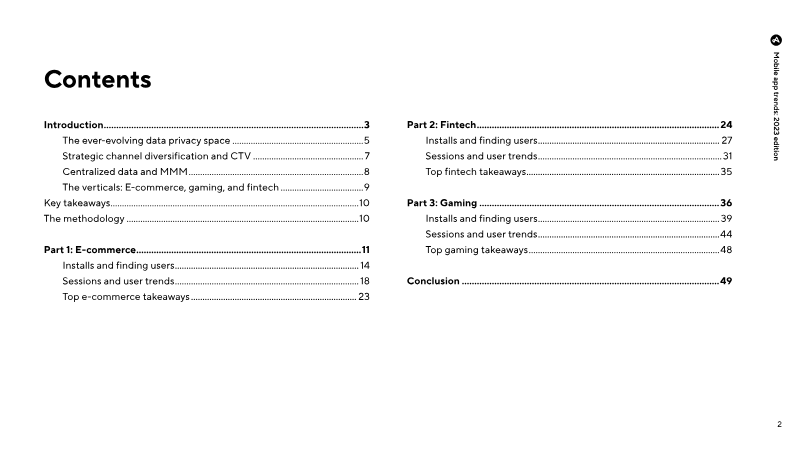
The mobile app industry experienced a period of robust expansion throughout 2021, characterized by $170 billion in consumer spending and $288 billion in advertising expenditures. Despite the implementation of Apple’s App Tracking Transparency framework, the sector demonstrated unexpected resilience as global opt-in rates reached 25%, significantly outperforming initial industry forecasts. This growth was distributed across several key verticals, with fintech and gaming leading the surge in installs at 35% and 32% respectively, while e-commerce maintained steady upward momentum with a 12% increase in downloads. Fintech emerged as a primary driver of engagement, particularly within the asset management and cryptocurrency subverticals. While traditional banking and payment apps maintained the highest share of installs, crypto apps achieved record session lengths exceeding 15 minutes. This heightened engagement occurred alongside a sharp rise in acquisition costs, with effective cost-per-install (eCPI) for fintech apps more than tripling. Consequently, developers are increasingly pivoting toward subscription-based models to ensure long-term profitability and offset the rising price of user acquisition. The e-commerce and gaming sectors mirrored this trend of higher costs paired with increased user value. Although e-commerce retention rates saw a slight decline, total in-app revenue jumped by 46%, driven by longer session durations in marketplace apps. Similarly, the gaming industry saw hyper-casual titles dominate download volumes while adventure and strategy games secured deeper engagement. Across all sectors, the transition toward higher-quality user bases is evident; while it is becoming more expensive to acquire users, those who remain are spending more time and money within apps, making retention and lifetime value the critical metrics for sustained success in a maturing mobile market.