Updated Mar 23, 2026 by Toho Holdings
Financial · November 1, 2017
Published by Toho Holdings
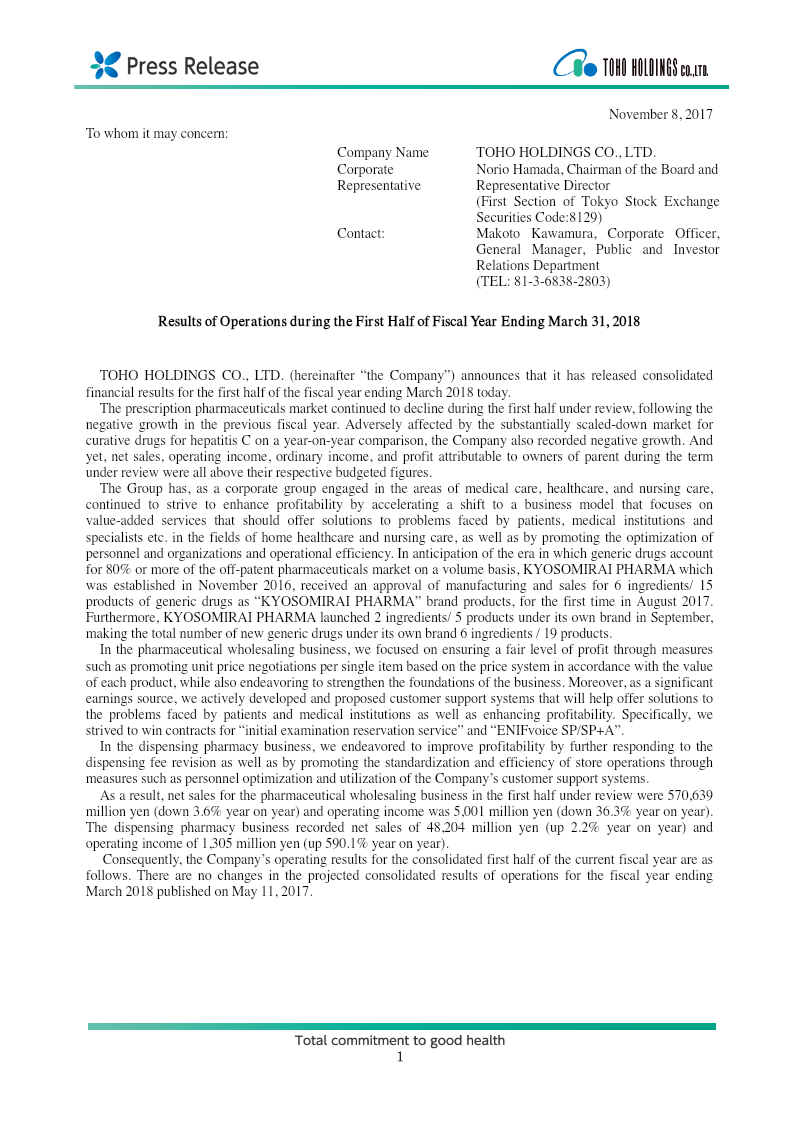
TOHO HOLDINGS CO., LTD. reported consolidated financial results for the first half of the fiscal year ending March 2018, reflecting a period of strategic transition within the Japanese medical, healthcare, and nursing care sectors. Despite a broader decline in the prescription pharmaceuticals market—exacerbated by a significant contraction in the hepatitis C curative drug segment—the company outperformed its internal budget projections across all primary financial metrics. This performance was driven by a shift toward value-added services and operational efficiencies, even as year-over-year consolidated net sales decreased by 3.2% to 595,962 million yen and operating income fell by 28.6% to 5,458 million yen. The pharmaceutical wholesaling business, which remains the company’s largest segment, faced headwinds with net sales of 570,639 million yen, a 3.6% decrease from the previous year. Conversely, the dispensing pharmacy business demonstrated strong growth, with net sales rising 2.2% to 48,204 million yen and operating income surging 590.1% to 1,305 million yen. These results were supported by the expansion of proprietary customer support systems and the launch of the KYOSOMIRAI PHARMA generic drug brand, which introduced 19 new products across 6 ingredients to align with the industry’s increasing reliance on generic alternatives. Management continues to prioritize the optimization of personnel and organizational structures to enhance profitability. By focusing on high-value solutions for medical institutions and patients, such as specialized voice-recognition software and examination reservation services, the company aims to mitigate market volatility. Given the performance in the first half, the company has maintained its original full-year earnings forecasts, signaling confidence in its current business model and ongoing efforts to strengthen its market foundation.
1 to the nearest million ven.) November 8, 2017 To whom it may concern: Company Name TOHO HOLDINGS CO., LTD. Corporate Norio Hamada, Chairman of the Board and Representative Representative Director (First Section of Tokyo Stock Exchange Securities Code:8129) Contact: Makoto Kawamura, Corporate Officer, General Manager, Public and Investor Relations Department (TEL: 81‑3‑6838‑2803) Results of Operations during the First Half of Fiscal Year Ending March 31, 2018 TOHO HOLDINGS CO., LTD. (hereinafter “the Company”) announces that it has released consolidated financial results for the first half of the fiscal year ending March 2018 today. The prescription pharmaceuticals market continued to decline during the first half under review, following the negative growth in the previous fiscal year. Adversely affected by the substantially scaled ‑down market for curative drugs for hepatitis C on a year ‑on‑year comparison, the Company also recorded negative growth. And yet, net sales, operating income, ordinary income, and profit attributable to owners of parent during the term under review were all above their respective budgeted figures. The Group has, as a corporate group engaged in the areas of medical care, healthcare, and nursing care, continued to strive to enhance profitability by accelerating a shift to a business model that focuses on value‑added services that should offer solutions to problems faced by patients, medical institutions and specialists etc. in the fields o f home healthcare and nursing care, as well as by promoting the optimization of personnel and organizations and operational efficiency.
ess model that focuses on value‑added services that should offer solutions to problems faced by patients, medical institutions and specialists etc. in the fields o f home healthcare and nursing care, as well as by promoting the optimization of personnel and organizations and operational efficiency. In anticipation of the era in which generic drugs account for 80% or more of the off‑patent pharmaceuticals market on a volume basis, KYOSOMIRAI PHARMA which was established in November 2016, received an approval of manufacturing and sales for 6 ingredients/ 15 products of generic drugs as “KYOSOMIRAI PHARMA” brand products, for the first time in August 2017. Furthermore, KYOSOMIRAI PHARMA launched 2 ingredients/ 5 products under its own brand in September, making the total number of new generic drugs under its own brand 6 ingredients / 19 products. In the pharmaceutical wholesaling business, we focused on ensuring a fair le vel of profit through measures such as promoting unit price negotiations per single item based on the price system in accordance with the value of each product, while also endeavoring to strengthen the foundations of the business. Moreover, as a significant earnings source, we actively developed and proposed customer support systems that will help offer solutions to the problems faced by patients and medical institutions as well as enhancing profitability.
while also endeavoring to strengthen the foundations of the business. Moreover, as a significant earnings source, we actively developed and proposed customer support systems that will help offer solutions to the problems faced by patients and medical institutions as well as enhancing profitability. Specifically, we strived to win contracts for “initial examination reservation service” and “ENIFvoice SP/SP+A”. In the dispensing pharmacy business, we endeavored to improve profitability by further responding to the dispensing fee revision as well as by promoting the standardization and efficiency of sto re operations through measures such as personnel optimization and utilization of the Company’s customer support systems. As a result, net sales for the pharmaceutical wholesaling business in the first half under review were 570,639 million yen (down 3.6% y ear on year) and operating income was 5,001 million yen (down 36.3% year on year). The dispensing pharmacy business recorded net sales of 48,204 million yen (up 2.2% year on year) and operating income of 1,305 million yen (up 590.1% year on year). Consequently, the Company’s operating results for the consol idated first half of the current fiscal year are as follows. There are no changes in the projected consolidated results of operations for the fiscal year ending March 2018 published on May 11, 2017.
1 to the nearest million ven.) Unit: million yen (Amounts are truncated to the nearest million yen.) Consolidated Net Sales Operating Ordinary Profit attributable Income Income to owners of parent First Half, FY ending March 2018 595,962 5,458 8,408 5,132 First Half, FY ended March 2017 615,778 7,640 10,569 6,890 YoY Change -19,816 -2,182 -2,160 -1,757 YoY Change Ratio 96.8% 71.4% 79.6% 74.5% Forecasts for the First Half, FY 573,000 5,000 7,200 4,000 Ending March 2018 Comparison with Forecasts for the 104.0% 109.2% 116.8% 128.3% First Half, FY Ending March 2018 Forecasts for the 1,186,000 14,300 18,700 10,300 FY Ending March 2018 Percentage against the 50.2% 38.2% 45.0% 49.8% Full‑year Earnings Forecasts
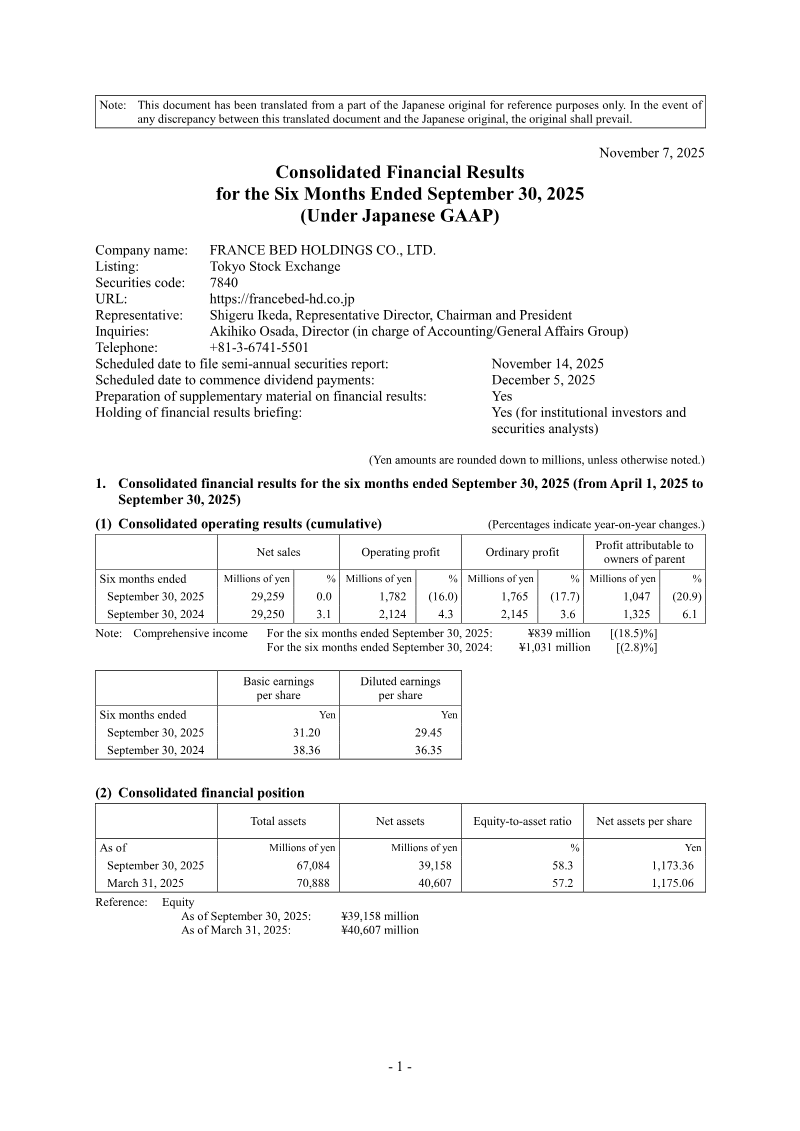
France Bed Holdings Co., Ltd. released its consolidated financial results for the six-month period ending September 30, 2025, prepared in accordance with Japanese GAAP. The report details the company’s operating performance, financial position, and cash flow status, while maintaining its previously announced earnings forecasts for the full fiscal year ending March 31, 2026. During the first half of the fiscal year, the company reported net sales of 29,259 million yen, remaining essentially flat compared to the same period in the previous year. However, profitability metrics experienced a decline, with operating profit falling 16.0% to 1,782 million yen and ordinary profit decreasing 17.7% to 1,765 million yen. Profit attributable to owners of the parent reached 1,047 million yen, representing a 20.9% year-on-year decline. Basic earnings per share for the period were 31.20 yen, down from 38.36 yen in the prior year. The company’s financial position as of September 30, 2025, shows total assets of 67,084 million yen and net assets of 39,158 million yen, resulting in an equity-to-asset ratio of 58.3%. Cash flows from operating activities provided 2,541 million yen, while investing and financing activities reflected ongoing capital allocation, including the purchase of treasury shares and continued investment in property, plant, and equipment. Looking ahead to the full fiscal year ending March 31, 2026, the company maintains its forecast of 62,300 million yen in net sales and 4,750 million yen in operating profit. These projections reflect a modest growth expectation of 2.8% in sales and 1.1% in operating profit compared to the previous fiscal year. The company continues to operate under stable accounting policies with no significant changes in the scope of consolidation.
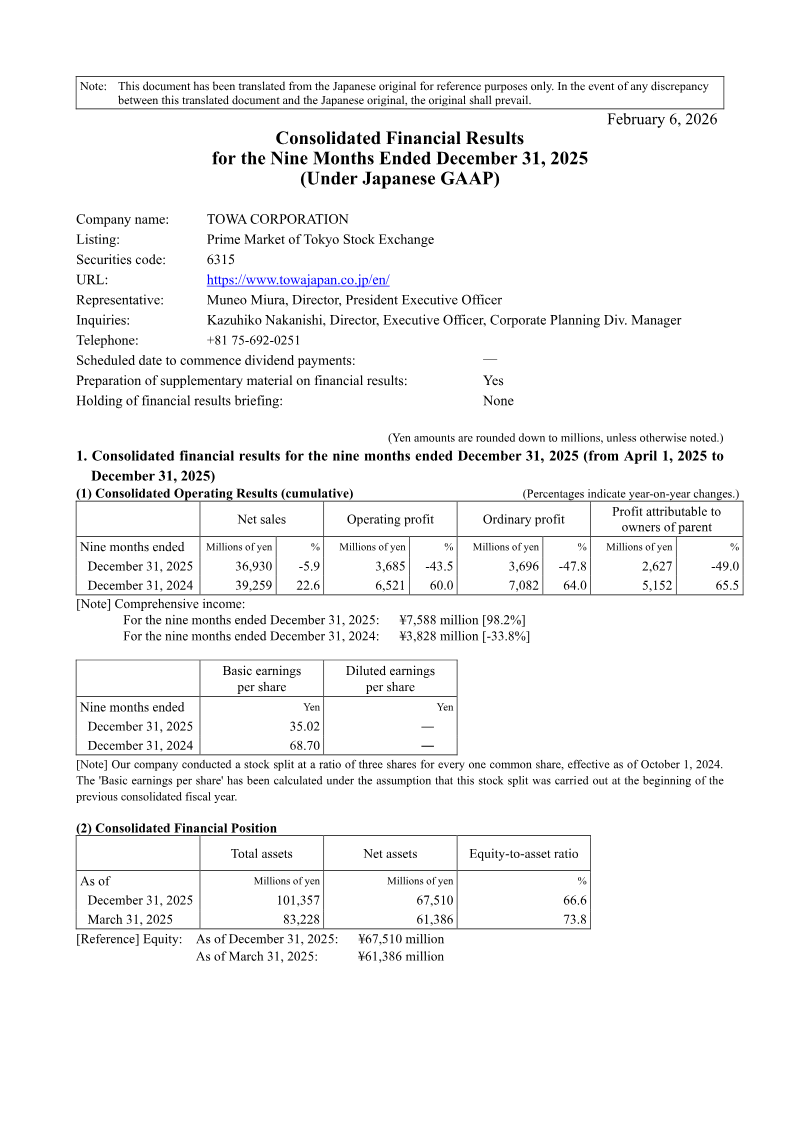
TOWA Corporation’s consolidated financial results for the nine months ended December 31, 2025, reflect a challenging period characterized by a year-on-year decline in both revenue and profitability. Net sales reached 36,930 million yen, representing a 5.9% decrease compared to the same period in the previous year. Operating profit fell significantly by 43.5% to 3,685 million yen, while profit attributable to owners of the parent declined by 49.0% to 2,627 million yen. These results were primarily driven by a shift in product mix, increased development costs, and the adverse impacts of U.S. tariff policies and sluggish demand within the automotive semiconductor sector. The company operates across three primary segments: Semiconductor Manufacturing Equipment, Medical Device, and Laser Processing Machine. The Semiconductor Manufacturing Equipment business, which constitutes the majority of total sales, saw a 6.0% decline in revenue to 33,940 million yen. While the Medical Device segment experienced a modest revenue increase of 7.8%, the Laser Processing Machine business faced a 20.0% decline in sales and an operating loss of 86 million yen. Despite these headwinds, the company reported a strong order environment, particularly for AI and data center-related memory applications, with third-quarter orders reaching their second-highest level on record. As of December 31, 2025, the company’s financial position remains stable with total assets of 101,357 million yen and an equity-to-asset ratio of 66.6%. Looking ahead, the company has revised its full-year forecasts downward due to delayed revenue recognition from mass production investments and higher costs associated with initial shipments. However, management anticipates a recovery trend, supported by a robust order backlog and expected improvements in product mix as demand for compression equipment grows.
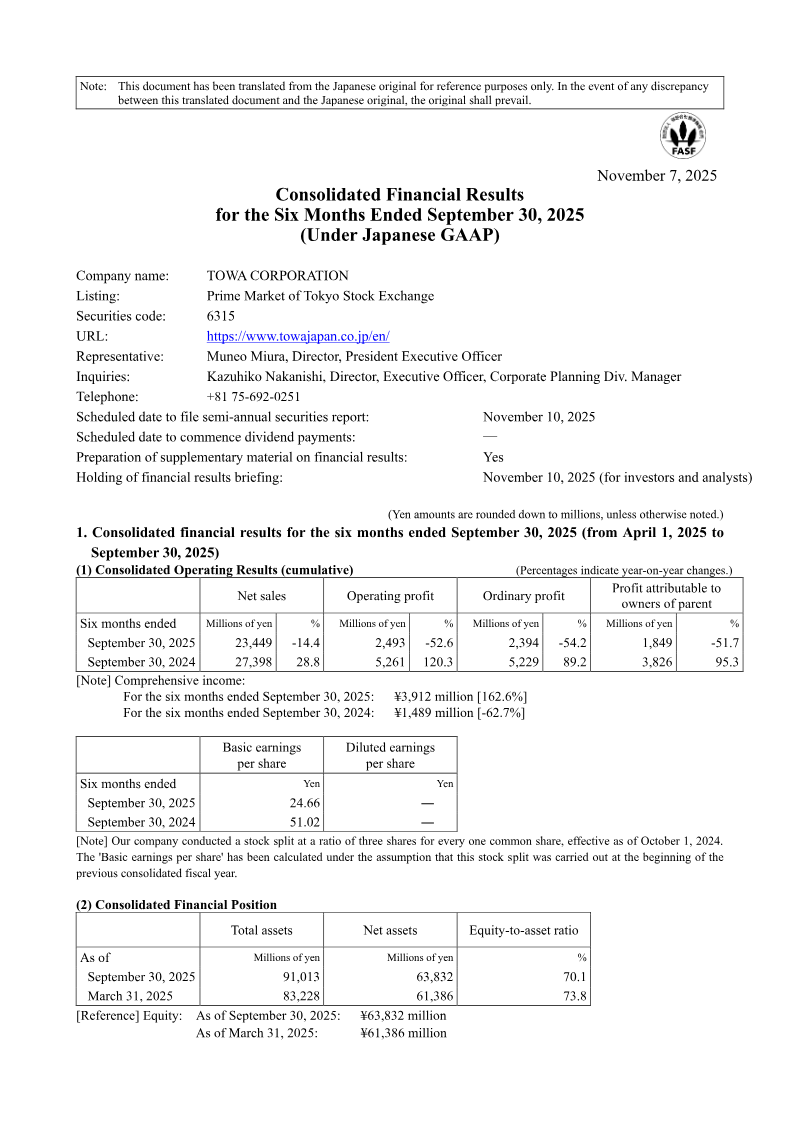
TOWA CORPORATION’s consolidated financial results for the six months ended September 30, 2025, reflect a period of significant year-on-year decline in both revenue and profitability. The company reported net sales of 23,449 million yen, a 14.4% decrease compared to the same period in the previous fiscal year. Operating profit fell by 52.6% to 2,493 million yen, while profit attributable to owners of the parent dropped 51.7% to 1,849 million yen. These results were primarily driven by a slowdown in orders that began in the second half of the previous fiscal year, stemming from weak demand in consumer and memory semiconductor markets and the impact of international tariff policies. The semiconductor manufacturing equipment business, which represents the company’s primary segment, saw net sales decline by 14.7% to 21,585 million yen, with operating profit falling 53.6%. The laser processing machine business also struggled, reporting an operating loss of 82 million yen. Conversely, the medical device business showed resilience, achieving an 8.4% increase in net sales to 1,224 million yen. Despite the overall downturn, the company noted a gradual recovery in capital investment during the second quarter, particularly in China, Taiwan, and other Asian markets, which helped profits exceed initial internal expectations. As of September 30, 2025, the company maintained a solid financial position with total assets of 91,013 million yen and an equity-to-asset ratio of 70.1%. Given the ongoing market uncertainties and fluctuating customer investment trends, the company has opted to maintain its previously announced full-year earnings forecast for the fiscal year ending March 31, 2026, which projects net sales of 56,000 million yen and an operating profit of 9,800 million yen.
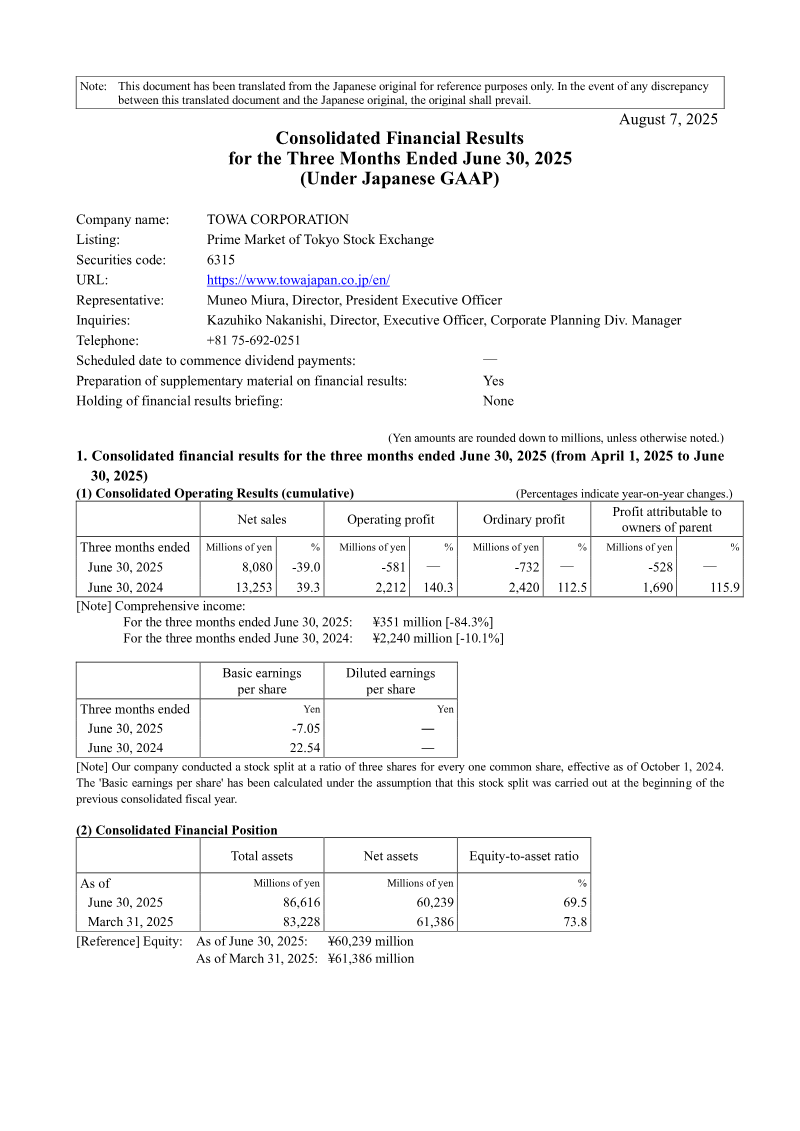
TOWA CORPORATION’s consolidated financial results for the first quarter ended June 30, 2025, reflect a period of significant contraction compared to the same period in the previous fiscal year. The company reported net sales of 8,080 million yen, representing a 39.0% year-on-year decline. Profitability metrics also shifted into negative territory, with an operating loss of 581 million yen, an ordinary loss of 732 million yen, and a loss attributable to owners of the parent of 528 million yen. This performance stands in stark contrast to the first quarter of 2024, which saw an operating profit of 2,212 million yen. The primary driver of this downturn was the semiconductor manufacturing equipment business, which experienced a 41.2% decrease in net sales, resulting in an operating loss of 607 million yen. Management attributes this decline to heightened uncertainty regarding U.S. tariff policies, which prompted customers to adopt a cautious approach to capital investment and led to the rescheduling of equipment deliveries. While the medical device business maintained steady performance with a 4.3% increase in net sales, the laser processing machine business also saw a decline, with net sales falling 33.2% year-on-year. Despite these results, the company maintains a neutral outlook for the remainder of the fiscal year. Management reports that the order environment is showing signs of recovery, particularly in China, and notes that the customer base for its generative AI-related molding equipment is expanding. Consequently, the company has not revised its previously announced consolidated earnings forecasts for the second quarter or the full fiscal year, anticipating a return to profitability as capital investment and demand recover across key Asian markets.