FinancialKaga Electronics Co.
Summary of Consolidated Financial Results: First Half Ended September 30, 2016
1 Nov 201612 pages~19 min full read
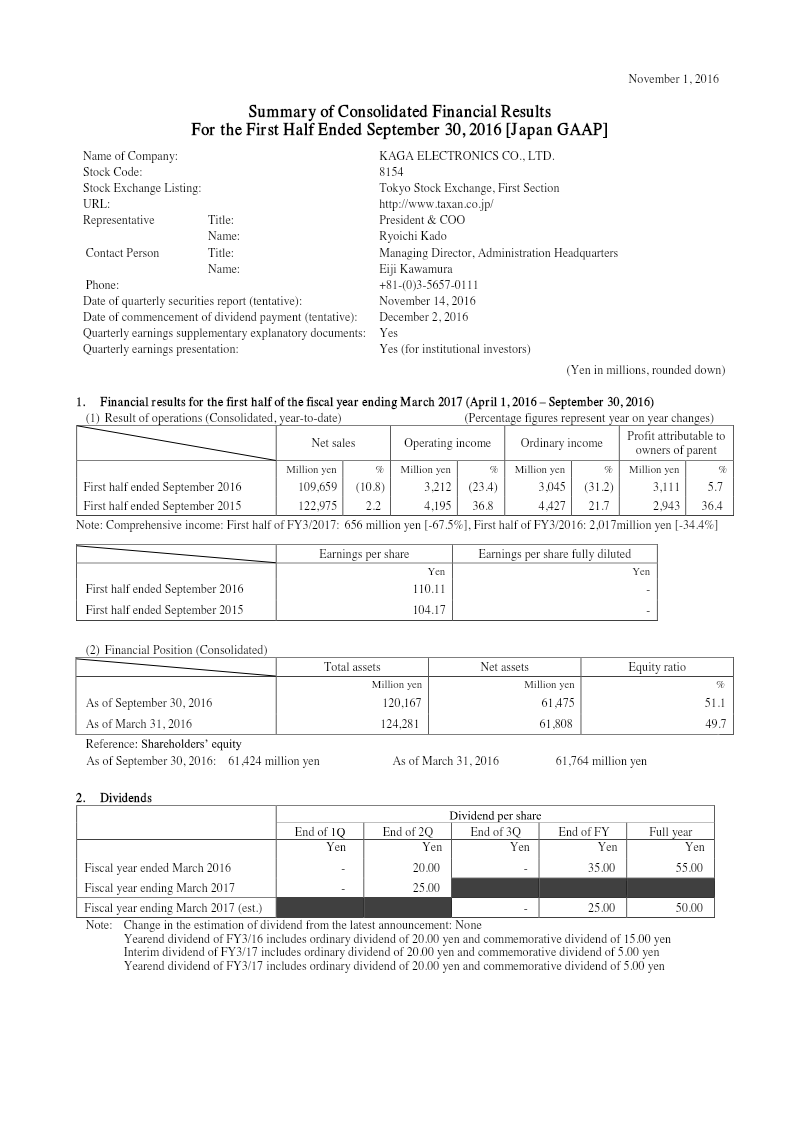
Kaga Electronics reported a 10.8% year-on-year decline in net sales to 109,659 million yen for the first half of the fiscal year ending September 30, 2016.
See it on page 1Operating income fell by 23.4% to 3,212 million yen, while ordinary income dropped 31.2% to 3,045 million yen due to soft demand in traditional markets like PCs and smartphones.
See it on page 4Profit attributable to owners of the parent increased by 5.7% to 3,111 million yen, primarily driven by the impact of tax effect accounting.
See it on page 8The electronic components segment, the company's largest business unit, saw sales decline by 13.6%.
See it on page 4The information equipment segment bucked the downward trend with a 2.0% increase in sales and a 135.5% surge in operating income.
See it on page 12The company maintained a stable financial position with an equity ratio of 51.1% and generated 7,723 million yen in net cash from operating activities.
See it on page 1Management is reallocating resources toward high-growth sectors including automotive electronics, IoT, and artificial intelligence while maintaining its original full-year forecasts for the fiscal year ending March 2017.
See it on page 4Kaga Electronics Co., Ltd. reported consolidated financial results for the first half of the fiscal year ending March 31, 2017, reflecting a challenging period for the Japanese electronics industry. The company’s primary objective during this period was to optimize business efficiency and reallocate resources toward high-growth sectors, such as automotive electronics, the Internet of Things (IoT), and artificial intelligence, to counter soft demand in traditional markets like PCs, smartphones, and amusement products.
Financial performance for the six-month period ending September 30, 2016, showed a decline in top-line results, with net sales falling 10.8% year-on-year to 109,659 million yen. Operating income decreased by 23.4% to 3,212 million yen, and ordinary income dropped 31.2% to 3,045 million yen. Despite these declines, profit attributable to owners of the parent rose 5.7% to 3,111 million yen, largely due to the impact of tax effect accounting. The electronic components segment, the company’s largest, experienced a 13.6% decline in sales, while the information equipment segment saw a 2.0% increase in sales and a significant 135.5% rise in operating income.
The company maintained a stable financial position with an equity ratio of 51.1%. Cash and cash equivalents increased to 25,683 million yen, supported by strong net cash provided by operating activities, which reached 7,723 million yen. Management noted that the Japanese economy remained flat during this period, influenced by currency fluctuations and global economic uncertainty. The company confirmed no changes to its previously announced full-year forecasts for the fiscal year ending March 2017, maintaining a focus on strengthening its core operations and expanding its international footprint.