Turtle Beach
Game Co.23 documents
Gaming headsets and accessories. #1 console gaming headset brand. Also PDP controllers.
Documents
Article
Form 10-Q: Q2 FY2026
Turtle Beach Corporation faces significant financial headwinds during the first half of fiscal year 2026, characterized by a net loss of $22.5 million and an 18.4% decline in net revenue to $98.5 million. These results stem from softer consumer demand and broader macroeconomic pressures affecting the gaming peripheral market. Despite these challenges, the company generated $35.9 million in cash from operating activities, bolstered by favorable working capital adjustments and an $8.2 million tariff refund received during the second quarter.
The company’s capital structure underwent a major transition with the establishment of an $85 million 2026 Term Loan Facility and a new revolving credit facility, both maturing in April 2029. While this refinancing incurred a $1.8 million loss on debt extinguishment and increased interest expenses, it provided the necessary liquidity to manage obligations. As of June 30, 2026, the company maintains $19.6 million in cash and approximately $31 million in excess borrowing availability, ensuring sufficient funding to support ongoing operations and a $75 million stock repurchase program, under which 1.99 million shares were acquired during the quarter.
Operational oversight remains a priority as management works to remediate previously identified material weaknesses in disclosure controls and procedures. Although the company is currently navigating multiple intellectual property lawsuits, it does not expect these legal matters to have a material adverse effect on its financial position. With total assets decreasing to $215.2 million, the company continues to focus on inventory management and debt compliance to stabilize its financial standing while navigating a difficult retail environment. Market capitalization currently remains above the business's carrying value, precluding the need for goodwill impairment charges at this time.
- Turtle Beach reported a net loss of $7.3 million for the three months ended June 30, 2026, and a $22.5 million net loss for the first half of the year.
- Net revenue for the first six months of 2026 declined 18.4% to $98.5 million compared to the same period in 2025, driven by softer market demand for gaming accessories and macroeconomic headwinds.
- On April 30, 2026, the company entered into an $85 million term loan facility with Blue Torch to refinance existing debt, resulting in a $1.8 million loss on debt extinguishment.
- Gross margin improved to 38.8% in Q2 2026 from 32.2% in Q2 2025, primarily due to a $4.3 million tariff refund recognized during the quarter.
- The company aggressively repurchased $25 million of its common stock during the three months ended June 30, 2026, totaling $27.2 million in share repurchases for the first half of the year.
+2
Turtle BeachAug 2026
Financial26 pages
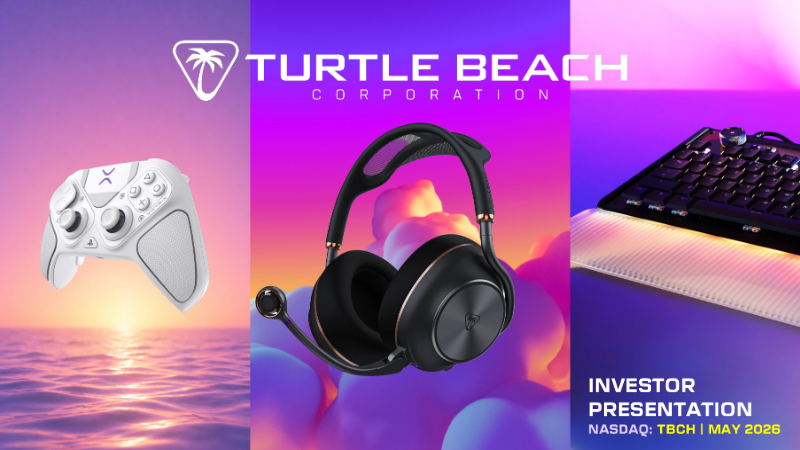
Turtle Beach Corporation: Investor Presentation
Turtle Beach Corporation operates as a prominent leader in the global gaming accessories market, maintaining a long-standing reputation for its gaming headsets, controllers, and PC peripherals. The company’s primary strategic objective is to leverage its brand heritage and innovation pipeline to capture growth within the $11.2 billion global gaming accessories sector. By transitioning from a performance-focused hardware manufacturer to a broader lifestyle brand, the company aims to engage mainstream gamers and capitalize on the expanding social nature of modern gaming.
The company’s market position is supported by significant historical performance, including 16 consecutive years as a top-selling gaming headset brand and a global distribution network spanning over 470,000 points of sale. Financial performance for the first quarter of 2026 reflected a challenging period, with revenue totaling $42.2 million compared to $63.9 million in the prior-year period. This decline was attributed to broader market softness and a temporary reduction in channel inventory ahead of new product launches. Consequently, the company reported a net loss of $15.2 million and an Adjusted EBITDA loss of $6.5 million for the quarter.
Despite these short-term headwinds, the company maintains a positive outlook for the full year 2026, projecting net revenue between $335 million and $355 million and Adjusted EBITDA between $44 million and $48 million. This guidance is predicated on an anticipated recovery in the gaming accessories market, driven by new console hardware momentum and the highly anticipated release of major software titles. To support this growth, the company is executing a balanced financial strategy that includes debt refinancing to enhance liquidity, ongoing investment in product innovation, and a disciplined capital allocation program that has seen approximately $50 million in common share repurchases since 2024.
- Turtle Beach projects full-year 2026 net revenue between $335 million and $355 million and Adjusted EBITDA of $44 million to $48 million, anticipating a market recovery driven by new console hardware and major software releases.
- Q1 2026 financial results showed a significant decline, with revenue falling to $42.2 million from $63.9 million in the prior-year period, resulting in a $15.2 million net loss.
- The company is shifting its strategic focus from a performance-focused hardware manufacturer to a broader lifestyle brand to capture growth in the $11.2 billion global gaming accessories market.
- Turtle Beach maintains a distribution network of over 470,000 points of sale and has held the position of top-selling gaming headset brand for 16 consecutive years.
- Management is executing a financial strategy that includes debt refinancing to improve liquidity and a capital allocation program that has repurchased approximately $50 million in common shares since 2024.
+2
Turtle Beach
Article
Form 10-Q: Q1 FY2026
Turtle Beach Corporation experienced a challenging start to fiscal year 2026, characterized by a significant contraction in financial performance. During the first quarter, net revenue fell to $42.2 million, down from $63.9 million in the same period of the previous year. This decline, attributed to broader macroeconomic pressures and softening demand for gaming accessories, resulted in a net loss of $15.2 million, a substantial increase over the $0.7 million loss reported in the first quarter of 2025. Operating losses reached $14.1 million, reflecting the impact of inflationary pressures and interest rate volatility on profit margins.
To stabilize its financial position, the company executed a major refinancing strategy immediately following the close of the quarter. On April 30, 2026, Turtle Beach repaid its 2025 Credit Facility in full, replacing it with a new $85 million term loan and a revolving credit facility, both maturing in 2029. These instruments are intended to support general corporate purposes and ongoing product development. Despite these liquidity measures, the company continues to navigate operational hurdles, including ongoing intellectual property litigation and the need to remediate previously identified material weaknesses in its disclosure controls and procedures, which were deemed ineffective as of March 31, 2026.
The company maintains a cautious outlook, balancing its inventory levels of $64.3 million against the realities of a volatile consumer market. While management asserts that current cash reserves and the newly secured credit facilities are sufficient to sustain operations and strategic initiatives, the firm remains exposed to external economic headwinds. No changes to executive trading arrangements were reported during this period, and the company continues to focus on internal governance and the resolution of outstanding legal and financial reporting challenges to restore long-term stability.
- Turtle Beach reported a net loss of $15.2 million for the first quarter ended March 31, 2026, compared to a net loss of $0.66 million in the same period of 2025.
- On April 30, 2026, the company entered into a new $60 million to $80 million revolving credit facility (depending on the season) with Bank of America, maturing in April 2029.
- As of March 31, 2026, the company held $12.3 million in cash and cash equivalents, down from $16.9 million at the start of the year.
- Goodwill remains valued at $50.4 million, with the company reporting no impairment indicators and confirming that market capitalization continues to exceed the net carrying value of the business.
- Customer concentration remains significant, with three major customers accounting for 23.8%, 17.2%, and 13.8% of revenue respectively during the first quarter of 2026.
+2
Turtle BeachMay 2026
Article
Annual Report on Form 10-K: 2025
Turtle Beach Corporation, a San Diego-based leader in the global gaming peripherals market, maintains a dominant position in console headsets and controllers. Following the 2024 acquisition of Performance Designed Products, the company operates within an $11.2 billion industry, serving a vast base of active gamers through a diverse portfolio of simulation gear and accessories. The primary objective of the 2025 fiscal year was the integration of this acquisition to bolster market share, despite facing a 14.2% decline in net revenue to $319.9 million due to softer consumer demand.
Financial performance in 2025 was characterized by disciplined cost management, which improved gross margins to 37.3% and yielded a net income of $15.7 million. While Adjusted EBITDA fell to $40.1 million from the previous year’s $56.4 million, the company significantly improved its cash position, reporting $35.5 million in net cash from operating activities. To ensure long-term stability, the company consolidated its debt under a new $150 million credit agreement in August 2025, maintaining sufficient liquidity and full compliance with all financial covenants as of year-end.
Operational risks remain a central concern, as the company navigates supply chain vulnerabilities, inflationary pressures, and a heavy reliance on three major retail customers who account for over 58% of total revenue. Furthermore, the company faces ongoing challenges regarding intellectual property litigation and the need to adapt to rapid technological shifts. Although previous internal control weaknesses were remediated, a new material weakness in IT general controls led to an adverse opinion on internal control over financial reporting for 2025. Despite these hurdles, the company continues to prioritize shareholder value, evidenced by a $75 million stock repurchase program and strategic investments in product innovation to sustain its competitive edge in the global gaming market.
- Turtle Beach reported a 14.2% decline in net revenue to $319.9 million for fiscal year 2025, attributed to softer consumer demand.
- The company achieved a net income of $15.7 million and improved gross margins to 37.3% through disciplined cost management.
- Revenue concentration remains a significant risk, with three major retail customers accounting for over 58% of total revenue.
- An adverse opinion on internal control over financial reporting was issued for 2025 due to a newly identified material weakness in IT general controls.
- The company consolidated its debt under a new $150 million credit agreement in August 2025 and reported $35.5 million in net cash from operating activities.
+2
Turtle BeachMar 2026
Financial1 pages
Turtle Beach 10-Q: Q3 FY2025
Turtle Beach’s Q3 FY2025 filing presents a mixed financial picture for the gaming peripherals company. Net revenue fell 12 % to $80.5 million, while gross profit declined to $30.1 million as cost of revenue rose to $50.4 million, reflecting higher tariffs and integration costs from the recent acquisition of Performance Designed Products (PDP). Operating income swung to a $5.4 million loss, driven by increased selling‑and‑marketing and R&D expenses and a $3.7 million interest charge, resulting in a net loss of $1.9 million for the quarter.
The PDP purchase, priced at $114.4 million and financed through a new term loan, added significant goodwill ($39.7 million) and integrated $54.4 million of net revenue over the nine‑month period. Concurrently, Turtle Beach restructured its debt, replacing a revolving facility with a $60 million term loan and a $90 million revolving line, while recording a $2.3 million deferred financing cost. Cash reserves slipped to $12.3 million, largely due to the acquisition and related financing activity.
Risk disclosures highlight a debt maturity schedule with $48.4 million in non‑current term loan debt and ongoing litigation that could materially affect the company if adverse outcomes occur. The firm has settled several shareholder class actions and a German insolvency dispute, but remains involved in multiple IP disputes. Treasury activity includes a $10.3 million share repurchase and a total nine‑month cost of $17.0 million.
Financial metrics beyond GAAP are also reported; Adjusted EBITDA for the nine‑month period was $11.98 million versus $20.76 million in 2024, underscoring a decline in core operating profitability. Market risk is primarily driven by interest‑rate, foreign‑currency and inflationary pressures, with hedging activity limited to forward contracts on British‑Pound expenses. Overall, the company’s performance reflects integration challenges and heightened financing costs amid a competitive gaming hardware market in North America, Europe and Asia over the 2025 fiscal year.
- Turtle Beach reported a net loss of $1.9 million for Q3 FY2025, with net revenue falling 12% to $80.5 million and operating income swinging to a $5.4 million loss.
- The $114.4 million acquisition of Performance Designed Products (PDP) significantly impacted financials, contributing to a rise in cost of revenue to $50.4 million and adding $39.7 million in goodwill.
- Adjusted EBITDA for the first nine months of FY2025 dropped to $11.98 million, down from $20.76 million in the same period of 2024, signaling a decline in core operating profitability.
- Cash reserves decreased to $12.3 million, driven by the PDP acquisition, related financing activities, and a $10.3 million share repurchase program.
- The company restructured its debt by replacing a revolving facility with a $60 million term loan and a $90 million revolving line, leaving $48.4 million in non-current term loan debt.
Turtle BeachNov 2025
Article
10-Q Q2 FY2025
Turtle Beach Corporation reported Q2 FY2025 financial results that illustrate a mixed performance amid ongoing acquisition costs and market headwinds. Net revenue for the six‑month period ended June 30, 2025 rose to $56.8 million, a 25% year‑over‑year increase, yet gross profit fell to $18.3 million as cost of revenue climbed to $38.5 million, resulting in a gross margin improvement from 30.2% to 32.2%. Operating expenses, including a $1.39 million acquisition‑related charge from the PDP purchase, pushed the company into a net loss of $3.6 million ($0.17 per share) for the six months, compared with a $7.52 million loss in the same period 2024.
Cash flow from operating activities was $A million, while cash on hand declined to $11.71 million from $12.99 million due to borrowing and repayment activity on a revolving credit facility. Total assets stood at $B million, with inventories increasing to $76.8 million and net property and equipment reduced by a $14.9 million write‑off. Long‑term debt remained largely unchanged, comprising a $50 million term loan and an $8.9 million revolving facility; interest expense for the quarter was $2.0 million.
The company’s balance sheet and debt profile remain compliant with all covenants under a new $60 million term loan and $90 million revolving credit facility entered into August 2025. Adjusted EBITDA improved to $3.0 million from a $1.0 million loss in the prior year’s six‑month period, reflecting lower acquisition costs and insurance recoveries. Intellectual‑property litigation continues, but no contingent loss reserves have been recorded due to the low likelihood of adverse outcomes. Warranty liabilities were $736 k, with uncertain tax positions totaling $2.5 million, including $0.6 million in interest and penalties.
Overall, Turtle Beach’s Q2 FY2025 results demonstrate revenue growth amid higher operating costs and debt servicing, with a narrowed loss profile and improved profitability metrics in the gaming peripherals market, which remains a $11 billion global industry driven by console and PC franchises.
- Turtle Beach reported a 25% year-over-year increase in net revenue to $56.8 million for the six-month period ending June 30, 2025.
- The company narrowed its net loss to $3.6 million ($0.17 per share) for the first half of 2025, compared to a $7.52 million loss during the same period in 2024.
- Adjusted EBITDA improved to $3.0 million for the six-month period, a significant recovery from the $1.0 million loss recorded in the prior year.
- Gross margin improved to 32.2% from 30.2%, despite gross profit falling to $18.3 million due to a rise in cost of revenue to $38.5 million.
- Operating expenses were impacted by a $1.39 million acquisition-related charge from the PDP purchase and a $14.9 million write-off of property and equipment.
Turtle BeachAug 2025
Financial1 pages
10-K: FY 2024
Turtle Beach Corporation’s FY 2024 10‑K demonstrates a robust rebound driven largely by the acquisition of Performance Designed Products (PDP). Net revenue surged 55 % to $372.8 million, with gross margin improving from 29.3 % to 34.6 %. Operating income flipped from a $16.4 million loss in 2023 to a $20.0 million profit, and net income turned positive at $16.2 million after a tax benefit of $5.5 million. The PDP deal added $97.4 million in net revenue, $42.3 million of goodwill, and significant intangible assets, while the company maintained liquidity through a $50 million term loan and $50 million revolving credit facility, leaving roughly $30.3 million of borrowing capacity at year‑end.
Revenue remains highly seasonal and retail‑centric, with 70 % of sales channeled through major U.S. and European retailers such as Walmart, Amazon, and Best Buy. Inflationary pressures, component shortages, and logistics disruptions threaten margins if price increases cannot be passed to consumers. Concentration risk is pronounced—approximately 69 % of gross sales come from a handful of large customers—and the company faces ongoing internal‑control weaknesses, including material misstatements in revenue recognition and a $3.4 million inventory loss.
Geographically, North America accounts for 76 % of revenue, while Europe & Middle East contribute $76.3 million, underscoring a focus on expanding beyond the U.S. market. The firm’s strategy centers on product line expansion into controllers and simulation accessories, leveraging the PDP acquisition to strengthen its position in a $2.9 billion headset market and a $3 billion controller market. Risks include intellectual‑property disputes with platform makers, potential default on debt covenants, cyber‑security threats, and regulatory compliance challenges across data privacy, ESG, and securities laws. Despite these risks, Turtle Beach’s financial turnaround and strategic acquisitions position it for continued growth in the competitive gaming‑accessory landscape.
- Turtle Beach achieved a financial turnaround in FY 2024, reporting $372.8 million in net revenue—a 55% increase—and shifting from a $16.4 million operating loss in 2023 to a $20.0 million profit.
- The acquisition of Performance Designed Products (PDP) was the primary growth driver, contributing $97.4 million in net revenue and expanding the company's footprint into the $3 billion controller and simulation accessory markets.
- The company faces significant customer concentration risk, with approximately 69% of gross sales derived from a small group of major retailers, including Walmart, Amazon, and Best Buy.
- Operating margins improved to 34.6% from 29.3% in the prior year, though profitability remains vulnerable to inflationary pressures, logistics disruptions, and potential inability to pass costs to consumers.
- Internal control weaknesses persist, highlighted by material misstatements in revenue recognition and a $3.4 million inventory loss reported during the fiscal year.
+2
Turtle BeachMar 2025
Article
10‑Q 2024 Q1
Turtle Beach’s first‑quarter 2024 financial results demonstrate a marked turnaround from the prior year, with net revenue increasing to $55.8 million and gross profit rising to $17.8 million, reflecting a 4.4 % revenue growth and an improvement in gross margin to 31.8 %. Operating expenses climbed to $23.5 million, largely driven by a $4.9 million increase in acquisition‑related costs following the purchase of PDP, which added $5.9 million in revenue and created $42.2 million of goodwill. The acquisition also generated a $6.4 million tax benefit from the reversal of valuation allowances and foreign tax adjustments, offsetting a $6.7 million deferred‑tax expense that contributed to the quarter’s net loss of only $155 thousand.
Cash flow remains robust, with operating cash inflows of $27.3 million and a net cash decrease of $910 thousand after investing outflows of $76.2 million for the PDP purchase and borrowing of $80.3 million under a revolving‑credit facility. Total assets rose to $258.4 million, driven by goodwill and intangible asset increases, while stockholders’ equity improved to $125.2 million despite remaining negative due to accumulated deficits. The company maintains compliance with all covenants of its $50 million term loan and revolving credit facility, leaving approximately $43.8 million of unused borrowing capacity.
Operationally, the company expanded its product line with the launch of the VelocityOne™ Race wheel‑pedal set and plans for additional racing‑sim accessories, supporting a 31.8 % gross margin. Warranty reserves and operating‑lease liabilities remain stable, with a lease portfolio of $10.1 million in obligations and minimum payments of $12.0 million over five years. Legal exposure is limited to a settled shareholder class action, dismissed opt‑out suit, and an unresolved German insolvency claim; no accrued losses are recorded. Management acknowledges that new accounting guidance, inflationary pressures, and interest‑rate fluctuations could materially affect future results.
- Turtle Beach acquired PDP, which contributed $5.9 million in revenue and resulted in $42.2 million of goodwill, while driving a $4.9 million increase in acquisition-related operating expenses.
- First-quarter 2024 net revenue grew 4.4% year-over-year to $55.8 million, with gross profit rising to $17.8 million and gross margin improving to 31.8%.
- The company reported a net loss of $155,000, heavily impacted by a $6.7 million deferred-tax expense that was largely offset by a $6.4 million tax benefit.
- Operating cash flow reached $27.3 million, though the company utilized $76.2 million for the PDP acquisition, funded in part by $80.3 million in new revolving-credit borrowings.
- Total assets increased to $258.4 million, and the company maintains $43.8 million in unused borrowing capacity while remaining in compliance with all debt covenants.
+1
Turtle BeachMay 2024
Financial1 pages
Form 10-K: FY 2023
Turtle Beach Corporation, a Nevada‑based gaming‑accessory manufacturer headquartered in White Plains, New York, reported FY 2023 results that underscore its continued dominance in the U.S. console‑headset market while highlighting strategic diversification and financial resilience. Net revenue rose 7 % to $258 million, driven by strong headset sales and the VelocityOne flight‑simulation line; gross margin improved to 29.3 % from 20.5 % in 2022, largely due to lower freight and promotional costs. Operating income swung to a $16 million loss from a $20 million profit in 2022, with a net loss of $17.7 million attributable to higher stock‑based compensation and goodwill impairment. Cash flow from operations turned positive at $27 million, and the company maintained an $80 million revolving credit facility with $60.6 million of unused capacity, meeting all covenants.
The company’s market position remains concentrated: 70 % of sales come from five major retailers, and holiday season drives 45 % of revenue. Risks include supply‑chain volatility, product launch delays, intellectual‑property exposure, and foreign‑currency fluctuations. Cybersecurity measures are in place, but legal proceedings and potential litigation remain material concerns. Turtle Beach’s internal controls over financial reporting were deemed effective, and governance practices meet SEC requirements.
Geographically, operations span the United States, Europe (Hamburg), Asia (New Taipei City), and the U.K. (Basingstoke). The fiscal year covered December 31, 2022 to December 31, 2023. Overall, the company demonstrates robust revenue growth and liquidity while navigating concentration risks and operational uncertainties in a competitive gaming‑accessory landscape.
- Turtle Beach reported a 7% increase in FY 2023 net revenue to $258 million, bolstered by strong console-headset sales and the VelocityOne flight-simulation line.
- Gross margin improved significantly to 29.3% in 2023, up from 20.5% in 2022, primarily due to reduced freight and promotional expenses.
- The company shifted to a $16 million operating loss and a $17.7 million net loss in 2023, driven by increased stock-based compensation and goodwill impairment charges.
- Operational cash flow turned positive at $27 million, supported by an $80 million revolving credit facility that retains $60.6 million in unused capacity.
- Revenue concentration remains high, with 70% of sales generated through five major retailers and 45% of annual revenue occurring during the holiday season.
+1
Turtle BeachMar 2024
Financial1 pages
10-Q: Q2 2023
Turtle Beach’s second‑quarter fiscal 2023 results demonstrate a modest revenue expansion of 18% to $47.98 million, yet the company remains in the red with a net loss of $15.92 million—an improvement from the prior quarter’s $17.83 million loss. Gross profit rose to $11.87 million, reflecting a higher gross margin of 24.7% versus 19.1% in the same period last year, largely due to reduced freight costs and a less promotional sales environment. Operating expenses fell 8% to $27.67 million, driven by a 10% decline in selling and marketing spend while research & development and general‑administrative costs increased modestly, underscoring continued investment in product innovation.
Cash flow dynamics show a healthy liquidity profile: operating cash inflows climbed to $24.2 million, and the company’s cash and equivalents rose to $15.8 million after a substantial draw on its $80 million revolving credit facility. The facility, extended to April 2025 with a $40 million accordion feature and LIBOR‑to‑SONIA transition, remains fully compliant with covenants, leaving $38.5 million of excess borrowing capacity. Total assets declined to $139.5 million, largely due to reductions in accounts receivable and inventories, while shareholders’ equity fell to $74.1 million because of an accumulated deficit increase and a modest foreign‑currency loss.
Legal exposure remains limited; the company has resolved shareholder, employment, and trademark disputes without material losses recorded. Warranty reserves have grown to $640 million, with accrued costs of $375 million and settlements of $353 million. Operating lease liabilities total $8.183 billion, with minimum payments of $9.461 billion over the remaining term. Overall, Turtle Beach maintains sufficient liquidity to support working capital needs and future investment while navigating inflationary cost pressures that have tightened margins in 2022.
- Turtle Beach reported Q2 2023 revenue of $47.98 million, an 18% increase, while narrowing its net loss to $15.92 million from $17.83 million in the previous quarter.
- Gross margin improved to 24.7% from 19.1% year-over-year, primarily driven by lower freight costs and a reduction in promotional sales activity.
- Operating expenses decreased by 8% to $27.67 million, as a 10% cut in selling and marketing spend offset modest increases in R&D and administrative costs.
- The company maintains a healthy liquidity profile with $15.8 million in cash and equivalents and $38.5 million in remaining borrowing capacity under its $80 million revolving credit facility.
- Operating cash inflows reached $24.2 million, supported by a reduction in inventory and accounts receivable balances.
+1
Turtle BeachAug 2023
Financial1 pages
Turtle Beach 10-Q — Q1 FY2023 (May 2023)
Turtle Beach reported a Q1 FY2023 net loss of $6.7 million, slightly higher than the $6.5 million loss in Q1 2022, as selling‑and‑marketing and research‑development expenses rose while revenue increased to $51.4 million, a 10% year‑over‑year gain driven by stronger U.S. console headset demand and new product launches. Gross margin slipped to 27.5% from 30.1%, reflecting higher promotional spend and lower freight costs, yet operating expenses fell to $20.6 million, improving adjusted EBITDA from a $5.7 million loss to $2.3 million.
Cash flow turned positive, with operating activities generating $28.9 million versus a $13.3 million outflow in the prior year, largely due to better inventory management and higher gross receipts. The company drew $53.9 million from its $80 million revolving credit facility, repaid $72.9 million, and maintained roughly $46.8 million of unused borrowing capacity, supporting liquidity for working capital, capital expenditures, and potential strategic initiatives.
Tax positioning shifted markedly; the effective tax rate dropped to 1.0% with a $0.1 million benefit, compared with a 29.0% rate and $2.6 million benefit in Q1 FY2022, driven by foreign tax payable adjustments and U.S. valuation allowance changes. A $2.9 million reserve for uncertain tax positions remains, reflecting ongoing pre‑tax losses and projected deficits.
The company faces concentrated customer risk—over 50% of sales come from three major retailers—and heightened inflation, supply‑chain disruptions, and competitive pressure that erode margins. Seasonal demand peaks in the holiday quarter expose inventory risks, while external factors such as logistics costs, currency fluctuations, geopolitical instability, and intellectual‑property licensing (notably Microsoft’s Xbox compatibility) could materially impact sales. Internal control weaknesses in tax provision oversight and activist shareholder activity add governance concerns, while cyber‑security threats, data‑privacy compliance costs, and potential litigation further threaten operational stability. Overall, Turtle Beach’s financial performance shows improvement in cash generation and revenue growth but remains vulnerable to cost pressures, customer concentration, and regulatory risks across its U.S. and international operations during FY2023.
- Turtle Beach reported a Q1 2023 net loss of $6.7 million, slightly wider than the $6.5 million loss in Q1 2022, despite a 10% year-over-year revenue increase to $51.4 million.
- Operating cash flow improved significantly to $28.9 million in Q1 2023, compared to a $13.3 million outflow in the prior year, primarily due to improved inventory management.
- Adjusted EBITDA improved from a $5.7 million loss in Q1 2022 to a $2.3 million loss in Q1 2023, even as gross margins contracted from 30.1% to 27.5% due to higher promotional spending.
- The company maintains a high level of customer concentration, with over 50% of total sales generated by only three major retailers.
- Liquidity remains supported by a revolving credit facility, which had $46.8 million in unused borrowing capacity as of the end of Q1 2023.
Turtle BeachMay 2023
Article
Turtle Beach 10-Q (Q3 FY2022)
Turtle Beach Corporation’s nine‑month financial results for 2022 reveal a pronounced decline in profitability and liquidity compared with the same period in 2021. Net revenue fell to $139 million from $256 million, driven by a sharp drop in gross profit and higher operating expenses. Operating losses widened to $43.4 million, largely due to increased selling‑and‑marketing and research‑development costs, while interest expense rose modestly. The company recorded a net loss of $12 million and a comprehensive loss of $38.4 million, with diluted earnings per share at –$2.21 versus a profit of $0.83 in 2021.
Cash and working‑capital positions deteriorated markedly; cash and equivalents fell to $10.5 million from $28.1 million, reflecting a $27.2 million net cash outflow from operations and a $45.2 million inflow from financing activities, primarily revolving credit usage. Total assets declined to $217.3 million, driven by lower inventories and modest reductions in property and equipment. Despite these setbacks, the company maintained compliance with its credit facility covenants, retaining $25.3 million of excess borrowing capacity and a fixed‑charge coverage ratio above the required threshold.
Operationally, Turtle Beach expanded into new product categories—microphones, flight‑simulation controls, and third‑party game controllers—adding roughly $1 billion to its addressable market. However, macro‑economic headwinds and supply‑chain constraints reduced gross margin to 14.1% from 34.3% a year earlier, resulting in an operating loss of $13.7 million for the first quarter of 2022. The firm relies on cash flow from operations and its $80 million revolving credit facility, with $44.6 million borrowed as of September 30.
Risk disclosures highlight significant exposure to supply‑chain disruptions, intense competition, rapid technological change, and seasonal demand volatility. Legal risks include ongoing trademark infringement litigation in the UK and a consumer‑class action under the Telephone Consumer Protection Act. Financial risks center on covenant compliance with the credit facility, foreign‑currency and interest‑rate volatility, and potential liquidity constraints if operating performance deteriorates further. ESG considerations emphasize regulatory evolution, supply constraints, talent diversity, and customer demand as potential reputational and compliance risks.
- Turtle Beach experienced a significant financial downturn in the first nine months of 2022, with net revenue dropping to $139 million from $256 million in the prior year and a net loss of $12 million compared to a profit in 2021.
- Gross margins compressed sharply to 14.1% from 34.3% due to macroeconomic headwinds and supply-chain constraints, contributing to a widened operating loss of $43.4 million.
- Liquidity has tightened significantly, with cash and equivalents falling to $10.5 million from $28.1 million, forcing the company to rely on its $80 million revolving credit facility, of which $44.6 million was drawn as of September 30, 2022.
- Despite operational losses, the company remains in compliance with credit facility covenants, maintaining $25.3 million in excess borrowing capacity and meeting required fixed-charge coverage ratios.
- The company is attempting to pivot through expansion into new product categories—including microphones, flight-simulation controls, and third-party controllers—to address a $1 billion increase in its total addressable market.
Turtle BeachNov 2022