Sensor Tower
Research137 documents
Documents

Report25 pages
An Analysis of IPs in U.S. Mobile Gaming
The analysis evaluates the influence of licensed intellectual property (IP) on the U.S. mobile gaming market during 2020, using Sensor Tower’s taxonomy and revenue data from the App Store and Google Play. It finds that only 9 % of mobile titles in the United States carry an IP license, yet these games generated 23 % of total player spending and 17 % of installs, indicating a disproportionate revenue contribution. Video game IPs dominate the licensed segment, accounting for one‑third of IP revenue and 60 % of that share; manga IPs represent the second largest category at 13 %, followed by television (12 %) and comics (10 %). The report highlights that action, shooter, and role‑playing game genres exhibit the highest proportion of IP revenue—64 % in action, 45 % in shooter, and 47 % in RPG—while genres such as racing and puzzle show minimal IP influence. Top performers include Pokémon GO (video game IP), Call of Duty: Mobile (shooter IP), and Marvel Contest of Champions (comics IP). Year‑over‑year growth for IP titles matched non‑IP titles at 33.8 %, driven largely by Call of Duty: Mobile and new releases like PUBG Mobile. The findings suggest that, despite a small market share in terms of titles, IP‑based games command significant revenue and are poised for continued expansion as publishers leverage popular franchises across multiple genres.
- Licensed IP titles represent only 9% of the U.S. mobile market but account for 23% of total player spending and 17% of all installs.
- Video game franchises are the primary drivers of IP revenue, contributing one-third of the total, followed by manga (13%), television (12%), and comics (10%).
- Action, shooter, and role-playing games rely most heavily on licensed IP, with these genres deriving 64%, 45%, and 47% of their respective revenues from such titles.
- IP-based mobile games achieved a 33.8% year-over-year growth rate in 2020, matching the growth performance of non-IP titles.
- High-performing titles such as Pokémon GO, Call of Duty: Mobile, and Marvel Contest of Champions demonstrate the significant revenue potential of leveraging established franchises.
Sensor TowerJan 2021

Report78 pages
The State of Mobile Gaming: An Analysis of Mobile Gaming Market Trends and Top Titles in the U.S., Europe, and Asia
The analysis demonstrates that the mobile‑gaming market expanded dramatically during the COVID‑19 pandemic, with global quarterly revenue reaching $33 billion in Q2 2020 and downloads climbing 39 % to 16 billion. The United States remains the dominant spend market, contributing 28 % of worldwide revenue in 2020 and generating $7 billion in Q1 2021, while emerging regions such as India (12 % of global installs) and Brazil drive download growth but lag in monetization. Hyper‑casual and shooter titles—PUBG Mobile, Garena Free Fire, Subway Surfers—consistently occupy top download positions worldwide.
In 2020 and early 2021, revenue concentration persisted in mature markets (U.S., Japan, China), yet fast‑growing regions like Europe and Southeast Asia presented expanding opportunities. European revenue was led by Playrix ($700 M) and Supercell ($600 M), with Israeli publishers also in the top‑10, while installs remained near pandemic highs at roughly 4 billion in Q1 2021. In Asia, India’s explosive download growth (nearly 3 billion installs in Q3 2020) and Indonesia’s 26 % YoY rise positioned the region as the dominant market, with PUBG Mobile and Honor of Kings topping download charts. Despite a 44 % YoY decline in Chinese installs, mobile‑game spend there continued to rise, contributing to Asian revenue of $12 billion in Q1 2021.
Genre‑level insights reveal hyper‑casual games as the fastest‑growing segment, expanding from 757 million installs in Q1 2018 to over 3.4 billion by Q1 2021 and accounting for more than 30 % of all mobile downloads that quarter. Freemium models dominate monetization, with 99 % of App Store revenue derived from free titles; subscription adoption remains a minority (≈29 %) among top U.S. games. Advertising revenue is heavily concentrated in puzzle and hyper‑casual titles, which captured over 30 % of ad spend across major networks in 2020. Playrix led overall ad spending, especially for its puzzle franchises, while Zynga’s acquisition of Rollic Games spurred a sharp increase in hyper‑casual ad spend on AdMob and Facebook.
Overall, the data underscore a mobile‑gaming ecosystem where mature markets generate the bulk of revenue, emerging regions drive download growth, hyper‑casual and battle‑royale titles dominate user acquisition, and freemium monetization models—supported by advertising—remain the primary revenue engine.
- The mobile gaming market is bifurcated between mature markets like the U.S., Japan, and China, which generate the bulk of global revenue, and emerging regions like India and Brazil, which drive the majority of download volume.
- Hyper-casual games are the fastest-growing segment, surging from 757 million installs in Q1 2018 to over 3.4 billion in Q1 2021, representing more than 30% of all mobile downloads.
- Freemium models are the industry standard, accounting for 99% of App Store revenue, while subscription models remain a minority, utilized by only 29% of top U.S. games.
- Asia remains a massive revenue engine, generating $12 billion in Q1 2021, even as China experienced a 44% year-over-year decline in installs alongside rising per-user spend.
- Advertising revenue is heavily concentrated in puzzle and hyper-casual genres, which captured over 30% of total ad spend across major networks in 2020.
+2
Sensor TowerJan 2021

Report53 pages
Mobile Market Forecast: 2021-2025
The global mobile application market is entering a period of sustained expansion, with total consumer spending projected to reach $270 billion and annual downloads expected to hit 230 billion by 2025. Although the rapid acceleration in activity triggered by the COVID-19 pandemic is normalizing, the industry maintains strong momentum across both the Apple App Store and Google Play. This growth is underpinned by a fundamental shift in revenue composition, as non-game applications increasingly capture market share. Projections indicate that non-game revenue will account for nearly half of total spending by 2025, with these applications expected to surpass gaming revenue on the App Store as early as 2024.
Geographically, the market landscape is evolving as mature regions and emerging economies follow distinct trajectories. While Asia continues to dominate global download volume, fueled largely by the massive scale of the Indian market, Europe is emerging as the primary engine for future revenue growth with a projected compound annual growth rate of 23 percent. Meanwhile, mature markets such as the United States are experiencing a deceleration in new app adoption, yet they continue to demonstrate significant increases in per-user spending. China, the United States, and India remain the most critical pillars of the global mobile economy.
These trends underscore a maturing ecosystem where developers and marketers must pivot toward high-value non-gaming sectors and capitalize on the rising monetization potential within European markets. As the industry moves toward 2025, the ability to leverage granular data on user demographics, advertising performance, and SDK adoption will be essential for navigating the shifting competitive landscape. The continued resilience of consumer spending, even as download growth stabilizes, confirms that the mobile economy remains a primary driver of global digital commerce.
- The global mobile application market is projected to reach $270 billion in consumer spending and 230 billion annual downloads by 2025.
- Non-game applications are rapidly gaining market share and are expected to account for nearly 50% of total spending by 2025.
- Non-game revenue is projected to surpass gaming revenue on the Apple App Store as early as 2024.
- Europe is positioned as the primary engine for future revenue growth, with a projected compound annual growth rate of 23%.
- While Asia leads in total download volume, the United States is seeing a deceleration in new app adoption alongside an increase in per-user spending.
+1
Sensor TowerJan 2021
Report80 pages
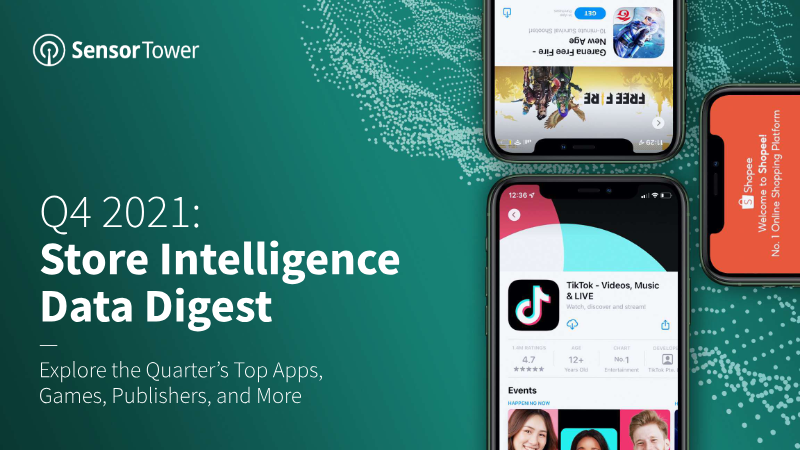
Store Intelligence Data Digest: Q4 2021
Global mobile application activity reached a significant milestone in 2021, with total annual downloads climbing to 144.2 billion. The fourth quarter alone accounted for 36.1 billion of these installs, representing a 2.7 percent year-over-year increase. While the mobile gaming sector remained a primary driver of volume, led by the global success of Garena Free Fire and the emergence of battle royale titles like PUBG: New State, other categories such as Finance and Utilities demonstrated faster growth rates. The market landscape saw China reclaim its position as the leading market for App Store installs, while India maintained its dominance on Google Play.
Market dynamics throughout the year reflected a complex transition toward post-pandemic normalization. Although most app categories returned to pre-pandemic baselines, Business and Medical applications remained elevated, with Business installs more than doubling 2019 levels. Simultaneously, the travel sector experienced a robust recovery, with U.S. vacation rental and online travel agency apps exceeding pre-pandemic download figures by the end of the year. Meta and Google solidified their positions as the world’s top publishers, each exceeding 600 million quarterly downloads, while European developers, particularly Say Games, gained significant traction on the Google Play platform.
Technological innovation continued to influence consumer behavior, evidenced by the rise of NFT-focused mobile applications and the integration of blockchain features into established cryptocurrency platforms. Regional recovery patterns varied, as North America stabilized more rapidly than Asian markets, where pandemic-era usage shifts persisted longer. Ultimately, the year was defined by a shift in market leadership, with TikTok retaining its status as the most downloaded app globally and Garena Free Fire securing its place as the top-downloaded game, underscoring the continued resilience and evolution of the mobile ecosystem.
- Global mobile app downloads reached 144.2 billion in 2021, with Q4 alone contributing 36.1 billion installs, a 2.7% year-over-year increase.
- Meta and Google maintained market dominance as the world’s top publishers, each surpassing 600 million downloads in the fourth quarter.
- Business app installs remained significantly elevated, more than doubling 2019 pre-pandemic levels, while Medical apps also sustained higher-than-normal activity.
- China reclaimed its position as the leading market for App Store installs, while India maintained its top position on the Google Play platform.
- Garena Free Fire was the most downloaded mobile game of 2021, leading a gaming sector that remains a primary driver of global download volume.
Sensor TowerJan 2021
Report73 pages
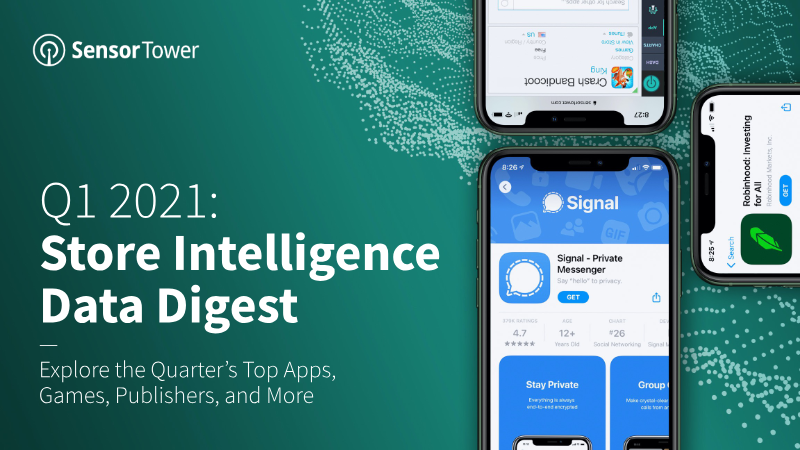
Q1 2021: Store Intelligence Data Digest
Global mobile app downloads reached 36.6 billion in the first quarter of 2021, representing an 8.7% year-over-year increase. This growth was primarily fueled by a 15.3% surge on Google Play, which reached 28.2 billion installs, effectively counteracting an 8.6% decline on the App Store. While emerging markets like India and the Philippines saw growth exceeding 30%, established markets such as the United States and Russia experienced slight contractions as the initial download spikes seen during the 2020 pandemic began to stabilize.
The quarter was defined by a significant shift in consumer behavior toward privacy-focused communication and financial management. Telegram and Signal saw massive adoption, with Telegram becoming the top messaging app worldwide and Signal’s installs jumping from 2 million to over 60 million. Simultaneously, interest in cryptocurrency and retail investing drove a 34% increase in Finance category downloads across the U.S. and Europe, propelled by platforms such as Robinhood, Coinbase, and Binance. TikTok maintained its position as the top global app, while Google and Facebook continued their rivalry as the leading publishers by volume.
In the gaming sector, hypercasual titles remained the dominant force, accounting for 80% of the top 20 games in the United States. Join Clash 3D emerged as the most downloaded game globally, bolstered by heavy adoption in Asia. Despite a late-quarter release, Crash Bandicoot: On the Run achieved a standout performance with 23 million installs in its first week. Although App Store game downloads fell 22.4% year-over-year due to a high 2020 baseline in China, the overall market remained competitive, with hypercasual publishers like Voodoo and Zynga maintaining high rankings through aggressive acquisition and rapid release cycles.
- Global mobile app downloads rose 8.7% year-over-year to 36.6 billion in Q1 2021, driven by a 15.3% surge on Google Play that offset an 8.6% decline on the App Store.
- Hypercasual games dominated the U.S. market, accounting for 80% of the top 20 titles, with Join Clash 3D ranking as the most downloaded game globally.
- Finance category downloads in the U.S. and Europe grew by 34%, fueled by retail investing and cryptocurrency platforms like Robinhood, Coinbase, and Binance.
- Privacy-focused communication apps saw massive adoption, with Telegram becoming the top global messaging app and Signal installs increasing from 2 million to over 60 million.
- Emerging markets like India and the Philippines experienced growth exceeding 30%, while established markets like the U.S. and Russia saw slight contractions as pandemic-era download spikes stabilized.
+1
Sensor TowerJan 2021
Report77 pages
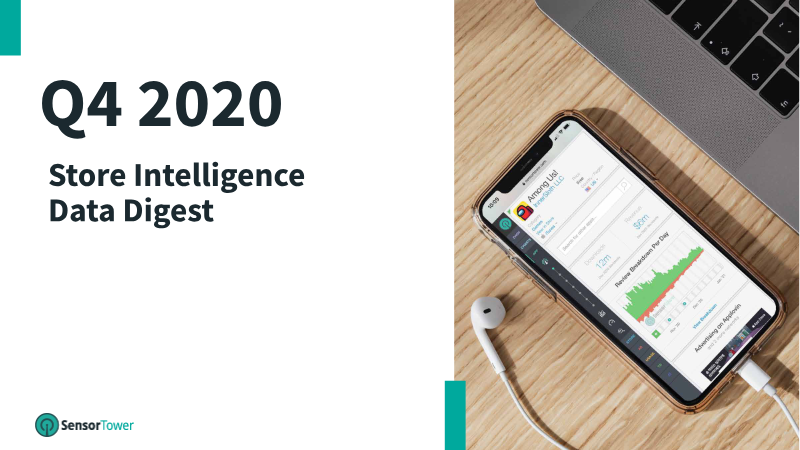
Store Intelligence Data Digest: Q4 2020
The global mobile app ecosystem experienced unprecedented expansion in 2020, culminating in a fourth quarter that saw 35.2 billion downloads and a year-end total of 143 billion. This 23.8% year-over-year increase was primarily catalyzed by the COVID-19 pandemic, which fundamentally altered consumer behavior across the App Store and Google Play. While Google Play drove the majority of volume growth with a 28% increase, the United States notably overtook China as the leading App Store market. India remained the global leader in total volume, contributing over 7 billion downloads in the final quarter alone.
The pandemic created a sharp divergence between industry segments, fueling record-breaking demand for Business and Gaming apps while severely depressing Travel and Navigation. Business category downloads surged by 134% as video conferencing tools like Zoom and Google Meet became essential, reaching 681 million and 331 million annual downloads respectively. Conversely, airline and rideshare apps saw declines of up to 46% in the United States. In the gaming sector, social-oriented titles thrived; Among Us emerged as a cultural phenomenon with 166 million quarterly downloads, while mobile gaming revenue surpassed $21 billion in the final quarter of the year.
Market leadership shifted significantly during this period as Google surpassed Facebook to become the top global publisher for the first time. TikTok maintained its status as the most downloaded non-gaming app globally for both the quarter and the year. Despite the overall surge in digital engagement, certain sub-sectors like hypercasual gaming faced headwinds in mature markets like the U.S. due to changes in commuting patterns. However, the successful late-year launches of titles such as Call of Duty: Mobile in China and the global rise of Genshin Impact signaled continued strength and diversification within the mobile gaming landscape heading into 2021.
- The global mobile app ecosystem reached 143 billion total downloads in 2020, a 23.8% year-over-year increase driven largely by pandemic-related shifts in consumer behavior.
- Business app downloads surged by 134% in 2020, highlighted by Zoom and Google Meet reaching 681 million and 331 million annual downloads respectively.
- Mobile gaming revenue exceeded $21 billion in Q4 2020, with social-oriented titles like Among Us driving engagement via 166 million quarterly downloads.
- Google surpassed Facebook to become the top global publisher for the first time, while TikTok maintained its position as the most downloaded non-gaming app globally for the year.
- India led the world in total download volume with over 7 billion downloads in Q4 2020, while the United States overtook China as the leading market for the App Store.
Sensor TowerJan 2021
Report78 pages
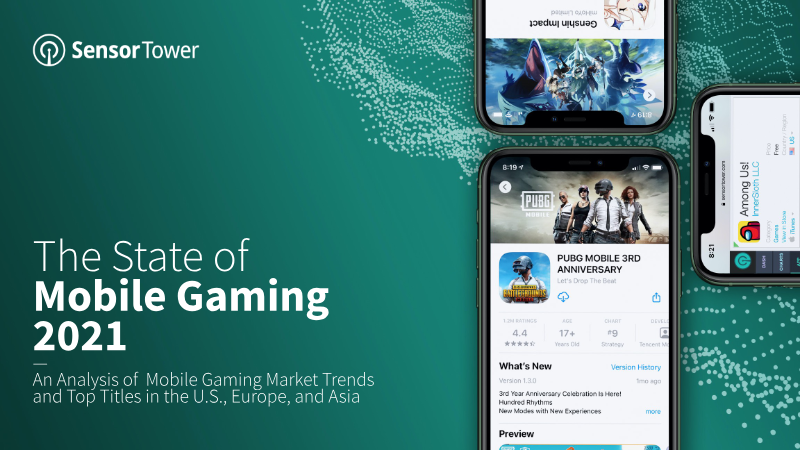
The State of Mobile Gaming 2021
The global mobile gaming industry experienced unprecedented expansion through early 2021, catalyzed by a pandemic-induced surge that drove quarterly revenue to a record $22.2 billion. This growth represents a significant 33% year-over-year increase, with the United States emerging as the premier revenue market, contributing 28% of global consumer spending. While mature markets in North America and Europe reached new financial heights, developing regions—most notably India—served as the primary engines for user acquisition, pushing global downloads to new peaks. Asia remains the largest collective region, surpassing $12 billion in quarterly revenue, anchored by Japan’s robust $5 billion contribution.
Market dynamics shifted toward social and multiplayer experiences, with titles such as Roblox and Genshin Impact dominating both engagement and monetization. RPG and Strategy remain the highest-grossing genres, generating $21.9 billion and $15.1 billion respectively in 2020, though Simulation and Shooter categories exhibited the fastest year-over-year growth. Simultaneously, the Hypercasual genre achieved staggering scale, reaching 3.4 billion downloads in a single quarter. This high-volume segment has become a cornerstone of the mobile advertising ecosystem, where publishers like Zynga and Playrix maintain a dominant share of voice across major digital networks.
Monetization has consolidated almost entirely around the freemium model, which now accounts for 99% of App Store revenue through a combination of in-app purchases, subscriptions, and advertising. Looking forward, the industry is projected to reach $117 billion in annual revenue by 2023, maintaining a compound annual growth rate of 13.5%. While the initial pandemic-driven spike in downloads has stabilized, the sustained increase in consumer spending and the rapid growth of markets in Southeast Asia and Europe indicate a permanent upward shift in the global gaming trajectory.
- The mobile gaming industry reached a record $22.2 billion in quarterly revenue in early 2021, marking a 33% year-over-year increase.
- The industry is projected to reach $117 billion in annual revenue by 2023, maintaining a compound annual growth rate of 13.5%.
- The freemium model now dominates the market, accounting for 99% of App Store revenue through in-app purchases, subscriptions, and advertising.
- RPG and Strategy remain the highest-grossing genres at $21.9 billion and $15.1 billion respectively, while Hypercasual games reached 3.4 billion downloads in a single quarter.
- The United States is the premier revenue market, contributing 28% of global consumer spending, while Asia remains the largest collective region with over $12 billion in quarterly revenue.
+1
Sensor TowerJan 2021
Report26 pages
An Analysis of the Card Battler Sub‑Genre 2021
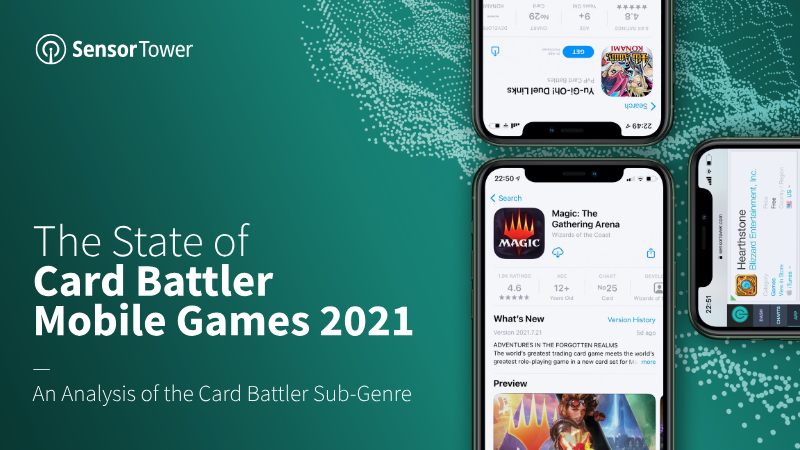
The card battler mobile sub-genre experienced significant growth and market shifts during the first half of 2021. While representing five percent of player spending within the broader strategy genre, card battlers reached a new revenue baseline exceeding $55 million per month. This growth was punctuated by a 17 percent quarterly revenue increase in early 2021, driven largely by established "forever franchises" and the successful mobile launch of legacy intellectual properties.
The geographic landscape of the sub-genre is diversifying. Although Asian markets like Japan and China historically dominated the space, the United States emerged as a critical growth region, accounting for 27 percent of player spending in the first half of 2021. The U.S. market also demonstrated the highest growth in revenue per download among strategy sub-genres, rising 53 percent. This trend suggests the market is maturing and becoming increasingly lucrative for developers targeting Western audiences.
Market leadership remains concentrated among titles leveraging powerful intellectual properties. Yu-Gi-Oh! Duel Links and Hearthstone continue to lead in lifetime earnings, while Magic: The Gathering Arena rapidly ascended to the top ten following its March 2021 release. The success of these titles, alongside niche performers like WWE SuperCard and the high download volume of Mighty Party, indicates a healthy appetite for both established tabletop conversions and new gameplay concepts.
The analysis utilizes data from Sensor Tower’s Game Intelligence and Store Intelligence platforms, covering global App Store and Google Play performance. Findings highlight that while the sub-genre is smaller than 4X strategy or MOBA categories, its increasing average revenue per user and the success of aggressive user acquisition strategies by new contenders point to significant ongoing opportunities for expansion.
- The card battler sub-genre reached a new revenue baseline exceeding $55 million per month in the first half of 2021, driven by a 17 percent quarterly revenue increase.
- The United States has become a critical market, accounting for 27 percent of global player spending and experiencing a 53 percent increase in revenue per download during the first half of 2021.
- Market leadership is dominated by established intellectual properties, with Yu-Gi-Oh! Duel Links and Hearthstone leading in lifetime earnings and Magic: The Gathering Arena entering the top ten shortly after its March 2021 launch.
- While card battlers represent five percent of total strategy genre spending, the sub-genre shows significant expansion potential due to rising average revenue per user and effective user acquisition strategies.
- The sub-genre demonstrates a healthy appetite for diverse gameplay, ranging from tabletop-to-mobile conversions like Magic: The Gathering Arena to high-volume download titles like Mighty Party and niche performers like WWE SuperCard.
+1
Sensor TowerJan 2021

Report30 pages
Mobile Ad Creative Report: August 2021
Mobile gaming creative trends in August 2021 centered on humanizing digital experiences and leveraging high-profile cultural partnerships. Analysis of top-performing ads across platforms like YouTube, Instagram, Snapchat, and Facebook reveals a heavy reliance on real-world celebrities, particularly musicians. Notable examples include Garena Free Fire featuring DJs Dimitri Vegas & Like Mike as playable characters and Call of Duty Mobile partnering with artist Ozuna. These collaborations often utilize cinematic storytelling and high-fidelity animations to bridge the gap between gaming and mainstream entertainment.
The industry continues to utilize specific psychological triggers and visual formats to drive engagement. Fail-state elements, where ads demonstrate a player losing a level to pique viewer interest, remain prevalent in titles like Royal Match and Evony. Additionally, hyper-casual games are increasingly adopting popular music soundtracks and expressive callouts to appeal to younger demographics on Snapchat. Other emerging visual trends include split-screen layouts, the use of Bitmojis, and "search bar" call-to-actions that visually demonstrate how to find the app in stores.
Geographically, the findings cover global releases with specific performance data from major ad networks including ironSource, Applovin, and Vungle. The scope encompasses diverse genres, from mid-core shooters and RPGs to hyper-casual and puzzle games. Methodology involves ranking creatives based on their performance and visibility across social media and ad networks during the August 2021 period. Conclusions suggest that successful creatives are moving away from pure gameplay footage in favor of narrative-driven content, anniversary themes, and interactive elements like Buzzfeed-style quizzes or "Christmas in July" promotions.
- Mobile gaming ads in August 2021 shifted toward high-fidelity, narrative-driven content featuring real-world celebrity partnerships, such as Garena Free Fire’s collaboration with Dimitri Vegas & Like Mike and Call of Duty Mobile’s integration of Ozuna.
- Top-performing creatives are increasingly moving away from pure gameplay footage in favor of cinematic storytelling, anniversary-themed promotions, and interactive elements like Buzzfeed-style quizzes.
- Psychological triggers remain a core engagement strategy, with 'fail-state' ads—demonstrating a player losing a level—continuing to drive performance for titles like Royal Match and Evony.
- Hyper-casual games are targeting younger demographics on platforms like Snapchat by integrating popular music soundtracks and expressive visual callouts.
- Emerging visual design trends for mobile ads include the use of split-screen layouts, Bitmojis, and 'search bar' call-to-actions that provide users with direct visual instructions on how to locate apps in stores.
+1
Sensor TowerJan 2021
Report27 pages
Mobile Game Store Asset Optimization Trends 2021
Strategic store asset optimization is a critical driver for increasing conversion rates and reducing user acquisition costs in the mobile gaming industry. Analysis of top-performing publishers reveals that the most successful entities treat app icons, screenshots, and product pages as dynamic marketing tools rather than static assets. This approach is particularly relevant following the release of iOS 15 in late 2021, which introduced Custom Product Pages and Product Page Optimization. These features allow developers to create up to 35 unique landing pages and conduct native A/B testing for up to 90 days, enabling highly targeted campaigns for specific audiences and influencers.
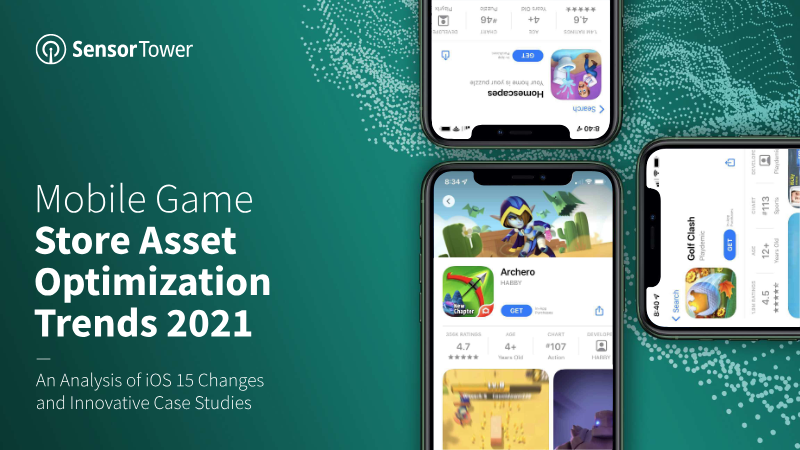
Data from major titles illustrates several dominant trends in asset management. Seasonal updates are a primary strategy; for instance, Golf Clash implemented 17 icon changes between 2017 and 2021 to reflect holidays like Halloween and St. Patrick’s Day. Other publishers, such as King and Garena, prioritize brand identity by integrating corporate logos across their entire portfolios to leverage existing brand equity. Furthermore, "forever franchises" like Animal Crossing: Pocket Camp use icon updates to signal anniversaries and live operations events, driving re-engagement among lapsed players.
A significant shift in the industry involves the alignment of store assets with high-performing ad creatives. Publishers like Playrix and Nexters successfully utilized "Pull the Pin" advertisements—which often differ from core gameplay—to lower costs per install. To minimize friction and improve conversion, these companies updated their App Store screenshots and icons to match the ad content. While such experimentation was historically more prevalent on Google Play due to its long-standing A/B testing tools, the new iOS 15 capabilities are expected to catalyze similar data-driven optimization strategies across the Apple ecosystem. This analysis utilizes Sensor Tower’s proprietary intelligence platforms to track these trends across global markets and major gaming segments.
- The release of iOS 15 in late 2021 introduced native A/B testing for up to 90 days and the ability to create 35 unique Custom Product Pages, enabling highly targeted audience acquisition.
- Top-performing publishers are aligning App Store screenshots and icons with high-performing ad creatives—such as Playrix and Nexters' 'Pull the Pin' ads—to reduce user acquisition costs and minimize conversion friction.
- Successful mobile game publishers treat store assets as dynamic marketing tools rather than static elements, frequently updating them to reflect seasonal events, anniversaries, and live operations.
- Strategic icon management is a proven re-engagement tactic, exemplified by Golf Clash, which implemented 17 distinct icon updates between 2017 and 2021 to capitalize on holiday-themed content.
- Major publishers like King and Garena leverage brand equity by integrating consistent corporate logos across their entire game portfolios to strengthen brand identity.
+2
Sensor TowerJan 2021
Report30 pages
The State of Mobile Game Advertising: An Analysis of U.S. Mobile Game Advertising Trends in 2021
Mobile game advertising in the United States remained resilient through the first half of 2021, showing no immediate negative impact from privacy changes such as the deprecation of IDFA. Analysis of the advertising landscape reveals a strategic divide between ad networks. Specialized platforms like AppLovin, Chartboost, and Vungle maintain a high concentration of gaming content, often exceeding 90 percent share of voice. In contrast, diversified platforms like Facebook, TikTok, and YouTube maintain a more balanced split between gaming and non-gaming advertisements, serving as critical channels for reaching broader audiences.
Market trends indicate that ad network selection is increasingly driven by genre and demographic alignment. Puzzle and Hypercasual games dominate gaming-focused networks, while mid-core genres like Strategy and Shooter find higher engagement on social platforms like YouTube and Instagram. Notably, Adcolony emerged as a primary hub for Casino games, catering to an older, female-leaning demographic. Across most platforms, video remains the dominant creative format, though playable ads have gained significant traction, particularly on AppLovin where they account for over 40 percent of gaming share of voice.
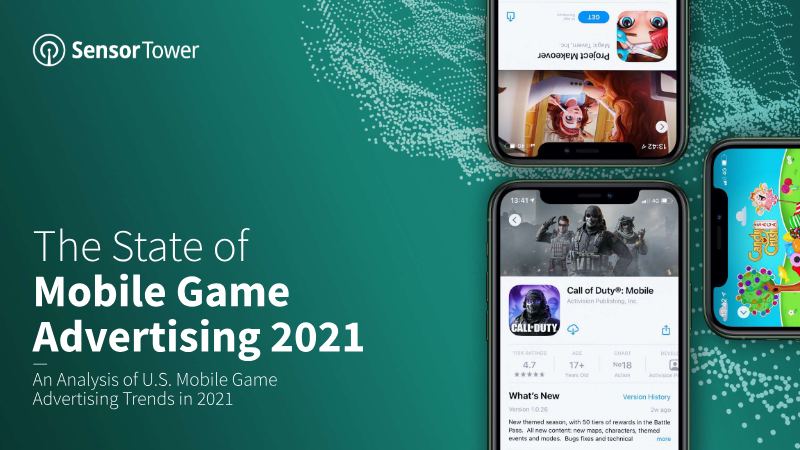
Creative strategies are evolving to include "fake playables," relaxing music for casual titles, and real-world testimonial-style conversations. Even mid-core titles with complex mechanics, such as Call of Duty: Mobile, have begun adopting simplified playable "mini-games" to lower the barrier for user acquisition. This data, compiled by Sensor Tower using its Ad Intelligence platform, covers U.S. trends across iOS and Android from 2018 through the second quarter of 2021, suggesting that success in the current market requires a sophisticated mix of genre-specific network targeting and experimental creative formats.
- Mobile game advertising in the U.S. remained resilient through H1 2021, showing no immediate negative impact from the deprecation of IDFA.
- Playable ads have become a dominant creative format, accounting for over 40 percent of the gaming share of voice on AppLovin.
- Specialized ad networks like AppLovin, Chartboost, and Vungle maintain a gaming-focused inventory exceeding 90 percent share of voice, while platforms like Facebook, TikTok, and YouTube provide broader audience reach.
- Ad network selection is increasingly genre-specific, with Puzzle and Hypercasual games favoring gaming-focused networks, while Strategy and Shooter titles find higher engagement on social platforms like YouTube and Instagram.
- Adcolony has established itself as a primary hub for Casino games, effectively targeting an older, female-leaning demographic.
+1
Sensor TowerJan 2021
Report39 pages
The State of MOBA Mobile Games 2021
This analysis explores the Multiplayer Online Battle Arena (MOBA) sub-genre within the mobile gaming market, focusing on its rapid financial growth and competitive landscape. Leveraging data from Sensor Tower’s Game Intelligence and Store Intelligence platforms, the report examines global trends from 2019 through August 2021. The central thesis identifies MOBAs as a "winner-takes-all" market dominated by a few high-performing titles that command significant player spending despite a general stagnation in overall sub-genre downloads.
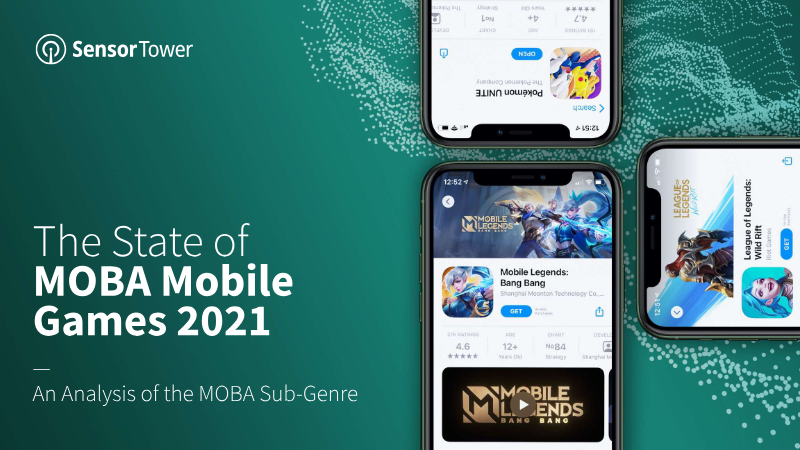
The findings reveal that MOBAs are among the fastest-growing segments of the Strategy genre, generating approximately $2 billion in global player spending during the first half of 2021. While Asia remains the dominant force, accounting for 84 percent of total revenue, emerging markets like Brazil, Indonesia, and Russia have become critical hubs for daily active users. Honor of Kings stands as the industry leader, surpassing $10 billion in lifetime revenue, while Mobile Legends and Brawl Stars maintain strong global positions. Notably, the September 2021 launch of Pokémon Unite set a new record for the sub-genre, achieving 15 million downloads in its first two days.
The study also highlights a divergence in monetization and engagement strategies. Titles like Brawl Stars favor simplified mechanics and high long-term retention, whereas others utilize "paid advantage" mechanics—such as stat-boosting skins—to drive higher revenue per download at the potential risk of lower retention. In the United States, intellectual property plays a significant role, with licensed IP games accounting for 43 percent of all MOBA installs. Ultimately, the market is characterized by high concentration among top publishers like Tencent, Supercell, and ByteDance, creating a challenging environment for new entrants without established brand recognition.
- The mobile MOBA market is a 'winner-takes-all' environment dominated by Tencent, Supercell, and ByteDance, making it difficult for new entrants to succeed without established brand recognition.
- Global MOBA player spending reached approximately $2 billion in the first half of 2021, with Asia accounting for 84 percent of total revenue.
- Honor of Kings is the industry leader with over $10 billion in lifetime revenue, while Pokémon Unite set a sub-genre record with 15 million downloads in its first two days following its September 2021 launch.
- While overall sub-genre downloads have stagnated, MOBAs remain one of the fastest-growing segments within the Strategy genre.
- Emerging markets including Brazil, Indonesia, and Russia have become critical hubs for daily active user growth.
+1
Sensor TowerJan 2021