Roblox
Game Co.20 documents
Documents

Financial1 pages
Roblox 10-Q — Q2 FY2023 (August 2023)
Roblox’s Q2 FY2023 Form 10‑Q presents a mixed picture of continued revenue growth amid escalating operating losses and significant capital outlays. Total platform revenue rose 15 % to $680.8 million, driven by higher bookings and an expanding paying‑user base of roughly 790 000 daily unique payers. Bookings, which reflect virtual‑currency sales deferred over an average 28‑month user lifetime, outpaced GAAP revenue and signal a more timely view of monetization trends. Nevertheless, operating losses widened to $313.9 million from $170.3 million in the prior year, largely due to surging infrastructure, research and development, developer‑exchange fees, and trust‑and‑safety costs. Cash balances fell sharply to $520 k after a $2.71 million outflow in investing activities, while financing inflows of $45 million and a modest $2.7 billion in investing outflows underscore heavy capital spending on technology, security and international expansion.
Geographically, revenue remains heavily U.S.‑centric (≈65 % of total), yet 35 % of revenue originates outside the U.S./Canada, reflecting a strategic push into international markets. The company’s risk profile is broad: regulatory exposure to child‑protection laws, data‑privacy statutes, and platform‑policy changes; operational dependencies on AWS, payment processors, and the Lua scripting language; and potential capital constraints if additional financing cannot be secured at favorable terms. Governance concerns include a dual‑class share structure that concentrates voting power and potential dilution from future equity issuances.
Overall, Roblox demonstrates robust user engagement growth but faces mounting costs and regulatory headwinds that could pressure profitability and liquidity in the near term.
- Roblox reported a 15% increase in total revenue to $680.8 million for Q2 FY2023, supported by a paying user base of approximately 790,000 daily unique payers.
- Operating losses nearly doubled year-over-year, rising from $170.3 million to $313.9 million due to increased spending on infrastructure, R&D, developer-exchange fees, and trust-and-safety initiatives.
- The company is undergoing significant capital expenditure, evidenced by $2.7 billion in investing outflows directed toward technology, security, and international expansion efforts.
- While 65% of revenue remains concentrated in the U.S., 35% is now generated internationally, highlighting the company's ongoing geographic diversification strategy.
- Roblox faces operational dependencies on third-party providers including AWS and various payment processors, alongside regulatory risks related to child-protection and data-privacy laws.
+1
RobloxAug 2023
Financial1 pages
Roblox Corporation 2023 Q1 10-Q
Roblox Corporation’s first‑quarter 2023 filing demonstrates continued revenue growth driven by its North American user base, with bookings rising to $773 million and GAAP revenue reaching $655 million. The company’s operating cash flow improved to $173.8 million, largely supported by a $123.8 million increase in deferred revenue and robust investment balances that generated $31 million in interest income. However, net losses widened to $269.9 million, reflecting sharp increases in infrastructure ($211 million), trust & safety ($276 million), and developer exchange fees, as well as a $7 million lease‑impairment loss. Capital expenditures on servers and platform infrastructure continue to expand, underscoring a strategic focus on sustaining user engagement.
Geographically, 48 % of revenue originates from mobile app stores, exposing the company to platform‑fee volatility and regulatory changes on Apple and Google. User metrics reveal that 43 % of daily active users are under 13, heightening COPPA and GDPR compliance obligations. The filing highlights persistent risks from cyber‑security incidents, data‑center supply constraints, and potential outages that could erode trust among users and developers.
Governance and financial structure present additional concerns. A dual‑class share scheme concentrates voting power, while anti‑takeover provisions and high debt maturities could limit liquidity and strategic flexibility. Macroeconomic pressures—including inflation, geopolitical tensions, and banking instability—may further compress discretionary spending on the platform. Overall, Roblox’s growth trajectory hinges on continued investment in infrastructure and compliance while managing escalating operating costs and regulatory uncertainties.
- Roblox reported Q1 2023 bookings of $773 million and GAAP revenue of $655 million, though net losses widened to $269.9 million due to rising infrastructure, trust and safety, and developer exchange costs.
- Operating cash flow reached $173.8 million, bolstered by $123.8 million in deferred revenue and $31 million in interest income from investment balances.
- The company faces significant platform dependency, with 48% of revenue originating from mobile app stores, exposing it to potential fee volatility and regulatory changes from Apple and Google.
- Infrastructure and safety investments are substantial, with $211 million spent on infrastructure and $276 million on trust and safety, alongside a $7 million lease-impairment loss.
- Regulatory and demographic risks are elevated, as 43% of daily active users are under 13, necessitating strict adherence to COPPA and GDPR compliance standards.
+1
RobloxMay 2023
Report30 pages
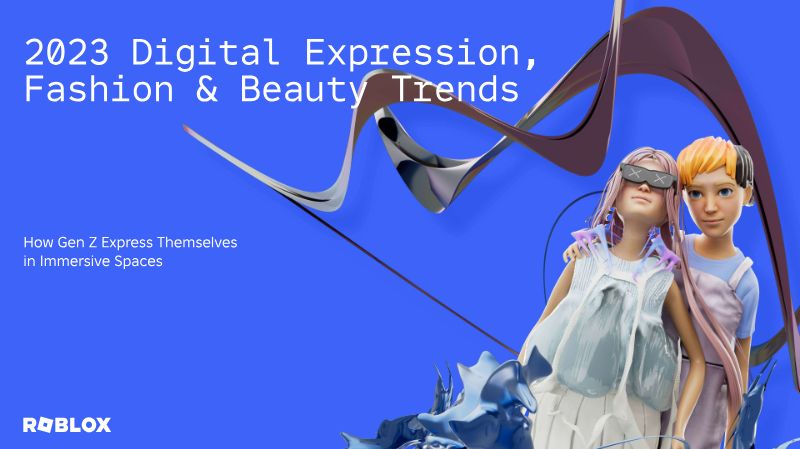
Fashion & Beauty Trends: How Gen Z Express Themselves in Immersive Spaces 2023
The 2023 analysis of digital expression among Generation Z demonstrates that immersive platforms have become the primary arena for personal style and identity formation. Across the year, more than half of Gen Z respondents now prioritize styling their avatars over physical clothing, and a substantial majority regard digital fashion as at least somewhat important, with over half noting a marked increase in relevance since the previous year. This shift is reflected in a 38 percent rise in avatar updates, reaching 165 billion actions, and a 15 percent growth in the purchase of virtual fashion items, totaling 1.6 billion transactions. Monthly spending on digital looks clusters between ten and one hundred dollars, driven especially by limited‑edition pieces that command significant resale premiums.
Customization behavior reveals a strong focus on clothing and hair, each selected by roughly half of users, while a sizable portion aligns skin tone and body type with their real‑world appearance. Daily or weekly avatar adjustments are reported by 70 percent of participants, with female‑identifying and non‑binary players leading the trend. Hairstyle purchases alone surged 20 percent to exceed 139 million items, underscoring the depth of aesthetic investment.
Beyond consumption, Gen Z leverages these spaces for co‑creation and personal development. Collaborative projects such as a Fenty Beauty product that amassed over one million community votes and student‑driven translations of digital runway concepts into physical garments illustrate the platform’s role as an incubator for fashion innovation. Moreover, 88 percent of respondents claim virtual self‑expression enhances their offline identity, while notable percentages report improved social connections, mood, and confidence, suggesting tangible mental‑health benefits. Industry forecasts anticipate that leading fashion talent will increasingly emerge from these immersive environments, positioning digital platforms as pivotal to the future of fashion and beauty.
- Digital fashion is a primary priority for Gen Z, with over 50% of users valuing avatar styling over physical clothing and 1.6 billion virtual fashion transactions occurring in 2023, a 15% growth.
- Avatar engagement is high and frequent, evidenced by 165 billion update actions—a 38% increase—with 70% of participants adjusting their avatars on a daily or weekly basis.
- Virtual aesthetic investment is significant, highlighted by a 20% surge in hairstyle purchases to over 139 million items and monthly spending on digital looks typically ranging from $10 to $100.
- Immersive platforms are functioning as fashion incubators, demonstrated by collaborative initiatives like the Fenty Beauty project that generated over one million community votes.
- Virtual self-expression has a measurable impact on offline life, with 88% of Gen Z respondents reporting that digital styling enhances their real-world identity and confidence.
+2
RobloxJan 2023
Report30 pages
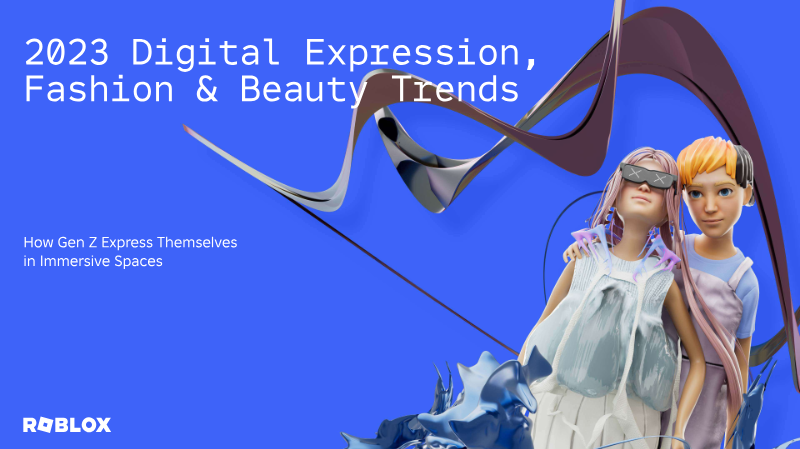
Fashion & Beauty Trends: How Gen Z Express Themselves in Immersive Spaces
This analysis explores the evolving relationship between digital identity, fashion, and physical self-expression among Gen Z consumers. The primary thesis asserts that digital avatars have become a central medium for authentic self-expression, significantly influencing physical world style, brand affinity, and mental well-being. As immersive spaces transition from mere gaming environments to social hubs, the distinction between digital and physical identity continues to blur, with a majority of users now prioritizing their virtual appearance over their physical one.
The findings are based on a dual methodology: behavioral data from the Roblox platform collected between January and September 2023, and a representative survey of 1,545 Gen Z users aged 14 to 26 in the United States and the United Kingdom. Key data points reveal a significant upward trend in engagement; total avatar updates grew 38% year-over-year to 165 billion, while purchases of digital fashion items rose 15% to 1.6 billion. Notably, 56% of Gen Z respondents stated that styling their avatar is more important than styling their physical selves, an increase from 42% in the previous year.
The research highlights a symbiotic relationship between realms, with 84% of respondents noting that their physical style is inspired by their avatar’s look. This digital-to-physical pipeline extends to commerce, as 84% of users are likely to consider a brand in the physical world after trying its items virtually. The report also emphasizes the psychological benefits of these spaces, with 88% of users crediting immersive expression with helping them feel more comfortable in the physical world. Industry segments covered include digital fashion, beauty, and music, noting a growing demand for exclusivity through limited-edition digital goods and community-created content. Overall, the data suggests that the metaverse is functioning as a low-stakes laboratory for identity, driving broader trends in gender-fluid fashion and diverse representation.
- 56% of Gen Z users now prioritize styling their digital avatars over their physical appearance, a significant increase from 42% in the previous year.
- Engagement with digital identity is surging, with Roblox users performing 165 billion avatar updates (a 38% year-over-year increase) and purchasing 1.6 billion digital fashion items (a 15% increase) between January and September 2023.
- Digital-to-physical brand influence is high, as 84% of Gen Z respondents are more likely to consider a physical-world brand after interacting with its items in an immersive space.
- Virtual spaces serve as a primary style incubator, with 84% of users reporting that their physical-world fashion choices are directly inspired by their avatar's look.
- Immersive self-expression provides tangible psychological benefits, with 88% of users stating that their virtual experiences help them feel more comfortable in the physical world.
+1
RobloxJan 2023

Financial1 pages
Roblox 10-Q — Q3 FY2022 (November 2022)
Roblox’s Q3 FY2022 filing demonstrates continued expansion of its equity base and a persistent operating loss, while highlighting significant risks that could materially affect future performance. The company reported revenue of $517.7 million, up 2% from the prior quarter and 22% year‑over‑year, driven by a 10% rise in bookings and an increase in daily paying users to 768,000. Monetization per user fell 3%, and operating costs surged to 159% of revenue, largely due to higher infrastructure, R&D, and developer exchange fees. A revised paying‑user life estimate of 28 months is expected to reduce future revenue by roughly $345 million and cost of revenue by $79 million. Cash flow remains positive from operations, but investing outflows rose sharply to $276.6 million, driven by capital expenditures and a $19 million acquisition of Byfron Technologies. Financing activity is modest, with only $41.8 million in proceeds from stock‑option exercise and ESPP.
Geographically, 34% of revenue originates outside the U.S./Canada, exposing Roblox to foreign‑exchange volatility and regulatory uncertainty. The platform’s user base is heavily skewed toward children under 13, triggering strict COPPA compliance and heightened scrutiny over content moderation, data privacy, and virtual‑currency regulation. Additional risks include potential cyber incidents, third‑party payment processor disruptions, geopolitical tensions affecting international expansion, and the company’s dual‑class share structure that concentrates voting power in founder David Baszucki. These factors, coupled with ongoing litigation and debt obligations (notably a $1 billion senior note due 2030), underscore the need for continued investment in infrastructure, security, and compliance to sustain growth and mitigate regulatory exposure.
- Roblox reported Q3 FY2022 revenue of $517.7 million, a 22% year-over-year increase, though operating costs surged to 159% of revenue due to rising infrastructure, R&D, and developer exchange fees.
- A revised estimate of the average paying-user life to 28 months is projected to decrease future revenue by approximately $345 million and cost of revenue by $79 million.
- While daily paying users grew to 768,000, overall monetization per user declined by 3% compared to the prior period.
- Investing outflows rose to $276.6 million, driven by significant capital expenditures and the $19 million acquisition of Byfron Technologies.
- With 34% of revenue generated outside the U.S. and Canada, the company faces material risks from foreign-exchange volatility, geopolitical tensions, and varying international regulatory environments.
RobloxNov 2022

Financial1 pages
Roblox 10-Q – Q2 FY2022 (August 2022)
The filing presents Roblox’s financial and operational status for the six months ended June 30, 2022, with a focus on revenue growth, cost dynamics, and risk exposure. Revenue rose 30 % to $591 million from $454 million a year earlier, driven by higher bookings recognition and an extended paying‑user lifetime estimate of 25 months. Operating expenses surged, particularly infrastructure (up 45 %), trust & safety, and research & development (70 % increase for the quarter), resulting in a net loss of $178 million or $4.30 per share. Cash reserves improved to $1.78 billion, largely from preferred‑stock and equity issuances, offsetting significant operating outflows.
Capital structure details show 545 million Class A and 51 million Class B shares outstanding, with a $4.5 million non‑controlling interest and total stockholders’ equity of $551.6 million against an accumulated deficit of $1.32 billion. Lease commitments total $455.5 million, including a new San Mateo office lease of $212.5 million beginning in 2023. Acquisitions of Hamul and Guilded added modest goodwill ($70 million combined) and intangible assets, deemed immaterial to the period’s financials.
Risk disclosures emphasize regulatory, security, and market uncertainties. Dependence on third‑party platforms (Apple, Google, AWS) exposes Roblox to fee increases, policy changes, and potential outages. International expansion introduces compliance costs under GDPR, COPPA, and emerging digital‑services legislation, while foreign‑currency volatility could erode revenue from the 77 % of daily active users outside the U.S./Canada. Cyber‑security, fraud, and intellectual‑property liabilities remain significant threats that could impair user trust and financial performance. The company’s dual‑class structure concentrates voting power, potentially limiting shareholder influence and affecting valuation.
Overall, the report underscores robust revenue growth tempered by escalating costs and a sizable operating loss, while highlighting a broad geographic footprint (global user base) and a time frame covering the first half of fiscal year 2022. The analysis indicates that continued investment in infrastructure, talent, and security is essential to sustain growth, yet these expenditures may delay profitability as the company navigates regulatory and competitive pressures.
- Roblox reported a 30% revenue increase to $591 million for Q2 2022, though this was offset by a $178 million net loss driven by aggressive spending in infrastructure, R&D, and safety.
- Operating expenses rose significantly, with R&D costs increasing by 70% for the quarter and infrastructure costs growing by 45%.
- The company maintains a strong liquidity position with $1.78 billion in cash reserves, bolstered by equity and preferred-stock issuances despite substantial operating outflows.
- Roblox faces significant operational risk due to its dependence on third-party platforms like Apple, Google, and AWS, which control key distribution channels and infrastructure.
- International expansion presents financial challenges, as 77% of daily active users are located outside the U.S. and Canada, exposing the company to foreign-currency volatility and complex global regulatory compliance.
+1
RobloxAug 2022

Financial1 pages
Roblox Q1 2022 Form 10-Q
Roblox Corporation’s Q1 2022 Form 10‑Q documents a period of accelerated growth and intensified investment. Revenue rose 39 % to $537 million, driven by higher bookings and a larger paying‑user base; 66 % of sales came from the United States and Canada, with Europe, Asia‑Pacific and other regions contributing 18 %, 9 % and 7 % respectively. Durable virtual items accounted for 90 % of platform revenue, up from 87 % in the prior year. Despite the top‑line expansion, operating losses widened to $151 million (28 % of revenue) as costs—payment‑processing fees, developer exchange fees, infrastructure and R&D expenses—grew 38 %, 24 % and 50 % respectively, with R&D surging 84 % due to headcount expansion and stock‑based compensation.
Cash flow remained positive, with operating cash inflows of $156 million offsetting a net loss of $162 million. Capital raised through 2030 senior notes ($987.5 million) and Series H convertible preferred stock ($534.3 million) bolstered a $3.1 billion cash balance, providing liquidity for 12‑month needs but underscoring the company’s continued reliance on external financing to fund growth.
Key risks highlighted include regulatory exposure (COPPA, GDPR, EU Digital Services Act), content‑moderation challenges, cybersecurity threats, and potential dilution from future equity or debt issuances. The report notes that user metrics may be affected by bot activity and analytics limitations, with approximately 4 % of bookings potentially inaccurate. Overall, the filing portrays a company investing heavily in platform infrastructure and developer incentives to sustain user engagement while navigating significant operational, regulatory, and financial uncertainties.
- Roblox revenue grew 39% to $537 million in Q1 2022, yet operating losses widened to $151 million as costs for R&D, infrastructure, and developer fees outpaced income.
- R&D expenses surged 84% year-over-year, driven primarily by aggressive headcount expansion and increased stock-based compensation.
- The company maintains a $3.1 billion cash balance bolstered by $987.5 million in senior notes and $534.3 million in Series H preferred stock, highlighting a continued reliance on external financing to fund operations.
- Durable virtual items remain the primary revenue driver, accounting for 90% of platform sales, up from 87% in the prior year.
- Geographic concentration remains high, with 66% of total revenue generated from the United States and Canada.
+1
RobloxMay 2022

Financial1 pages
Roblox 10-K — FY2021 (February 2022)
Roblox Corporation’s FY 2021 filing demonstrates a rapid acceleration in user engagement and revenue, with daily active users rising 40 % to 45.5 million and total bookings climbing 45 % to $2.73 billion. Revenue surged 108 % to $1.92 billion, driven by a doubling of daily paying users and a 23‑month deferred recognition model for durable virtual items. Despite strong cash flow from operations ($659 million) and a rebound in free‑cash‑flow, the company posted a net loss of $491 million, largely due to heightened developer exchange fees and infrastructure costs. Capital expenditures remained modest at $93 million, while financing activities raised $1.6 billion through notes and preferred stock to fund growth and potential acquisitions.
The platform’s ecosystem expanded globally, with developers from 170+ countries earning over $538 million in real‑world currency and more than 1,900 experiences generating a million hours of engagement annually. Monetization relies on a 70/30 split with developers, supplemented by Roblox Premium subscriptions and brand partnerships. Safety and compliance systems—human review of 140 million assets, real‑time moderation, and adherence to COPPA, GDPR, CCPA—are integral to sustaining user trust.
Risk disclosures highlight regulatory exposure across multiple jurisdictions, dependence on third‑party app stores (Apple, Google), and the potential impact of changing privacy laws and content‑moderation requirements. Operational risks include cyber‑security threats, infrastructure outages, and the challenge of scaling while maintaining culture. Financially, a dual‑class share structure concentrates voting power, and future equity issuances or debt could dilute shareholders. Overall, Roblox’s FY 2021 performance underscores explosive growth tempered by significant regulatory, operational, and financial uncertainties that could influence future profitability and liquidity.
- Roblox experienced rapid financial growth in FY 2021, with revenue increasing 108% to $1.92 billion and total bookings rising 45% to $2.73 billion.
- Despite strong operational cash flow of $659 million, the company reported a net loss of $491 million, primarily driven by high infrastructure costs and developer exchange fees.
- User engagement surged as daily active users grew 40% to 45.5 million, supported by an ecosystem where over 1,900 experiences generated at least one million hours of annual engagement.
- The platform paid out over $538 million to developers across 170+ countries, maintaining a core monetization model based on a 70/30 revenue split.
- Roblox raised $1.6 billion through notes and preferred stock to fund growth, while maintaining a modest capital expenditure of $93 million.
RobloxFeb 2022