MDPI
MDPI is an open access academic publisher of peer-reviewed scientific journals across many disciplines. It publishes research articles, including studies on serious games for water resource management and stakeholder collaboration.
Documents
Socio-Psychological Perspectives on the Potential for Serious Games to Promote Transcendental Values in IWRM Decision-Making
This paper, a 2018 review published in Water, argues that serious games designed for integrated water resource management (IWRM) should aim to cultivate transcendental values, meaning motivations that extend beyond self-interest to social equity, intergenerational fairness, and environmental sustainability.
- The paper argues that serious games for integrated water resource management should aim to cultivate transcendental values, meaning motivations beyond self-interest such as social equity, intergenerational fairness, and environmental sustainability.
- Drawing on Schwartz's Theory of Basic Human Values, which identifies ten cross-culturally validated values confirmed across 82 countries, the authors single out universalism and benevolence as the self-transcendence values most aligned with IWRM's equity goals across space and time.
- Values are largely emotion-driven and resistant to direct persuasion, and intergroup conflict, differences in empathy, and moral disengagement impose psychological limits on their adoption.
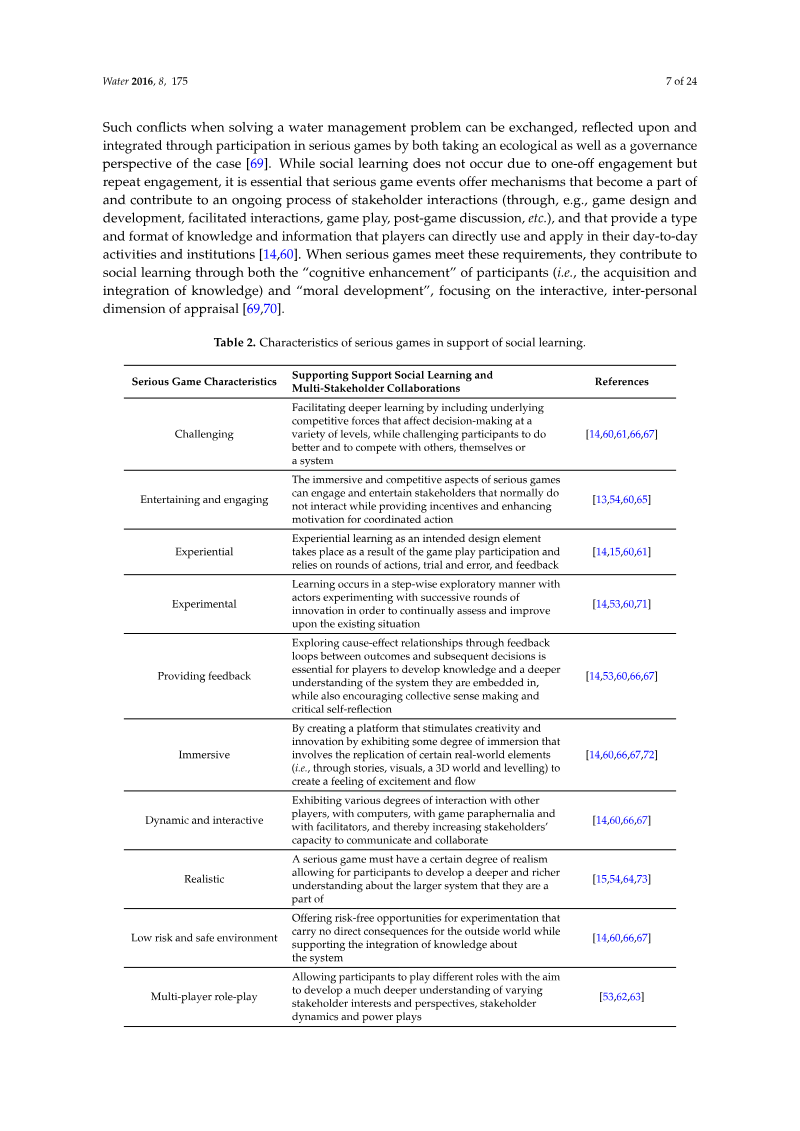
Exploring the Potential Impact of Serious Games on Social Learning and Stakeholder Collaborations for Transboundary Watershed Management of the St. Lawrence River Basin
This study examines whether serious games, which combine computer simulation with role-play, can strengthen social learning and stakeholder collaboration in transboundary water governance of the St. Lawrence River Basin, a system spanning two countries, multiple Canadian provinces, and numerous local jurisdictions.
- Social learning in St. Lawrence River Basin transboundary water governance is occurring only in isolated cases rather than as routine practice, and the study proposes serious games (computer simulation combined with role-play) as a bottom-up tool to strengthen it.
- Jurisdictional fragmentation and inconsistent policy are central obstacles, illustrated by the American eel being listed as endangered in Ontario but not in Québec.
- Communication is judged adequate at the federal level but weak between provincial and state agencies, which often operate in silos even where shared Great Lakes Agreement goals apply.