GameVault System
Research4 documents
Internal system writer for automated discovery sources.
Documents

Financial1 pages
How to Read a 10-K/10-Q
The guide explains how U.S. public companies disclose detailed business, risk, and financial information through Form 10‑K annual reports and Form 10‑Q quarterly filings. Companies prepare these documents, certify their accuracy, and file them with the SEC; the SEC reviews compliance but does not guarantee correctness. All filings are publicly available via EDGAR and often posted on corporate websites.
Key sections of the 10‑K include Item 1 “Business,” which outlines products, subsidiaries, markets, and operational factors; Item 1A “Risk Factors,” listing significant risks by importance; and Item 7 “Management’s Discussion and Analysis (MD&A),” where executives explain results, liquidity, trends, accounting judgments, and risk management. Financial statements (income statement, balance sheet, cash flow) appear in Item 8, accompanied by auditor reports and GAAP compliance notes. Items 9–14 cover accounting changes, internal controls, governance, executive compensation, ownership, related transactions, and accountant fees. Item 15 lists exhibits such as bylaws and contracts.
The 10‑Q mirrors the 10‑K but is abbreviated, focusing on financial statements, MD&A, market risk disclosures, controls, legal proceedings, and risk factors for the quarter. The document also notes that some companies use their 10‑K as the annual shareholder report, though it may be more detailed than a glossy presentation.
Overall, the guide serves investors by outlining the structure, content, and regulatory context of 10‑K and 10‑Q filings, emphasizing the importance of certifications, auditor opinions, and non‑GAAP measures for informed analysis.
- Form 10-K provides a comprehensive annual overview of a company's business operations, risk factors, and audited financial statements, while Form 10-Q serves as an abbreviated quarterly update.
- Item 7, the Management’s Discussion and Analysis (MD&A), is a critical section where executives provide context on financial results, liquidity, emerging trends, and risk management strategies.
- Item 1A in the 10-K explicitly lists significant business risks, prioritized by their potential impact on the company.
- Item 8 contains the core financial data—including income statements, balance sheets, and cash flow statements—alongside mandatory auditor reports and GAAP compliance notes.
- All 10-K and 10-Q filings are submitted to the SEC and are publicly accessible through the EDGAR database or corporate investor relations websites.
GameVault System

Financial1 pages
SEC Filings
The primary purpose of the material is to facilitate user interaction with SEC filing information and manage email subscription preferences for Chipotle. The interface offers a drop‑down menu that allows users to select specific filing types and date ranges, enabling targeted access to regulatory disclosures. Following the selection process, users are guided through subscription steps for Chipotle’s email and mobile updates.
The content includes confirmation messages that appear after a user subscribes to the Chipotle email list, indicating that an email will be sent for verification. A similar confirmation appears for mobile updates, informing the user that a text message will be sent to confirm their phone number. These steps ensure that contact information is verified before adding the user to marketing lists.
An unsubscribe section acknowledges a user’s request to remove themselves from all promotional communications. It offers an option to re‑subscribe by entering an email address, thereby maintaining a clear path for users who may wish to change their preferences later.
Overall, the material serves as a concise user interface guide for accessing SEC filings and managing Chipotle’s marketing communications, ensuring compliance with subscription verification protocols and providing straightforward options for users to opt in or out of promotional content.
- Chipotle provides a dedicated interface for users to access specific SEC regulatory filings by filtering through document types and date ranges.
- The platform integrates a subscription management system that allows users to sign up for Chipotle’s email and mobile marketing updates.
- All new email and mobile subscriptions require a mandatory verification step, involving a confirmation email or text message, before the contact is added to marketing lists.
- The interface includes a dedicated unsubscribe function that allows users to opt out of all promotional communications.
- Users who have unsubscribed from Chipotle’s marketing lists retain the ability to re-subscribe at any time by re-entering their email address into the system.
+1
GameVault System
Financial22 pages
Consolidated Financial Results: 3rd Quarter Fiscal Year Ending March 2023
The consolidated financial results for the third quarter of the fiscal year ending March 2023 reflect a period of mixed performance for Daicel Corporation. While the company achieved sales revenue of 404.5 billion yen, representing a 17.9% year-on-year increase, operating income declined by 6.9% to 36.6 billion yen. The growth in top-line revenue was primarily driven by strategic price revisions, cost-reduction initiatives, and favorable foreign exchange impacts. Conversely, the contraction in operating income was attributed to sluggish automobile production, weakened demand for electronic devices, and rising costs for raw materials, fuel, and logistics.
The geographic and industry scope of these results spans global markets, with significant exposure to the automotive, semiconductor, and LCD panel sectors. Performance across segments varied, as the company faced headwinds from production adjustments in the LCD market and a slower-than-anticipated recovery in automotive manufacturing, exacerbated by semiconductor shortages and COVID-19-related lockdowns in China. While the Materials and Engineering Plastics segments managed to exceed internal profit plans, the Medical/Healthcare, Smart, and Safety segments fell short of expectations.
To address these challenges, the company is implementing a series of corrective measures aimed at improving profitability for the remainder of the fiscal year. These actions include a rigorous review of corporate and production expenses, inventory reduction strategies, and targeted efforts to expand sales in high-demand areas, such as acetate tow and specific cosmetic ingredients. Looking forward, the company plans to provide a comprehensive revision of its mid-term management strategy in May 2023, alongside the full-year financial results, to better align its operational structure with current market realities and demand recovery timelines.
- Daicel Corporation reported a 17.9% year-on-year increase in sales revenue to 404.5 billion yen for the third quarter ending March 2023, driven by price revisions and favorable foreign exchange impacts.
- Operating income declined by 6.9% to 36.6 billion yen due to rising costs for raw materials, fuel, and logistics, alongside weakened demand in key sectors.
- Performance was negatively impacted by sluggish automobile production, semiconductor shortages, and COVID-19-related lockdowns in China, which hindered recovery in the automotive and LCD panel markets.
- While the Materials and Engineering Plastics segments exceeded internal profit plans, the Medical/Healthcare, Smart, and Safety segments performed below expectations.
- The company is implementing corrective measures including rigorous expense reviews and inventory reduction, while focusing on growth in high-demand areas like acetate tow and cosmetic ingredients.
GameVault System
Report2 pages
Q1 2026 Market Themes to Watch
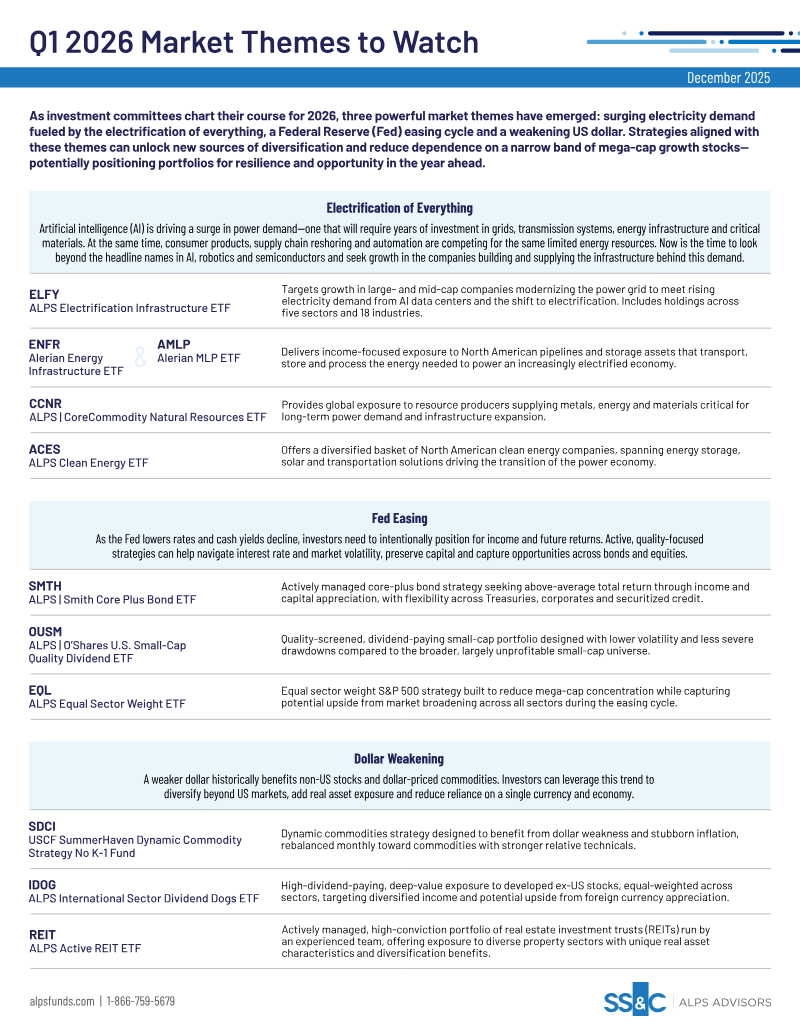
Investment committees navigating the 2026 landscape are advised to pivot toward three primary market themes: the widespread electrification of the global economy, the Federal Reserve’s interest rate easing cycle, and the depreciation of the US dollar. These trends offer a strategic framework for diversifying portfolios beyond the narrow concentration of mega-cap growth stocks, potentially enhancing resilience and capturing emerging opportunities across various asset classes.
The surge in power demand, driven by artificial intelligence, data center expansion, and industrial automation, necessitates significant capital allocation toward infrastructure. Rather than focusing solely on headline technology firms, investors are encouraged to target the underlying grid modernization, energy transmission, and critical material supply chains. This thematic shift encompasses North American energy pipelines, clean energy solutions, and global natural resource producers, all of which are essential to sustaining an increasingly electrified economy.
Simultaneously, the transition toward lower interest rates requires a shift in focus toward quality-oriented income strategies. As cash yields decline, active management in fixed income and the inclusion of quality-screened, dividend-paying small-cap equities can help mitigate volatility and reduce reliance on unprofitable market segments. Furthermore, the anticipated weakening of the US dollar provides a catalyst for diversifying into non-US developed markets and real assets, such as commodities and real estate investment trusts. By rebalancing toward these sectors, investors can hedge against currency risk and inflation while positioning for broader market participation across international and domestic landscapes.
- Investors should pivot from mega-cap growth stocks toward infrastructure assets that support the electrification of the economy, including grid modernization, energy transmission, and critical material supply chains.
- The surge in power demand driven by AI, data centers, and industrial automation necessitates capital allocation into North American energy pipelines, clean energy solutions, and global natural resource producers.
- The Federal Reserve’s interest rate easing cycle requires a shift toward quality-oriented income strategies, such as active fixed-income management and dividend-paying small-cap equities, to replace declining cash yields.
- Anticipated depreciation of the US dollar creates a strategic opportunity to diversify portfolios into non-US developed markets to hedge against currency risk.
- Real assets, including commodities and real estate investment trusts (REITs), should be utilized to hedge against inflation and capture broader market participation as the dollar weakens.
+2
GameVault System