The primary objective is to analyze the performance of new video game releases on Steam during January 2026, while providing broader context on industry trends, console hardware, and platform discovery. The analysis utilizes proprietary sales estimates to identify top-performing titles and evaluates the impact of influencer engagement and genre trends on commercial success.
January 2026 saw several notable Steam debuts, led by the zombie-themed simulation title Quarantine Zone: The Last Check, which surpassed 650,000 units sold. Other significant performers included the factory-action title StarRupture, which exceeded 500,000 sales, and the co-op roguelite LORT, which moved over 250,000 units. While the extraction shooter ARC Raiders dominated overall unit sales with 2.1 million copies on Steam for the month, Counter-Strike 2 maintained its position as the top revenue generator. The data highlights a strong market for high-quality original intellectual property from small and medium-sized developers, even during a traditionally slower month for the industry.
Beyond Steam, the analysis covers the global gaming landscape, noting that PlayStation 5 holiday sales reached 8.1 million units, outperforming the Switch 2. Mobile gaming trends indicate a shift toward yield-focused monetization, with in-app purchases surging 10.6% despite stagnant download growth. Additionally, the report tracks the rising market share of the Godot engine in game jams and observes that sequels consistently outperform original titles in influencer-driven viewership. These findings reflect a maturing market where platform competition, hardware component costs, and creator-led discovery remain the primary drivers of industry performance.
The analysis examines the successful early 2026 Steam launch of the co-op action roguelite LORT, while contextualizing broader industry trends through the Game Developers Conference (GDC) 2026 State of the Game Industry survey. The primary thesis posits that indie success in the current market requires a combination of strategic genre selection, aggressive pricing, and targeted influencer marketing, even as the broader industry faces significant structural challenges regarding employment and the relevance of large-scale trade events.
LORT, developed by the eight-person studio Big Distraction, achieved a top-five Steam debut for 2026, selling 281,000 units within its first two weeks of Early Access. Key drivers of this performance included a focus on the PvE co-op genre, which filled a market gap similar to Risk of Rain 2, and an aggressive $10 launch price point designed to maximize reach. The studio supplemented organic interest with a low-six-figure investment in paid influencer campaigns, specifically targeting roguelite and co-op gaming communities.
The broader industry landscape, as reflected in the GDC survey of approximately 2,300 professionals, remains volatile. Data indicates that 28% of respondents experienced layoffs within the past two years, with 50% of companies conducting layoffs in the last 12 months. This environment has prompted critical discourse regarding the utility of large conferences like GDC. As deal-making becomes increasingly data-driven and discovery shifts to online platforms, the traditional role of industry trade shows is being questioned, with observers noting a decline in deal flow and a shift toward more metrics-focused investment strategies.
The analysis explores the utility of the Steam More Like This section as a proxy for measuring platform favorability and algorithmic visibility. The core thesis posits that while the More Like This list is not a definitive indicator of success, it serves as a valuable metric for identifying games that have achieved significant recent revenue and strong community engagement. Because this section is not personalized to the individual user, it provides a transparent look at which titles the Steam algorithm is currently prioritizing across the broader ecosystem.
Data indicates that the algorithm favors games with high recent revenue and relevant, consistent tagging. When a game experiences a surge in interest—often driven by DLC launches, marketing showcases, or community buzz—it frequently sees a corresponding increase in mentions across other game pages. The analysis highlights that while tag optimization can assist in cross-promotion, it is most effective for titles already generating substantial weekly sales. Ultimately, the algorithm prioritizes external interest and organic player activity over internal platform tricks.
The scope of this assessment covers the global Steam marketplace, focusing on trends observed in early 2026. The methodology relies on tracking the frequency of game appearances within the More Like This widget, comparing these occurrences against sales performance and recent release milestones. The findings emphasize that while tracking these links offers insight into platform momentum, developers should prioritize building external interest and player demand before relying on store-page visibility to drive growth.
The primary objective of this analysis is to examine the successful early-access launch of the video game StarRupture, which achieved 500,000 sales within its first 11 days on Steam in January 2026. The thesis posits that the game’s success stems from a strategic blend of multiple genres—specifically factory building, survival, and combat—coupled with a unique gameplay hook and the developer’s established track record. By leveraging extensive playtesting with over 158,000 participants prior to launch, the studio, Creepy Jar, effectively refined the product to meet market expectations while avoiding the pitfalls of direct competition with larger genre incumbents.
Key data points highlight the game’s strong performance, including a peak of 42,000 concurrent users on Steam and high player engagement, with an average playtime exceeding 12 hours. The user base is geographically diverse, with the United States, Germany, and China representing the largest segments. Affinity data indicates that StarRupture successfully captured audiences from established titles like Satisfactory and various survival-crafting games. The developer’s pricing strategy, which positioned the game at a competitive entry point for early access, was identified as a significant factor in driving initial momentum.
The scope of this analysis covers the global PC market via Steam and includes broader industry observations regarding 2025 console hardware trends and Apple Arcade performance. The methodology relies on proprietary platform data, including Steam wishlist charts, player review sentiment, and affinity metrics, supplemented by direct insights from the developer’s business development team. The analysis concludes that while the game currently faces minor early-access challenges, its ability to differentiate itself through a unique "firestorm" mechanic and accessible design has secured its position as an early 2026 market success.
This analysis examines Steam games from 2024 and 2025 that achieved significant commercial success despite having low pre-launch wishlist counts. The primary objective is to identify "zero to hero" titles—games that outperformed their initial expectations by massive margins—and to determine the common characteristics that drive such unexpected viral growth. The findings are based on proprietary database queries of Steam sales performance relative to launch-day wishlists, focusing on conversion variance and post-release momentum.
Key findings indicate that these unexpected successes often share specific traits, most notably modest pricing. The most successful titles typically retail between $4.99 and $7.99, with some as low as $0.99. Contrary to the assumption that low-priced games offer limited engagement, these titles often demonstrate substantial playtimes, with median sessions frequently exceeding seven hours. These games are generally produced by small, independent developers who rely on gameplay mechanics and viral potential rather than traditional, high-budget marketing campaigns.
Genre analysis reveals that roguelikes, idlers, and clickers are particularly well-represented among these breakout hits. Additionally, the data highlights a notable trend in FMV dating simulations, particularly those originating from China, which frequently experience post-release surges in popularity. While these "needle in a haystack" successes are not necessarily replicable through a standardized formula, the study suggests that developers can gain valuable insights by iterating on the microgenres and mechanics that characterize these viral titles. The analysis underscores that while wishlists remain a useful indicator of interest, they are not a definitive guarantee of success, as community engagement and influencer pickup remain critical drivers of long-term sales momentum.
The analysis examines effective pre-release discovery strategies in the modern video game industry, using the indie title How Many Dudes? as a primary case study. The central thesis posits that combining a high-concept, hook-driven premise with iterative prototyping and strategic influencer engagement allows veteran development teams to break through in a saturated market. By focusing on a clear, viral-ready concept—specifically the debate regarding how many people could defeat a gorilla—the developers successfully leveraged streamer interest and public demos to generate significant wishlist momentum.
Key findings highlight that while early outreach to influencers yielded limited results, the release of a public demo on Steam served as a critical catalyst. This demo, which peaked at 3,000 concurrent users, provided tangible proof of audience interest, subsequently attracting major influencers and driving over 100,000 wishlists in a single month. The analysis emphasizes that the game’s design, which functions as an autobattler that encourages streamer commentary and audience participation, was instrumental in its viral success.
The scope of the analysis covers the global PC and console gaming landscape as of early 2026, with additional insights into the Roblox platform. Data points include specific performance metrics for trending Steam titles and Roblox earners, such as The Forge, which achieved over 1 million concurrent users within two weeks of release. The methodology relies on internal developer timelines, platform-specific engagement data, and industry tracking tools to provide a comprehensive look at how games gain traction in the 2020s. The findings underscore a shift where production quality is increasingly secondary to the ability to capture and sustain player attention through unique, shareable gameplay loops.
The management of a game’s long-tail revenue—the ongoing sales performance of titles after their initial launch window—is an increasingly vital yet complex aspect of the video game industry. While many developers view catalog management as a simple matter of scheduling discounts, professional optimization reveals significant untapped potential. By outsourcing these responsibilities to specialized firms, studios can achieve substantial revenue growth through data-driven pricing strategies, proactive platform relationship management, and sophisticated third-party key distribution.
A primary case study involves Subset Games, which utilized the services of the firm Rekoup to manage its strategy titles, FTL and Into The Breach. Following this engagement, the games saw revenue increases of 46% year-over-year, alongside significant growth in unit sales. These results were driven by more dynamic discount scheduling, a shift toward events that prioritize curated visibility over raw price cuts, and consistent, professional outreach to storefront operators. For many independent developers, this approach solves a critical operational challenge: allowing creators to focus on game development rather than the time-consuming, specialized tasks of business and marketing operations.
The scope of this analysis covers the PC and console markets, with a focus on the mid-2020s landscape. Methodology for these findings relies on industry interviews, comparative analysis of store discount histories, and performance data from firms specializing in long-tail revenue services. The evidence suggests that while basic discounting is accessible to all, the "long tail" requires a methodical, dedicated mindset that is often missing in small-to-medium-sized studios. Ultimately, effective catalog management is not merely about lowering prices, but about navigating the complex, evolving requirements of digital storefronts to maximize the lifecycle value of evergreen titles.
The virtual reality gaming market experienced significant contraction and strategic shifts throughout 2025, characterized by widespread layoffs at major industry players like Meta’s Reality Labs and the closure of prominent first-party studios. While the sector remains active, the economic viability of premium, paid blockbuster titles has diminished. Instead, the market is increasingly dominated by free-to-play, sandbox-style experiences that rely on voice chat and social interaction, with users frequently migrating between titles.
Data from the Meta Quest platform indicates that approximately 70% of user time is spent in free-to-play environments. Top-grossing titles for 2025 were largely comprised of established evergreens and sandbox hits such as Gorilla Tag, Animal Company, and Yeeps. Conversely, new paid releases struggled to gain traction, with only a small fraction of titles achieving significant commercial success. Steam data for 2025 reflects a similar trend, showing that only four paid, VR-only titles managed to sell more than 100,000 copies. PlayStation VR has largely become a secondary platform with minimal market impact compared to the Quest and PC ecosystems.
The analysis draws on industry reports, platform-specific revenue charts, and sales estimates to evaluate the state of the VR landscape. The findings suggest that while the underlying technology remains a critical component of broader wearable computing and augmented reality development, the current VR gaming model faces substantial hurdles. High barriers to entry, social isolation, and a lack of multitasking capabilities have hindered the growth of the premium paid market, forcing developers to pivot toward free-to-play models or reconsider the sustainability of large-scale, standalone VR game production.
The emergence of a new class of agile, micro-publishers is challenging traditional industry models by prioritizing high-frequency, low-budget releases to navigate the complexities of game discovery. Rather than relying on large-scale investments, these publishers focus on rapid iteration, strict performance-based quality control, and organic community building. By leveraging transparent communication channels and targeting specific, commercially minded developer demographics, these firms aim to identify hits through volume and data-driven acquisition strategies.
Polden Publishing serves as a primary case study for this approach, having released six titles since mid-2025 with budgets ranging from $50,000 to $150,000. This model relies on identifying niche, catchy concepts—such as restaurant simulations or unique card-collection games—and utilizing demo performance as a key indicator for potential success. While these titles often face challenges typical of smaller-scale development, such as technical bugs or reliance on generative AI, the strategy allows for a faster "speedrun" of the publishing process compared to traditional firms that require million-dollar budgets to initiate projects.
The broader industry landscape reflects a shift toward these specialized, lean operations. Data from late 2025 indicates that while the market remains hit-driven, successful discovery is increasingly tied to targeted genre expertise and the ability to scale inexpensive titles. This trend is further supported by broader market observations, including the continued dominance of 4x strategy games on mobile, the integration of AI in nearly 20% of top new Steam sellers, and evolving platform requirements for user safety and engagement. Ultimately, this new breed of publisher represents a departure from the traditional reliance on extensive back catalogs, favoring instead a high-velocity, data-informed approach to finding success in a crowded digital marketplace.
This analysis examines the 2025 revenue performance of games on the Steam platform, utilizing official year-end charts to identify market trends and shifts in consumer behavior. The primary thesis suggests that Steam’s revenue rankings are increasingly front-loaded toward recent releases, with 31 of the top-grossing titles debuting in 2025 or the preceding year, compared to 24 in 2024. This shift likely reflects a combination of a strong release calendar and a market environment where revenue-based sorting favors full-priced new titles over discounted catalog games.
Key findings indicate that while established live-service titles like Counter-Strike 2, DOTA 2, PUBG: Battlegrounds, and Apex Legends maintain consistent Platinum-tier status, the broader landscape is evolving. Certain long-standing titles, such as Warframe and Dead by Daylight, remain rare examples of sustained high-revenue performance over a four-year period. Conversely, other major titles have seen fluctuations, with some moving between tiers as they age or transition to new versions. The data also highlights a growing presence of Asia-developed free-to-play titles in the Silver revenue tier, including Delta Force and Once Human.
Beyond revenue rankings, the analysis incorporates performance marketing data from Gamesight, which tracked over $625 million in digital marketing spend during 2025. The findings emphasize that last-click attribution models often undervalue upper-funnel marketing efforts, such as YouTube exposure, which are essential for building demand. Furthermore, the data suggests that for paid titles, improving user review scores from mixed to positive significantly boosts conversion rates, whereas review sentiment has no measurable impact on free-to-play titles due to the absence of a financial barrier to entry. These insights provide a comprehensive overview of the current PC gaming market, focusing on discovery, monetization, and the effectiveness of promotional strategies.
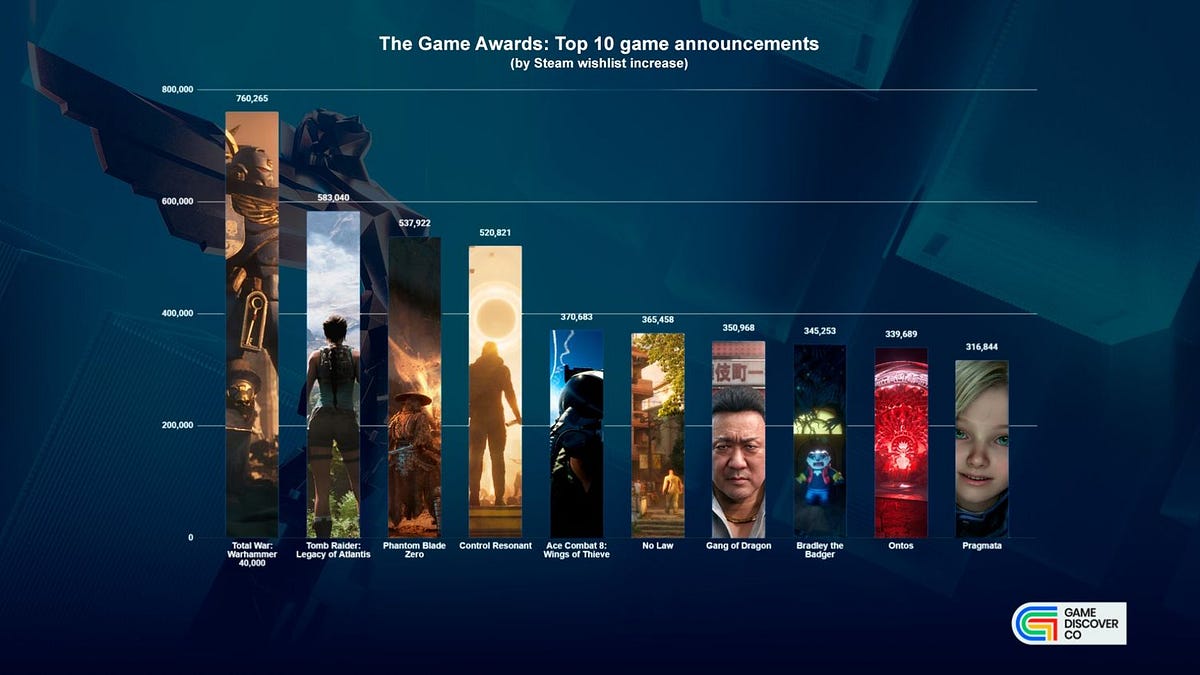
The 2025 Game Awards generated significant industry attention, with organizers reporting 171 million global livestreams, an 11% increase over the previous year. To determine which game announcements captured the most audience interest, a multi-metric analysis was conducted, evaluating Steam wishlist growth, YouTube trailer views on official channels, and traditional media mentions provided by Footprints.gg.
The analysis highlights several standout titles that dominated post-event engagement. Total War: Warhammer 40,000 led the Steam wishlist charts with 760,000 additions, followed closely by Tomb Raider: Legacy Of Atlantis and Control Resonant. When aggregating data across all three metrics—wishlists, trailer views, and media coverage—the top five most impactful announcements were Tomb Raider, Star Wars: Fate Of The Old Republic, Phantom Blade Zero, Resident Evil Requiem, and Divinity. The findings note that while some titles benefited from immediate Steam page launches, others, such as Forest 3, generated substantial interest despite being in early development stages without active store pages.
Beyond the awards, the broader 2025 industry landscape reflects a complex market. Newzoo estimates the global games market reached $197 billion, a 7.5% year-over-year increase, with PC growth notably driven by premium releases. Conversely, U.S. console hardware sales faced a downturn, with significant year-over-year declines in unit sales for major platforms. Additionally, consumer sentiment research indicates a strong aversion to generative AI in gaming, with 85% of surveyed players expressing a negative or neutral stance. These insights, combined with data on mobile advertising performance and shifting hardware trends, provide a comprehensive overview of the industry's state at the close of 2025.
The 2025 video game landscape is characterized by a continued surge in new releases alongside a clear bifurcation in consumer preferences between high-budget, long-form experiences and accessible, co-op-oriented titles. The industry saw nearly 20,000 new titles debut on Steam in 2025, marking an all-time high and a 20% increase in total available inventory. While Steam and Switch release volumes grew by 2% and 8% respectively, Xbox console releases declined by 20% year-over-year, reflecting a broader shift in platform strategy and hardware market saturation.
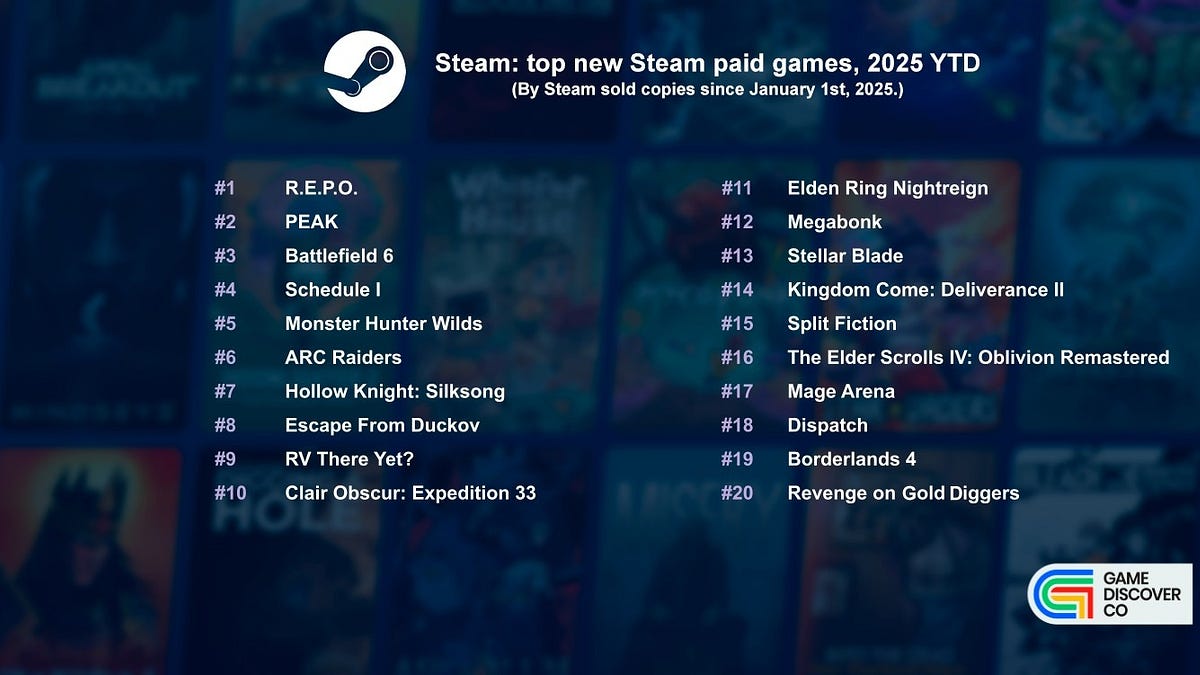
Data analysis of 2025 performance reveals that high-budget action RPGs, such as Monster Hunter Wilds and Kingdom Come: Deliverance II, maintained strong market dominance, with many titles achieving median playtimes exceeding 45 hours. Simultaneously, the "friendslop" genre—defined by cooperative, casual-friendly gameplay—emerged as a significant commercial force, with multiple titles securing spots in the top 20 by units sold. Notably, the revenue landscape for 2025 was dominated by premium-priced games, as no new free-to-play titles reached the top 20 revenue rankings on Steam.
Methodologically, these findings are derived from proprietary platform data tracking unit sales, revenue, and engagement metrics across PC and console ecosystems. The analysis highlights that while the sheer volume of games continues to rise, the market remains highly competitive, with a growing number of titles reaching the 100-review threshold. Ultimately, the 2025 data underscores that success in the current climate is increasingly dependent on a game’s ability to navigate specific platform-based audience behaviors, such as the preference for evergreen sports titles on consoles versus the diverse, high-engagement trends observed on PC.