Analysis of global gaming trends for late April and early May 2021 reveals significant momentum for major franchises and breakout indie titles across Steam, Nintendo Switch, and Twitch. The primary focus centers on the impending launch of Resident Evil Village, which has secured over 60,000 Steam followers and an estimated 500,000 to 700,000 wishlists, signaling a potential multi-million unit seller. Other notable upcoming releases include Distant Kingdoms and Almighty: Kill Your Gods, both entering Early Access with strong genre-blending appeal.
Market data indicates that recent high-profile releases are stabilizing after initial technical hurdles. Total War: Rome Remastered and NieR Replicant both faced early "mixed" user reviews due to UI or performance issues but have since seen recovery in sentiment and sales, with NieR estimated to reach one million copies on Steam. In the indie sector, Turnip Boy Commits Tax Evasion has emerged as a viral success, achieving "Overwhelmingly Positive" status through its unique charm despite a crowded market.
On the Nintendo Switch, UK eShop data suggests a high churn rate for most new releases, which often drop out of the top 100 shortly after launch. However, Cozy Grove demonstrates unusual staying power, while licensed titles like The Game of Life 2 benefit from the platform's preference for digital board games and multiplayer experiences.
Twitch viewership trends highlight the impact of strategic launches and betas. NieR Replicant dominated streaming hours upon release, while the Steam beta for Naraka Bladepoint reached over 120,000 concurrent users. Additionally, Scavengers utilized a Twitch-drop strategy to manage Early Access entry, successfully driving engagement despite server stability challenges. These findings underscore the critical role of streamer coverage and platform-specific audience preferences in determining a game's commercial trajectory.
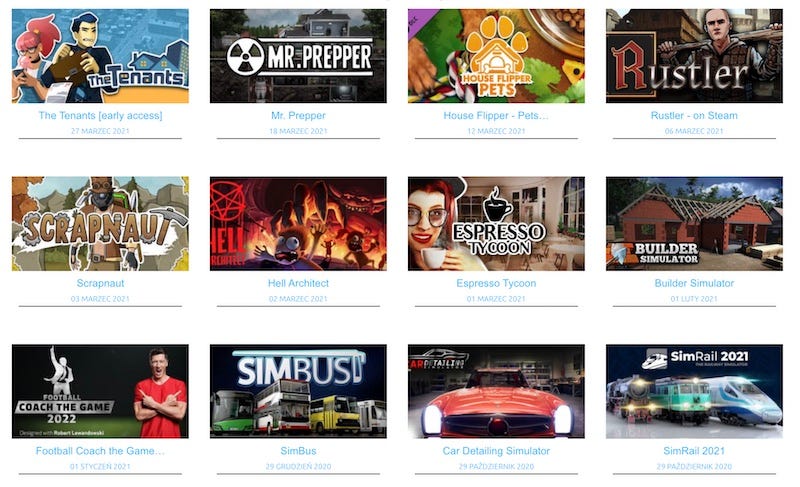
The Polish publisher PlayWay and its network of subsidiary studios represent a unique and controversial model in the modern PC gaming industry. By analyzing Steam wishlist data and market trends, it is evident that PlayWay dominates the platform’s unreleased rankings, often holding dozens of titles in the top 100. This success is driven by a centralized "ideas machine" that commissions specific, commercially viable concepts—primarily realistic 3D simulators and city builders—to be developed by newer Polish studios in exchange for equity stakes.
The core of PlayWay’s strategy involves a high-volume, market-led approach where numerous game ideas are announced via "target gameplay" trailers to gauge consumer interest. Development is then prioritized based on which titles gain the most traction and wishlists. This methodology has faced criticism for its "truthiness," as many trailers feature pre-rendered content rather than functional gameplay, leading to accusations of "fast-following" successful indie hits or maintaining "zombie" Steam pages that provide infrequent updates to stall for time.
Despite these polarizing tactics, the industry can observe several effective business practices within the PlayWay model. The publisher excels at identifying underserved niches and utilizing aggressive cross-promotion across its vast ecosystem. While the "backwards" development process—creating a trailer first and building the game to match it later—can lead to long production cycles, it often results in high-quality, commercially successful products like House Flipper and Mr. Prepper. Ultimately, PlayWay illustrates a ruthless, "success at all costs" philosophy that effectively leverages platform algorithms, even as it pushes the boundaries of transparency and platform guidelines.
This analysis examines current market trends and upcoming releases for the PC and console gaming sectors, focusing on Steam and the Nintendo Switch during late April 2021. By utilizing proprietary Hype charts, real-time sales data, and platform-specific rankings, the findings provide a snapshot of consumer behavior and technical performance across major digital storefronts.
The Steam market is currently dominated by Total War: Rome Remastered, which leads the Hype charts as a top 50 unreleased wishlist title. While the upcoming release schedule includes major AAA titles like Resident Evil Village and Mass Effect, the current week’s performance is highlighted by the launch of NieR Replicant. Despite high sales expectations, the title faces criticism for a poor PC conversion where gameplay speed is erroneously tied to frame rate. In contrast, smaller titles like Turnip Boy Commits Tax Evasion have found success through strong hooks and subverting genre expectations, outperforming more complex competitors like We Are The Caretakers in initial player engagement.
Long-term Steam revenue continues to be anchored by established Games As A Service (GaaS) titles such as PUBG, Apex Legends, and Destiny. A notable outlier is the co-op title It Takes Two, which has surpassed one million copies sold, suggesting a significant market under-served by innovative two-player experiences. Conversely, many high-profile DLC releases, such as Stellaris: Nemesis, show a pattern of rapid initial sales followed by a steep decline in chart position.
On the Nintendo Switch, the UK eShop data indicates that the "cozy" and management subgenres remain exceptionally strong, evidenced by the successful launch of Deiland: Pocket Planet Edition. The data also suggests that "stealth-launching" games immediately following a Nintendo Indie World presentation, as seen with Fez and The Longing, provides a measurable short-term sales boost. Additionally, the analysis notes that high-quality indie titles like Haven maintain strong shelf-lives through strategic discounting, even if they initially underperform Hype expectations.
Strategic use of game demos and prologues on Steam can significantly enhance a title's discoverability and community building, provided the game features a specific type of replayable loop. While conventional wisdom often suggests keeping demos short and time-limited to avoid cannibalizing sales, evidence from breakout hits suggests that high-quality, short gameplay loops can sustain long-term engagement without exhausting player interest in the full release.
Case studies of titles like Loop Hero and The Riftbreaker demonstrate that successful demos often result in "super fans" who log dozens or even hundreds of hours in a free version. The Riftbreaker, for instance, utilized both a demo and a standalone prologue to garner over 415,000 combined downloads. Data indicates that a significant subset of these players—approximately 34,500 individuals—played for over 200 minutes, effectively treating the demo as an early access experience that fostered a modding community and drove the game to a top-25 wishlist ranking on Steam.
The broader industry landscape shows a trend toward increased platform saturation and evolving distribution models. While the Nintendo Switch storefront is becoming as crowded as Steam, historical data suggests that Steam game pricing has remained relatively stable rather than collapsing. Success in this environment increasingly relies on leveraging festivals like Steam Next Fest and utilizing technical tools such as UTM tracking links within demos to convert player engagement into measurable wishlist growth and eventual sales.
NieR Replicant ver.1.22474487139 is positioned to dominate the Steam market for the week of April 19, 2021. Analysis of Steam Hype points—a proprietary metric aggregating followers, wishlist rankings, and forum activity—indicates that the title enters the week with over 64,000 followers and an estimated wishlist count exceeding 500,000. This significant lead comes during an exceptionally quiet release window where only one game exceeds the 500 Hype point threshold, compared to eight games in the preceding week.
Beyond the primary focus on the NieR prequel, the analysis covers several indie titles and market trends across Steam and the Nintendo Switch. We Are The Caretakers, Turnip Boy Commits Tax Evasion, and Buildings Have Feelings Too are identified as notable upcoming releases, though they face challenges ranging from flat follower growth to overcrowded genres. Recent performance data shows that TaleSpire and Voxel Tycoon have successfully converted pre-launch interest into positive early user reviews, while First Class Trouble is experiencing a surge in popularity driven by high Twitch viewership and the ongoing demand for online co-op experiences.
Geographically focused on global Steam trends and the UK Nintendo eShop, the findings highlight a stark contrast between platform ecosystems. While Steam is characterized by rapid turnover and high-volume debuts, the Switch market remains heavily dominated by Nintendo first-party titles. However, Cozy Grove has emerged as a significant third-party success on the Switch, climbing from 89th to 20th in the overall rankings within a week. The methodology relies on a mix of public data scraping, proprietary scoring algorithms, and hand-compiled 14-day download charts to track game discovery and sales velocity.
This analysis deconstructs the legal strategies and internal data revealed in the 2021 federal antitrust lawsuit between Epic Games and Apple. The core of the dispute centers on whether Apple’s 15% to 30% commission on in-app purchases and its exclusive control over iOS app distribution constitute anticompetitive behavior. While Epic seeks to force the opening of iOS to third-party storefronts, Apple maintains that its "walled garden" approach is a proprietary business model essential for user security and integrated hardware-software performance.
Epic’s primary thesis argues that Apple’s App Store restrictions are motivated by profit rather than security, claiming that the manual review process is often used to stifle competitive threats. Epic positions its challenge as an altruistic move to lower platform fees across the industry. Conversely, Apple’s defense highlights that its commission rates are industry standard, matching those of Nintendo, PlayStation, and Xbox. Apple further alleges that Epic’s "Project Liberty" was a calculated PR campaign designed to offset declining Fortnite revenues and pivot toward a user-generated content model by reclaiming platform fees.
Financial disclosures within the filings provide a rare look at the Epic Games Store (EGS) on PC. Data indicates that EGS is currently a loss-leading venture, with Epic losing approximately $181 million in 2019 and $273 million in 2020. These losses are driven largely by $444 million in minimum guarantees to developers, resulting in at least $330 million in unrecouped costs. While Epic views these as necessary investments to build a future ecosystem, Apple uses these figures to argue that Epic is an unprofitable operator seeking judicial intervention to subsidize its business model.
The scope of this conflict covers the global mobile and PC gaming segments during the 2018–2021 period. The findings are based on over 700 pages of court filings, including internal emails, expert testimony, and financial projections. Ultimately, the analysis suggests that while Epic’s challenge exerts pressure on platform holders to reconsider revenue splits, a judicial mandate for a technical redesign of iOS remains an impractical and unlikely outcome.
This analysis introduces a new methodology for tracking performance on the Nintendo Switch eShop while providing updates on Steam market trends. By utilizing hand-compiled data from the United Kingdom eShop’s "recently released" section, the study aims to bypass the noise created by heavily discounted older titles that typically dominate standard 14-day download charts. The UK market serves as a primary proxy for European performance, offering a clearer view of how new releases fare at or near full price.
Key findings from the Switch data indicate that first-party Nintendo titles occupy approximately 50% of the top 20 rankings. However, specific third-party niches show significant strength, particularly "chill" farming and village simulation games like Story of Seasons and Harvest Moon. The data also suggests that certain titles, such as Lost Words: Beyond the Page, may find more receptive audiences on the Switch platform than on PC. While the Switch remains a viable platform for smaller titles to gross between $100,000 and $200,000 through strategic discounting, the new tracking method focuses on the organic popularity of recent debuts.
On the Steam platform, the analysis highlights the impact of external discovery drivers. The Slormancer saw a significant surge in "Very Positive" reviews attributed to influencer coverage, while Before Your Eyes benefited from a viral TikTok campaign. The report concludes that deep simulation games and niche RPGs continue to hold the highest "Hype" ratings for upcoming releases. The scope of this analysis covers the first half of 2021, focusing on digital storefront trends in the UK and global Steam markets, utilizing follower counts, review velocity, and download rankings as primary metrics.
Valve has introduced UTM (Urchin Tracking Module) analytics to the Steamworks platform, providing developers with a privacy-focused method to track the effectiveness of external marketing campaigns. This update allows creators to monitor how specific referral links—such as those used in emails, social media, or paid advertisements—convert into page visits, wishlists, purchases, and product activations. By utilizing an abstracted and anonymized data model, the system avoids sharing personal user information or Steam IDs, only displaying total numbers once a minimum visit threshold is met to protect individual privacy.
The tracking logic operates on a three-day attribution window, meaning a conversion is only credited to a UTM link if the action occurs within 72 hours of the initial visit. Furthermore, the system prevents double-counting by ensuring that multiple visits from the same user do not inflate conversion metrics for a single UTM. While the current implementation focuses on external traffic, future iterations may include UTM tracking for Steam’s internal wishlist notification emails.
Beyond the Steam update, the analysis observes a strategic shift at the Epic Games Store (EGS). Data suggests that Epic is moving away from aggressive timed-exclusivity deals in favor of opening its backend to a broader range of non-exclusive titles. While high-profile exclusives like Sifu continue to be signed, the storefront is increasingly focused on catalog depth. Additional industry trends noted include the rise of digital-only events like E3, increasing global regulatory pressure on loot boxes due to their link to problem gambling, and the evolving role of variety streamers in game discovery.
This analysis examines significant shifts in the digital gaming landscape during early 2021, focusing on platform strategy pivots and data privacy regulations. The primary thesis suggests that subscription services like Apple Arcade and Xbox Game Pass are fundamentally altering the "buy once to play once" business model, while evolving privacy standards are complicating how developers track and market to their audiences.
A major finding involves Apple Arcade’s strategic expansion beyond its original mandate of platform-exclusive titles. By introducing "Timeless Classics" and "App Store Greats," Apple has moved away from requiring all games to run across Mac and Apple TV, focusing instead on the iOS mobile experience which accounts for an estimated 95% of the service's engagement. This shift allows Apple to license existing premium hits, providing a more sustainable catalog of replayable, ad-free content compared to its initial emphasis on niche narrative experiences.
The report also highlights the impact of the General Data Protection Regulation (GDPR) on the Steam platform. Following the implementation of a prominent cookie preference interface in Europe, developers have reported a significant drop in visible data, with some seeing only 30% of previous European traffic appearing in Google Analytics. This change creates a new baseline for marketing analytics, as opt-in requirements for tracking cookies become the standard for European users.
Geographically, the scope covers global trends with specific emphasis on the European regulatory environment and the North American mobile and console markets. Data sources include internal GameDiscoverCo research, SteamDB tracking, and developer surveys. The findings conclude that the industry is entering a transitional phase where subscription bundles and increased user privacy are no longer peripheral trends but central pillars of the modern gaming economy.
This analysis examines Steam platform trends and launch performance for late March and early April 2021, utilizing proprietary Hype rankings, follower counts, and concurrent player data to evaluate game discovery and commercial success. The primary focus is on the volatile launch of Outriders, which achieved a massive initial peak of 100,000 simultaneous players on Steam but suffered from a "Mixed" review rating (64%) due to server instability and mandatory online requirements for single-player content. Despite these technical hurdles, the title’s pre-launch momentum—evidenced by 95,000 followers and a high Hype ranking—suggests strong underlying demand for the looter-shooter genre.
In contrast, the co-op title It Takes Two demonstrated significant staying power, securing over 4,000 "Overwhelmingly Positive" reviews and estimated Steam sales of 150,000 units within its first week. The data suggests that "perfect pandemic games" featuring high-quality cooperative play are currently resonating strongly with the PC audience. Other notable performances include the "mellow citybuilder" Dorfromantik and the expansion for The Binding of Isaac, both of which capitalized on deep gameplay systems to drive revenue.
The scope of the analysis covers the global Steam market, specifically highlighting the impact of simultaneous Game Pass releases on Steam sales velocity. Findings suggest that while Game Pass provides massive reach, it may contribute to slower initial Steam traction for "console-style" games like Narita Boy. Looking forward, the RPG segment shows promise with upcoming titles like The Legend of Heroes: Trails of Cold Steel IV and Colony Ship, indicating a robust market for niche Japanese titles and complex, choice-driven Western RPGs. Methodology relies on tracking Steam followers, wishlist momentum, and review-to-sales multipliers to forecast and validate market performance.
The launch of Car Mechanic Simulator 2021 serves as a primary case study for analyzing successful sequel performance and the efficacy of specific Steam marketing strategies. Developed by Red Dot Games and published by PlayWay, the title achieved significant commercial success, selling 132,000 PC units within its first three days. This performance was preceded by a strong pre-launch interest, characterized by 270,000 Steam wishlists and a high follower-to-wishlist multiplier of 16x, which is notably above the industry median of 9.5x.
Data indicates that the game’s success is driven by its unique "flipper" gameplay loop and effective monetization through launch-day DLC. Approximately 50-60% of early purchasers opted for a bundle including two DLC packs, significantly increasing the initial yield per user. Furthermore, the publisher utilized a tiered discounting strategy, combining a 5% launch discount with a 10% loyalty discount for owners of previous franchise entries or other PlayWay titles. While PC remains the dominant platform, Xbox sales reached 11,000 units in two days, representing roughly 10% of the PC volume, with lower DLC attachment rates due to storefront interface differences.
Broader industry trends highlighted include the stabilization of review-to-sales ratios, which often start high (100:1) before settling between 40:1 and 70:1. Analysis of engine market share also reveals Unity’s continued dominance in total game volume on Steam, despite a slight resurgence from Unreal Engine. These findings underscore the importance of leveraging existing fanbases, utilizing cross-promotional widgets, and preparing day-one content to maximize the impact of a sequel launch in the current PC and console market.
The current landscape of premium PC and console gaming is defined by the convergence of three previously distinct trends: Games as a Service (GaaS), in-game purchases (IAP) or DLC-centric monetization, and catalog subscription services. This "combo" era allows major publishers to create a powerful network effect where base games serve as entry points for long-term monetization. By integrating titles into services like Xbox Game Pass or offering them for free on the Epic Games Store, publishers can significantly expand their player base to drive recurring revenue through microtransactions and expansions.
Data from major industry players illustrates the financial success of this integrated approach. For instance, Grand Theft Auto V generated nearly $1 billion in revenue in a single fiscal year despite its age, a figure equivalent to selling 33 million standalone copies at $30. This success is driven by persistent online updates and strategic placement in subscription tiers, which Microsoft executives note acts as a catalyst for further spending rather than the end of the monetization cycle. Similarly, Electronic Arts utilizes EA Play within Game Pass to funnel players toward high-margin modes like FIFA Ultimate Team.
For small to medium-sized developers, the shift necessitates a focus on replayability and extensibility to ensure a "long tail" of sales. While indie developers may not scale to full GaaS models, the use of paid DLC and cosmetic IAP is presented as a viable method to monetize committed players. The analysis suggests that for single-purchase, "one-and-done" titles, partnering with publishers may be increasingly necessary to hedge financial risks. Ultimately, while subscription services offer discovery benefits for GaaS-style titles, they may eventually degrade monetization opportunities for traditional single-purchase games produced by smaller entities that lack the leverage to join these platforms.