Competition
Organization1 document
Documents
Report72 pages
Appendix J: Apple's and Google's Privacy Changes
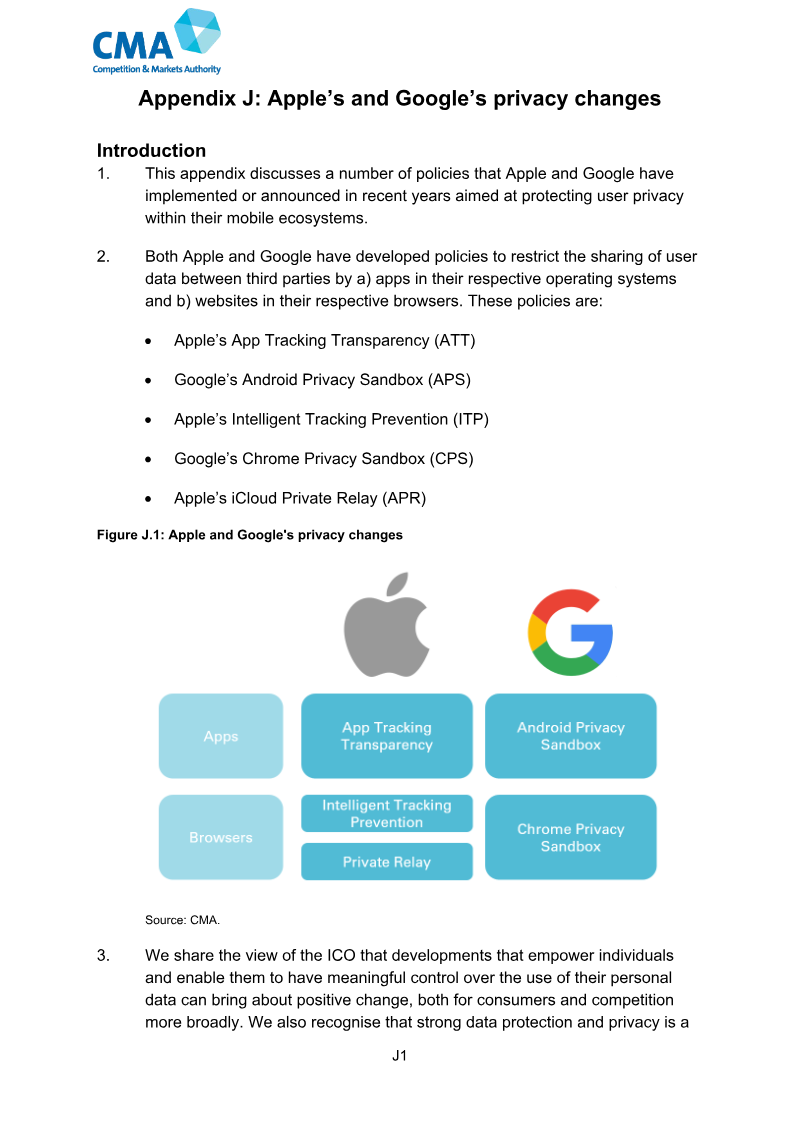
The mobile advertising ecosystem is undergoing a fundamental transformation as Apple and Google implement restrictive privacy frameworks, including App Tracking Transparency, the Privacy Sandbox, and Intelligent Tracking Prevention. While these initiatives provide tangible benefits by enhancing user control over personal data and limiting cross-app tracking, they simultaneously disrupt the technical infrastructure required for third-party ad targeting and attribution. By restricting access to device-level identifiers like IDFA and AdID, these policies have significantly increased costs for developers and reduced the efficacy of digital marketing, forcing a widespread shift in advertising budgets and monetization strategies across the global mobile industry.
A central concern is that these privacy-centric design choices create competitive imbalances that favor the platforms' own advertising services. Evidence suggests that Apple’s choice architecture—specifically the framing and placement of consent prompts—may leverage behavioral biases to discourage data sharing, while its proprietary attribution tools, such as SKAdNetwork, offer inferior data granularity compared to the insights available to Apple Search Ads. This asymmetry effectively creates a barrier to entry for third-party competitors, potentially consolidating market power within Apple and Google’s ecosystems. Developers report that these constraints not only hinder campaign optimization but also force a reliance on commission-based models that further entrench the platforms' dominance.
Ultimately, the transition toward privacy-first frameworks presents a complex trade-off between individual user protection and market competition. While the policies align with broader regulatory goals regarding data privacy, their implementation risks distorting the digital advertising landscape. The ongoing shift necessitates careful oversight to ensure that privacy-enhancing technologies do not serve as a pretext for self-preferencing or the suppression of competition, as the long-term viability of the app economy depends on maintaining a fair and transparent environment for all participants.
- Apple and Google’s privacy frameworks—including App Tracking Transparency, Privacy Sandbox, and Intelligent Tracking Prevention—have fundamentally disrupted the technical infrastructure for third-party ad targeting and attribution.
- The restriction of device-level identifiers like IDFA and AdID has increased costs for developers while simultaneously reducing the efficacy of digital marketing campaigns.
- Apple’s proprietary attribution tools, such as SKAdNetwork, provide lower data granularity than the insights available through Apple Search Ads, creating a competitive disadvantage for third-party advertisers.
- The framing and placement of consent prompts by Apple may leverage behavioral biases to discourage data sharing, effectively creating barriers to entry for competitors.
- These privacy-centric policies risk consolidating market power within Apple and Google by forcing developers to rely on the platforms' own advertising services and commission-based monetization models.
CompetitionAug 2026