École normale supérieure
Organization2 reports
2 reports, presentations and talks by École normale supérieure in the Game Industry Library, the newest “DEEP: A Model of Gaming Preferences Informed by the Hierarchical Nature of Goal-Oriented Cognition” (2025).
Documents
Whitepaper67 pages
DEEP: A Model of Gaming Preferences Informed by the Hierarchical Nature of Goal-Oriented Cognition
The DEEP model establishes a comprehensive framework for understanding gaming preferences by mapping player agency onto the hierarchical nature of goal-oriented cognition.
- The DEEP model categorizes player engagement into four hierarchical dimensions—Discovering, Experimenting, Expanding, and Performing—which map directly to the cognitive architecture of human goal-setting.
- Empirical analysis of 16,598 video games confirms that 90% of titles utilize this nested hierarchical structure, aligning game design with fundamental cognitive processes.
- Player behavior is predictable based on these dimensions: those who prioritize 'Discovering' and 'Experimenting' engage with a wider variety of titles, while those who favor 'Performing' focus on mastering fewer, specific games.
Institut Jean NicodFeb 2025
Whitepaper6 pages
Video Games as a Corpus: Sentiment Analysis using Fallout New Vegas Dialog
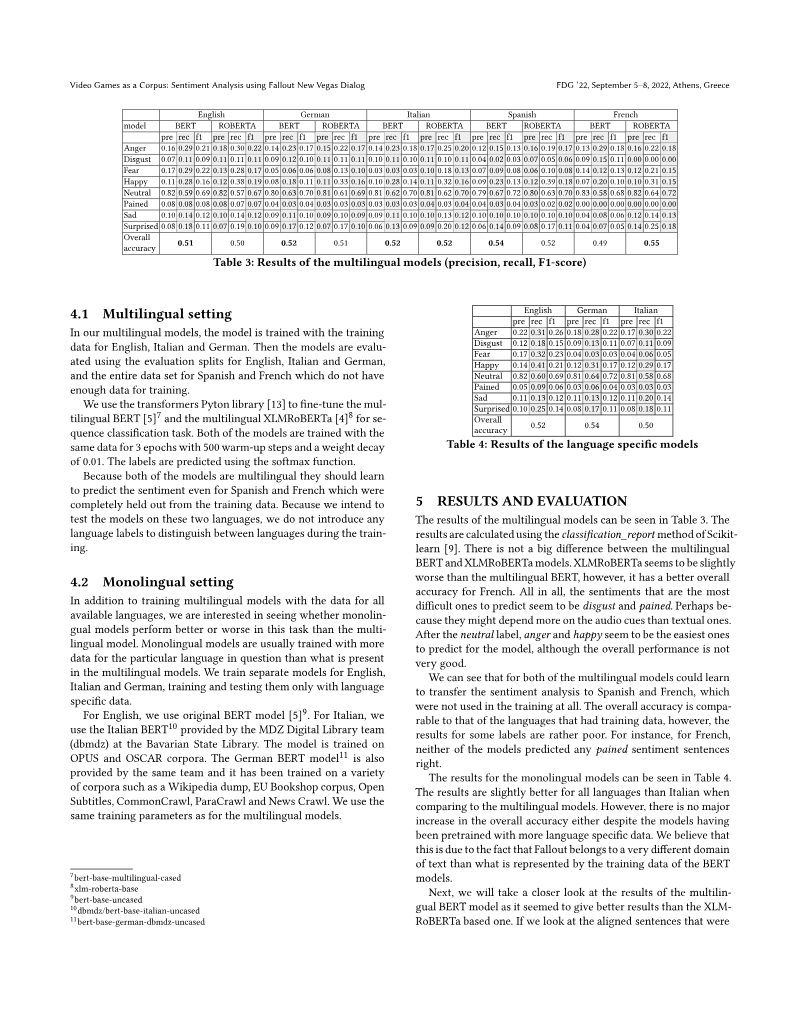
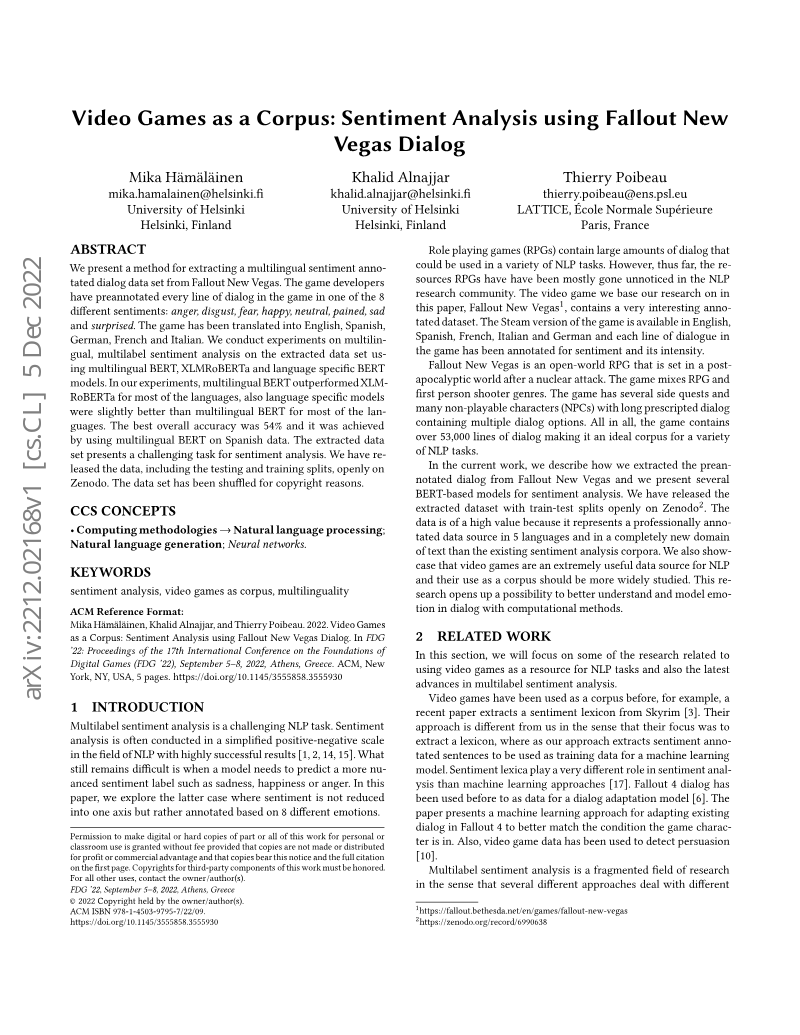
This research explores the utility of video games as a rich, professionally annotated corpus for natural language processing (NLP) tasks, specifically focusing on multilabel sentiment analysis.
- Video games serve as a high-quality, professionally annotated corpus for NLP, as demonstrated by a new dataset extracted from Fallout New Vegas containing over 53,000 lines of dialogue.
- The dataset supports cross-lingual sentiment analysis across five languages—English, Spanish, German, French, and Italian—with eight distinct sentiment labels including anger, disgust, fear, happy, neutral, pained, sad, and surprised.
- Multilingual BERT models achieved a peak accuracy of 54% when predicting sentiment in Spanish, demonstrating the ability to transfer sentiment understanding to languages not included in the training set.
University of HelsinkiSep 2022
Do you work at École normale supérieure? Get a free report of how these documents are read and cited here.