Bernstein
Organization1 document
Documents
Report32 pages
Global Video Gaming: The State of Play, 2025
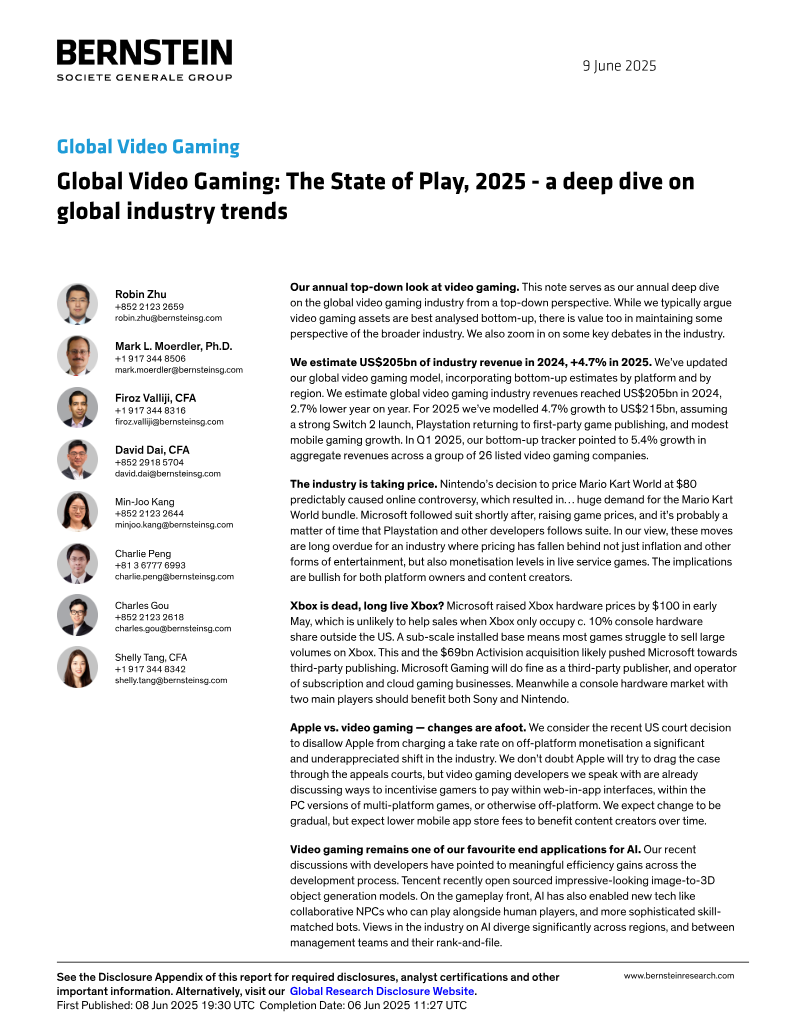
The global video gaming industry is entering a phase of stabilization and renewed growth, with total revenue projected to reach US$215 billion in 2025, representing a 4.7% increase following a 2.7% decline in 2024. This recovery is underpinned by strategic pricing adjustments for software and subscription services, alongside the anticipated launch of new console hardware. While the mobile gaming sector shows signs of modest growth and the console market faces a period of recalibration, the PC gaming ecosystem, particularly Steam, has emerged as a critical driver of industry expansion.
A significant structural shift is currently underway as major industry players reevaluate their hardware-centric strategies. Microsoft, for instance, is pivoting toward a third-party publishing model, prioritizing the reach of its Game Pass and cloud gaming services over the expansion of its proprietary console installed base. This transition reflects a broader trend where companies are leveraging cloud infrastructure and generative AI to enhance development efficiency and maximize software distribution across diverse platforms. Although developer sentiment regarding AI remains varied, its integration into production pipelines is increasingly viewed as a necessary evolution for operational sustainability.
Despite short-term headwinds, such as the delayed release of major titles, the industry’s long-term earnings outlook remains positive. The balance of power between platform owners and content creators continues to evolve, influenced by landmark legal rulings that may reduce mobile app store fees. These findings are intended for institutional investors, supported by rigorous analytical frameworks that account for the complex financial relationships and regulatory environments governing major entities like Sony, Tencent, and Square Enix. The industry is effectively transitioning from a post-pandemic contraction toward a more diversified, software-led growth model.
- The global video gaming industry is projected to reach $215 billion in revenue in 2025, marking a 4.7% recovery following a 2.7% decline in 2024.
- Major industry players are shifting from hardware-centric models to software-led growth, exemplified by Microsoft’s pivot toward third-party publishing and the expansion of Game Pass and cloud services.
- The PC gaming ecosystem, led by Steam, has emerged as a primary driver of industry expansion, offsetting the recalibration occurring within the console market.
- Generative AI is being integrated into production pipelines as a necessary evolution for operational sustainability, despite varied sentiment among developers.
- Industry revenue growth is being supported by strategic pricing adjustments for software and subscriptions, alongside the anticipated launch of new console hardware.
Societe Generale Group