Alinea Analytics
Research24 documents
Documents
Article
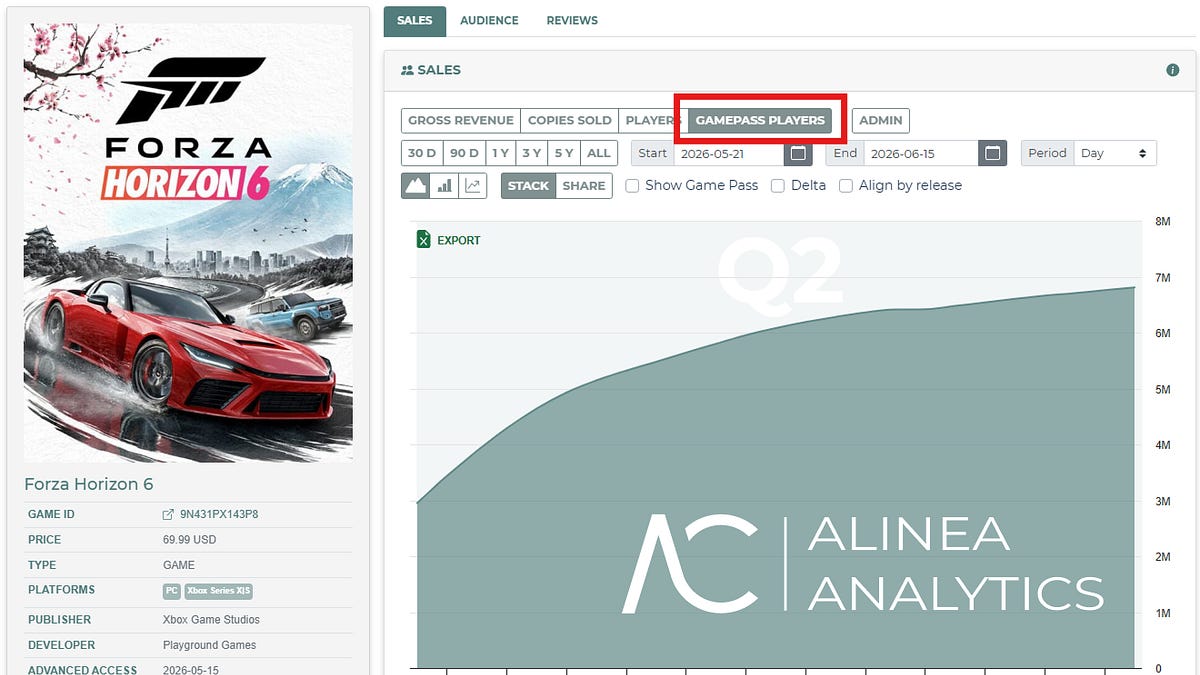
2026's Top Xbox Games by New Game Pass Players
The analysis examines the impact of the Xbox Game Pass subscription model on first-party and third-party game revenue during the first half of 2026. The central thesis posits that while Game Pass effectively drives player engagement and reach, it simultaneously cannibalizes premium sales for high-profile titles. This trend creates significant financial pressure for Xbox, which is currently operating under a 3% accountability margin, suggesting that the platform’s strategy of day-one releases is becoming increasingly unsustainable.
Key data points highlight the scale of this cannibalization. Forza Horizon 6, a major day-one release, attracted 6.8 million Game Pass players, generating $270 million in revenue through premium upgrades and sales. However, other titles show more severe revenue displacement; Subnautica 2 drew 3.5 million Game Pass players while selling only 100,000 units on Xbox, contrasting sharply with its 5.4 million copies sold on Steam. Similarly, Escape the Backrooms and High on Life 2 demonstrated significantly lower sales on Xbox compared to PlayStation, where the titles are not included in a subscription service.
The analysis utilizes proprietary engagement metrics and sales estimates to track performance across console, PC, and cloud platforms. It identifies a clear distinction between new, high-demand releases and older back-catalogue titles. For instance, the inclusion of Cyberpunk 2077 is cited as a successful model for subscription services, as the game had already exhausted its primary sales potential before joining the platform. Conversely, the report concludes that the current strategy of offering major tentpole franchises on day one is likely to face further restrictions, following the precedent set by the removal of Call of Duty from the service.
- Xbox's Game Pass is cannibalizing first-party game revenue, with the company operating on a 3% accountability margin, prompting a likely shake-up of the service.
- Forza Horizon 6, a day-and-date Game Pass release on April 19, attracted 6.8 million Game Pass players but generated $270 million on Xbox alone, indicating potential lost sales from committed players who would have purchased the game.
- Subnautica 2, another day-one Game Pass title released May 14, drew 3.5 million Game Pass players on Xbox but sold only 100,000 copies on the platform, compared to 5.4 million copies and $130 million in revenue on Steam where it is not part of a subscription service.
- Third-party games on Game Pass also show significant cannibalization; Escape the Backrooms, which shadow-dropped on console Game Pass on May 28, garnered 2.8 million new Game Pass players but sold under 30,000 copies on Xbox, versus almost 600,000 on PlayStation where it's not on a subscription.
- NBA 2K26 joined Game Pass on April 3, attracting 1.4 million new Xbox players, with a significant portion (30%) also playing Fortnite and 29% playing Roblox, suggesting it draws a younger, family, and sports-fan demographic.
+1
Alinea AnalyticsJun 2026
Article
Alinea Analytics: PlayStation Studios Performance Review 2026
This performance review evaluates the commercial success of six PlayStation Studios titles released between mid-2025 and early 2026. The analysis utilizes proprietary sales and engagement estimates to assess the viability of Sony’s current strategy, which prioritizes prestige single-player exclusives on the PlayStation 5 platform while simultaneously evaluating the impact of PC porting decisions.
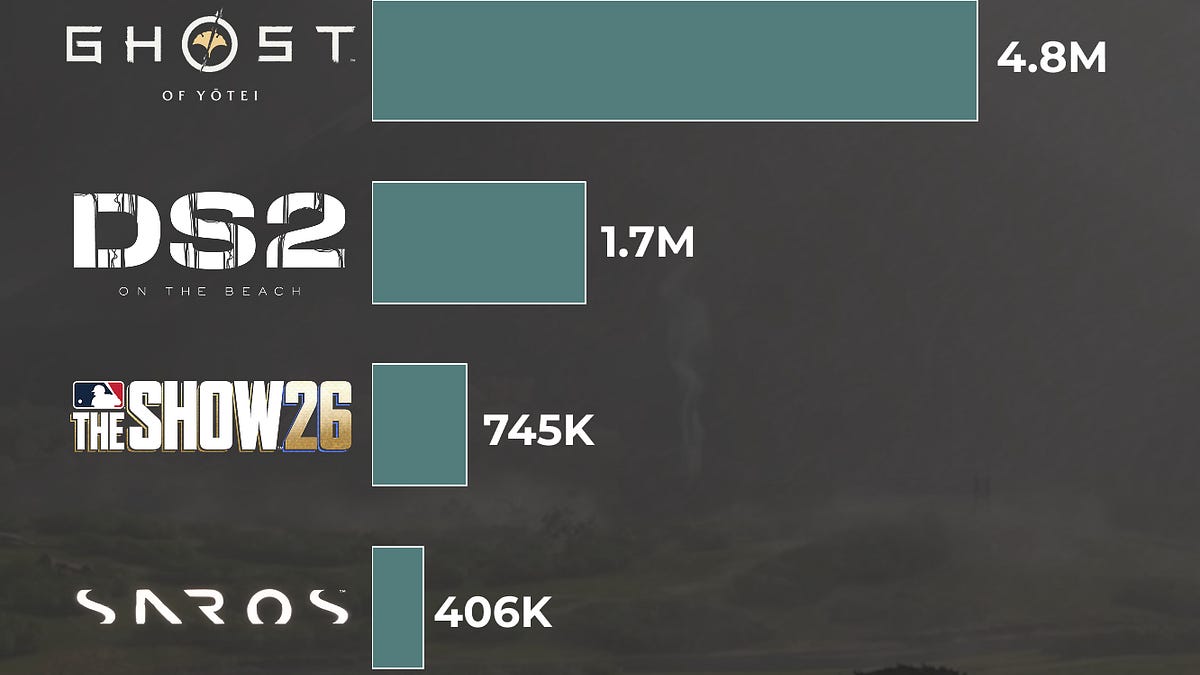
The findings highlight a significant disparity in performance across the portfolio. Ghost of Yotei stands out as a major success, having sold 4.8 million units on PS5 and generating approximately $350 million in revenue, effectively validating the company’s focus on established, high-budget intellectual property. Conversely, other titles show mixed results; Death Stranding 2: On the Beach reached 1.7 million units on PS5, with an additional 600,000 units sold following its Steam release. Smaller titles like Saros and the spin-off God of War Sons of Sparta demonstrate niche appeal but face challenges in achieving broad profitability without wider distribution.
The data suggests that while PlayStation’s strategy of keeping major blockbusters exclusive to its own ecosystem remains profitable, the withdrawal from Steam ports for single-player titles presents a strategic dilemma. Steam releases have historically provided critical access to the Chinese market and served as a catalyst for renewed interest in the PS5 versions of these games. As the company shifts its focus toward strengthening the value of its proprietary hardware, it risks losing the growth opportunities and cross-platform marketing benefits previously afforded by PC availability. The analysis concludes that while the prestige single-player model remains robust for proven blockbusters, the long-term sustainability of smaller, experimental titles may require a more flexible approach to multi-platform distribution.
- Ghost of Yotei, launched October 2, 2025, has been a significant success for PlayStation, selling 4.8 million copies and generating almost $350 million in revenue on PS5 alone.
- Death Stranding 2: On the Beach, a second-party title, sold 1.7 million copies on PS5 ($116M revenue) and an additional 600,000 copies ($35M revenue) after its PC port on March 19, 2026, bringing its total to 2.3 million copies and $150 million.
- The release of PC ports for games like Death Stranding 2 and Stellar Blade has shown a positive spillover effect, boosting sales on PS5, even without discounts in some cases, by increasing cross-platform marketing visibility.
- MLB The Show 26 sold 745,000 copies on PS5, generating over $50 million, with 95% of its audience in North America, but its sales are slower than the previous year's edition, which had sold 1.2 million copies by the same point.
- Saros, a 3D bullet-hell roguelite, sold 406,000 copies on PS5 ($30M revenue), but its profitability is questioned without a PC port, suggesting a potential missed revenue opportunity for PlayStation.
+3
Alinea AnalyticsJun 2026
Article
Summer Game Fest: Steam Wishlist Winners
The analysis evaluates the impact of the 2026 Summer Game Fest (SGF) on consumer interest by tracking new Steam wishlist additions between June 2 and June 8, 2026. The primary thesis is that established intellectual properties—specifically remakes, sequels, and known franchises—dominate consumer attention and wishlist growth, while entirely new concepts struggle to gain similar traction.
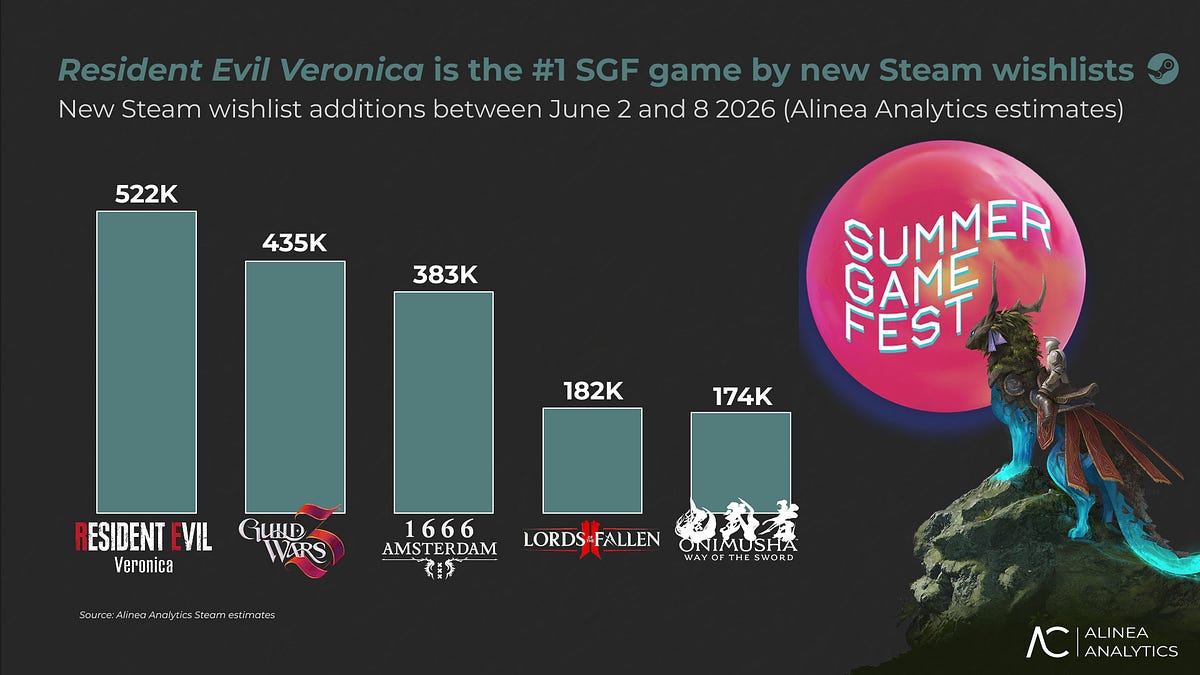
Resident Evil Veronica emerged as the event's top performer, securing 522,000 new wishlists, a figure attributed to the strong brand equity built by previous Capcom remakes. Other notable performers included Guild Wars 3 with 435,000 wishlists and 1666 Amsterdam with 383,000. The data highlights a clear trend of "serial wishlisting," where users add multiple high-profile titles to their accounts during major industry events. However, the analysis cautions that wishlist counts are primarily indicators of long-term interest rather than immediate conversion, noting that historical conversion rates for similar titles often remain in the single digits even months after launch.
The methodology relies on internal proprietary estimates to track Steam wishlist velocity and user overlap data. By examining the demographic overlap of wishlisters, the findings demonstrate that audiences for these games are highly segmented by genre affinity, such as Soulslike fans or horror enthusiasts. The analysis concludes that while the 2026 release calendar is robust, the high volume of quality titles competing for finite consumer time and capital risks market saturation, potentially leading to the cannibalization of sales among even well-received games.
- Summer Game Fest 2026 was highly successful, generating a significant number of Steam wishlists for announced games between June 2nd and 8th.
- Capcom's 'Resident Evil Veronica' led the new wishlists with 522K, demonstrating strong interest from existing Resident Evil players (55% played RE2 Remake, 53% played RE4 Remake).
- Known quantities such as remakes, sequels, licensed IP, and revived franchises dominated the top wishlist spots, indicating a preference for established brands among players.
- 'Guild Wars 3' secured the second spot with 435K new wishlists, and its reveal was strategically timed with a 20% discount on 'Guild Wars 2' DLC, generating over $110K in Steam sales for the older titles.
- '1666 Amsterdam' (383K wishlists) and 'Lords of the Fallen 2' (182K wishlists) also performed well, with the latter benefiting from its confirmed Steam release after previously being an Epic Games Store exclusive.
+2
Alinea AnalyticsJun 2026
Article
May's Top PlayStation Games by Copies Sold
This analysis examines the top-performing PlayStation titles by copies sold during May 2026, highlighting a market landscape defined by successful new intellectual property, enduring evergreen titles, and strategic platform-wide engagement initiatives. The primary objective is to provide a granular look at sales performance and player behavior across the PlayStation ecosystem, utilizing proprietary daily tracking data.
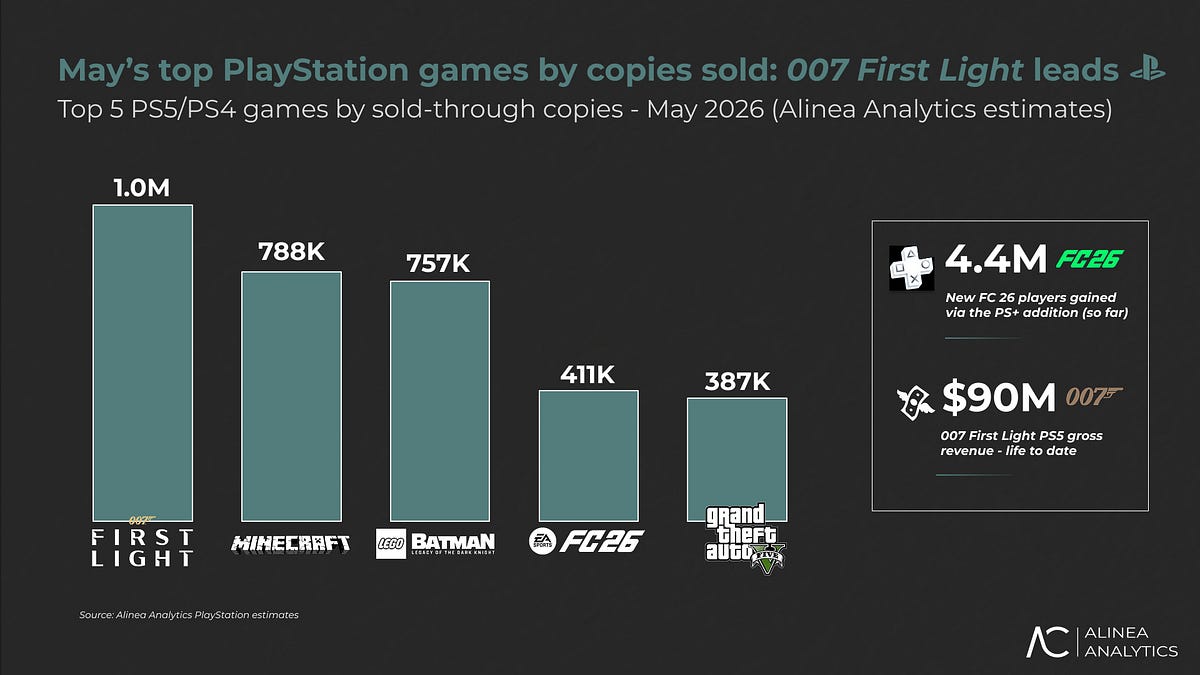
The new release 007 First Light emerged as the month’s leader, selling 1 million copies on PlayStation 5, with over 80% of those sales being digital. The title has achieved 2.2 million total copies sold across all platforms, generating $150 million in gross revenue, with PlayStation accounting for 60.5% of that total. This revenue concentration is attributed to a higher concentration of players in North American and Western European markets compared to the Steam version, which maintains a significant user base in China.
Evergreen titles continue to anchor the platform’s performance. Minecraft maintained its consistent volume with 788,000 copies sold, while Grand Theft Auto V added 387,000 copies to its lifetime total. These titles function as generational gateways, with data indicating that their player bases frequently overlap with younger-skewing titles like Fortnite and Roblox. Additionally, Lego Batman: Legacy of the Dark Knight performed strongly with 757,000 copies sold on PlayStation 5.
Strategic shifts in distribution also impacted the market, most notably with FC 26. While premium unit sales dropped to 411,000 copies—the lowest of the year—the game’s inclusion in the PlayStation Plus monthly catalog drove a record 24 million monthly active users. This move reflects a deliberate strategy to expand the player pool ahead of the FIFA World Cup, prioritizing long-term engagement and potential in-game spending over immediate unit sales.
- 007 First Light was May's top-selling PS5 game, moving 1 million copies, with over 80% being digital sales. To date, it has sold 2.2 million copies across all platforms (55.1% PS5, 33.1% Steam, 11.8% Xbox) and generated $150 million in gross revenue.
- FC 26 sold 411,000 copies on PlayStation in May, a significant drop from April's 700,000, largely due to its inclusion as a PlayStation Plus monthly game since May 6th. This strategy aims to boost the player base ahead of the FIFA World Cup, with 4.4 million new players accessing the game via PS Plus, leading to a record 24 million monthly active users (MAUs) on PlayStation in May.
- Lego Batman: Legacy of the Dark Knight sold 757,000 copies on PS5 in May, bringing its lifetime total on the platform to over 800,000. PlayStation accounts for over half of the game's 1.5 million total copies sold across all platforms.
- Grand Theft Auto V continues to perform strongly, selling another 387,000 copies on PlayStation in May. It has sold 1.8 million copies on PS5 in the first half of this year alone, contributing to the franchise surpassing 230 million copies sold across all platforms.
- Crossover data indicates that 11% of PS5 players who played 007 First Light in May also played Lego Batman: Legacy of the Dark Knight. For Lego Batman players on PS5, 27% also played Fortnite, 16% Roblox, 16% FC 26, and 14% NBA 2K.
+1
Alinea AnalyticsJun 2026
Article
007 First Light: Estimating Steam Market Performance
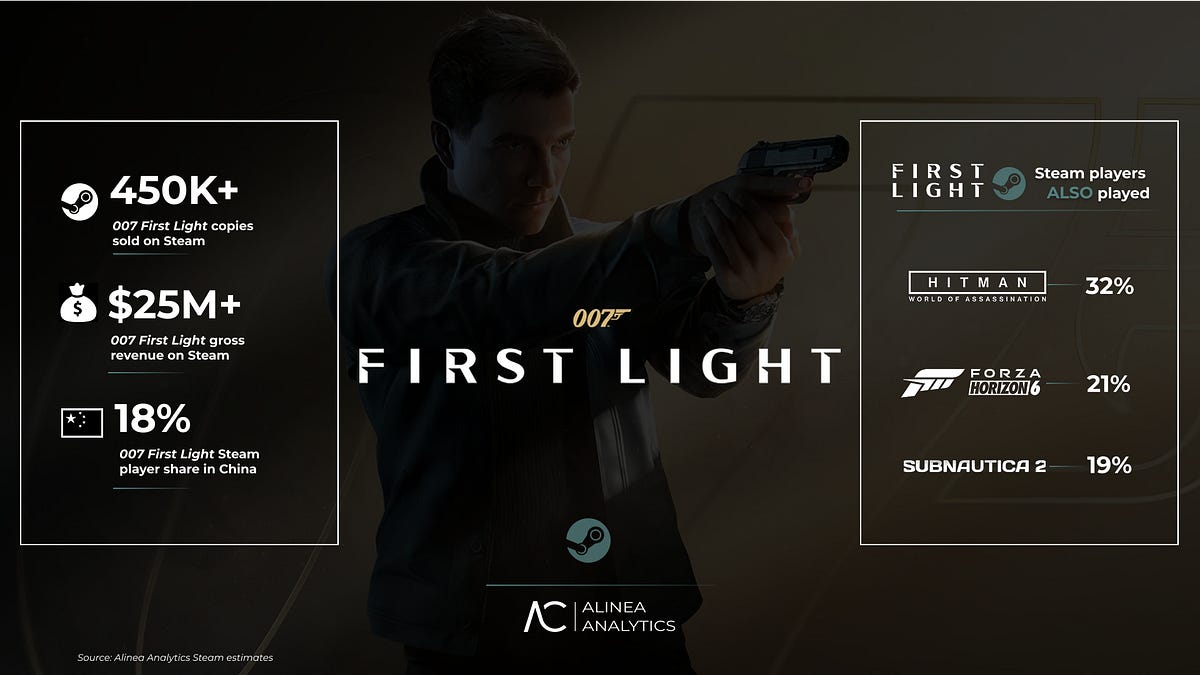
The release of 007 First Light represents a significant commercial success for developer IO Interactive, demonstrating the studio’s ability to translate its signature stealth-action expertise into a high-profile, cinematic franchise. Launched on May 17, 2026, the title achieved 1.5 million copies sold globally within its first 24 hours. On the Steam platform specifically, the game moved nearly 500,000 units in its first three days, generating over $25 million in gross revenue.
The analysis highlights a strong "halo effect" stemming from the developer’s previous work, with approximately one-third of the game's Steam player base having previously played the Hitman trilogy. Furthermore, the title successfully captured a core cohort of early-adopter AAA gamers who consistently purchase major releases throughout the year. The data also reveals a notable regional performance, with China emerging as the second-largest market for the game, accounting for 18% of Steam players. This success is attributed to proactive marketing efforts, such as participation in local industry events, and effective regional pricing strategies.
Methodologically, the findings rely on proprietary sales estimates and audience crossover data, which track player behavior across various platforms and titles. The analysis identifies a clear demographic overlap between 007 First Light buyers and fans of other 2026 releases, such as Resident Evil Requiem and Forza Horizon 6. While the game has secured a strong initial foothold, the long-term commercial viability of the franchise will depend on sustained retention and performance across console platforms, which remain key areas for future evaluation.
- 007 First Light sold over 450,000 copies on Steam in its first three days, generating over $25 million in gross revenue.
- China is the second-largest Steam market for 007 First Light, accounting for 18% of players, behind the US at 29%. This success is attributed to regional marketing efforts, including participation in BiliBili Game First Look and competitive regional pricing ($44 in China, 37% cheaper than US pricing).
- The game's early buyers on Steam are a cohort of early adopters who purchase many major releases, with significant overlap with players of titles like Resident Evil Requiem (37%), Crimson Desert (28%), and Forza Horizon 6 (21%).
- IO Interactive's strong reputation from the Hitman trilogy is converting directly into 007 First Light sales, with 9% of First Light's Steam players also playing Hitman World of Assassination in May.
- Amazon, which owns the Bond rights, has seen strong early commercial results for 007 First Light, suggesting potential for sequels and DLC from IO Interactive.
+1
Alinea AnalyticsMay 2026
Article
Legacy of the Dark Knight: Market Performance Review
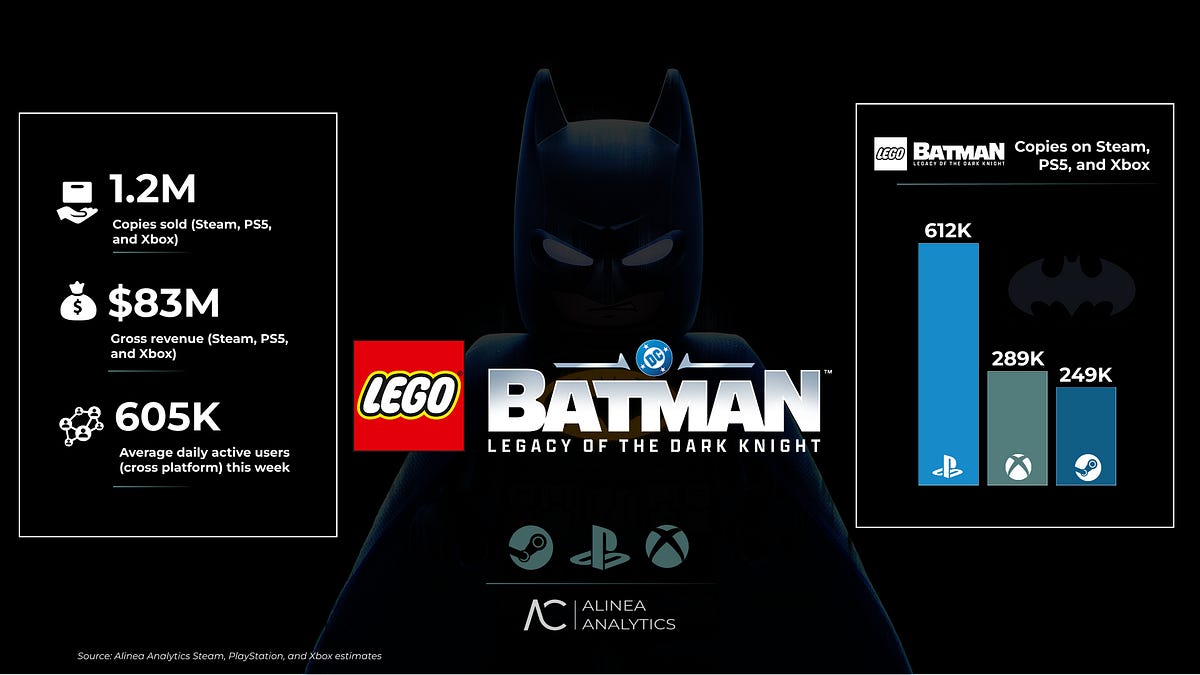
Lego Batman: Legacy of the Dark Knight achieved a solid market debut, selling 1.2 million copies across PlayStation 5, Xbox, and Steam within its first week of release in May 2026. This performance generated $83 million in gross revenue. The launch was notably console-led, with PlayStation 5 accounting for 53.3% of unit sales and 56.4% of revenue, followed by Xbox and Steam. While these figures represent a smaller commercial event than the 2022 launch of Lego Star Wars: The Skywalker Saga, the results are consistent with the title’s higher price point and more focused content scope.
The analysis highlights that Lego games function as long-term assets within a broader transmedia strategy, often serving as a funnel for younger audiences toward future Warner Bros. properties. Although some core gamers criticized the game’s departure from traditional Lego mechanics and its premium pricing, the title maintains a 96% positive user score on Steam. Critics and players praised the combat systems, which draw inspiration from the Arkham series, and the high level of production polish.
The release timing, while perceived by some as suboptimal due to proximity to other major titles, is identified as a strategic decision aligned with the summer toy retail calendar and the 20th anniversary of the Lego Batman theme. By launching in late May, the title secured market runway ahead of a crowded summer schedule of cinema releases and major sporting events. Ultimately, the game is positioned as a foundational product intended to build lifetime customer value, with expectations for sustained sales through future discounts and holiday cycles.
- Lego Batman: Legacy of the Dark Knight sold 1.2 million copies across PS5, Xbox, and Steam in its first week (May 19-22 launch), generating $83 million in gross revenue.
- The game's launch was console-led, with PS5 accounting for 53.3% of copies sold and 56.4% of gross revenue, and Xbox for 25.1% of copies and 25.4% of revenue, while Steam represented 21.6% of copies and 18.2% of revenue.
- Revenue per copy was higher on consoles, partly because 82% of PS5 players were in Western Europe or North America, compared to 68% on Steam, where geographic diversity compressed revenue per unit.
- Legacy of the Dark Knight's launch was a smaller commercial event in unit terms than Lego Star Wars: The Skywalker Saga, which benefited from a bigger IP, more new content, and a lower price point ($60 vs. $70-$90).
- Common criticisms include frame rate drops, save file corruption, lack of dedicated online co-op, a $70-$90 price point for only seven characters (compared to 60-100+ in traditional Lego games), and a departure from signature Lego mechanics.
+2
Alinea AnalyticsMay 2026
Article
Forza Horizon 6 Performance Analysis
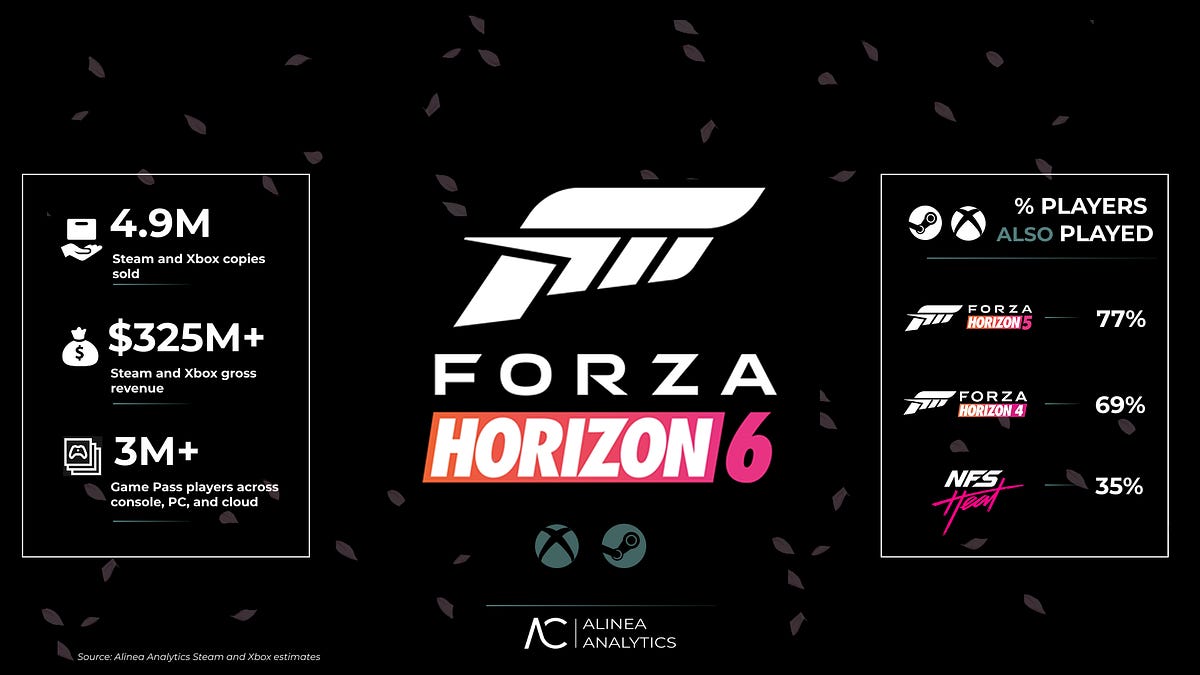
Forza Horizon 6 has achieved a strong commercial launch, reaching nearly 5 million copies sold across Steam and Xbox within its first week of availability in May 2026. The title generated over $325 million in gross revenue, securing a position among the top four best-selling games of the year. While Steam accounted for 2.8 million units, the Xbox ecosystem—comprising console, PC, and cloud—contributed 2.1 million paid copies and an additional 3 million players via Game Pass. Notably, the Xbox version generated 51% of total gross revenue, driven by higher price points in Western markets compared to the more geographically diverse Steam user base.
The game’s performance highlights the effectiveness of regional setting choices, as the Japan-themed map successfully increased audience share in that territory. However, the launch faced challenges in the Chinese market, where technical infrastructure issues and pricing disputes led to review bombing. Excluding Chinese user sentiment, the game’s positive review score on Steam rises from 80% to approximately 86%. These findings suggest that while the title is a major success, there remains significant untapped potential for growth in China through improved regional pricing, better technical support, and the inclusion of culturally relevant content.
Methodologically, these insights are derived from proprietary sales and engagement estimates across Steam and Xbox platforms. The data indicates that the day-one Game Pass strategy continues to serve as a primary driver for engagement, even as it potentially cannibalizes some premium unit sales. Looking ahead, the upcoming PlayStation 5 release is expected to further bolster the franchise's commercial footprint, with analysts anticipating it will outperform the previous entry’s performance on the platform.
- Forza Horizon 6 has sold almost 5 million copies, with 1.7 million players purchasing the premium early access edition, making it one of the top four 2026 releases in its first week.
- Xbox players accounted for 42% (2.1 million) of copies sold, while Steam players bought 2.8 million copies. Despite lower unit sales, Xbox generated 51% of total gross revenue due to higher pricing in Western markets, compared to Steam's 49%.
- Over 3 million additional players accessed Forza Horizon 6 via Game Pass, demonstrating the success of Microsoft's day-and-date strategy where Steam drives unit sales and Game Pass drives Xbox engagement.
- The Japan setting of Forza Horizon 6 significantly boosted its popularity in Japan, with the country ranking #4 on Steam for this title, up from #8 for Forza Horizon 5, and China accounting for 13% of Steam players.
- Key player feedback highlights the Japan map, cultural authenticity, and extensive car roster as strengths, while common complaints include unfair AI, PC instability, a weak story, and server issues.
+2
Alinea AnalyticsMay 2026
Article
Subnautica 2: Early-Access Market Analysis
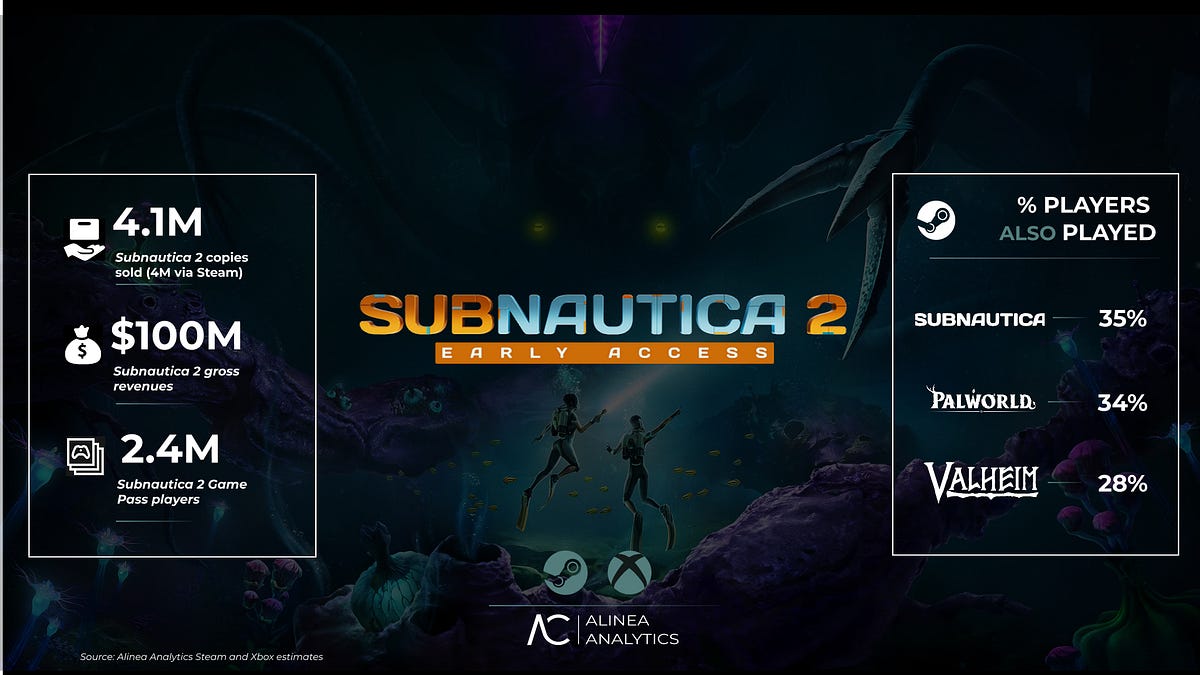
Subnautica 2 has achieved significant commercial success following its early-access release in May 2026, recording 4.1 million copies sold and $100 million in revenue within its first week. The vast majority of these sales occurred on Steam, while the title simultaneously reached an additional 2.4 million players through the Xbox Game Pass service, bringing the total player base to over 6 million. These figures establish the game as the fastest-selling title on Steam for the 2026 calendar year to date.
The analysis highlights that while the game entered early access with 5.5 million Steam wishlists, only 9% of those wishlisters converted into day-one purchasers. This data serves as a cautionary indicator for industry stakeholders, suggesting that high wishlist counts are a directional barometer rather than a reliable predictor of direct conversion. Furthermore, the release demonstrates the viability of the early-access model, providing the developer with a substantial initial revenue stream and a large, active player base to support a multi-year development roadmap.
Player reception remains largely positive, with a 91% approval rating on Steam, though sentiment is nuanced by regional feedback and specific design debates regarding the game’s non-violent mechanics. The development team has committed to a transparent, community-driven roadmap to address technical optimization and quality-of-life requests. By leveraging both direct sales and subscription-based engagement, the title has secured a strong market position, with its long-term commercial performance contingent on the developer's ability to maintain consistent content updates and respond effectively to player feedback throughout the early-access period.
- Subnautica 2 generated over $100 million in revenue and sold more than 4 million copies within its first week of early access, with 4 million copies sold on Steam and under 100,000 on Xbox.
- The game also saw significant engagement through Game Pass, with 2.4 million players across console, Windows, and cloud, bringing the total player count to over 6 million.
- Despite having 5.5 million Steam wishlists prior to launch, only under 9% of these wishlisters converted to purchases, indicating that high wishlists do not guarantee a proportional conversion rate at launch.
- Subnautica 2 has a 91% positive review score on Steam across all markets, rising to 93% when excluding Chinese reviews, which are typically more negative (73% positive for Simplified Chinese reviews).
- Player feedback highlights positives such as co-op gameplay and narrative setup, but also negatives including lack of content, optimization issues, a mandatory EULA, and missing accessibility features like an FOV slider.
+2
Alinea AnalyticsMay 2026
Article
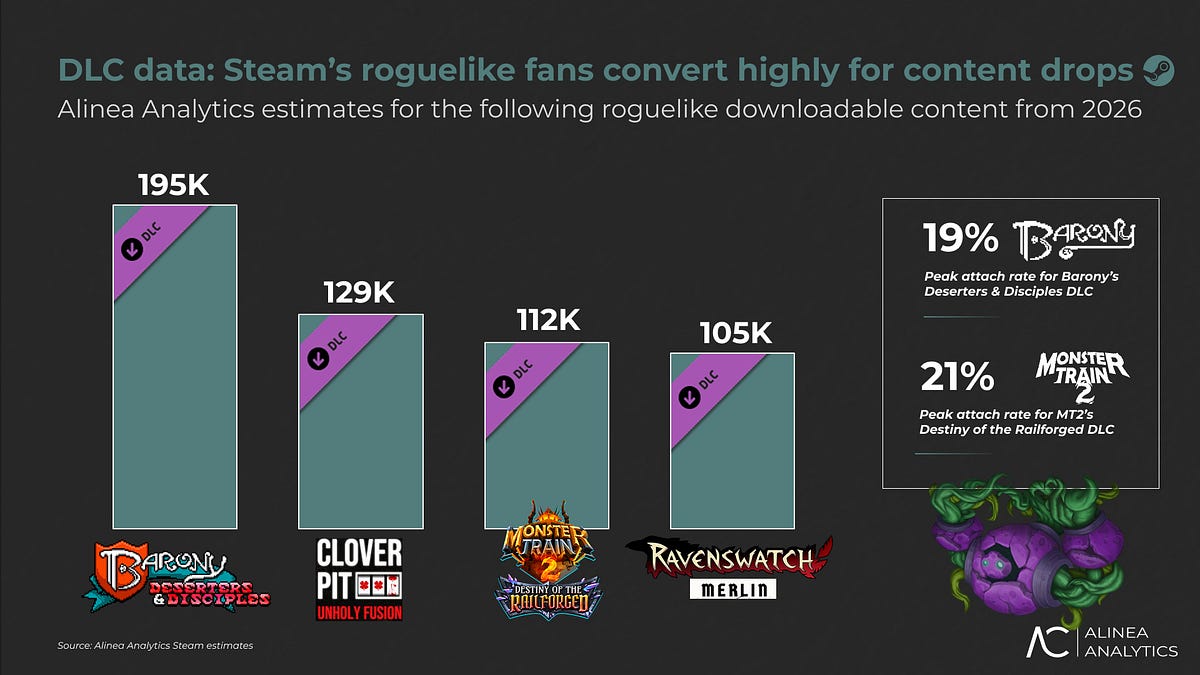
Steam DLC Data: High Attach Rates for 2026 Roguelike DLC
The roguelike genre on Steam demonstrates exceptionally high player engagement and monetization potential, characterized by DLC attach rates that significantly outperform the industry baseline. Analysis of 2026 market data reveals that four prominent roguelike titles successfully converted over 100,000 units each through downloadable content, driven by a highly dedicated player base that frequently invests both time and money into their preferred titles.
Key findings highlight the performance of specific releases, such as the Barony: Deserters & Disciples expansion, which achieved a 19% attach rate, and Monster Train 2’s Destiny of the Railforged DLC, which reached a 21% peak attach rate. These results suggest that pricing strategies—specifically keeping DLC under the $10 threshold—are instrumental in maintaining these elevated conversion levels. However, the data also underscores the sensitivity of these audiences to monetization models; for instance, the Ravenswatch Merlin DLC faced negative sentiment due to the decision to charge for a playable character in a premium-priced game, signaling that while players are willing to spend, they remain critical of perceived exploitative practices.
The analysis further emphasizes the importance of release timing in a competitive landscape. The performance of Monster Train 2 illustrates how major industry releases, such as the early access launch of Slay the Spire 2, can abruptly shift player engagement and daily active user counts. By strategically timing content drops ahead of major genre releases, developers can effectively bolster quarterly revenue and sustain player interest. These insights are derived from proprietary sales and engagement estimates, providing a granular look at how specific titles navigate the intersection of community loyalty and market competition within the PC gaming sector.
- Roguelike DLC on Steam is achieving significantly higher attach rates than the genre-wide baseline, with four major 2026 releases each exceeding 100,000 units sold.
- The 'Barony: Deserters & Disciples' DLC achieved a 19% attach rate, selling nearly 200,000 units and generating $1.2M in gross revenue since its January 2026 launch.
- Pricing for successful roguelike DLC remains at or below $10, with the highest-performing title by attach rate, 'Monster Train 2', priced at the top of this range and achieving a 21% attach rate.
- Strategic release timing is critical; 'Monster Train 2' saw a significant spike in daily active users following its February 2026 DLC launch, but experienced a sharp decline after the March 5 early access launch of 'Slay the Spire 2'.
- The 'CloverPit: Unholy Fusion' DLC sold 129,000 units at a $2.99 price point, representing an 8% peak attach rate and generating $300,000 in revenue.
+2
Alinea AnalyticsMay 2026
Article
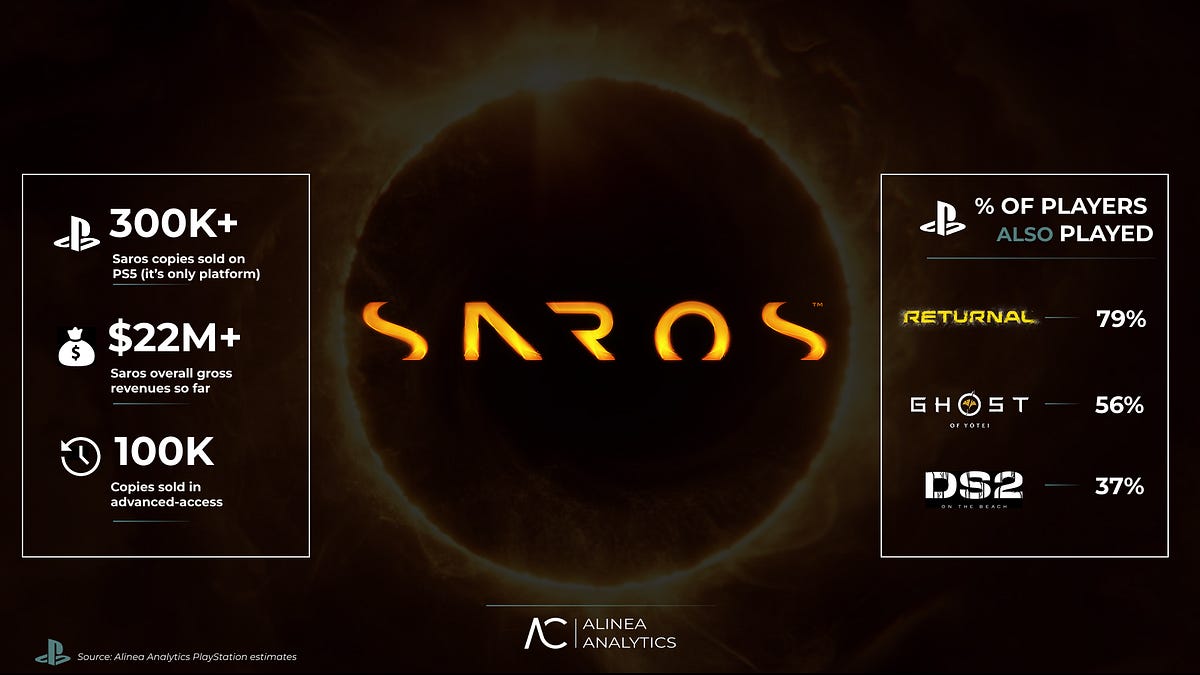
Saros: Sales Performance and Industry Estimates
The release of the PlayStation 5 exclusive Saros, developed by Housemarque, has yielded a lukewarm commercial performance in its initial two-week window. As of May 12, 2026, the title has surpassed 300,000 units sold, generating over $22 million in revenue. Despite the significantly larger PS5 install base compared to the launch period of the studio’s previous title, Returnal, Saros has experienced slower sales momentum. This performance is attributed to a crowded release calendar and the niche appeal of the 3D bullet-hell genre at a $70 price point.
Data indicates that the game’s early adoption is driven primarily by a core segment of PlayStation enthusiasts. Approximately 78% of Saros players are identified as having previously played Returnal, while a significant portion of the user base also engaged with other recent first-party releases, such as Ghost of Yotei and Death Stranding 2. This suggests that while the game has successfully captured the attention of the existing PlayStation hardcore, it has struggled to penetrate the broader, more casual market.
Despite the modest sales figures, engagement metrics remain positive. Daily active users peaked at nearly 142,000 shortly after launch and have maintained a stable range between 115,000 and 140,000. Furthermore, 40% of players have logged over 15 hours of playtime, and 20% have completed the game, indicating high retention among those who purchased the title. While the current sales trajectory poses challenges for recouping the reported $76 million development budget, the strong engagement levels suggest potential for long-term value through future discounts, subscription service inclusion, or potential PC porting, mirroring the revenue tail observed with previous PlayStation exclusives.
- Saros, Sony's first big 2026 exclusive from Housemarque, sold over 300,000 copies and generated over $22 million in revenue in its first two weeks since launching on April 30th on PS5.
- Despite a PS5 install base of 93 million, Saros sold slower than Returnal did at its launch when the PS5 install base was only 8 million, indicating a lukewarm start for the niche title.
- The PlayStation hardcore audience is driving Saros' sales, with 56% of players having previously played Ghost of Yotei (Oct 2025), 37% Death Stranding 2 (June 2025), 11% God of War: Ghost of Sparta (Feb 2026), and 8% Marathon (early March 2026).
- Engagement for Saros is strong among purchasers, with daily active users (DAUs) peaking at nearly 142,000 on May 2nd and consistently staying between 115,000-140,000 for the first 10 days post-launch.
- Player retention and completion rates are high for Saros; 40% of players have played over 15 hours, 30% over 20 hours, and over 20% have finished the game, double Returnal's completion rate at the same point.
+1
Alinea AnalyticsMay 2026
Report23 pages
PC & Console Year in Review: 2025
The 2025 PC and Console Year in Review provides a comprehensive analysis of the global gaming landscape, focusing on market performance, consumer behavior, and development trends. The primary thesis highlights that while pre-launch marketing and wishlist campaigns remain foundational for success, post-release player reception and the integration of social, co-op elements are the primary drivers of long-term revenue and sustainability. The analysis covers the period from January 1, 2025, through late 2025, utilizing proprietary data estimates to track sales, player engagement, and platform distribution across global markets.
Key findings indicate that the premium game market remains dominant, accounting for 78% of Steam’s $16.8 billion revenue. Indie developers continue to capture significant market share, contributing over 25% of Steam’s total revenue, with "Triple-I" titles demonstrating exceptional return on investment. Geographically, China has solidified its position as a critical market, serving as the top region for Steam and a major driver for both Western and Eastern-developed titles. Furthermore, the data reveals a shift in marketing efficacy; while wishlist counts are rising, conversion rates are declining, forcing studios to experiment with in-game incentives and community-driven engagement strategies.
Genre trends show that action, adventure, and RPG titles continue to lead in player interest, though "cute" and atmospheric games experienced significant year-over-year growth in revenue. Co-op mechanics have emerged as a vital pillar for commercial success, with 11 of the top 20 highest-grossing titles featuring cooperative elements. From a technical perspective, Unreal Engine maintains its status as the market leader for AA and AAA development, while many studios continue to leverage proprietary engines for large-scale projects. The report concludes that while pre-launch hype is a useful tool for visibility, the post-release sales trajectory is ultimately dictated by player sentiment and the ability of a title to foster sustained social interaction.
- Premium games dominate the market, accounting for 78% of Steam’s $16.8 billion total revenue in 2025.
- Cooperative gameplay is a primary driver of commercial success, with 11 of the top 20 highest-grossing titles featuring co-op mechanics.
- Indie developers contribute over 25% of Steam’s total revenue, with 'Triple-I' titles delivering exceptional return on investment.
- China has become the top global region for Steam, serving as a critical market for both Western and Eastern-developed titles.
- Marketing efficacy is shifting as wishlist counts rise while conversion rates decline, necessitating a move toward in-game incentives and community-driven engagement.
+3
Alinea AnalyticsJan 2025
Report23 pages
PC & Console Year in Review 2025
Alinea Analytics provides a comprehensive review of the PC and console gaming market for 2025, offering data-driven insights into player behavior, revenue trends, and regional growth. The analysis highlights a year defined by the continued rise of indie and "Triple-I" titles, which accounted for over 25% of Steam’s revenue. Major success stories like RimWorld’s Odyssey DLC, which earned $10 million to date, and the rapid development of viral hits like RV There Yet? underscore a market where high return on investment is increasingly decoupled from massive studio sizes.
Geographically, the report identifies China as a dominant force, ranking as the top market for Steam and the fifth for PlayStation. This surge is attributed to the momentum of titles like Black Myth: Wukong, with Chinese players making up a significant percentage of the audience for games such as Escape from Duckov and Monster Hunter Wilds. In Europe, the Swedish development scene saw a massive year, capturing significant market share through titles like R.E.P.O. and Split Fiction.
Technical and genre trends show Unreal Engine maintaining its position as the industry standard for AA and AAA development, while Unity remains the backbone for indie successes. Co-op games emerged as a primary revenue driver, representing 11 of the top 20 highest-grossing titles. While adventure and RPGs remain popular, "cute" and "realistic" tags saw the highest year-over-year revenue growth. The data also notes a shift in marketing dynamics: while wishlist campaigns are now standard—requiring nearly 200,000 wishlists to break the top 200 most-anticipated list—conversion rates have declined, placing greater emphasis on post-launch player reception and "shadow drops" for viral success.
- Indie and 'Triple-I' titles have become a major market force, accounting for over 25% of total Steam revenue in 2025.
- Co-op games are a primary revenue driver, representing 11 of the top 20 highest-grossing titles of the year.
- China has emerged as a dominant global market, ranking as the top region for Steam and the fifth for PlayStation, largely driven by the success of titles like Black Myth: Wukong.
- Marketing dynamics have shifted as wishlist conversion rates decline, with developers now requiring nearly 200,000 wishlists to break into the top 200 most-anticipated games list.
- Unreal Engine remains the industry standard for AA and AAA development, while Unity continues to serve as the primary engine for indie market successes.
+1
Alinea AnalyticsJan 2025