11 bit studios
Game Co.217 documents
Documents
Financial84 pages
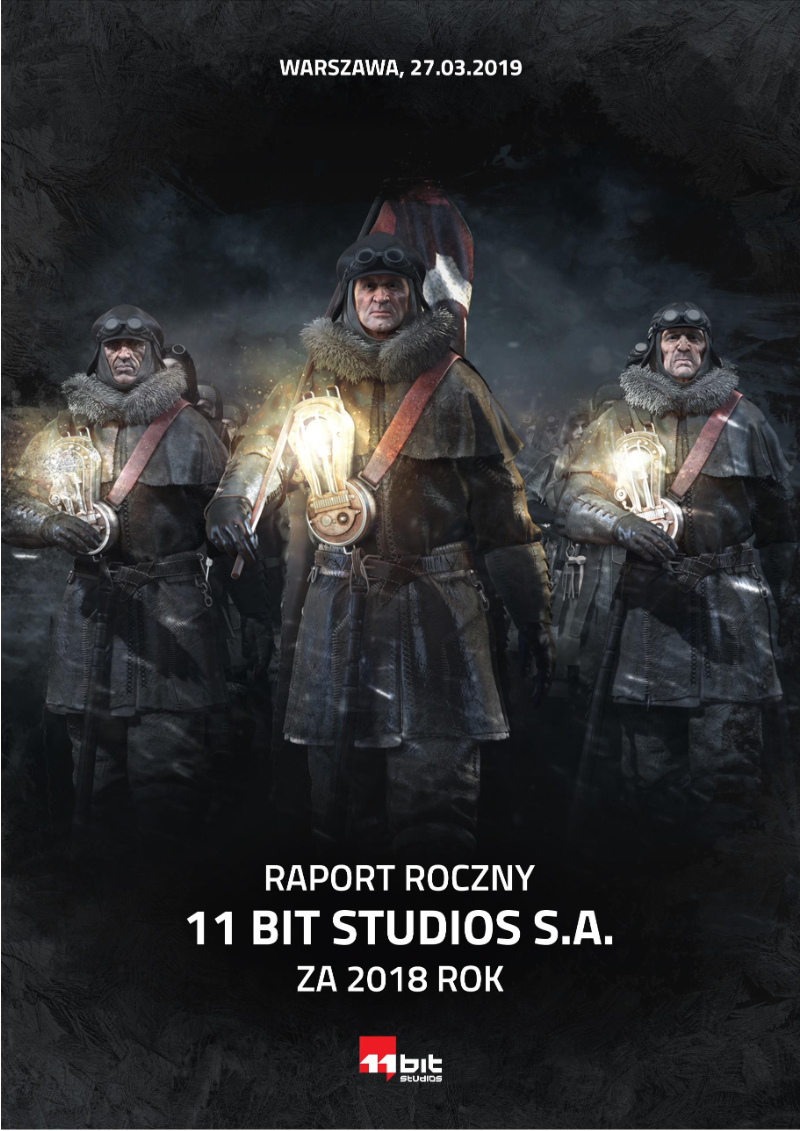
Annual Report 11 Bit Studios S.A. for 2018
The 2018 fiscal year marked a transformative period of record-breaking financial and operational growth for 11 bit studios S.A. Driven by the commercial success of the proprietary title Frostpunk and the publishing hit Moonlighter, the company reported a 328.8% increase in revenue to 82.11 million PLN and a nearly tenfold rise in net profit to 37.55 million PLN. This performance was underpinned by the global digital distribution market, with the United States accounting for 82.5% of total sales. Following the sale of its subsidiary Games Republic Limited, the company transitioned to a standalone entity, focusing its capital on internal development and high-potential publishing projects.
Strategically, the firm is shifting toward a multi-team model to support a release cycle of one proprietary title every 12–18 months. To facilitate this, the company plans to double its workforce to 200 employees and invested 18.1 million PLN in a new Warsaw headquarters. Significant capital was also allocated to "Project 8" and the enhancement of its proprietary game engine. While the company maintains a strong liquidity position with 109.3 million PLN in total assets, it manages risks associated with high USD currency exposure and the competitive landscape for specialized talent and intellectual property rights.
Corporate governance remained stable under the leadership of founders Grzegorz Miechowski, Przemysław Marszał, and Michał Drozdowski, who collectively hold approximately 16% of the share capital. The company adopted new IFRS 9 and 15 standards to modernize revenue recognition and financial instrument classification. Beyond financial metrics, the studio reinforced its commitment to social responsibility, donating over 648,000 PLN to the War Child foundation. This combination of fiscal discipline, strategic infrastructure investment, and successful product launches led to the company’s promotion to the mWIG40 index on the Warsaw Stock Exchange.
- 11 bit studios achieved record financial performance in 2018, with revenue increasing 328.8% to 82.11 million PLN and net profit rising nearly tenfold to 37.55 million PLN.
- The company’s growth was primarily driven by the commercial success of the proprietary title Frostpunk and the publishing hit Moonlighter, with 82.5% of total sales originating from the United States.
- To support a new release cycle of one proprietary title every 12–18 months, the company is transitioning to a multi-team model and plans to double its workforce to 200 employees.
- The studio invested 18.1 million PLN in a new Warsaw headquarters and allocated significant capital toward the development of 'Project 8' and its proprietary game engine.
- The company maintains a strong liquidity position with 109.3 million PLN in total assets and was promoted to the mWIG40 index on the Warsaw Stock Exchange following its 2018 performance.
+1
11 bit studiosMar 2019
Legal1 pages
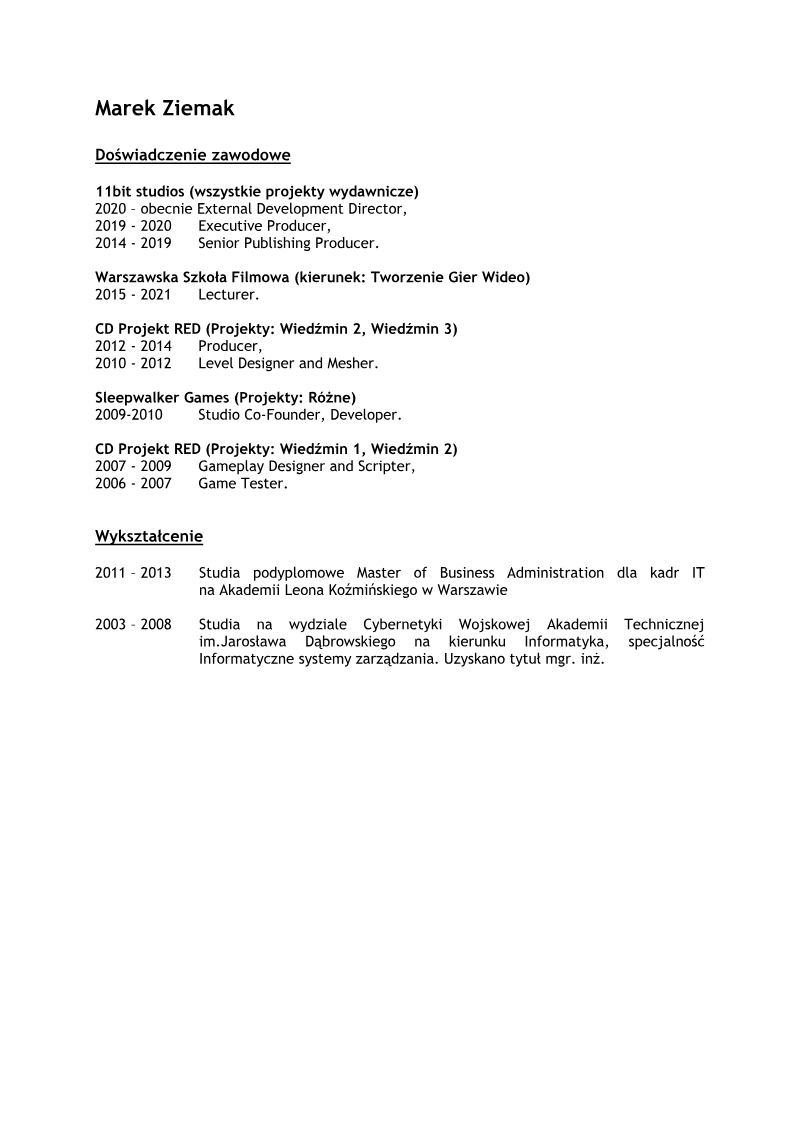
Marek Ziemak: Professional Curriculum Vitae
Marek Ziemak is a veteran of the Polish video game industry whose career spans nearly two decades, characterized by a progression from technical development roles to high-level executive leadership. His professional trajectory highlights a deep involvement in some of the region's most critically acclaimed titles, most notably within the Witcher franchise. Starting as a game tester and scripter at CD Projekt RED in 2006, Ziemak eventually transitioned into level design and production roles for The Witcher 2 and The Witcher 3. This foundational experience in AAA development provided the groundwork for his subsequent move into the publishing sector of the industry.
Since 2014, Ziemak has been a central figure at 11 bit studios, where he has overseen various publishing projects. His roles have evolved from Senior Publishing Producer to Executive Producer, culminating in his current position as External Development Director. This tenure reflects a strategic focus on managing external partnerships and scaling production efforts across a diverse portfolio of titles. Beyond his corporate contributions, Ziemak influenced the next generation of developers through a six-year period as a lecturer at the Warsaw Film School, specifically within the Video Game Creation department.
His professional expertise is supported by a robust academic background in both technical and managerial disciplines. He holds a Master of Engineering in Information Technology from the Military University of Technology, specializing in IT management systems. Furthermore, he supplemented his technical education with a Master of Business Administration for IT professionals from the Kozminski University. This combination of hands-on development experience, academic rigor, and executive oversight positions Ziemak as a significant figure in the operational and strategic landscape of the Polish gaming sector.
- Marek Ziemak has nearly two decades of experience in the Polish video game industry, transitioning from technical development at CD Projekt RED to executive leadership at 11 bit studios.
- During his tenure at CD Projekt RED starting in 2006, Ziemak contributed to the development of The Witcher 2 and The Witcher 3 in roles ranging from game tester and scripter to level designer and producer.
- Since joining 11 bit studios in 2014, Ziemak has advanced from Senior Publishing Producer to his current role as External Development Director, focusing on scaling production and managing external partnerships.
- Ziemak holds a Master of Engineering in IT from the Military University of Technology and an MBA for IT professionals from Kozminski University, bridging technical and managerial expertise.
- He contributed to industry education by serving as a lecturer in the Video Game Creation department at the Warsaw Film School for six years.
+1
11 bit studiosJan 2019
Financial28 pages
Interim Financial Report: Nine Months Ended September 30, 2018
The first nine months of 2018 marked a period of unprecedented financial expansion and strategic transformation for 11 bit studios S.A., characterized by a fivefold increase in revenue to PLN 59.62 million. This growth represents a 422.9% year-on-year surge, shifting the company from a net loss in 2017 to a net profit of PLN 28.52 million. The primary catalyst for this performance was the April launch of Frostpunk, which recouped its PLN 12 million development cost within days and generated over PLN 40 million in revenue by the end of the third quarter. The success was further bolstered by the publishing hit Moonlighter and the sustained long-tail sales of This War of Mine, with the United States emerging as the dominant market, accounting for PLN 50.1 million of total sales.
The company’s balance sheet reflects a robust liquidity position, with cash reserves and short-term financial assets exceeding PLN 61.67 million. While operating expenses rose by 167.6% due to increased headcount, royalties, and marketing investments, the company maintained a high operating margin of 59.1%. Total assets grew to PLN 86.7 million, supported by a significant rise in intangible assets as development work on proprietary game engines and new titles reached completion. This financial stability has attracted institutional investment, evidenced by threshold-crossing share acquisitions by NN TFI and Aviva Investors during the period.
Looking forward, the strategic focus shifts toward scaling production and stabilizing recurring revenue. The company is currently transitioning its next major internal title, Project 8, into full production with a PLN 20 million investment. Simultaneously, the publishing division is expanding its scope, increasing per-project budget caps to PLN 5 million following the success of third-party titles. By leveraging upcoming console ports for Frostpunk and new releases like Children of Morta, management aims to implement a long-term release cycle of one internal and one external title per quarter to ensure consistent financial performance.
- 11 bit studios achieved a 422.9% year-on-year revenue surge to PLN 59.62 million for the first nine months of 2018, resulting in a net profit of PLN 28.52 million compared to a net loss in 2017.
- The launch of Frostpunk was the primary growth driver, recouping its PLN 12 million development cost in days and generating over PLN 40 million in revenue by the end of Q3.
- The company maintains a strong financial position with cash reserves and short-term assets exceeding PLN 61.67 million and a high operating margin of 59.1%.
- The United States is the company's dominant market, accounting for PLN 50.1 million of total sales during the nine-month period.
- Management is scaling production with a PLN 20 million investment in a new internal title, 'Project 8,' and has increased third-party publishing budget caps to PLN 5 million per project.
11 bit studiosNov 2018
Financial49 pages
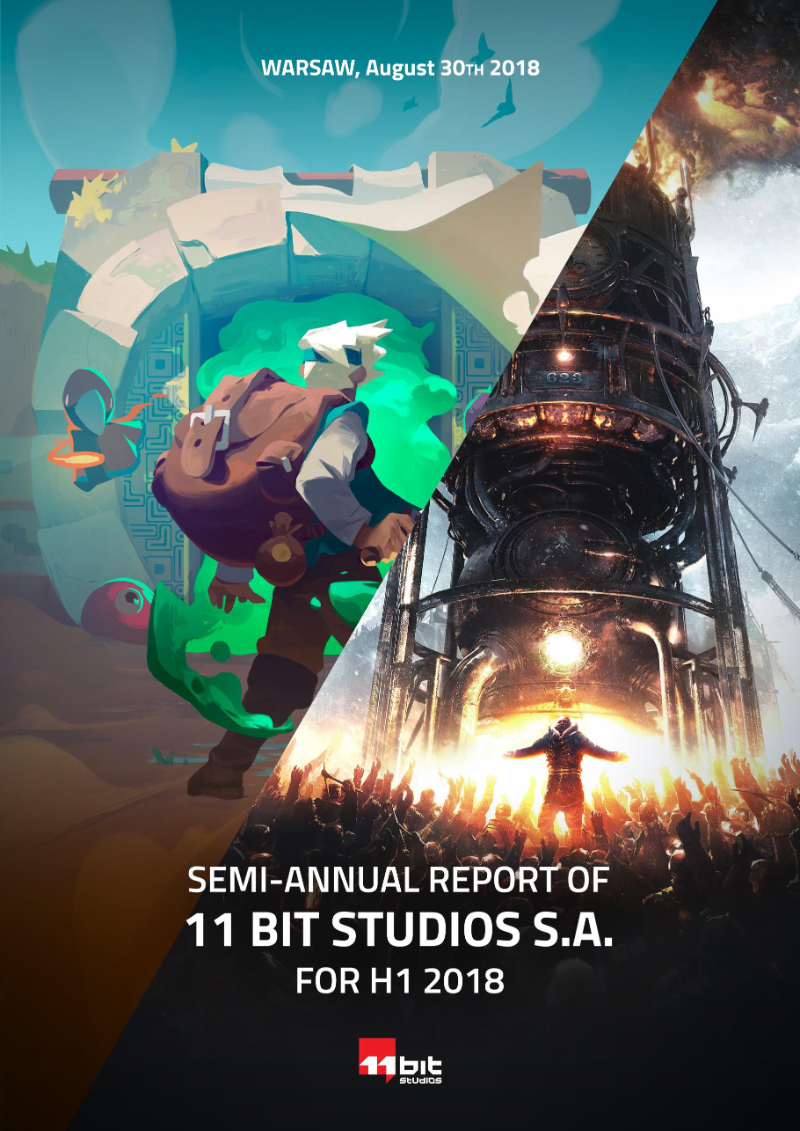
Half-Year Report of 11 bit studios S.A. for H1 2018
The first half of 2018 marked a transformative period for 11 bit studios S.A., characterized by record-breaking financial performance and a strategic shift toward larger-scale game production. Driven primarily by the April launch of Frostpunk, which recouped its PLN 10-12 million development costs within 66 hours, the company saw revenue surge 427% year-on-year to PLN 45.7 million. This commercial success, bolstered by the publishing hit Moonlighter and the sustained performance of This War of Mine, resulted in a net profit of PLN 24.9 million—a more than ninety-fold increase over the previous year.
The company’s financial position is exceptionally robust, with total assets reaching PLN 82.3 million and a cash position exceeding PLN 51 million. This liquidity allows for the self-funding of all current operations and future projects without the need for external debt. International markets remain the primary revenue driver, accounting for 96% of total sales, with 85% originating from the United States. This global reach contributed to the company’s market capitalization surpassing PLN 1 billion, leading to its inclusion in the mWIG40 index.
Strategically, the firm is transitioning away from the indie segment to focus on more ambitious titles, exemplified by the development of Project 8. To support this growth, the company is expanding to three independent development teams and scaling its publishing division to target quarterly third-party releases. Future growth initiatives include porting key titles to the Nintendo Switch and other consoles to extend product lifecycles. With a headcount of over 100 employees and a proprietary engine, the organization is positioned to stabilize long-term financial results through a diversified portfolio of internal and external intellectual properties.
- 11 bit studios achieved a record-breaking H1 2018 with PLN 45.7 million in revenue, a 427% year-on-year increase, and a net profit of PLN 24.9 million.
- The launch of Frostpunk was the primary growth driver, recouping its PLN 10-12 million development costs within 66 hours of its April release.
- The company maintains a strong balance sheet with over PLN 51 million in cash, allowing for self-funded operations and future development without external debt.
- International markets account for 96% of total sales, with the United States representing 85% of the company's revenue base.
- The firm is strategically shifting from the indie segment to larger-scale productions, exemplified by the development of 'Project 8' and an expansion to three independent development teams.
+1
11 bit studiosAug 2018
Financial26 pages
Quarterly Report of 11 Bit Studios S.A.: Q1 2018
The first quarter of 2018 represented a transitional period for 11 bit studios S.A., characterized by a strategic pivot from the lifecycle of previous titles toward the highly anticipated launch of Frostpunk. Financial results for the period ending March 31, 2018, showed a net loss of PLN 0.98 million on revenues of PLN 2.24 million. This decline in year-on-year performance was primarily due to the natural aging of This War of Mine and a deliberate reduction in promotional activities to avoid market saturation ahead of new releases. Despite the quarterly deficit, the company maintained a robust liquidity position with cash and equivalents exceeding PLN 26 million and total assets of PLN 46.85 million.
The company’s mid-term strategy focuses on achieving greater financial stability by expanding its publishing division, with a target of launching one third-party game per quarter alongside one in-house title per year. This approach is supported by significant investments in development, with ongoing work assets rising to PLN 13.01 million. Key upcoming projects include Moonlighter, Children of Morta, and the internal development of Project 8. Furthermore, the company continues to benefit from government grants for technology and game development, which comprise a significant portion of its PLN 1.2 million in deferred income.
Management expects 2018 to be a record-breaking year following the exceptional commercial performance of Frostpunk in April. The title sold over 250,000 copies within 66 hours of its release, recouping its PLN 12 million development and marketing budget in less than three days. This success, combined with a disciplined publishing pipeline and a strong balance sheet, positions the company for significant growth. Operational stability remains high, with major distribution partnerships through Apple Inc. and Valve Corporation continuing to drive the majority of trade receivables.
- Frostpunk recouped its PLN 12 million development and marketing budget in less than three days, selling over 250,000 copies within 66 hours of its April 2018 release.
- 11 bit studios reported a net loss of PLN 0.98 million on revenues of PLN 2.24 million for Q1 2018, attributed to the aging of 'This War of Mine' and reduced promotional spending.
- The company maintains a strong financial position with total assets of PLN 46.85 million and cash and equivalents exceeding PLN 26 million.
- The mid-term growth strategy targets a publishing cadence of one third-party game per quarter and one in-house title per year, supported by PLN 13.01 million in ongoing development assets.
- Upcoming publishing projects include 'Moonlighter' and 'Children of Morta', while internal development continues on 'Project 8'.
+2
11 bit studiosMay 2018
Financial74 pages
Annual Report 11 bit Studios S.A. for 2017
In 2017, 11 bit studios S.A. underwent a strategic transition, focusing on its core multiplatform video game production and publishing business. The company reported annual sales revenue of 19.15 million PLN and a net profit of 3.42 million PLN, representing a decline from 2016 levels. This financial performance was primarily driven by the aging of the flagship title This War of Mine, the strategic postponement of the Frostpunk release to 2018, and significant currency exchange losses totaling 3.4 million PLN due to the strengthening of the Polish złoty against the USD. Despite lower profits, the company maintained a robust liquidity position with over 31 million PLN in cash resources and no bank debt.
A major corporate milestone was the dissolution of the Capital Group through the sale of the subsidiary Games Republic Limited in April 2017. This divestment allowed the company to operate as a standalone entity and concentrate resources on its "meaningful entertainment" model. This strategy involves a dual-team internal development structure—highlighted by the 10 million PLN budget for Frostpunk and the initiation of "Project 8"—alongside a growing publishing division. The publishing arm, featuring titles such as Beat Cop and Tower 57, successfully contributed over 10% of total revenue during the period.
Operating primarily in global digital markets, the company generated approximately 97% of its revenue from exports via platforms like Steam, Apple, and Google. To mitigate the inherent risks of this international exposure, management reduced foreign currency holdings and implemented a new 2017–2019 incentive program targeting a cumulative gross profit of 71.2 million PLN. Throughout this period of internal scaling and portfolio expansion, the company maintained its commitment to corporate social responsibility, donating over 485,000 PLN to the War Child foundation. Management concludes that the investments made in 2017 position 2018 as a breakthrough year for the studio.
- 11 bit studios reported 19.15 million PLN in annual revenue and 3.42 million PLN in net profit for 2017, reflecting a decline due to the aging of 'This War of Mine' and the postponement of 'Frostpunk' to 2018.
- The company incurred 3.4 million PLN in currency exchange losses caused by the strengthening of the Polish złoty against the USD, though it maintained a strong liquidity position with over 31 million PLN in cash and zero bank debt.
- The firm divested its subsidiary Games Republic Limited in April 2017 to focus exclusively on its internal 'meaningful entertainment' development model and its growing publishing division.
- The publishing division, which includes titles like 'Beat Cop' and 'Tower 57', successfully generated over 10% of the company's total revenue in 2017.
- Approximately 97% of the company's revenue was generated through international exports via digital platforms such as Steam, Apple, and Google.
+1
11 bit studiosMar 2018
Financial86 pages
Annual Report of 11 bit studios S.A. for 2016
In 2016, 11 bit studios S.A. achieved its strongest historical financial performance, characterized by a 16.6% increase in consolidated revenue to 27.02 million PLN and a net profit of 12.93 million PLN. This growth was achieved without a major new title release, driven instead by the sustained monetization of This War of Mine across consoles and mobile platforms. Geographically, the company remains heavily export-oriented, with 98.6% of revenue generated outside Poland. The United States remains the primary market at 77.8% of sales, while China has emerged as the second-largest region.
The Group maintained a robust and debt-free balance sheet, ending the year with 29.11 million PLN in cash and equivalents. This financial stability allowed for a significant increase in R&D investment, which doubled to 5.4 million PLN. These funds were directed toward the development of the high-budget title Frostpunk, the creation of a second internal development team, and the expansion of the 11 bit publishing division. Strategically, the company transitioned toward a multi-project model while discontinuing underperforming assets, specifically the Games Republic distribution platform.
Operating under International Financial Reporting Standards (IFRS), the Group identified currency fluctuation as a primary risk factor, as approximately 90% of revenues are denominated in USD. Other noted strategic risks include the intense competition for indie publishing projects and the challenges of recruiting specialized talent. Despite these factors, the company’s market valuation saw significant appreciation, with its stock price increasing by 108% and gaining inclusion in the sWIG80 index. Governance remained stable, with the reappointment of the existing Management and Supervisory Boards to new three-year terms to oversee the next phase of the company's expansion.
- 11 bit studios achieved record financial performance in 2016 with 27.02 million PLN in consolidated revenue—a 16.6% increase—and a net profit of 12.93 million PLN, driven by the sustained monetization of This War of Mine.
- The company is highly export-dependent, generating 98.6% of its revenue outside Poland, with the United States accounting for 77.8% of sales and China emerging as the second-largest market.
- R&D investment doubled to 5.4 million PLN in 2016 to fund the development of the high-budget title Frostpunk, the creation of a second internal development team, and the expansion of the publishing division.
- The company maintains a debt-free balance sheet with 29.11 million PLN in cash and equivalents, supporting a strategic transition toward a multi-project model and the discontinuation of the Games Republic distribution platform.
- Market confidence in the company grew significantly, resulting in a 108% increase in stock price and inclusion in the sWIG80 index.
+2
11 bit studiosMar 2017
Legal11 pages
PlayWay S.A. Articles of Association
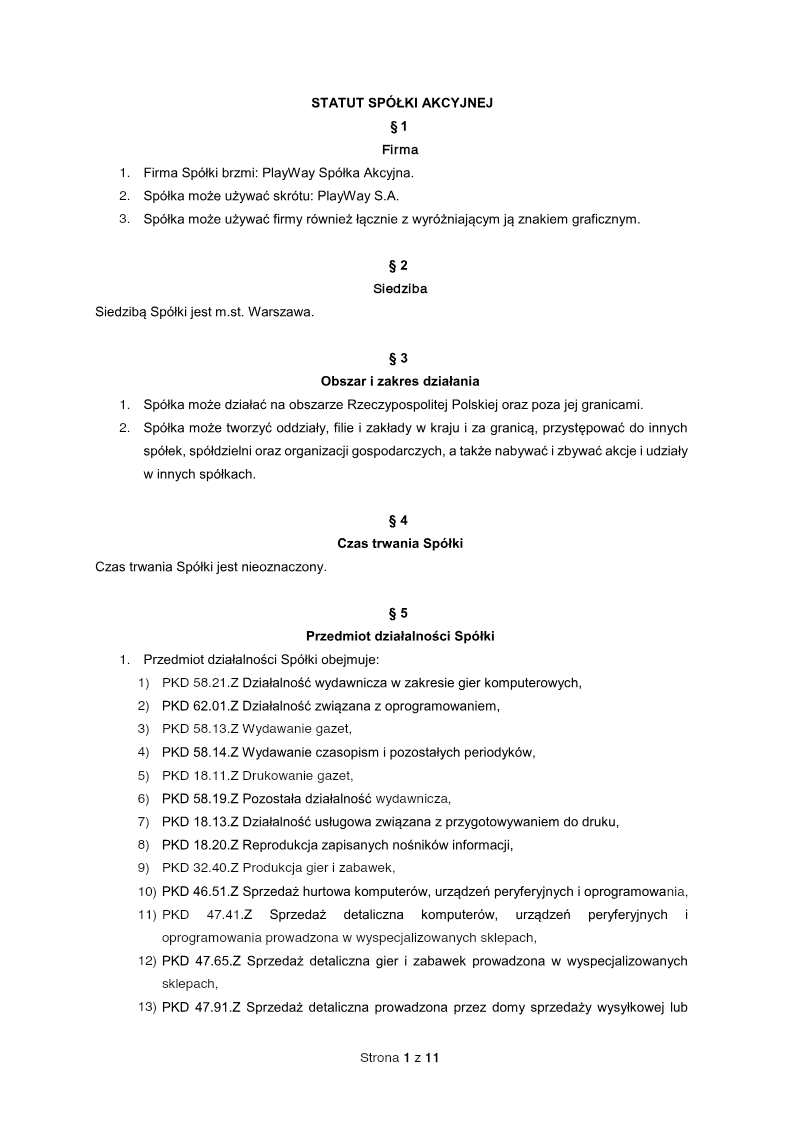
The Articles of Association for PlayWay S.A. establish the legal and operational framework for the Warsaw-based joint-stock company, primarily known for its activities in computer game publishing and software development. The company is established for an indefinite duration and possesses a broad operational scope that includes publishing periodicals, manufacturing games and toys, and engaging in retail and wholesale trade of electronic equipment and software.
The share capital is set at 660,000 PLN, divided into 6,600,000 bearer shares with a nominal value of 0.10 PLN each. These shares are categorized into nine series (A through I), and the document explicitly prohibits their conversion into registered shares. Each share entitles the holder to one vote at the General Meeting. Provisions are included for the increase or decrease of capital via General Meeting resolutions, requiring a three-quarters majority, as well as the potential issuance of convertible bonds.
Governance is structured through three primary bodies: the General Meeting, the Supervisory Board, and the Management Board. The Management Board, consisting of one to five members serving five-year terms, handles daily operations and external representation. The Supervisory Board, composed of five members also serving five-year terms, provides oversight and assumes the role of an audit committee should the company become public. Specific voting thresholds are defined for major corporate actions, such as a two-thirds majority for significant changes to the business object or company mergers.
Financial regulations dictate that the fiscal year follows the calendar year. The company is mandated to maintain a supplementary capital fund, fueled by at least 8% of annual net profits until the fund reaches one-third of the share capital. Shareholders are entitled to dividends as determined by the Ordinary General Meeting, with provisions allowing for advance dividend payments if the company maintains sufficient liquidity and recorded a profit in the previous year.
- PlayWay S.A. operates with a share capital of 660,000 PLN, divided into 6,600,000 bearer shares with a nominal value of 0.10 PLN each.
- Governance is split between a Management Board of one to five members and a five-member Supervisory Board, both serving five-year terms.
- The company is authorized to issue nine series of shares (A through I), all of which are strictly prohibited from being converted into registered shares.
- Major corporate actions, such as mergers or changes to the business scope, require a two-thirds majority vote, while capital adjustments require a three-quarters majority.
- The company must allocate at least 8% of annual net profits to a supplementary capital fund until that fund reaches one-third of the total share capital.
+1
PlayWayOct 2016
Legal13 pages
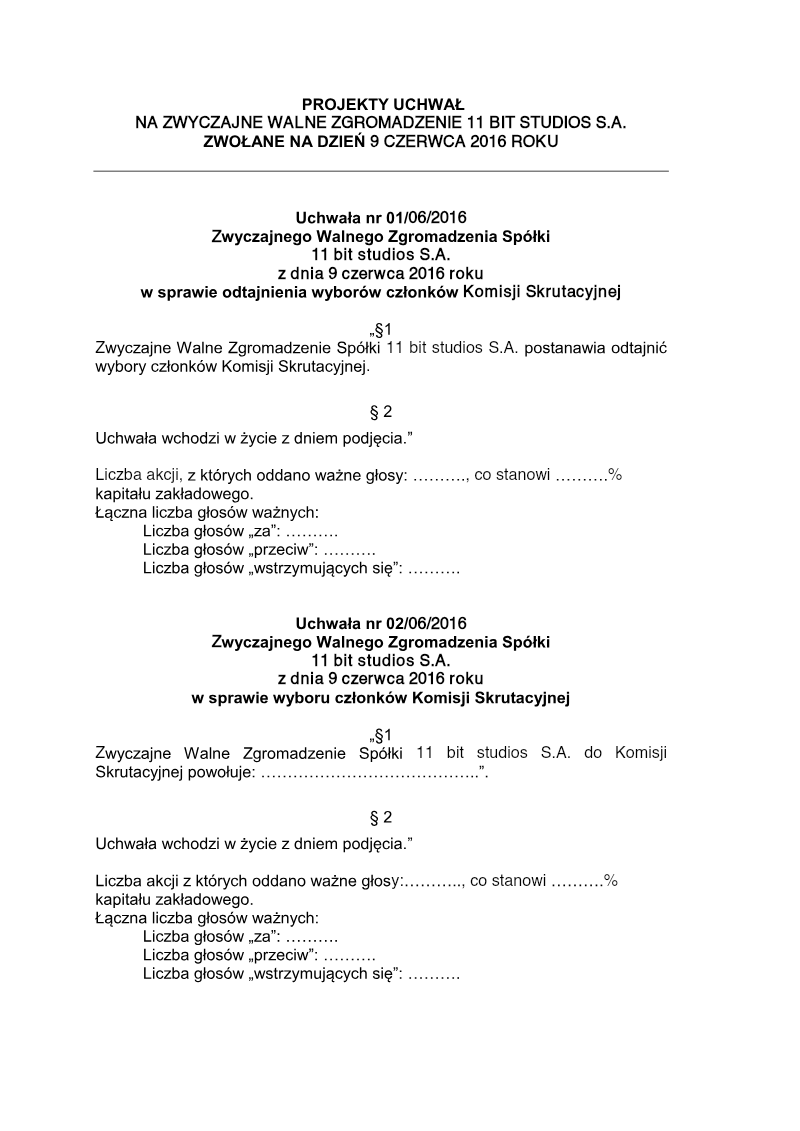
Draft Resolutions for the Ordinary General Meeting — 11 bit studios S.A. (June 2016)
These draft resolutions for the Ordinary General Meeting of 11 bit studios S.A., scheduled for June 9, 2016, outline the formal corporate governance actions and financial approvals required for the 2015 fiscal year. The primary purpose of these documents is to provide a structured framework for shareholder voting on the company’s administrative leadership, financial performance, and strategic allocation of capital. The scope is limited to the Polish corporate entity and its capital group for the period spanning January 1 to December 31, 2015.
Key financial data points indicate a highly successful year for the company. The standalone financial statement for 11 bit studios S.A. reports a net profit of 12,755,371 PLN and total assets of 33,895,516 PLN. On a consolidated basis, the 11 bit studios Group reported a net profit of 11,565,579 PLN. A significant resolution proposes that the entire standalone net profit of 12.75 million PLN be allocated to the company’s reserve capital rather than being distributed as dividends, suggesting a focus on reinvestment and financial stability.
The resolutions also cover essential governance mandates, including the discharge of duties for members of the Management Board and the Supervisory Board. Specific individuals named for discharge include President Grzegorz Miechowski and board members Bartosz Brzostek, Michał Drozdowski, and Przemysław Marszał. Furthermore, the documents provide for the election of a new Supervisory Board for a term ending in June 2019. The methodology follows standard Polish Commercial Companies Code requirements, utilizing formal voting blocks for shareholders to record their support, opposition, or abstention regarding each proposal.
- 11 bit studios S.A. reported a standalone net profit of 12,755,371 PLN and a consolidated group net profit of 11,565,579 PLN for the 2015 fiscal year.
- The company proposed allocating the entire 12.75 million PLN standalone net profit to reserve capital, prioritizing reinvestment over dividend distribution.
- As of the end of the 2015 fiscal year, 11 bit studios S.A. held total assets valued at 33,895,516 PLN.
- The June 9, 2016, Ordinary General Meeting included formal discharge of duties for Management Board members Grzegorz Miechowski, Bartosz Brzostek, Michał Drozdowski, and Przemysław Marszał.
- Shareholders were tasked with electing a new Supervisory Board to serve a three-year term ending in June 2019.
+1
11 bit studiosJun 2016
Legal26 pages
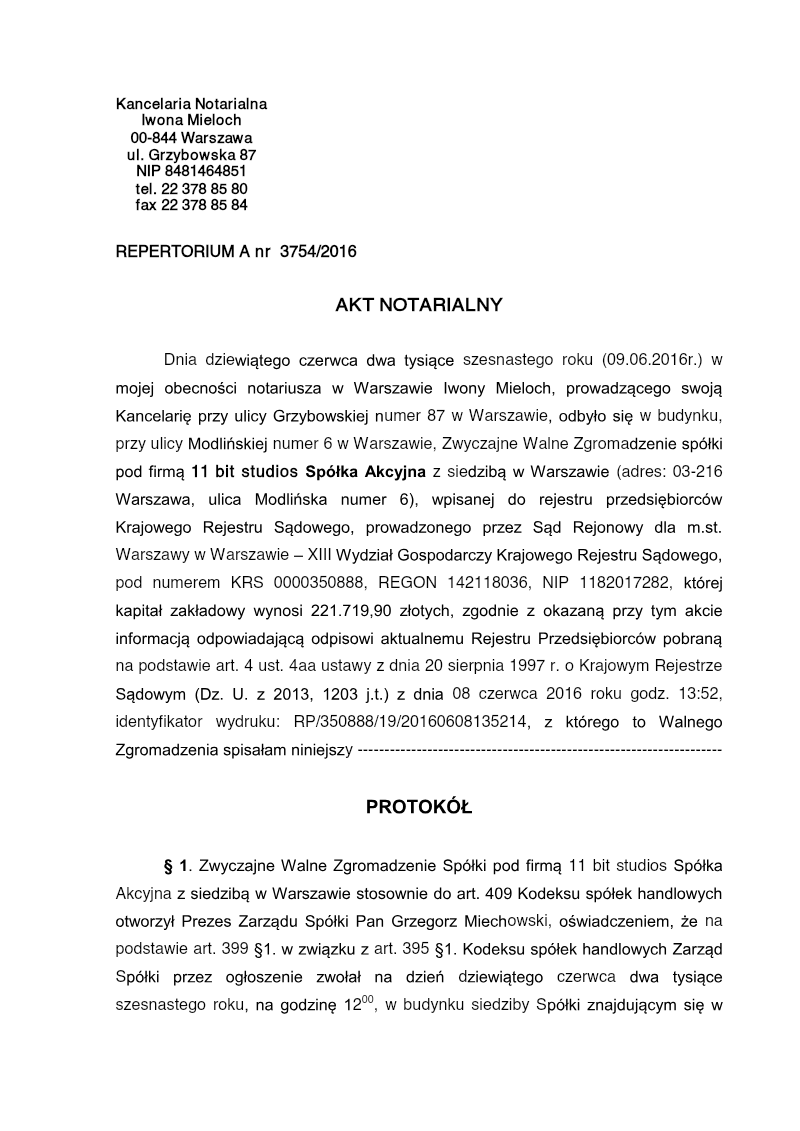
Ordinary General Meeting Resolutions — 11 bit studios S.A. (June 2016)
The 2015 fiscal year for 11 bit studios S.A. culminated in a period of significant financial growth and structural consolidation, as evidenced by the outcomes of the June 2016 Ordinary General Meeting. Representing 29% of the total share capital, shareholders formalized the company’s transition into a more robust financial position by reporting a net profit of approximately 12.76 million PLN. This performance contributed to a total asset and liability valuation exceeding 33.8 million PLN, reflecting a successful operational period driven by the studio's development and publishing activities.
A central strategic decision involved the allocation of the entire 12,755,371 PLN net profit to the company’s reserve capital. This move underscores a commitment to long-term financial stability and internal reinvestment rather than immediate dividend distribution. To validate the leadership's performance during this profitable cycle, the assembly granted full discharge to all members of the Management Board, including Grzegorz Miechowski and Przemysław Marszał, signaling shareholder confidence in the executive direction and the accuracy of the 2015 financial statements.
The governance structure was further solidified through the reappointment and election of the Supervisory Board for terms lasting until June 2019. Key appointments included Piotr Sulima, Jacek Czykiel, Agnieszka Maria Kruz, Wojciech Ozimek, and Radosław Marter, most of whom were confirmed with overwhelming majority support. These administrative actions ensure leadership continuity as the company moves beyond the 2015 reporting period. By finalizing these resolutions and formalizing the corporate records, the company established a clear mandate for its management and supervisory bodies to pursue future growth while maintaining a strengthened capital reserve.
- 11 bit studios S.A. reported a net profit of approximately 12.76 million PLN for the 2015 fiscal year.
- Shareholders voted to allocate the entire 12,755,371 PLN net profit to the company’s reserve capital to prioritize long-term reinvestment over dividend payouts.
- The company reached a total asset and liability valuation exceeding 33.8 million PLN by the end of the 2015 reporting period.
- The Ordinary General Meeting granted full discharge to Management Board members Grzegorz Miechowski and Przemysław Marszał, confirming shareholder approval of their 2015 performance.
- The Supervisory Board was reconstituted with the election of Piotr Sulima, Jacek Czykiel, Agnieszka Maria Kruz, Wojciech Ozimek, and Radosław Marter for terms extending until June 2019.
+1
11 bit studiosJun 2016
Financial38 pages
Annual Report of 11 bit studios S.A. for 2015
The 2015 fiscal year marked a transformative period for 11 bit studios S.A., characterized by record-breaking financial performance and a formal transition to International Financial Reporting Standards (IFRS). Sales revenue climbed to 22.7 million PLN, a significant increase from 15.6 million PLN in 2014, while net profit rose to 12.8 million PLN. This growth was primarily driven by the sustained global commercial success of This War of Mine across major digital distribution platforms such as Steam, Apple, and Google. The company’s liquidity position strengthened remarkably, with cash reserves increasing from 7.64 million PLN to 22.93 million PLN by year-end.
The adoption of IFRS necessitated substantial balance sheet adjustments, most notably the reclassification of 4.86 million PLN in development costs from inventories to intangible assets. The company maintains a rigorous accounting policy for game production, capitalizing development costs and amortizing completed titles over 12 to 18 months, while proprietary game engines are amortized over 36 months. Despite writing off approximately 175,000 PLN for abandoned projects, the company continued heavy investment in its technological infrastructure and future pipeline, ending the year with 6.39 million PLN in intangible assets.
Operating within a single business segment of game production, the company remains exposed to significant currency risk, as the majority of its revenue is generated in USD while its functional currency is the Polish złoty. Beyond operational achievements, the period saw the implementation of an employee stock option program and a management incentive scheme tied to financial targets. Following the close of the fiscal year, the company expanded its market reach with the January 2016 console launch of This War of Mine: The Little Ones, signaling a continued strategy of platform diversification and brand extension.
- 11 bit studios achieved record financial performance in 2015, with sales revenue increasing to 22.7 million PLN from 15.6 million PLN in 2014 and net profit reaching 12.8 million PLN.
- The company’s cash reserves tripled during the fiscal year, rising from 7.64 million PLN to 22.93 million PLN.
- Financial growth was primarily driven by the sustained global commercial success of the title This War of Mine across Steam, Apple, and Google platforms.
- The company transitioned to International Financial Reporting Standards (IFRS), resulting in the reclassification of 4.86 million PLN in development costs from inventories to intangible assets.
- 11 bit studios maintains a specific amortization policy, depreciating completed game titles over 12 to 18 months and proprietary game engines over 36 months.
11 bit studiosJun 2016
Legal9 pages
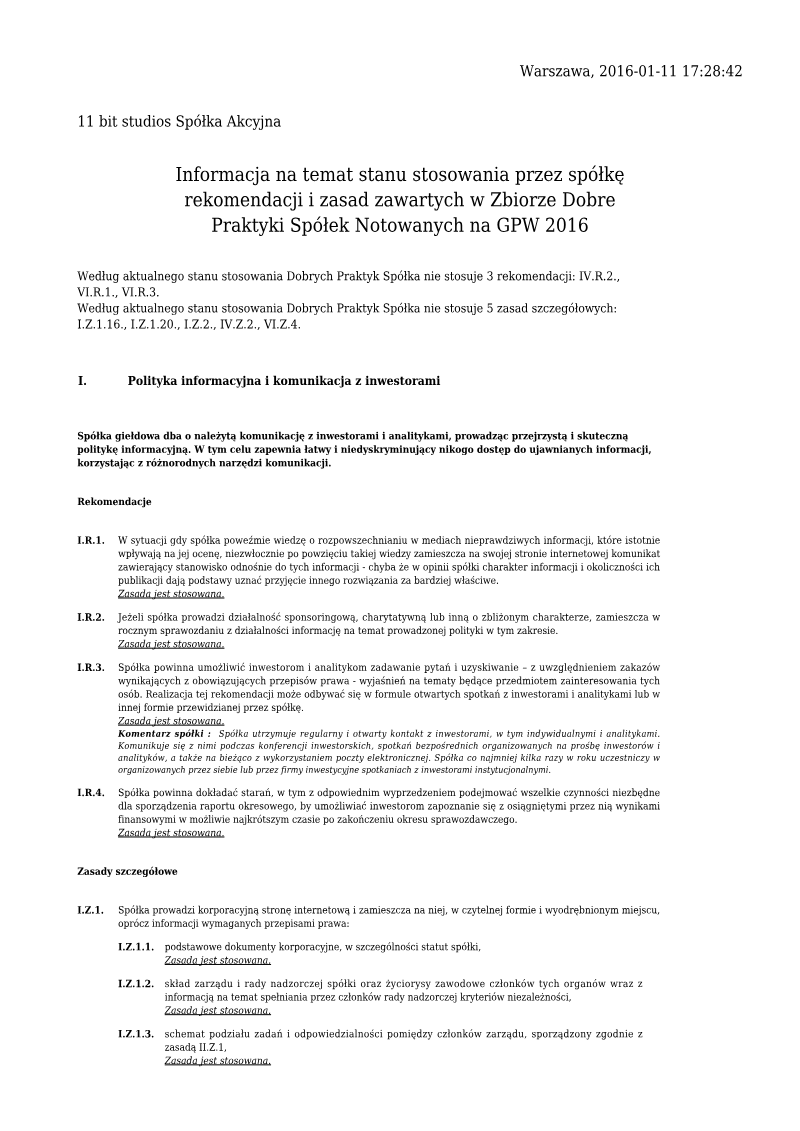
11 bit studios S.A. Corporate Governance Compliance Statement (WSE Best Practices 2016)
11 bit studios S.A. demonstrates a high level of alignment with the corporate governance standards established for the Polish capital market, though it maintains specific, intentional deviations based on cost-benefit analyses and strategic priorities. The company’s governance framework emphasizes a clear division of responsibilities between the Management and Supervisory Boards, prioritizing transparency in investor relations and strict adherence to internal audit and risk management protocols. While the company supports diversity and independence within its leadership structures, it currently opts out of several technical and linguistic recommendations, such as providing video transmissions of general meetings or maintaining a comprehensive English-language website, citing high implementation costs and a lack of significant shareholder demand.
Shareholder relations are characterized by a focus on long-term growth over immediate capital distribution, as evidenced by a five-year suspension of dividend payments to fund strategic investments. Although the company facilitates shareholder participation through traditional means, it rejects the implementation of real-time electronic voting or bilateral communication during general meetings. Furthermore, while conflict-of-interest procedures and oversight of related-party transactions remain robust, the company does not fully comply with formal remuneration reporting standards. It has declined to establish a dedicated remuneration committee or a comprehensive remuneration policy report, choosing instead to provide only partial disclosures within its periodic activity reports.
The scope of these governance practices reflects the company’s status as a listed entity on the Warsaw Stock Exchange during the 2016 fiscal period. The overall strategy balances the necessity of regulatory compliance with the practicalities of a growth-oriented business model. By maintaining rigorous internal controls and supervisory oversight while bypassing certain non-mandatory technical recommendations, the company aims to protect corporate interests and ensure operational efficiency without incurring what it deems unnecessary administrative expenses.
- 11 bit studios S.A. prioritizes long-term growth over capital distribution, evidenced by a five-year suspension of dividend payments to fund strategic investments.
- The company maintains a clear division of responsibilities between its Management and Supervisory Boards, supported by robust internal audit and risk management protocols.
- 11 bit studios S.A. has opted out of establishing a dedicated remuneration committee or publishing a comprehensive remuneration policy report, providing only partial disclosures in periodic activity reports.
- The company rejects real-time electronic voting and bilateral communication during general meetings, opting instead for traditional shareholder participation methods.
- Management has declined to implement certain technical and linguistic recommendations, such as video transmissions of general meetings and a comprehensive English-language website, citing high costs and low shareholder demand.
+2
11 bit studiosJan 2016