
Covid 19

1 documents·1 publishers

Documents

Page 1
Report145 pages

Cultural and Creative Sectors in Post-COVID-19 Europe: Crisis Effects and Policy Recommendations

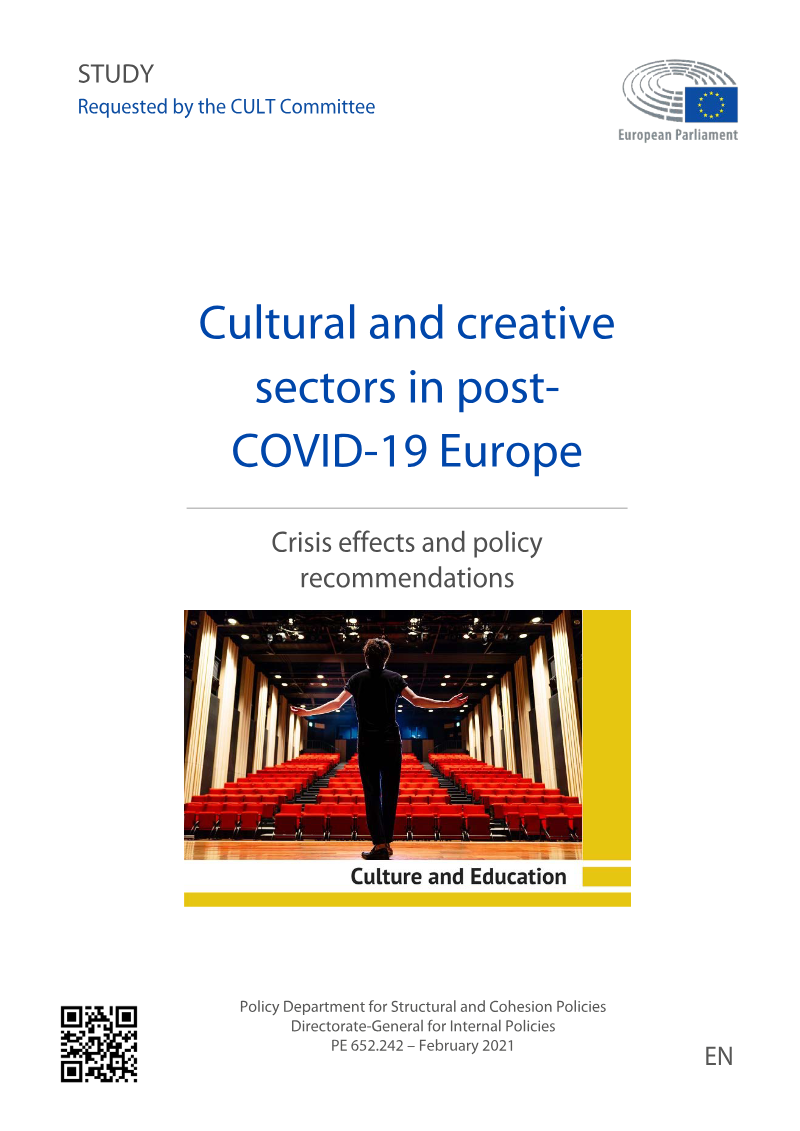
Requested by the CULT Committee European Parliament Policy Department for Structural and Cohesion Policies Directorate-General for Internal Policies PE 652.242 – February 2021 EN Cultural and creative sectors (CCS) have been hit hard by the consequences of the COVID -19 pandemic. This study analyses the so far effects of the crisis on the CCS, as well as the policy responses that are formulated to support the sectors.
  • The Cultural and Creative Sectors (CCS) in the EU-27 were economically fragile before COVID-19, characterized by over 1.1 million enterprises (5% of non-financial businesses) generating EUR 145 billion (2.3% of the non-financial business economy) in 2017, with growth rates slightly above the overall non-financial business economy (1.5% vs 1.4% annually between 2012-2017).
  • The COVID-19 pandemic severely impacted the CCS through measures like halting non-essential business, banning public events, and restricting movement, leading to significant income loss for suppliers (e.g., sound/lighting, caterers) and local economies dependent on festivals and events.
  • Freelance performing artists, who often rely on multiple income streams and networking at events, were particularly hard hit by movement bans and social distancing, with many unable to access public support.
  • While some digital-native CCS sub-sectors (e.g., gaming) and those with large IP portfolios thrived, content creators often did not receive fair remuneration from digital platforms, highlighting a need for equitable compensation models.
  • The crisis accelerated the adoption of digital income sources and online distribution for CCS sub-sectors traditionally reliant on physical/live components (e.g., performing arts, live music), demonstrating potential for crisis resistance.
+1
European ParliamentFeb 2021

Publishers

Related Topics