Showing 11 of 14 results · 0.04s
Apr 2026
Enthusiast Gaming Holdings Inc. Consolidated Financial Statements: 2025 and 2024
Enthusiast Gaming Holdings
accounting policies emphasize foreign‑currency translation, principal‑vs‑agent revenue recognition across media, subscription, events, esports and merchandise streams, and goodwill impairment testing. IFRS‑based policies apply
Financial54 pages
Nov 2024
Outcome of Board Meeting held on Thursday, November 14, 2024
Nazara Technologies
company reported a 7% year-over-year increase in consolidated revenue, reaching ₹56,902 lakh, with the eSports segment serving as the primary growth engine. While standalone
Financial22 pages
Nov 2020
Turtle Beach Form 10-Q: Q3 2020
Turtle Beach
Recon 70 and Stealth 600/700 contributing to a 65 % year‑over‑year revenue lift and an improved gross margin of 41 %. Market dynamics are dominated by console
Financial1 pages
Consolidated Financial Results: Fiscal Year Ended March 31, 2026
Capcom
surged 49.7 % to ¥10,033 million, supported by long‑term hall operations, global esports events, and media initiatives such as Street Fighter 6 tournaments. Other Businesses sales climbed
Financial24 pages
Jul 2026
FY26/3 Earnings Summary and Mid- to Long-Term Growth Strategies: Japan
Capcom Co.
flywheel business model that utilizes established intellectual property across consumer games, eSports, and media to broaden the global fan base. By leveraging data-driven marketing across 244 countries
Financial42 pages
Consolidated Financial Results: Three Months Ended June 30, 2026
Capcom
sales, the Amusement Equipments and Other business segments experienced slight declines in revenue. The company’s financial position remains stable, with a shareholder equity ratio
Financial13 pages
1st Quarter Financial Results: Fiscal Year Ending March 31, 2027
Capcom
cumulative units sold. Digital sales, particularly on PC platforms, continue to dominate the revenue mix, accounting for the vast majority of consumer unit sales. Other business segments, including
Financial17 pages
Aug 2022
Corsair Gaming 10-Q: Q2 2022
Corsair Gaming
Corsair Gaming’s Q2 FY2022 filing documents a sharp contraction in revenue and profitability amid persistent liquidity pressures. Net sales for the first half of FY 2022 fell
Financial1 pages
Consolidated Financial Results: Six Months Ended September 30, 2022
Konami Group Corporation
year fiscal forecast of ¥320,000 million in revenue and ¥76,500 million in operating profit. Despite these revenue gains, profitability faced significant downward pressure during the first
Financial19 pages
Consolidated Financial Results: Nine Months Ended December 31, 2022
Konami Group Corporation
company’s continued reliance on its Digital Entertainment division as a primary revenue engine, even as it diversifies its international footprint. Despite these gains, profitability faced substantial headwinds
Financial18 pages
2015 Interim Report
Tencent
Tencent Holdings Limited demonstrated robust financial growth during the first half of 2015, characterized by
Financial90 pages
Enthusiast Gaming Holdings Inc. Consolidated Financial Statements: 2025 and 2024
Apr 202654 pages34k words
Summary
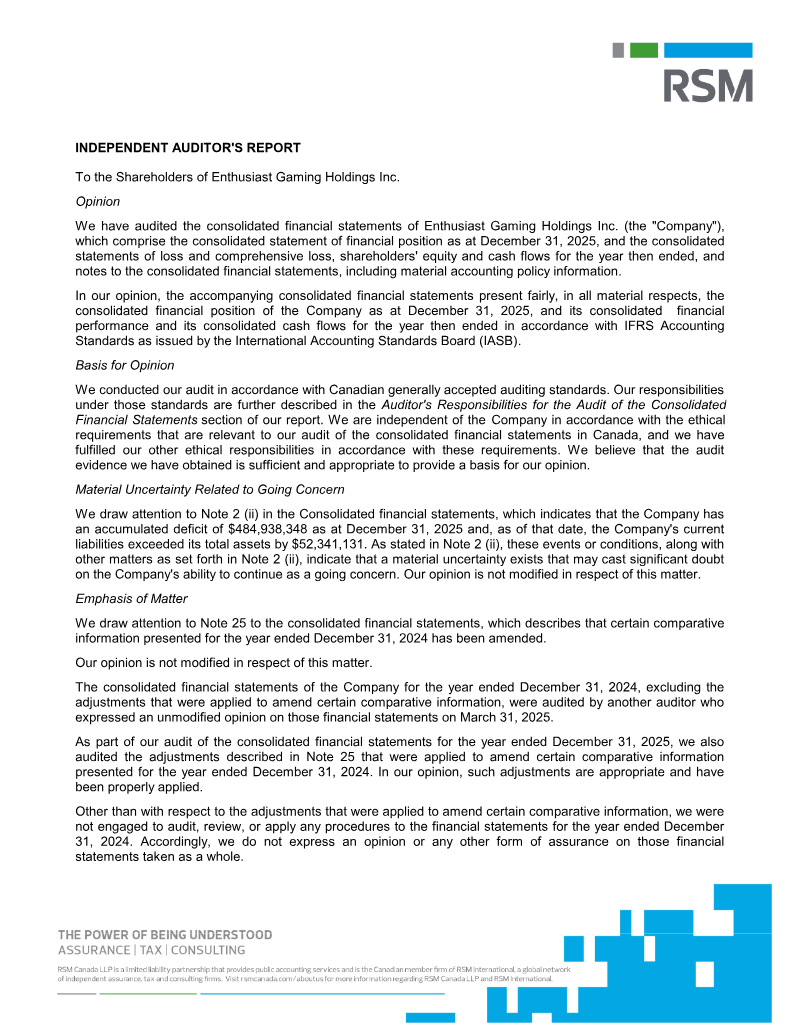
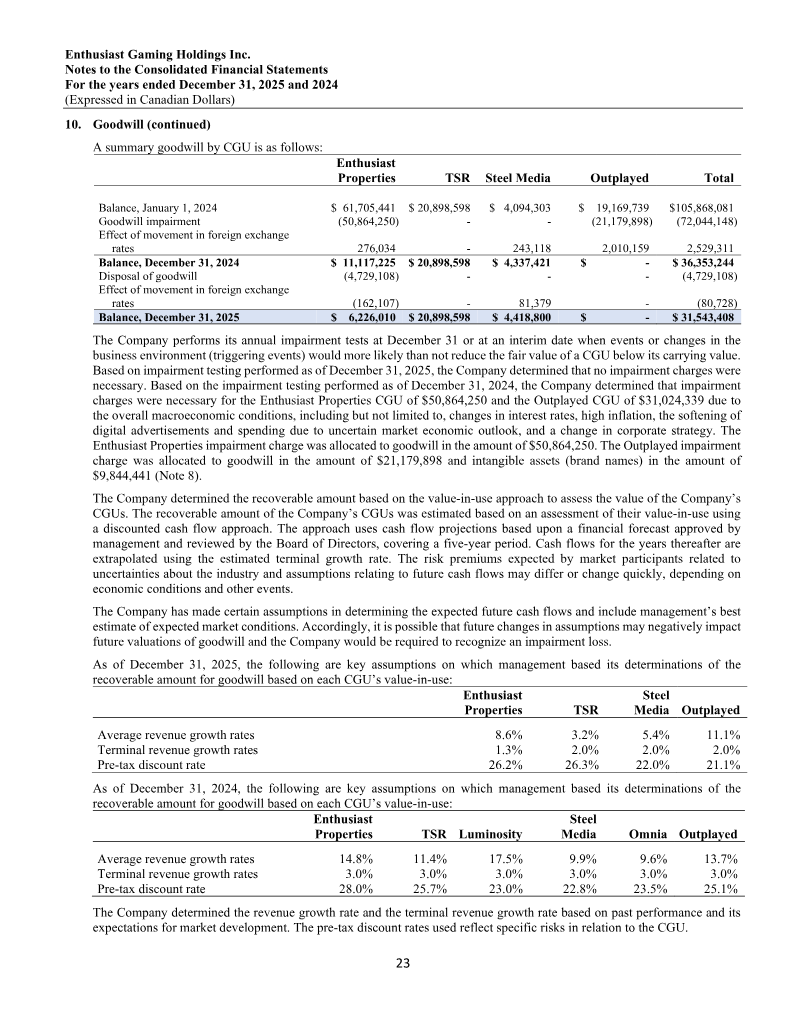
Enthusiast Gaming Holdings Inc. experienced a pronounced deterioration in financial health during 2025, with total assets halving to $64.9 million from $128.4 million in 2024 and a cumulative deficit of $484.9 million. Net loss narrowed to $44 million, yet revenue fell sharply to $32 M and operating losses from discontinued operations reached $34 M. Shareholders’ equity collapsed to $1.78 million, while liabilities rose to $64.9 M, creating a working‑capital deficit that raises serious going‑concern doubts.
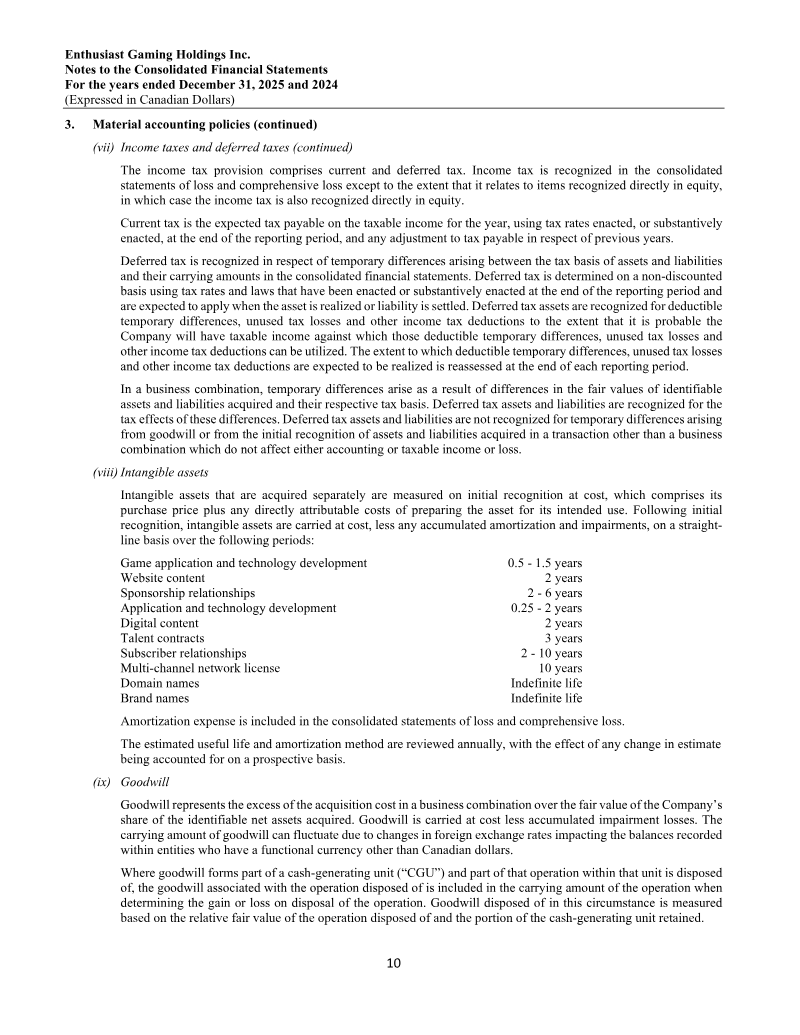
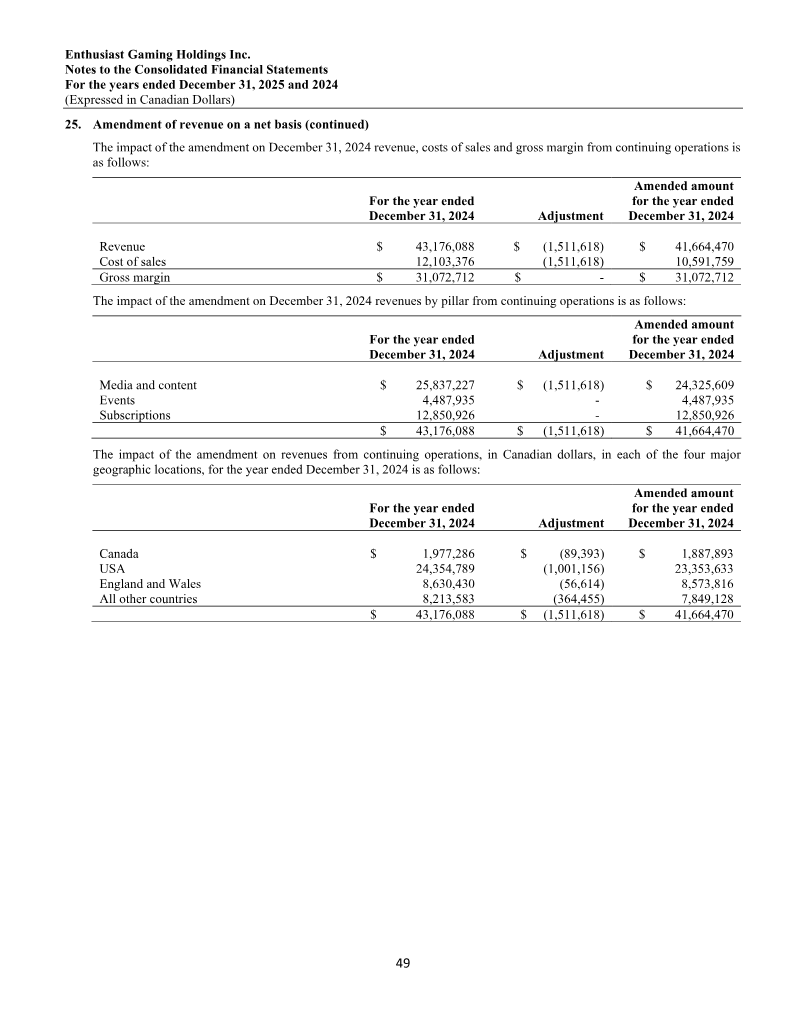
Key accounting policies emphasize foreign‑currency translation, principal‑vs‑agent revenue recognition across media, subscription, events, esports and merchandise streams, and goodwill impairment testing. IFRS‑based policies apply CGU impairment reviews, fair‑value measurement for financial instruments, and simplified expected credit loss provisioning. Recent IAS 21 amendments had no material effect, but forthcoming IFRS 18 and IFRS 9 changes are under review.
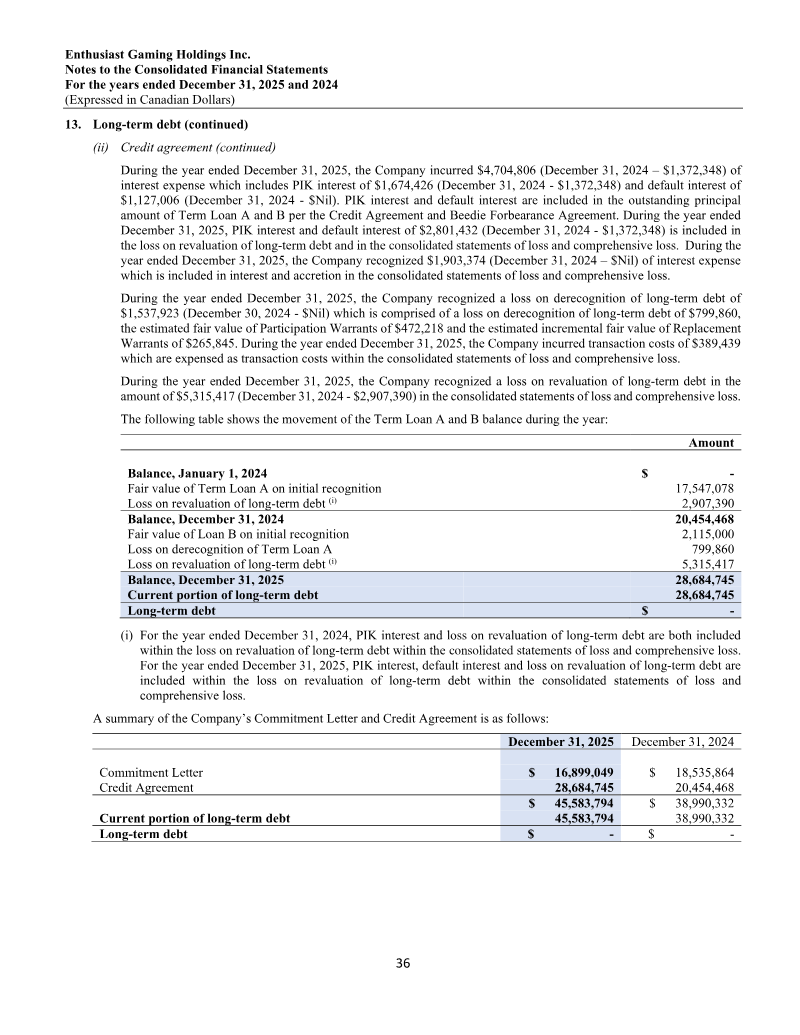
Debt restructuring dominated 2025, with multiple forbearance agreements and new term loans (A and B) carrying high fixed rates (14–16%) and PIK/convertible features. Losses on debt modification totaled over $400 million, and covenant breaches triggered potential acceleration of repayments. Current long‑term debt portions rose to $45.58 million, while earn‑out liabilities were largely settled.
Liquidity remains fragile; trade receivables fell to $4.81 million, and interest expense—including default interest—reached $1.81 million. Capital management remains heavily reliant on external financing, with significant deferred tax assets tied to Canadian loss carryforwards expiring by 2045. Overall, the company’s financial position has weakened sharply, and continued viability depends on additional capital or restructuring.
Pages
Insights
- Enthusiast Gaming faces severe going-concern risks as shareholders’ equity collapsed to $1.78 million against $64.9 million in total liabilities.
- Total assets halved year-over-year, dropping from $128.4 million in 2024 to $64.9 million in 2025, while the cumulative deficit reached $484.9 million.
- Revenue fell sharply to $32 million in 2025, compounded by $34 million in operating losses from discontinued operations and a net loss of $44 million.
- Debt restructuring in 2025 resulted in over $400 million in modification losses, with new term loans carrying high interest rates of 14–16% and potential repayment acceleration due to covenant breaches.
- Current long-term debt obligations rose to $45.58 million, placing extreme pressure on a liquidity position characterized by only $4.81 million in trade receivables.
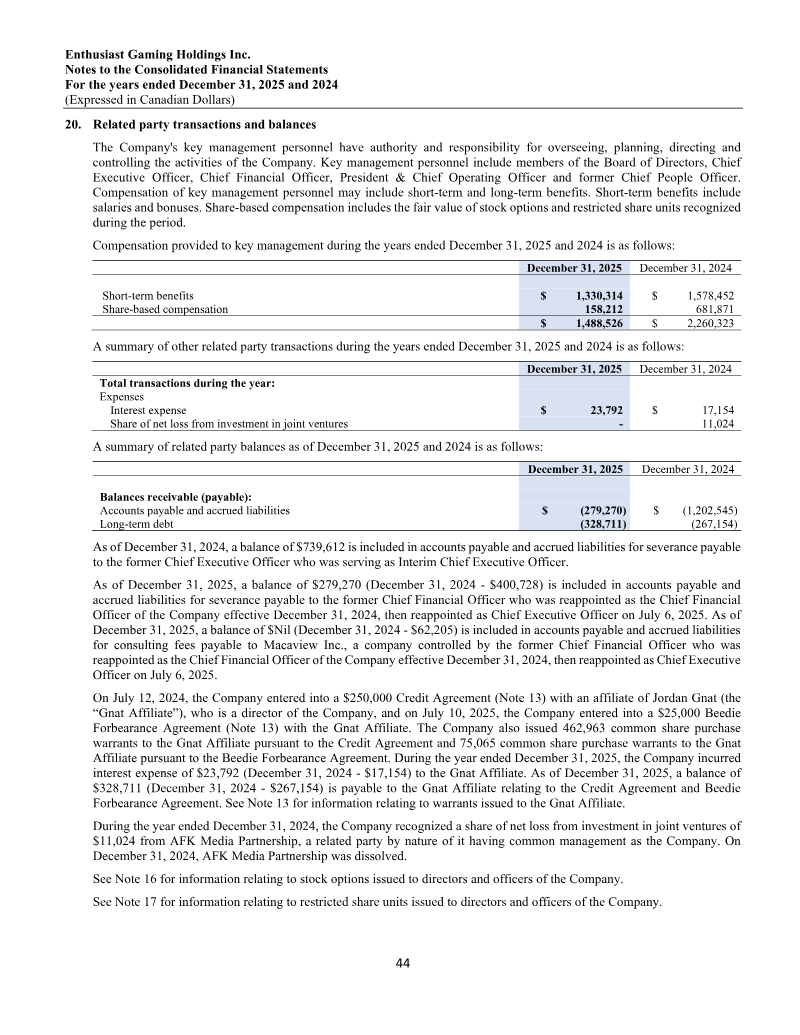
Compensation provided to key management during the years ended December 31, 2025 and 2024