
Report
Llibre Blanc d’Accessibilitat per al Desenvolupament de Videojocs
The central thesis is that video‑game accessibility must be embedded from the earliest design stages, using a standardized, non‑subjective evaluation framework, to achieve universal inclusion while avoiding the steep costs of retro‑fitting. Drawing on the European EN 301 549 ICT‑accessibility standard and the Ga11y portal launched in July 2022, the analysis provides a comprehensive catalogue of functional measures that map directly to specific disability profiles. The market context is global, with more than three billion gamers worldwide, roughly 400 million of whom have a disability, and an estimated 18 million regular players in Spain. Despite growing awareness since 2014 and heightened industry focus from 2018, major publishers often omit disclosure of the accessibility features they implement. The work outlines 28 “star‑rated” guidelines, ranging from simple one‑star options such as clear iconography, customizable audio mixes, and control‑swap mechanisms, to complex five‑star solutions like sign‑language interpretation and AI‑driven navigation assistance. Each measure is linked to visual, auditory, motor, speech or cognitive impairments, and the guidance stresses that low‑complexity features can be integrated early with minimal technical effort, delivering broad, cost‑effective support. A parallel emphasis is placed on the expanding hardware ecosystem. Commercial adaptive controllers—from the modular Sony Access Controller to eye‑tracking solutions like Tobii Eye Tracker 5—are complemented by low‑cost 3‑D‑printed accessories that enable bespoke adaptations. Collaboration between industry bodies such as AEVI and the Fundación ONCE underpins the push for mandatory, inclusive design practices across the European development landscape, positioning accessibility as a strategic imperative rather than an optional add‑on.
AEVIJan 2023

Report
Libro Blanco de Accesibilidad para Desarrolladores
The core thesis emphasizes that video‑game accessibility must be embedded from the earliest design stages, rather than added later, because retro‑fitting dramatically inflates development time and cost. Drawing on the European EN 301 549 standard and the Ga11y catalogue, the work presents a systematic methodology for evaluating both closed platforms (consoles) and open platforms (PC and mobile) and supplies developers with a practical reference for implementing auditory, visual, motor and cognitive options. Globally, roughly three billion people play video games, of whom about four hundred million experience some form of disability. Within the Spanish ecosystem, industry bodies such as AEVI and Fundación ONCE have positioned universal accessibility as a strategic priority, encouraging adoption of the outlined standards across the period 2018‑2023, when systematic measures began to emerge after an initial appearance in 2014. A tiered catalogue of more than thirty accessibility measures is detailed, ranging from basic 1‑star options—identifiable icons, joystick swapping, sound‑mix controls and puzzle‑skip functions—to advanced 5‑star features such as sign‑language interpretation, voice‑to‑text and text‑to‑voice for multiplayer. Each measure is mapped to specific disability profiles (partial or total vision loss, colour‑vision deficiency, hearing loss, motor impairments and cognitive challenges) and is recommended for early integration with configurable settings. A self‑assessment matrix forces developers to verify compliance for every mandatory feature, underscoring that true inclusivity also depends on compatible adaptive peripherals. The analysis of hardware solutions lists the principal adaptive controllers and accessories available for major consoles, including the Xbox Adaptive Controller, Hori Flex, PlayStation Access Controller, QuadStick, Tobii Eye Tracker 5, the Ford Adapta racing simulator and the OWO haptic jacket, together with their price ranges. It concludes that while commercial peripherals are expanding, gaps remain, making coordinated software‑hardware strategies essential for delivering fully inclusive gameplay across the global market.
AEVIJan 2023

Whitepaper
Accessibility for Developers: Spain
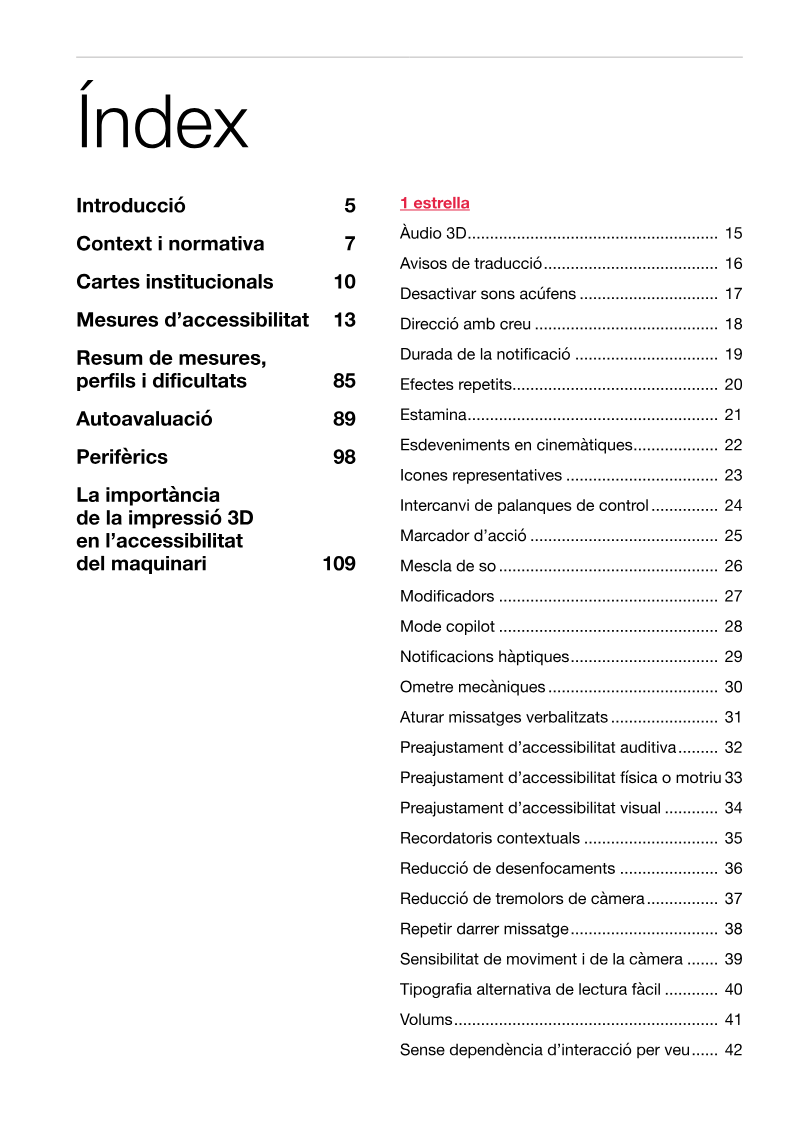
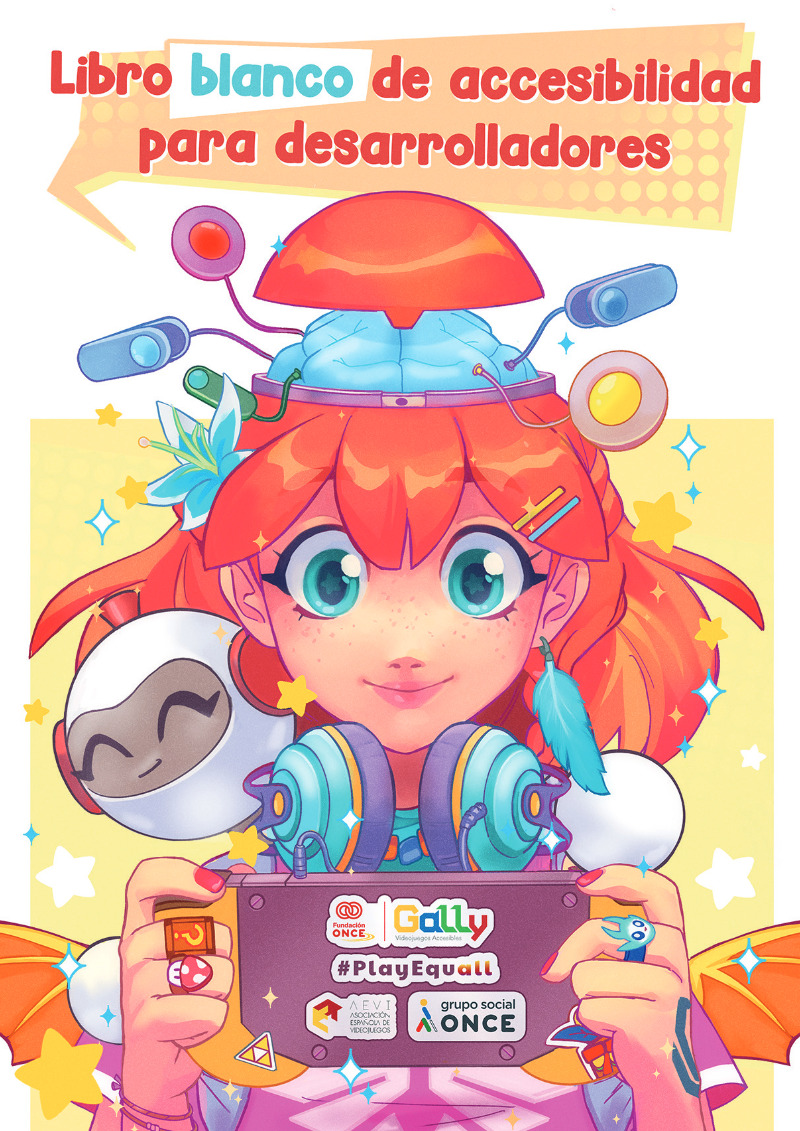
NCE Videojuegos Accesibles (Spanish Video Games Association): Arturo Monedero and Miriam Fdez Simon (Spanish National Organisation of the Blind Foundation: Juan Aguado Delgado and Enrique García Cortés (@kike_mep) Front and back cover illustration: Natalia Morillo (@heynatnatart) Illustrations of accessibility guidelines: Pablo Ruiz Moyano and Alba Martos Melero Laura Enciso Baringo and Pablo Pérez Ortega Introduction 1 star Context 3D audio .......
Fundación ONCEJan 2021