Reports matching your filters
By European Game Developers Federation (EGDF) Supported by Video Games Europe European Video Games Industry Data 5 Number of game developer studios 7 Number of service providers 8 Number of people working in the video games industry 9 Percentage of women working in the industry ...
The 2022 white paper evaluates the state of Catalonia’s video‑game sector, arguing that while the region has become an increasingly attractive hub for development, persistent structural constraints—particularly in talent supply and financing—limit its growth potential. By mapping the ecosystem’s performance against recent trends, the analysis highlights the urgent need for coordinated policy action to sustain the momentum generated by recent investment inflows.
A striking 59 % of Catalan studios report difficulty recruiting qualified personnel, a proportion that, although lower than in 2019‑2020, remains markedly high. Financing emerges as the foremost ongoing obstacle, closely followed by challenges in attracting and retaining skilled staff and the absence of competitive fiscal incentives. Despite these constraints, foreign direct investment surged, with five new projects injecting €39.5 million into the local economy and creating 377 jobs, representing a 32 % year‑on‑year increase in employment opportunities within the sector.
The findings suggest that reinforcing fiscal support mechanisms, expanding specialised training programmes, and fostering stronger links between academia and industry are essential to convert Catalonia’s investment appeal into durable, high‑value growth. Strengthening these levers would not only alleviate the talent bottleneck but also enhance the region’s capacity to attract further capital, positioning Catalonia as a leading European centre for video‑game development in the medium term.
The global video game industry achieved unprecedented financial expansion in 2021, characterized by a surge in capital deployment that solidified the sector as a primary target for institutional and strategic investors. Total deal value reached $80.4 billion across 967 transactions, representing a 2.5-fold increase over the previous year. This growth was underpinned by a robust environment for mergers and acquisitions, which accounted for nearly half of the total transaction volume, alongside a significant intensification in early-stage venture capital funding.
The investment landscape was defined by a shift toward emerging technologies and high-growth segments. Most notably, blockchain-integrated gaming experienced an explosive 68-fold year-over-year increase in deal value, signaling a fundamental pivot in investor interest toward decentralized gaming models. Simultaneously, the mobile gaming segment continued to serve as a critical engine for growth, attracting substantial capital as strategic players like Tencent maintained aggressive acquisition strategies to consolidate market share and secure long-term intellectual property.
These findings reflect a broader trend of heightened investor confidence in the long-term viability of the gaming ecosystem. By spanning a diverse range of deal structures—including public offerings, venture capital, and strategic M&A—the 2021 activity highlights a maturing industry that is increasingly capable of attracting massive capital inflows. This record-breaking performance underscores the industry's transition from a niche entertainment sector to a dominant force in the global digital economy, setting a new benchmark for future investment activity across all major gaming segments.
By European Game Developers Federation (EGDF) Supported by Video Games Europe European Video Games Industry Data 5 Number of game developer studios 7 Number of game publishers 8 Number of people working in the video games industry 9 Percentage of women working in the industry ...
The first quarter of 2021 marked a historic surge in global video game industry investments, signaling a potential record-breaking year. Total deal value for closed transactions reached $25 billion across 249 deals, representing a twofold increase compared to the first half of 2020. When including announced but unclosed transactions, the total deal value for the quarter climbed to $39 billion. This growth was observed across all primary investment frontiers, including private placements, public offerings, and mergers and acquisitions (M&A).
M&A activity served as the primary engine for this expansion, accounting for $14.3 billion in closed deal value, a nearly sixfold increase year-over-year. This segment was dominated by high-profile "mega-deals," most notably Microsoft’s $7.5 billion acquisition of ZeniMax Media and ByteDance’s $4 billion acquisition of Moonton. Public offerings also saw record activity, generating $8.3 billion in value—a 29-fold increase over the previous year—driven by a tripling of initial public offerings and the rising popularity of Special Purpose Acquisition Companies (SPACs). Private investments reached a segment record of $2.6 billion, with late-stage rounds for companies like Roblox and Dapper Labs accounting for 73% of that total.
Strategic and venture capital activity remained highly concentrated among top-tier players. Tencent maintained its leadership in deal volume, closing 35 transactions with a focus on PC and console developers. Meanwhile, the top five strategic investors—Tencent, Microsoft, Embracer Group, Electronic Arts, and ByteDance—contributed over half of the total announced deal value. Early-stage venture capital also grew significantly, with a 120% increase in capital raised by game developers. Geographically and by segment, mobile and multiplatform studios remained the most attractive targets for investors, while PC and console segments drove the majority of M&A value. This analysis is based on tracked closed transactions in the global video game industry, excluding gambling and betting, utilizing data from public media, business partners, and S&P Capital IQ.
Venture capital investment in AI-focused gaming startups has experienced significant growth, totaling $1.8 billion between 2020 and 2024. This influx of capital reflects a strategic shift in investor interest toward verticalized AI tooling designed to enhance scalability and production efficiency within the gaming sector. By 2024, AI-focused startups accounted for approximately 65% of total deal activity in gaming infrastructure, signaling a move away from broader platform bets toward specialized technological solutions.
The investment landscape is categorized into three primary segments: in-game content generation, development infrastructure, and other AI-focused applications. Content generation, which includes tools for creating assets, worlds, and narrative elements, leads the market with $1.2 billion in deal value across 119 deals. Development infrastructure, encompassing productivity tools, testing automation, and backend analytics, secured $0.4 billion across 72 deals. The remaining $0.2 billion was directed toward marketing, influencer tools, and player analytics.
Methodologically, the analysis focuses on startups that received venture financing between 2020 and 2024, specifically excluding studios that utilize AI solely for internal production. The data reveals a robust compound annual growth rate of approximately 35% in deal value from 2022 to 2024. While early-stage rounds dominate the market, the average check size has tripled over the five-year period, rising from $2.6 million in 2020 to $7.3 million by 2024. Andreessen Horowitz, Bitkraft, and Y Combinator emerge as the most active investors, with Andreessen Horowitz leading in both the number of deals and total invested capital.
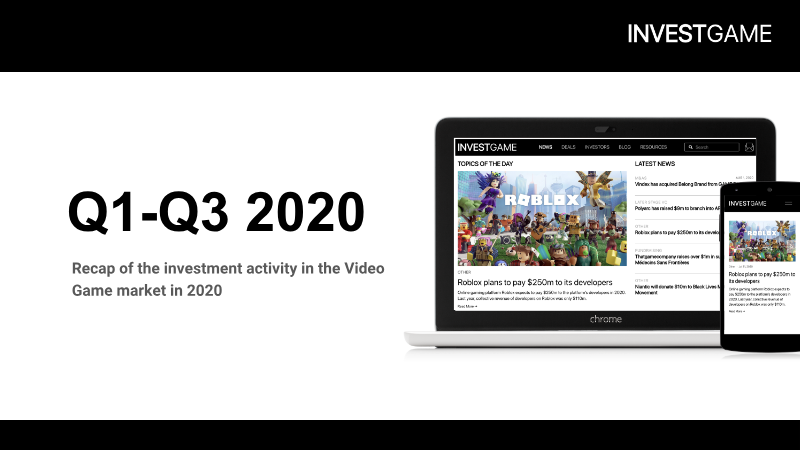
The report documents investment activity in the global gaming industry from January to September 2020, covering mobile, PC & console, multiplatform, VR/AR, cloud‑native and esports segments. Total deal value reached $27.5 billion across 1,000 transactions, with gaming deals accounting for the largest share ($15.3 billion in 211 contracts). Platform & tech deals contributed $4 billion, esports $685 million and other categories $504 million. Public offerings dominated the capital‑raising landscape, generating $9.2 billion from 51 IPOs and PIPEs, while M&A activity totaled $6.6 billion across 132 deals and private venture investments added $4.7 billion from 254 rounds.
Early‑stage VC activity fell sharply after the COVID‑19 outbreak in May, dropping to 5–7 deals per month, but later‑stage and corporate funding remained relatively stable at 1–2 deals monthly until July. The period saw $2.7 billion raised by developers and publishers, with 69 pre‑seed/seed/Series A rounds and 9 Series B+ deals. U.S. firms dominated later‑stage funding (over 90% of value), whereas only 30% of early‑stage capital went to U.S. startups. Three high‑profile transactions—Scopely ($200 m), Roblox ($150 m), and Epic Games ($1.78 b)—accounted for 78% of total capital inflows.
M&A activity remained resilient, with major deals such as Zynga’s acquisition of Peak Games ($2 billion) and Microsoft’s purchase of ZeniMax ($7.5 billion). Tencent, Zynga, and Microsoft were the top strategic acquirers, collectively exceeding $11 billion in announced deals. Public market activity stalled early in the year but rebounded in June with IPOs from Archosaur Games ($280 m) and Kakao Games ($330 m). The report highlights a shift toward mobile acquisitions, sustained corporate investment despite pandemic disruptions, and a growing trend of large‑scale consolidations in the gaming sector.
VENTSPILS HIGH TECHNOLOGY PARK ERHVERVSAKADEMI DANIA TECHNOLOGY PARK This model scheme illustrates “how to run” an incubation programme for game development companies, drafted in form of a manual for business support providers and intermediaries working with Dania University of Applied Sciences Kaunas Science and Technology Park Ventspils High Technology Park für internationale Zusammenarbeit mbH Title page: © iStock.com-bedya, 1.
Promoted by: With support from: Promoted by: With support from: LÍNEA Covid-19<sub>CULTURA</sub> One more year, DEV, the Spanish Association of Video Games and Entertainment Software Producers and Development Companies, keeps its commitment to the sector it represents by publishing the White Paper on Spanish Video Game Development, the leading report that makes an in-depth analysis of the video game industry in our The White Paper, this year celebrating its seventh edition, is aimed at dev...