Report2 pages
Financial Highlights: 1st Half of the Fiscal Year Ending March 2022
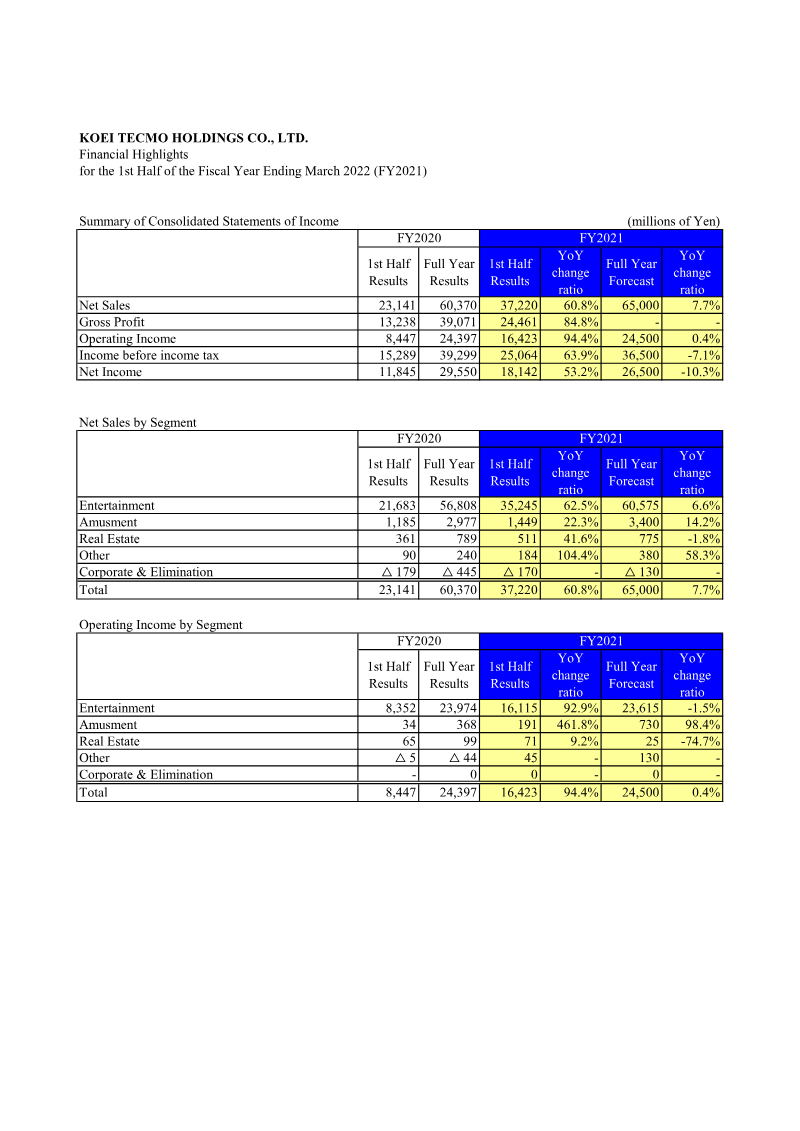
The financial highlights for KOEI TECMO Holdings’ first half of the fiscal year ending March 2022 demonstrate a robust expansion across all core segments. Net sales surged 60.8 % year‑over‑year to ¥23,141 million, driven primarily by the Entertainment segment, which contributed 62.5 % of the increase and generated ¥21,683 million in sales. Amusement revenue grew 22.3 %, while Real Estate and Other segments added 41.6 % and 104.4 % respectively, offsetting a modest decline in Corporate & Elimination activities.
Operating income rose 94.4 % to ¥8,447 million, with Entertainment accounting for 92.9 % of the gain and Amusement showing a remarkable 461.8 % jump, though Real Estate income increased only 9.2 %. Net income climbed 53.2 % to ¥11,845 million, reflecting higher profitability and efficient cost management.
Balance‑sheet analysis reveals a stable asset base of ¥190.8 billion, with current assets increasing to ¥39,179 million largely due to higher marketable securities and contract receivables. Fixed assets remained steady at ¥151,625 million. Liabilities rose modestly to ¥25,825 million, driven by short‑term loan activity. Shareholders’ equity expanded to ¥155,599 million, supported by retained earnings growth and a slight increase in capital surplus.
The data cover Japan‑based operations for the first half of FY2021, with comparative figures from FY2020 and full‑year projections. The report relies on consolidated financial statements prepared under Japanese GAAP, providing a comprehensive view of the company’s performance and liquidity position.
- KOEI TECMO Holdings achieved a 60.8% year-over-year increase in net sales to ¥23,141 million for the first half of the fiscal year ending March 2022.
- Operating income nearly doubled, rising 94.4% to ¥8,447 million, while net income grew 53.2% to ¥11,845 million due to improved profitability and cost management.
- The Entertainment segment served as the primary growth engine, contributing 62.5% of the total sales increase and 92.9% of the gain in operating income.
- Amusement segment performance was a standout, with revenue growing 22.3% and operating income surging 461.8% compared to the previous year.
- Real Estate and Other segments recorded significant growth, with sales increasing by 41.6% and 104.4% respectively.
Koei Tecmo

Report2 pages
Koei Tecmo Holdings Financial Summary: FY2024 3Q
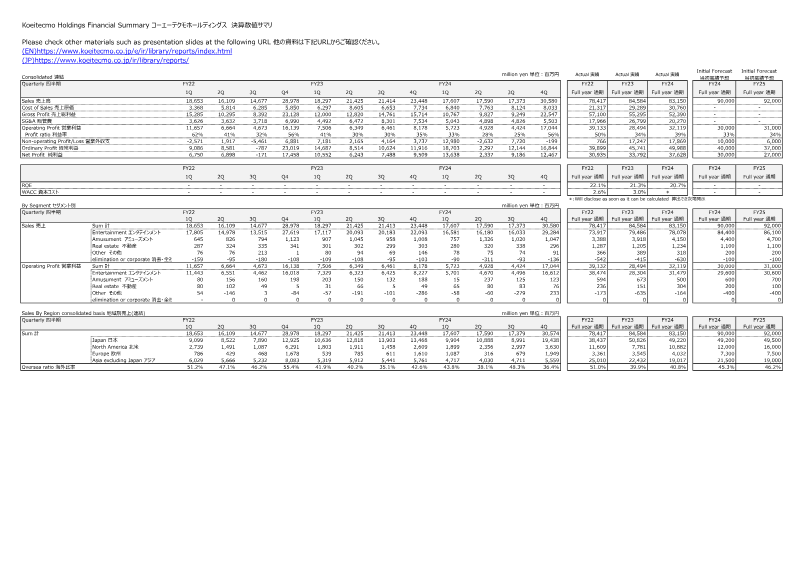
Koei Tecmo Holdings reported FY2024 Q3 results, showing a 17.6 % decline in consolidated sales to ¥14,677 million versus ¥16,109 million in Q2 and a 25.4 % drop from the same period in FY2023. Gross profit fell to ¥8,392 million, reflecting higher cost of sales (¥6,285 million) and a lower gross margin of 32 % compared with 41 % in Q2. Operating profit contracted to ¥4,673 million (profit ratio 32 %) from ¥6,664 million in Q2 and 41 % in FY2023 Q3. Ordinary profit turned negative for the first time in the quarter, at ¥(787) million, largely due to a ¥5,461 million non‑operating loss. Net profit was ¥(171) million, a reversal from the ¥6,898 million gain in Q2.
Segment analysis indicates entertainment sales dominated at ¥13,515 million (92 % of total), with console/PC and digital downloads each contributing roughly ¥5–6 million. Amusement revenue remained modest at ¥794 million, while real‑estate income was negligible. Regional sales were strongest in Japan (¥7,890 million) and Asia excluding Japan (¥5,232 million), with North America and Europe contributing ¥1,087 million and ¥468 million respectively.
Expenses rose in cost of sales (¥6,285 million) and SG&A (¥3,718 million). Employment costs increased to ¥5,200 million, and outsourcing expenses climbed to ¥1,400 million. Digital download units accounted for 75 % of total sales units in Q3, up from 73.9 % in Q2, indicating a continued shift toward digital channels.
Headcount remained steady at 2,400 employees. Capital expenditures for FY2024 were ¥1,967 million, with real‑estate investment at ¥1,631 million and depreciation expense at ¥1,776 million. The data cover the Japanese market and overseas regions for FY2024 Q3, with comparative figures from FY2023.
- Koei Tecmo reported a net loss of ¥171 million for FY2024 Q3, a significant reversal from the ¥6,898 million profit recorded in the previous quarter.
- Consolidated sales fell 25.4% year-over-year to ¥14,677 million, while operating profit contracted to ¥4,673 million from ¥6,664 million in Q2.
- Ordinary profit turned negative at ¥(787) million, primarily driven by a substantial non-operating loss of ¥5,461 million.
- The entertainment segment remains the core revenue driver, accounting for 92% of total sales at ¥13,515 million.
- Digital download penetration continues to rise, reaching 75% of total sales units in Q3 compared to 73.9% in Q2.
+1
Koei Tecmo
Report4 pages
FY2024 Annual Data Appendix
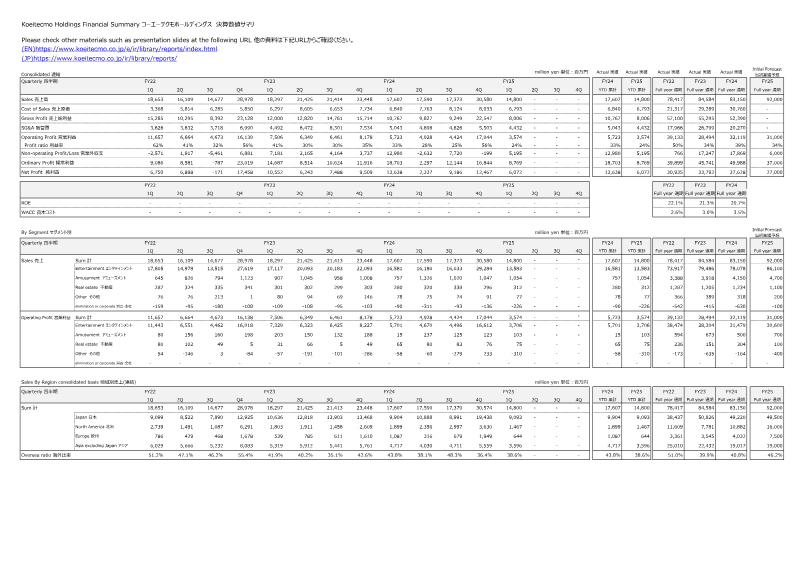
The FY2024 Annual Data Appendix presents a comprehensive financial and operational snapshot of Koei Tecmo’s performance across fiscal years 2022–2025, with detailed quarterly and full‑year figures for sales, cost of sales, gross profit, SG&A, operating profit, ordinary profit, and net profit. Sales peaked in FY22 Q4 at ¥28,978 million before declining to ¥17,590 million in FY23 Q4 and rebounding to ¥23,448 million in FY24 Q4. Gross profit margins fell from 62% in FY22 Q1 to 25% in FY24 Q4, reflecting rising cost of sales and SG&A. Operating profit followed a similar trend, with FY24 Q4 at ¥8,178 million versus ¥16,139 million in FY22 Q4. Net profit swung from ¥17,458 million in FY22 Q4 to a loss of ¥171 million in FY24 Q3, before recovering to ¥9,509 million in FY24 Q4. Return on equity rose from 20.7% in FY22 to 22.1% in FY24, while the weighted average cost of capital increased from 2.6% to 3.0%.
Segment analysis shows the Entertainment division dominates revenue, contributing ¥73,917 million in FY24 and accounting for 94% of total sales. Amusement and real‑estate segments remain small, each under ¥5 billion annually. Geographic revenue distribution highlights Japan as the largest market (¥38,437 million FY24), followed by Asia excluding Japan (¥25,010 million) and North America (¥11,609 million). Overseas sales consistently exceed 40% of total revenue, peaking at 55.4% in FY24 Q4.
Cost breakdowns reveal SG&A expenses rising from ¥3,626 million in FY22 Q1 to ¥8,301 million in FY24 Q3, driven largely by advertising and other variable costs. Employment costs increased modestly from ¥5,110 million to ¥6,500 million over the period. Capital expenditures remained modest, with FY24 cumulative investment at ¥1,967 million.
Headcount grew from 2,413 employees in FY22 Q1 to 2,736 by FY24 Q4, a 9% YoY increase. Digital sales dominate the Entertainment segment, with digital download and DLC revenue accounting for over 60% of total entertainment sales in FY24. New title launches remain steady, with 2,370 units sold in FY24.
The appendix also outlines the FY24 title line‑up, featuring high‑profile releases such as “Romance of the Three Kingdoms 8 Remake” and “Fairy Tail 2,” targeting global markets across console, PC, and mobile platforms. These releases are positioned to support the company’s strategy of expanding digital and overseas sales while maintaining strong domestic performance.
- Koei Tecmo's Entertainment division remains the primary revenue driver, contributing ¥73,917 million in FY24 and accounting for 94% of total company sales.
- Gross profit margins experienced a significant contraction, falling from 62% in FY22 Q1 to 25% in FY24 Q4 due to rising costs of sales and SG&A expenses.
- Overseas markets are increasingly critical to the company's performance, with international revenue reaching 55.4% of total sales in FY24 Q4.
- Digital revenue, including downloads and DLC, now accounts for over 60% of total entertainment sales, underscoring the company's shift toward digital-first distribution.
- Operating profit in FY24 Q4 reached ¥8,178 million, a decline from the ¥16,139 million peak recorded in FY22 Q4.
+1
Koei Tecmo
Report6 pages
FY2025 1st Quarter Data Appendix: Koei Tecmo
Koei Tecmo’s FY2025 first‑quarter financial appendix presents consolidated performance for the fiscal year 2024, with comparative data through FY2023 and projections to FY2025. Sales rose from ¥18.7 billion in Q1 2024 to ¥21.4 billion in Q1 2025, driven by a 20% increase in the Entertainment segment and a 30% rise in the Amusement division. Gross profit improved to ¥15.3 billion, reflecting a higher gross margin of 82% versus 78% in the prior year. Operating profit climbed to ¥11.7 billion, with SG&A costs rising modestly to ¥3.6 billion as marketing spend increased in the online and mobile sectors.
Segment analysis shows Entertainment sales of ¥17.8 billion, Amusement ¥0.6 billion, Real Estate ¥0.3 billion, and Other ¥0.08 billion in Q1 2024, with Entertainment maintaining the largest share at 95%. Regional revenue distribution highlights Japan as the leading market (¥9.1 billion, 49% of total), followed by North America (¥2.7 billion) and Asia excluding Japan (¥6.0 billion). Overseas sales accounted for 51% of total revenue, up from 46% in the previous year.
Capital expenditures totaled ¥789 million for FY2024, with real estate and equipment investments of ¥526 million and ¥263 million respectively. Depreciation expense reached ¥1.6 billion, consistent with prior periods.
The appendix also details major series performance, noting that “Dynasty Warriors” and “Nobunaga’s Ambition” collectively exceed 30 million units sold, while online/mobile titles such as “DEAD OR ALIVE Xtreme Venus Vacation” and “Romance of the Three Kingdoms: Hadou” have sustained multi‑year service periods. Overall, Koei Tecmo demonstrates steady growth across core entertainment offerings, with strategic emphasis on digital and mobile platforms to sustain revenue momentum.
- Koei Tecmo reported Q1 2025 sales of ¥21.4 billion, a significant increase from ¥18.7 billion in Q1 2024, driven by 20% growth in the Entertainment segment and 30% growth in the Amusement division.
- Operating profit reached ¥11.7 billion, supported by an improved gross margin of 82%, up from 78% in the previous year.
- Overseas markets now account for 51% of total revenue, surpassing domestic Japan revenue (49%) for the first time compared to 46% in the prior year.
- The Entertainment segment remains the company's primary revenue driver, contributing 95% of total sales, with core franchises like 'Dynasty Warriors' and 'Nobunaga’s Ambition' maintaining a cumulative lifetime sales volume exceeding 30 million units.
- Strategic investment is shifting toward online and mobile platforms, evidenced by increased SG&A spending on marketing and the sustained performance of long-running titles like 'DEAD OR ALIVE Xtreme Venus Vacation' and 'Romance of the Three Kingdoms: Hadou'.
+1
Koei Tecmo
Report6 pages
Financial Highlights: 2nd Quarter FY2025
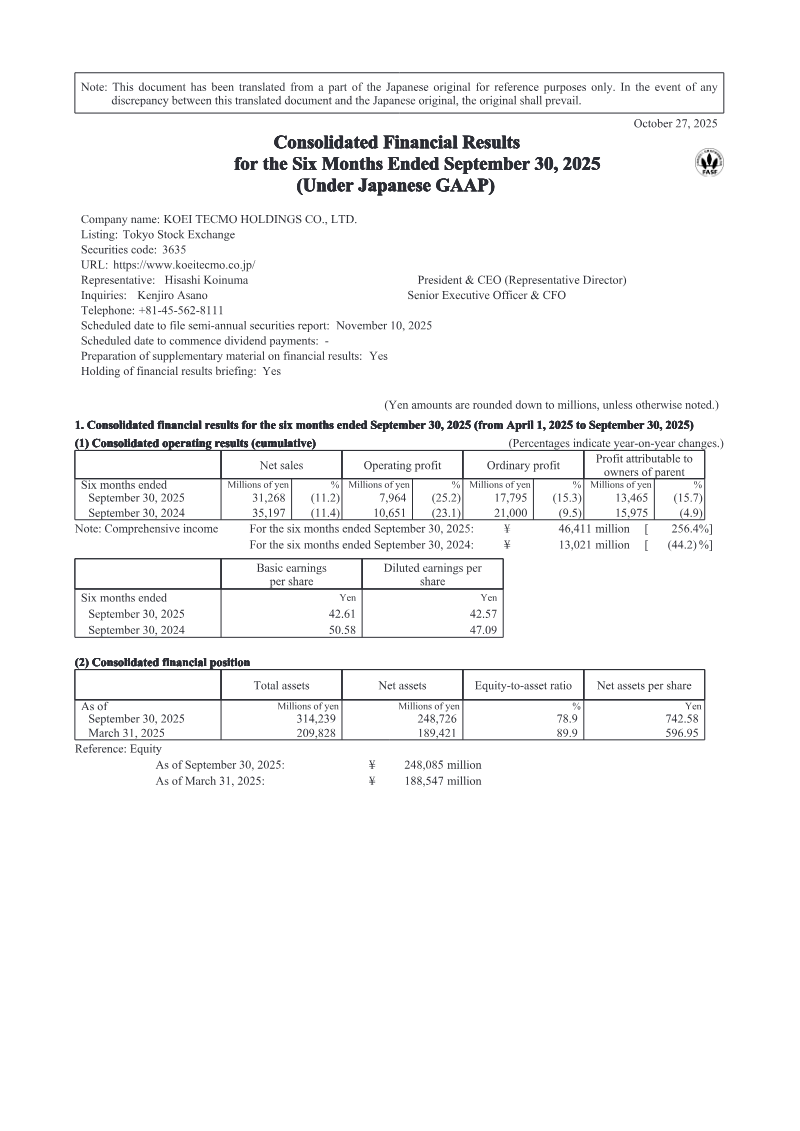
The financial highlights cover the first half of fiscal year 2025 for Koei Tecmo Holdings, a Tokyo‑listed video game and entertainment company. The six‑month period ending September 30 shows net sales of ¥31,268 million, down 11.2% YoY, while operating profit fell 25.2% to ¥7,964 million and ordinary profit declined 15.3% to ¥17,795 million. Comprehensive income surged 256.4%, driven largely by gains on investment securities and derivatives, reaching ¥46,411 million versus a 44.2% loss of ¥13,021 million in the prior year’s half.
Profitability metrics reveal a decline in gross margin from ¥20,593 million to ¥17,238 million and operating margin from 30.6% to 25.4%. Net income attributable to the parent fell 15.7% to ¥13,465 million, with basic earnings per share decreasing from ¥50.58 to ¥42.61. Total assets increased 49% to ¥314,239 million, largely due to a rise in investment securities and cash balances. Net assets grew 31% to ¥248,726 million, with the equity‑to‑asset ratio improving from 89.9% to 78.9%.
The report notes no significant consolidation changes, accounting policy shifts, or restatements. Treasury shares were reduced from 20.25 million to 2.01 million during the period, reflecting a public offering and secondary issuance. Dividend policy remains unchanged, with no cash dividends declared for the first half of FY 2025. The company’s financial position is strengthened by higher liquidity and a solid equity base, but operating performance has weakened relative to the previous year.
- Koei Tecmo Holdings experienced a decline in core operating performance for the first half of FY2025, with net sales falling 11.2% YoY to ¥31,268 million and operating profit dropping 25.2% to ¥7,964 million.
- Comprehensive income surged 256.4% to ¥46,411 million, primarily driven by significant gains from investment securities and derivatives compared to a loss in the same period last year.
- Profitability margins tightened during the six-month period ending September 30, with the operating margin decreasing from 30.6% to 25.4% and net income attributable to the parent falling 15.7% to ¥13,465 million.
- Total assets grew by 49% to ¥314,239 million, supported by increased cash balances and a rise in investment securities, while the equity-to-asset ratio shifted to 78.9%.
- Basic earnings per share declined from ¥50.58 to ¥42.61, reflecting the overall contraction in net income.
+1
Koei Tecmo
Report6 pages
FY2025 Third Quarter Financial Highlights: Japan
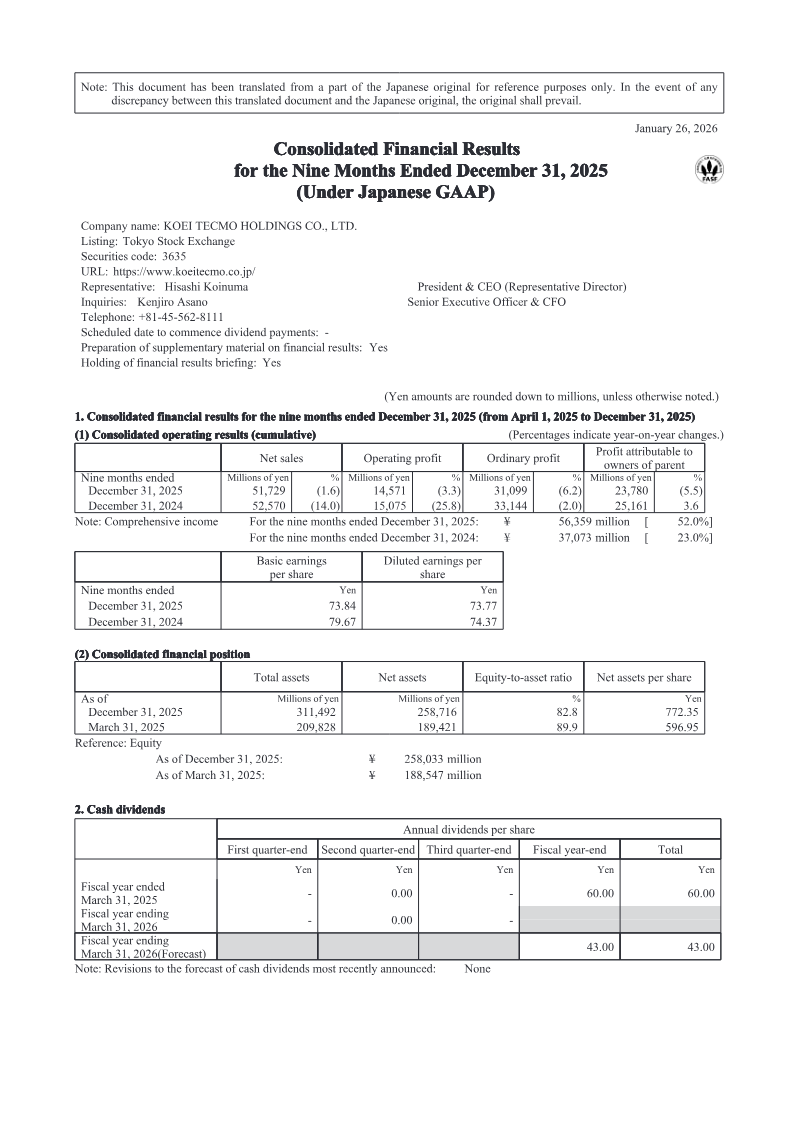
The FY2025 third‑quarter financial highlights for Koei Tecmo Holdings detail a modest decline in core operating metrics while comprehensive income rises sharply. Net sales for the nine months ended December 31, 2025 fell 1.6% to ¥51,729 million from ¥52,570 million in the prior year. Operating profit slipped 3.3% to ¥14,571 million, and ordinary profit decreased 6.2% to ¥31,099 million. Despite these contractions, comprehensive income surged 52.0% year‑on‑year to ¥56,359 million, driven by significant gains in non‑operating items such as interest income and foreign exchange gains. Basic earnings per share declined slightly to ¥73.84 from ¥79.67, reflecting a higher weighted‑average share count due to treasury share disposals and secondary offerings.
Total assets expanded from ¥209,828 million at March 31, 2025 to ¥311,492 million by December 31, 2025, largely through increases in investment securities and property, plant, and equipment. Net assets rose to ¥258,716 million, with the equity‑to‑asset ratio improving to 82.8% from 89.9%. Treasury shares reduced dramatically, lowering the average number of outstanding shares to 322 million from 315 million.
Dividend policy remains unchanged, with a forecast of ¥43.00 per share for the fiscal year ending March 31, 2026, and no revisions to cash dividend forecasts. The report covers Japan‑based operations for FY 2025, presenting consolidated quarterly financial statements without significant changes in consolidation scope or accounting policies.
- Koei Tecmo Holdings reported a 1.6% decline in net sales to ¥51,729 million and a 3.3% drop in operating profit to ¥14,571 million for the nine months ended December 31, 2025.
- Comprehensive income surged 52.0% year-on-year to ¥56,359 million, primarily fueled by non-operating gains from interest income and foreign exchange fluctuations.
- Total assets grew significantly to ¥311,492 million by December 31, 2025, up from ¥209,828 million at the start of the fiscal year, driven by increases in investment securities and property, plant, and equipment.
- Basic earnings per share fell to ¥73.84 from ¥79.67, impacted by an increase in the weighted-average share count following treasury share disposals and secondary offerings.
- The company maintains its dividend forecast at ¥43.00 per share for the fiscal year ending March 31, 2026, with no changes to its current dividend policy.
+2
Koei Tecmo
Report8 pages
Consolidated Financial Data: FY2025 3rd Quarter
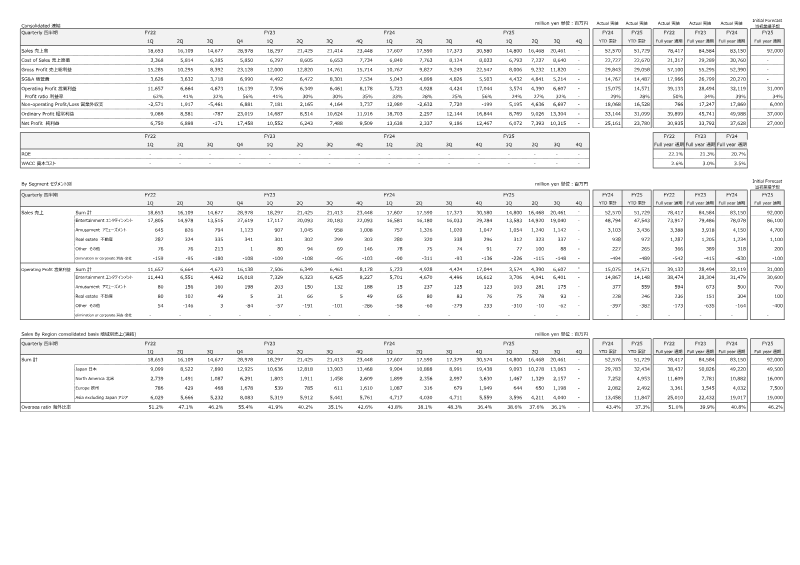
The consolidated financial data for FY2025 third quarter presents a mixed performance across the company’s core segments. Total sales reached ¥30,580 million in Q3 FY25, a 5.4% increase from the same period in FY24 but still below the ¥28,978 million recorded in Q3 FY22. Gross profit improved to ¥22,547 million, up 0.6% YoY, while operating profit fell to ¥17,044 million, a 15.5% decline driven by higher SG&A and cost of sales in the entertainment segment. Net profit for Q3 FY25 stood at ¥12,467 million, a 6.4% YoY increase, supported by a positive non‑operating profit of ¥3,737 million. Profitability ratios show operating margin at 56% and ROE rising to 22.1%, reflecting efficient capital use.
Geographically, Japan remains the largest market with ¥19,438 million in Q3 FY25, followed by North America at ¥3,630 million and Europe at ¥1,949 million. Overseas sales accounted for 51.0% of total revenue in FY25, up from 46.2% in FY24, indicating a strategic shift toward international expansion. The entertainment segment dominated sales at ¥29,284 million (95% of total), with console/PC and online/mobile channels contributing 60.5% and 71.2% of digital sales respectively.
Headcount increased from 2,384 to 2,531 employees by year‑end FY25, a 6.7% rise aligned with new product launches and expanded online services. Capital expenditures for FY25 totaled ¥1,967 million, primarily in real estate and equipment, while depreciation expenses reached ¥1,776 million. The data suggest a focus on sustaining growth through digital monetization and overseas market penetration, while managing cost pressures in traditional entertainment operations.
- Operating profit declined 15.5% YoY to ¥17,044 million in Q3 FY25, primarily due to rising SG&A and cost of sales within the entertainment segment.
- Total sales grew 5.4% YoY to ¥30,580 million, though this figure remains below the ¥28,978 million recorded in Q3 FY22.
- Overseas revenue grew to 51.0% of total sales in FY25, up from 46.2% in FY24, signaling a successful strategic shift toward international market penetration.
- Net profit rose 6.4% YoY to ¥12,467 million, bolstered by a positive non-operating profit of ¥3,737 million.
- The entertainment segment accounts for 95% of total sales, with digital revenue driven by a 60.5% contribution from console/PC channels and 71.2% from online/mobile.
+1
Koei Tecmo
Report2 pages
Summary of Q&A: FY2016 4Q GREE Results Briefing
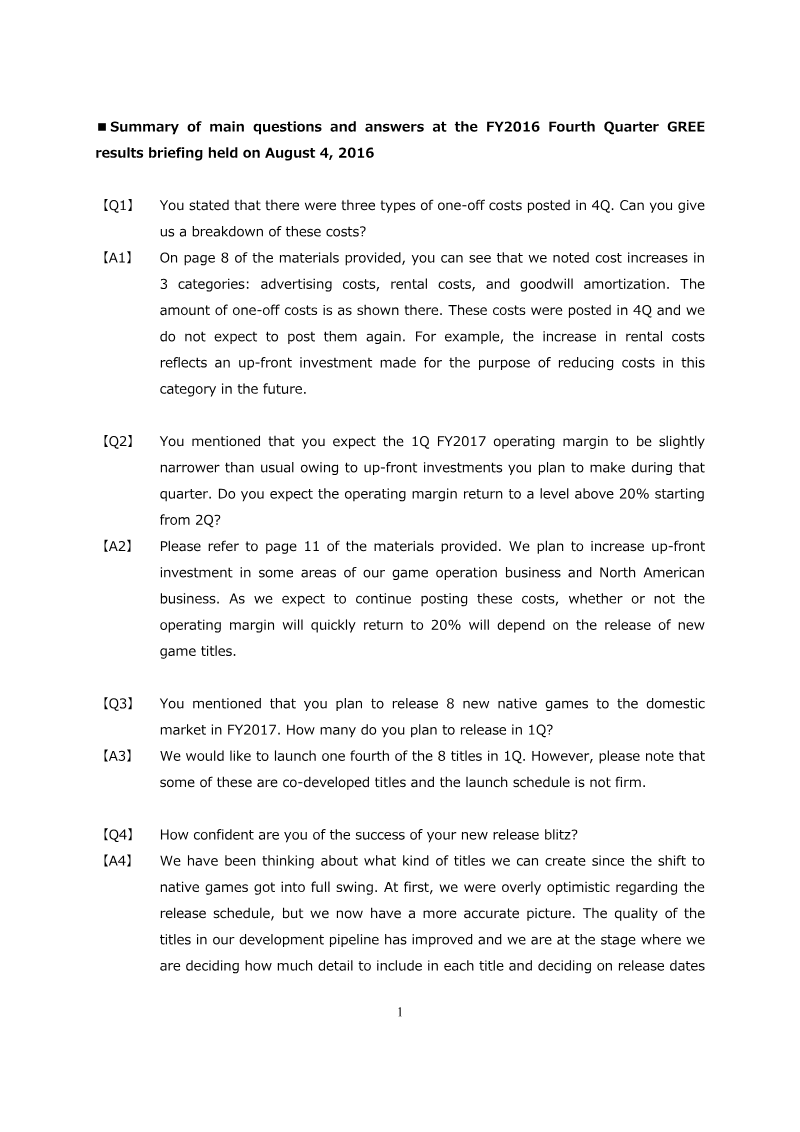
The briefing clarified GREE’s financial and strategic outlook for FY2016–FY2017. One‑off costs in Q4 were broken into advertising, rental and goodwill amortization, with rental increases reflecting upfront investments aimed at future cost reductions. These expenses are not expected to recur. Operating margin for Q1 FY2017 is projected to be slightly below normal due to continued upfront spending, particularly in game operations and North America; a return above 20% is contingent on new title releases. GREE plans to launch eight native games in FY2017, with a quarter‑backed schedule of one‑quarter releases for roughly two titles, though co‑development timelines remain fluid. Confidence in the release blitz has improved as development pipelines mature and release dates are refined based on competitive market conditions.
Strategically, each studio is positioned to leverage core strengths: Wright Flyer focuses on action RPGs and IP integration, while Pokelabo targets GvG titles built on card‑battle expertise. Hit titles are defined by top‑ten App Store rankings in the games category. Financially, GREE aims to use its strengthened capital base to sustain long‑term game development and pursue selective M&A or IP acquisitions, exemplified by the 4Q acquisition of ad‑media firm ADFULLY. The scope covers domestic Japanese markets, with implications for North American expansion, and the time frame spans FY2016 Q4 through FY2017. The briefing relied on internal financial statements and strategic planning documents to outline cost structures, margin expectations, product pipelines, studio focus areas, success metrics, and capital deployment strategies.
- GREE plans to launch eight native games in FY2017, targeting a release cadence of two titles per quarter.
- Operating margins for Q1 FY2017 are expected to remain below 20% due to upfront investments in game operations and North American expansion, with a return to higher margins contingent on new title performance.
- The company defines 'hit titles' as games that achieve top-ten rankings within the App Store games category.
- One-off costs incurred in Q4 FY2016—including advertising, rental, and goodwill amortization—are non-recurring expenses intended to facilitate future cost reductions.
- Studio strategies are specialized: Wright Flyer is focused on action RPGs and IP integration, while Pokelabo is focused on GvG titles leveraging card-battle expertise.
+1
GREE
Report3 pages
Summary of Questions and Answers: FY2017 2Q GREE Results Briefing
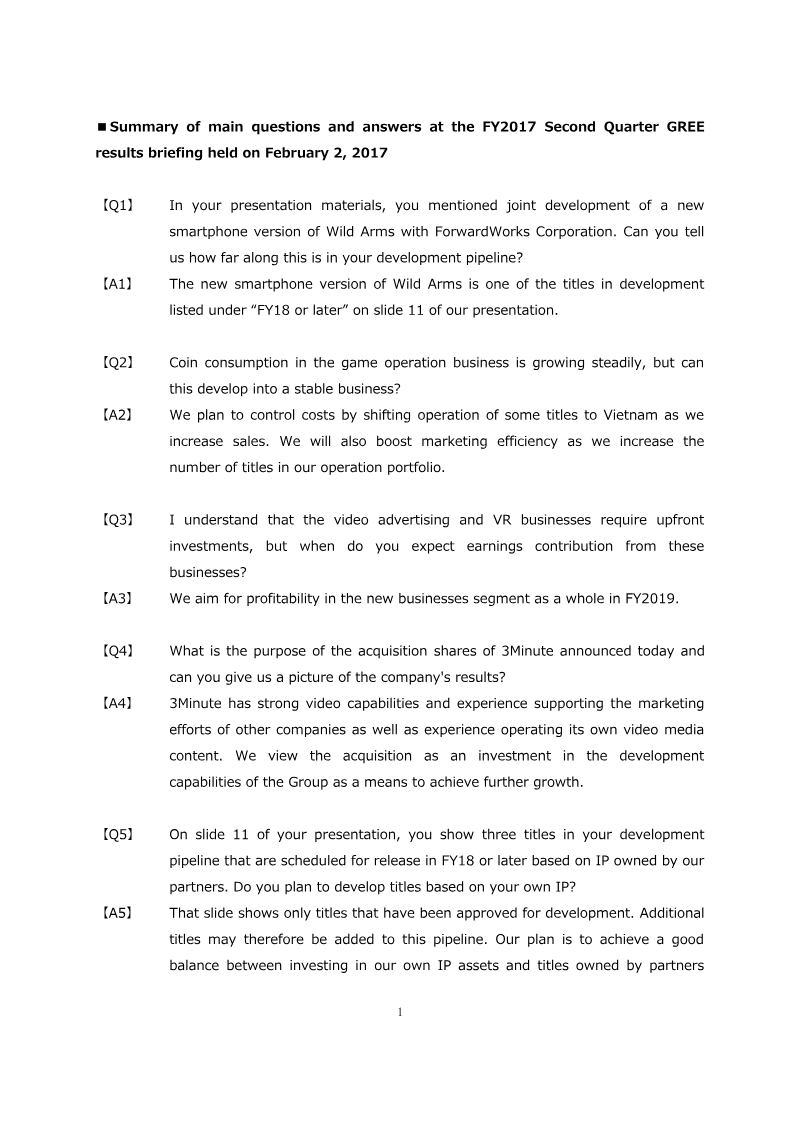
The briefing clarified GREE’s strategic focus for FY2017 and beyond. The company confirmed that a smartphone adaptation of Wild Arms, developed with ForwardWorks Corporation, remains in the FY18‑later pipeline. To stabilize coin‑consumption revenue from its game operation segment, GREE plans to shift operations of select titles to Vietnam and enhance marketing efficiency as its portfolio expands. New ventures in video advertising and virtual reality are expected to reach profitability by FY2019, while the acquisition of 3Minute is positioned as an investment in video‑content capabilities to support broader growth.
Regarding intellectual property, GREE indicated that its development pipeline includes both partner‑owned IP and its own assets, aiming for a balanced mix. The company highlighted Rara‑MAGI’s strong launch performance and noted that coin consumption for other overseas native titles has declined quarter‑over‑quarter, though a new title is slated for late second half release. Seven titles scheduled for the latter half of the year will see roughly half released in Q3 and the remainder in Q4, with Rara‑MAGI already live.
Operating income is projected to dip in Q3 due to increased fixed costs from new releases. GREE will evaluate ongoing titles, closing those unlikely to grow while reallocating resources to high‑potential games. Poor performance is attributed mainly to insufficient content depth or breadth at launch, and lessons learned will inform future development.
- GREE expects Q3 operating income to decline due to increased fixed costs associated with a pipeline of seven new game releases scheduled for the second half of the fiscal year.
- The company is shifting operations for select titles to Vietnam and improving marketing efficiency to stabilize coin-consumption revenue within its game segment.
- New business ventures in virtual reality and video advertising are targeted to reach profitability by FY2019.
- GREE acquired 3Minute to bolster its video-content capabilities as part of a broader growth strategy.
- The smartphone adaptation of Wild Arms, developed in partnership with ForwardWorks Corporation, is confirmed for release in FY2018 or later.
+3
GREE
Report3 pages
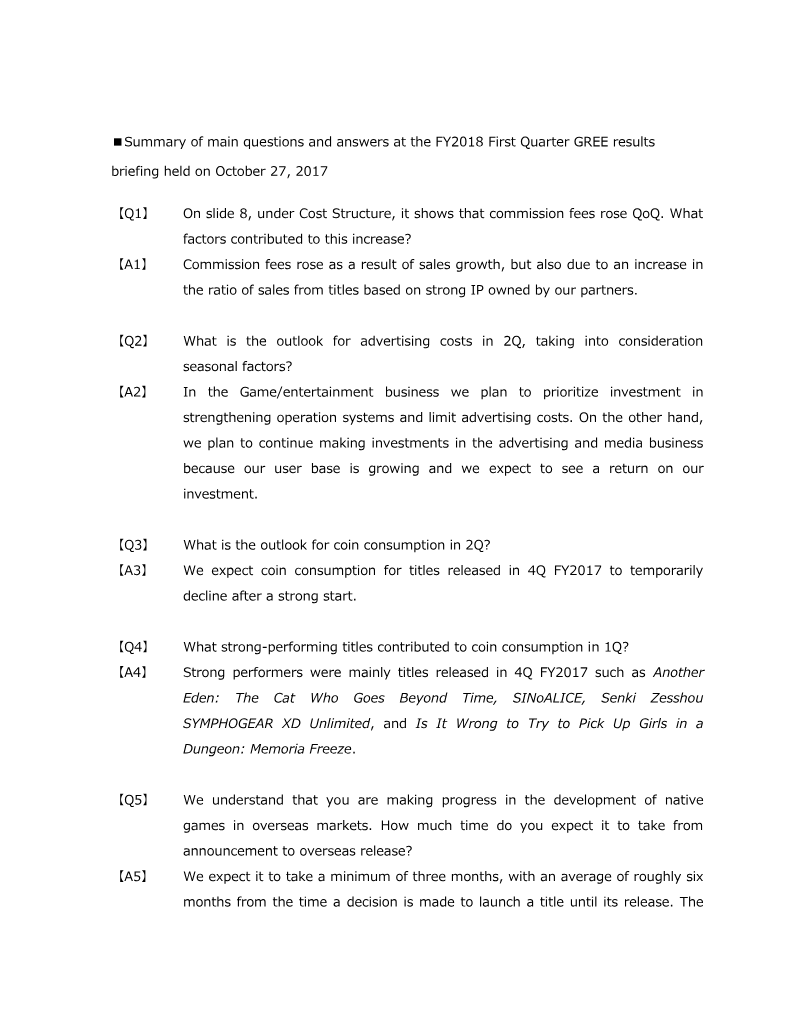
Summary of Main Questions and Answers at the FY2018 First Quarter GREE Results Briefing
The briefing, held on October 27 2017, focused on GREE’s first‑quarter FY2018 performance and future strategy. Commission fees rose quarter‑on‑quarter, driven by overall sales growth and a higher proportion of revenue from partner titles with strong intellectual property. Advertising spend outlook for the second quarter varies by segment: the game and entertainment arm will tighten costs while continuing to invest in advertising for its expanding user base, expecting a return on investment. Coin consumption is projected to dip temporarily after the strong start of Q4 FY2017 releases, yet titles such as Another Eden: The Cat Who Goes Beyond Time, SINoALICE, Senki Zesshou SYMPHOGEAR XD Unlimited, and Is It Wrong to Try to Pick Up Girls in a Dungeon: Memoria Freeze drove robust coin usage in Q1.
GREE’s overseas native‑game development pipeline is expected to take a minimum of three months from announcement to launch, averaging six months. The company emphasizes delivering versions faithful to the original Japanese product and local operation for success in China, noting that Chinese users prefer authenticity and require localized fine‑tuning with strong local partners. In the VR arena, GREE is expanding its development knowledge base and partnering to provide access points for users lacking personal VR hardware, anticipating market growth.
Regarding the domestic native‑game environment, GREE acknowledges rising user expectations and a challenging acquisition landscape. Leveraging its financial strength and industry relationships, the company plans large‑scale development and mixed‑media initiatives to deliver hit titles. Sales of native games are expected to experience a temporary decline before operations are strengthened—through larger support teams, content enhancement, overseas launches, and tailored promotional activities—to drive subsequent growth.
- GREE’s Q1 FY2018 revenue growth was driven by increased commission fees from partner titles that leverage strong intellectual property.
- Key titles driving robust coin consumption in Q1 included 'Another Eden: The Cat Who Goes Beyond Time', 'SINoALICE', 'Senki Zesshou SYMPHOGEAR XD Unlimited', and 'Is It Wrong to Try to Pick Up Girls in a Dungeon: Memoria Freeze'.
- The company expects a temporary decline in native game sales as it transitions to larger support teams, enhanced content, and more aggressive promotional activities to drive future growth.
- GREE’s overseas native-game development pipeline requires a minimum of three months from announcement to launch, with an average lead time of six months.
- Success in the Chinese market is predicated on delivering versions faithful to original Japanese products while utilizing strong local partners for necessary fine-tuning.
+3
GREE
Report5 pages
FY2018 2Q Result Presentation
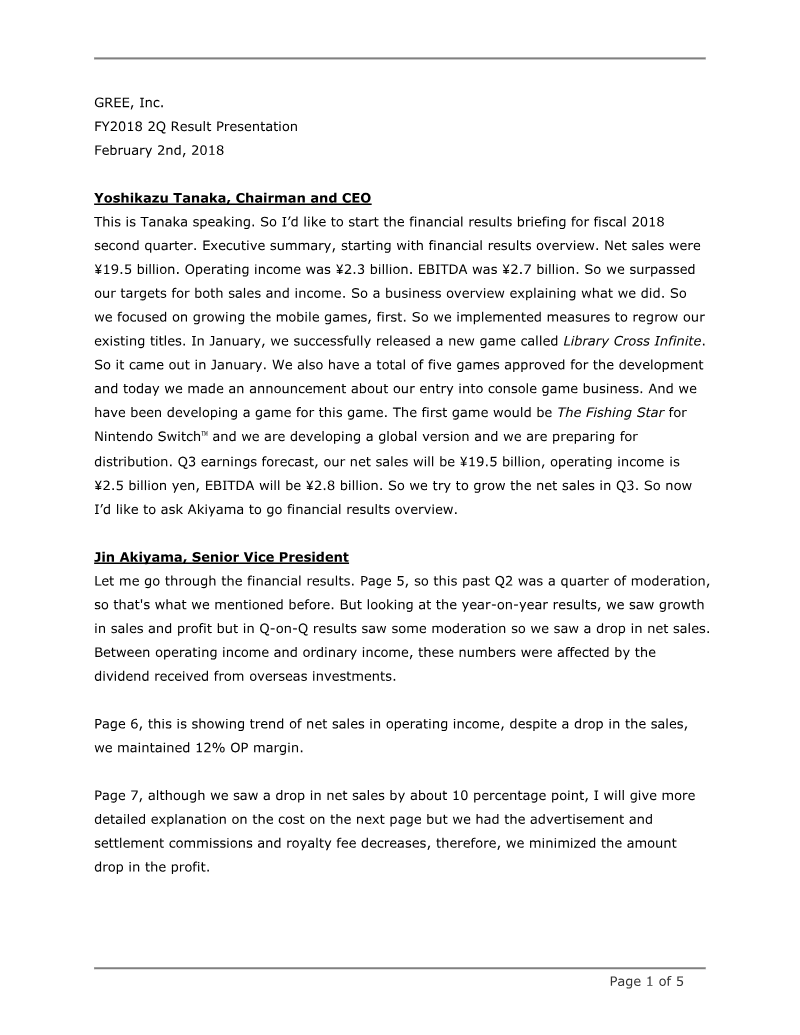
GREE, Inc. reported FY2018 second‑quarter results on February 2, 2018, with net sales of ¥19.5 billion and operating income of ¥2.3 billion, exceeding targets for both metrics. EBITDA reached ¥2.7 billion. Year‑on‑year growth was achieved, though quarter‑over‑quarter sales moderated by roughly 10 percentage points; operating margin remained at 12 %. The company attributed the sales dip to reduced advertising spend and lower commission fees, while cost controls on labor and outsourcing mitigated profit erosion. A strategic shift toward console gaming was announced, with the first title “The Fishing Star” slated for Nintendo Switch and a global release in development. Mobile game performance was bolstered by the launch of “Library Cross Infinite” and ongoing content updates for titles such as Another Eden, Danmachi, SINoALICE, SYMPHOGEAR, and Puchiguru Love Live. Five new mobile titles are approved for development, with three slated for release this fiscal year.
The FY2018 Q3 forecast projects flat net sales at ¥19.5 billion and operating income of ¥2.5 billion, aiming for a year‑to‑date total of ¥60.6 billion. GREE plans to sustain growth through aggressive title reinforcement, overseas expansion, and cost discipline across mobile, console, VR, advertising, and media segments. The presentation covered financial performance, cost structure adjustments following overseas operation closures, and a pipeline of upcoming releases across multiple platforms.
- GREE reported FY2018 Q2 net sales of ¥19.5 billion and operating income of ¥2.3 billion, both exceeding internal targets.
- The company is pivoting toward console gaming, with 'The Fishing Star' confirmed for Nintendo Switch and a global release currently in development.
- While year-on-year growth was positive, quarterly sales moderated by approximately 10 percentage points due to reduced advertising spend and lower commission fees.
- Operating margin held steady at 12%, supported by strict cost controls on labor and outsourcing that offset the impact of lower sales.
- Mobile performance was driven by the launch of 'Library Cross Infinite' and ongoing updates to key titles including 'Another Eden,' 'Danmachi,' 'SINoALICE,' 'SYMPHOGEAR,' and 'Puchiguru Love Live.'
+2
GREE
Report2 pages
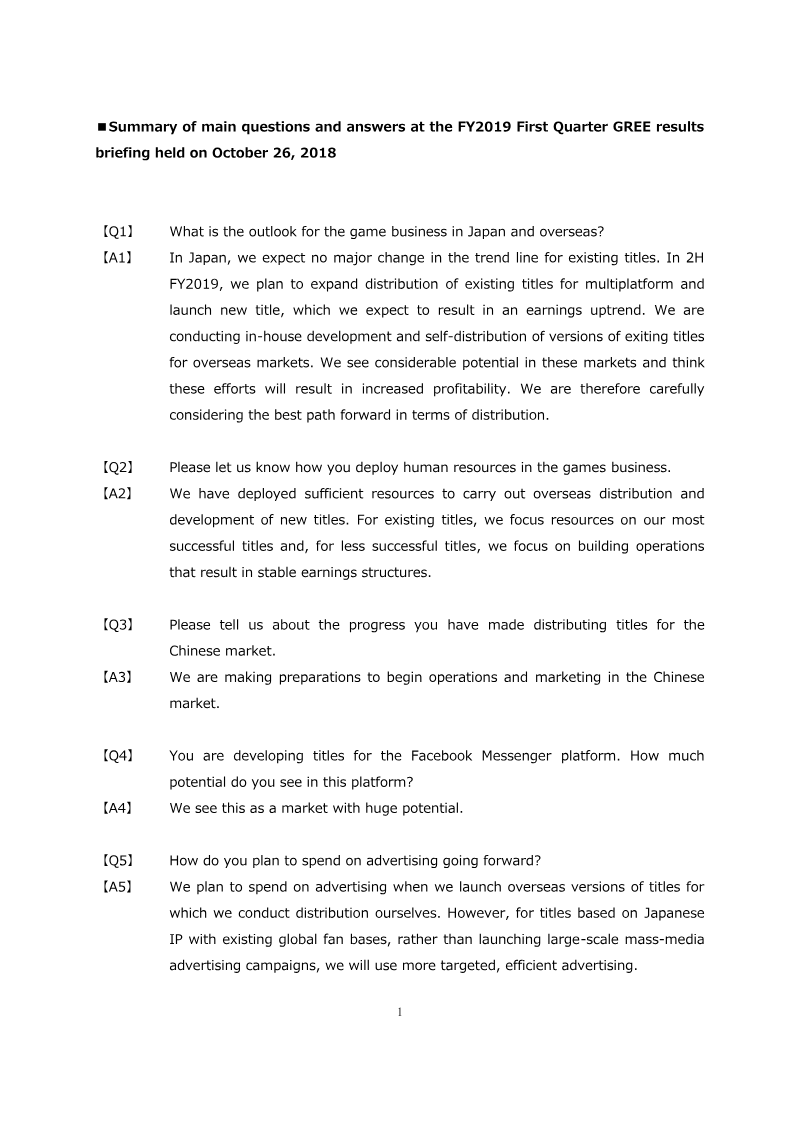
Summary of main questions and answers at the FY2019 First Quarter GREE results briefing held on October 26, 2018
The briefing clarified GREE’s strategic outlook for FY2019, emphasizing a steady domestic game portfolio while pursuing growth overseas. In Japan, the company expects no major shift in performance for existing titles but plans to broaden multiplatform distribution and launch new releases in the second half of FY2019, projecting an earnings uptrend. Internationally, GREE is developing and self‑distributing overseas versions of current titles, targeting markets with high profitability potential. Human resource allocation reflects this focus: sufficient staff are dedicated to overseas distribution and new title development, while existing titles receive concentrated support for top performers and operational stability for less successful ones.
China is identified as a priority market, with preparations underway to initiate operations and marketing. The company also highlights the Facebook Messenger platform as a high‑potential channel for new titles, indicating an expansion into social media gaming. Advertising strategy will be selective; overseas launches of self‑distributed titles will receive targeted, efficient campaigns rather than broad mass media spend.
Regulatory compliance and consumer protection are addressed through company‑wide measures to prevent gacha system issues, including strengthened evaluation protocols and employee training. The REALITY livestreaming platform for VTubers is in an exploratory phase, with ongoing data collection on technology, planning, and marketing to build know‑how for future content expansion. Overall, GREE’s FY2019 strategy balances domestic stability with aggressive international diversification and platform innovation.
- GREE is prioritizing international expansion by self-distributing existing titles in high-profitability markets, with China identified as a key target for upcoming operations and marketing.
- The company plans to drive an earnings uptrend in the second half of FY2019 through new title releases and expanded multiplatform distribution in Japan.
- GREE is diversifying its distribution channels by targeting social media gaming, specifically highlighting Facebook Messenger as a high-potential platform for new releases.
- Advertising strategy for overseas launches will shift away from mass media spend in favor of targeted, efficient campaigns for self-distributed titles.
- Human resource allocation is being restructured to concentrate support on top-performing domestic titles while maintaining operational stability for lower-performing ones.
+5
GREE
Report2 pages
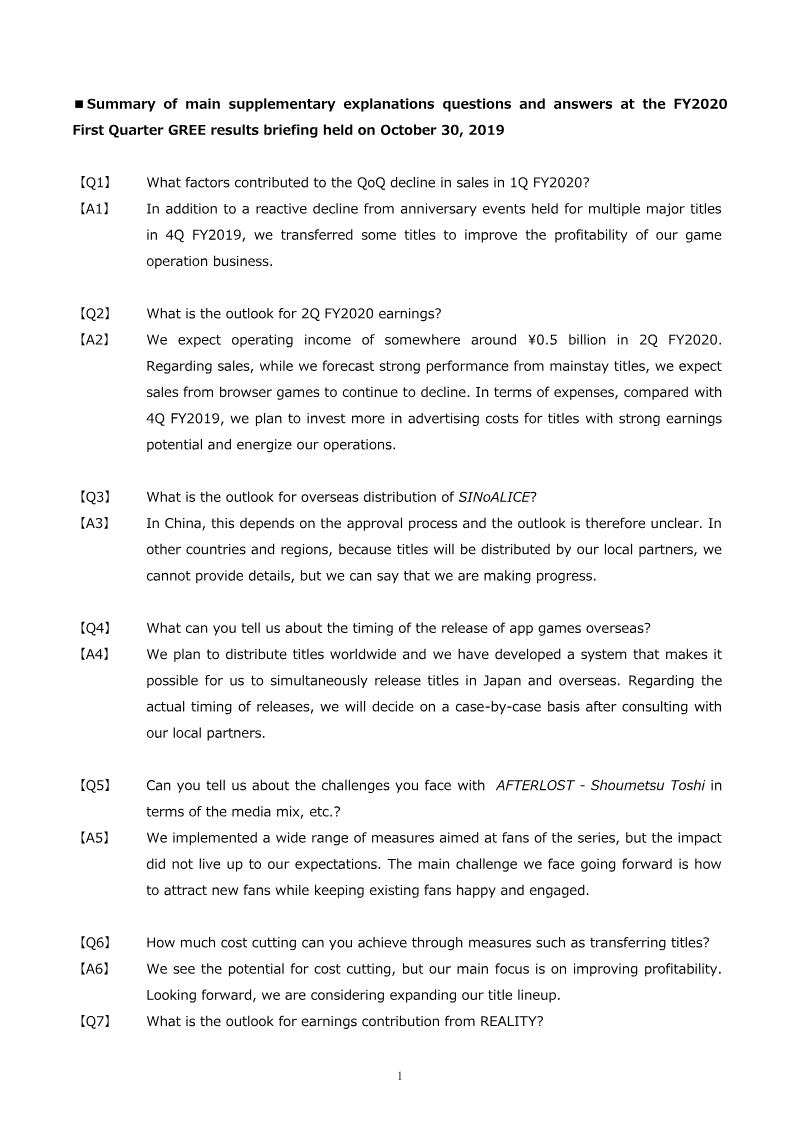
Summary of main supplementary explanations questions and answers at the FY2020 First Quarter GREE results briefing held on October 30, 2019
The briefing addressed key financial and operational questions for GREE’s first quarter of FY2020. A decline in sales was attributed to a reactive drop following anniversary events for major titles in the previous quarter and strategic title transfers aimed at improving profitability. Management projected operating income of roughly ¥0.5 billion for the second quarter, with strong expectations for core titles but a continued decline in browser game revenue; advertising spend was to increase on high‑potential games. Overseas distribution of SINoALICE remains uncertain in China due to regulatory approval, while other regions rely on local partners and progress is ongoing. Global release strategy now allows simultaneous launches in Japan and abroad, with timing set on a case‑by‑case basis after partner consultation. Challenges for AFTERLOST – Shoumetsu Toshi include attracting new fans while retaining existing ones, despite extensive fan‑targeted measures. Cost‑cutting through title transfers is viewed as a means to improve profitability, with plans to broaden the title lineup. Earnings contribution from REALITY depends on internal factors such as lifetime value enhancement and external 5G infrastructure development; the focus is on steady content portfolio expansion and platform functionality rather than rapid growth before full infrastructure deployment.
- GREE projects an operating income of approximately ¥0.5 billion for the second quarter of FY2020.
- First-quarter sales declined due to the conclusion of major title anniversary events and the strategic transfer of titles to improve overall profitability.
- Management expects browser game revenue to continue its decline while increasing advertising spend on high-potential mobile titles.
- The global release strategy has shifted to allow for simultaneous launches in Japan and international markets, contingent on partner consultation.
- The release of SINoALICE in China remains stalled due to pending regulatory approval, while other international markets rely on local distribution partners.
+3
GREE
Report1 pages
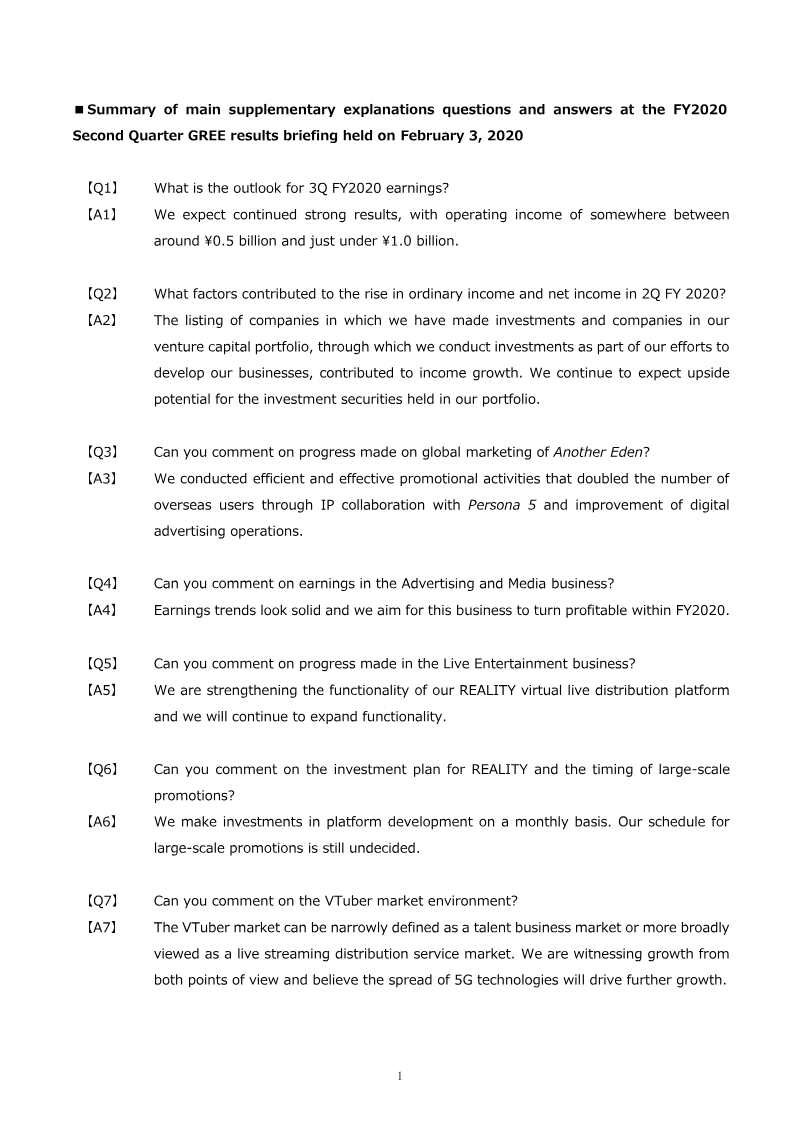
Summary of main supplementary explanations questions and answers at the FY 2020 Second Quarter GREE results briefing held on February 3, 2020
The briefing focused on GREE’s financial outlook, investment performance, and strategic initiatives across its entertainment and advertising segments. Management projected operating income for the third quarter of FY2020 to range between ¥0.5 billion and just under ¥1.0 billion, reflecting confidence in continued strong results. The rise in ordinary and net income during the second quarter was attributed to gains from listed companies and venture‑capital investments, with expectations of further upside in portfolio securities.
Marketing efforts for the game “Another Eden” were highlighted, noting a doubling of overseas users through an IP collaboration with Persona 5 and enhanced digital advertising operations. In the Advertising and Media business, earnings trends were described as solid, with a target of achieving profitability within FY2020. The Live Entertainment division emphasized ongoing enhancements to the REALITY virtual live‑distribution platform, with monthly investments in development and an undecided schedule for large‑scale promotions.
Regarding the broader VTuber market, management characterized it as both a talent‑based business and a live‑streaming distribution service, observing growth from both angles. The anticipated impact of 5G technology was cited as a catalyst for further expansion in the sector. Overall, the briefing underscored GREE’s focus on diversified revenue streams, strategic investment in emerging platforms, and a proactive marketing approach to sustain growth across its core business segments.
- GREE projects Q3 FY2020 operating income to range between ¥0.5 billion and just under ¥1.0 billion.
- Q2 FY2020 net and ordinary income growth was driven by gains from venture capital investments and listed company holdings.
- The game 'Another Eden' doubled its overseas user base following an IP collaboration with Persona 5 and optimized digital advertising.
- The Advertising and Media segment is performing steadily with a firm target to reach profitability within the 2020 fiscal year.
- The Live Entertainment division is prioritizing ongoing development of the REALITY virtual live-distribution platform, with large-scale promotional spending currently on hold.
+1
GREE
Report1 pages
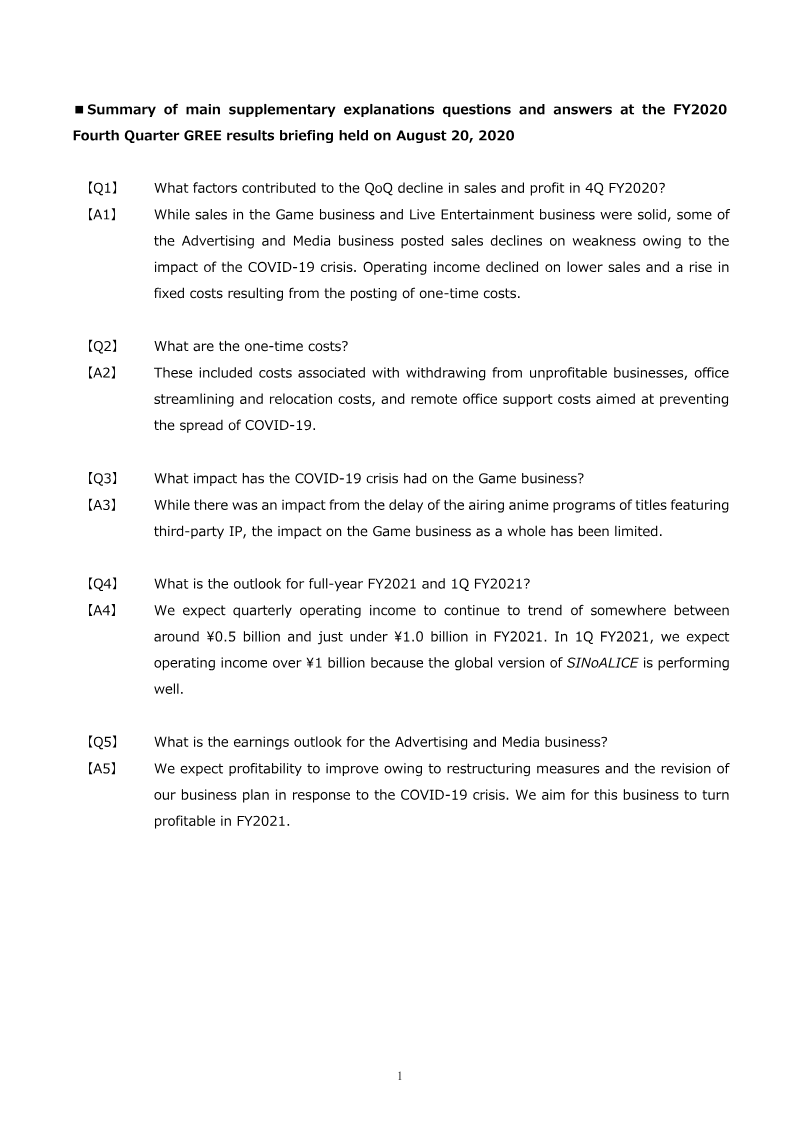
Summary of Main Supplementary Explanations Questions and Answers: FY2020 Fourth Quarter Results Briefing
The briefing clarified the reasons behind the quarter‑over‑quarter decline in sales and operating income for the fourth quarter of fiscal 2020. Core revenue streams from Game and Live Entertainment remained robust, while the Advertising and Media segment suffered sales drops linked to COVID‑19 disruptions. Operating income fell further due to lower sales and increased fixed costs, notably one‑time expenses such as divestitures of unprofitable units, office consolidation and relocation costs, and remote‑office support to curb virus spread. The Game business itself experienced only limited impact despite delays in anime broadcasts featuring third‑party intellectual property.
Looking ahead, the company projects full‑year fiscal 2021 operating income to stay within a range of approximately ¥0.5 billion to just under ¥1.0 billion per quarter, with a stronger first‑quarter outlook of over ¥1 billion driven by the successful global launch of SINoALICE. For the Advertising and Media division, profitability is expected to improve through restructuring initiatives and a revised business plan tailored to the pandemic context, with an aim to achieve profitability within fiscal 2021. The analysis covers Japan‑based operations across gaming, live entertainment, and advertising/media segments during the 2020–2021 fiscal period.
- The company projects fiscal 2021 quarterly operating income to range between ¥0.5 billion and just under ¥1.0 billion, with a Q1 forecast exceeding ¥1 billion.
- The Q1 2021 earnings surge is driven by the successful global launch of the game title SINoALICE.
- Fiscal 2020 Q4 operating income declined due to decreased sales and one-time costs, including unit divestitures, office consolidation, and remote-work support.
- The Advertising and Media segment is undergoing restructuring to reach profitability within fiscal 2021, following pandemic-related sales declines in 2020.
- Core revenue streams from Game and Live Entertainment remained robust throughout fiscal 2020 despite COVID-19 disruptions.
+1
GREE
Report1 pages
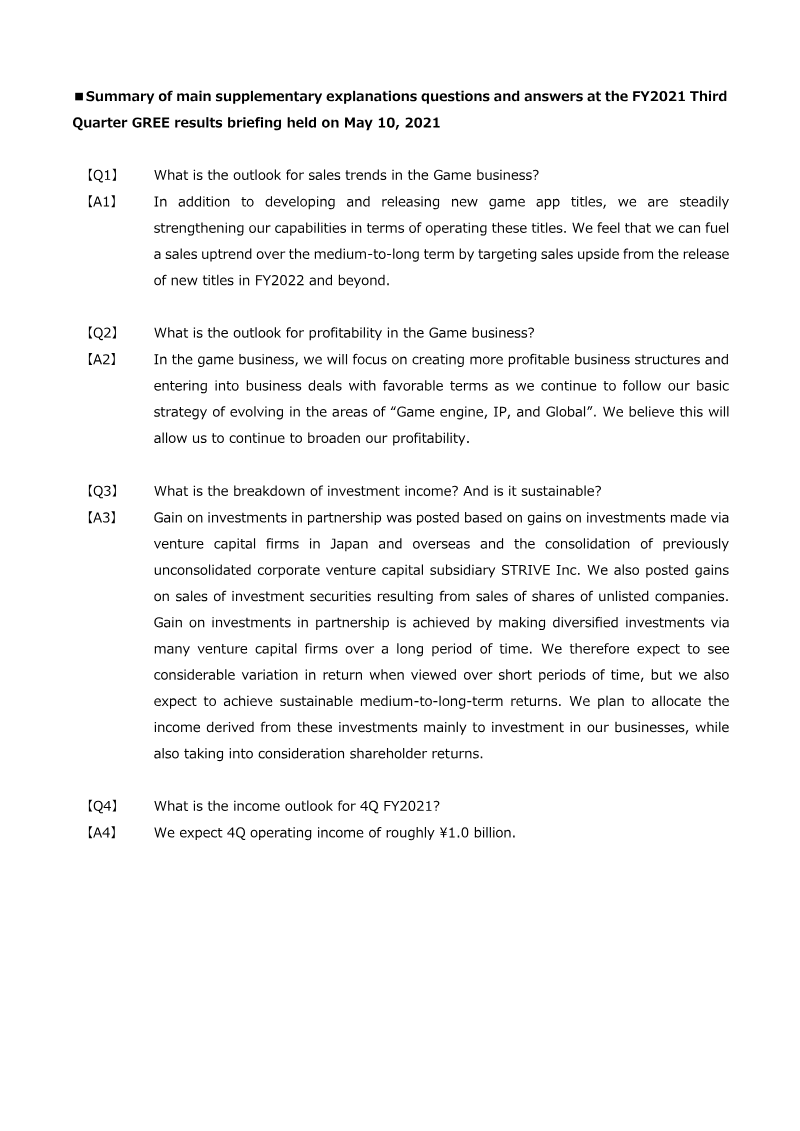
Summary of Main Supplementary Explanations Questions and Answers: FY2021 Third Quarter GREE Results Briefing
The briefing outlines GREE’s strategic outlook for the remainder of FY2021 and beyond, focusing on its core Game business, profitability trajectory, investment income sustainability, and short‑term financial expectations. GREE anticipates a medium‑to‑long‑term sales uptrend driven by the release of new game titles in FY2022 and subsequent years, while simultaneously strengthening operational capabilities for existing titles. Profitability is expected to broaden through the creation of more profitable business structures and favorable contractual terms, aligned with a strategy centered on Game engine development, intellectual property acquisition, and global expansion.
Investment income derives primarily from gains on venture‑capital partnerships in Japan and overseas, as well as the consolidation of previously unconsolidated subsidiary STRIVE Inc. The company notes that short‑term returns may fluctuate due to diversified investment portfolios, but medium‑to‑long‑term sustainability is projected. Planned allocation of these gains targets reinvestment in core businesses and shareholder returns.
Financially, GREE projects operating income for the fourth quarter of FY2021 at approximately ¥1.0 billion, reflecting confidence in its current revenue streams and cost management. The briefing covers Japan’s domestic market with implications for global expansion, covering the period up to FY2021 and projecting into FY2022. Methodological details are limited, but the focus remains on strategic investment, operational efficiency, and incremental revenue growth.
- GREE projects operating income for the fourth quarter of FY2021 to reach approximately ¥1.0 billion.
- The company anticipates a medium-to-long-term sales uptrend driven by a pipeline of new game titles scheduled for release in FY2022 and beyond.
- Strategic growth initiatives focus on game engine development, intellectual property acquisition, and global market expansion.
- Investment income is bolstered by gains from venture-capital partnerships and the consolidation of the subsidiary STRIVE Inc.
- Profitability improvements are being pursued through the restructuring of business models and the negotiation of more favorable contractual terms.
+3
GREE
Report1 pages
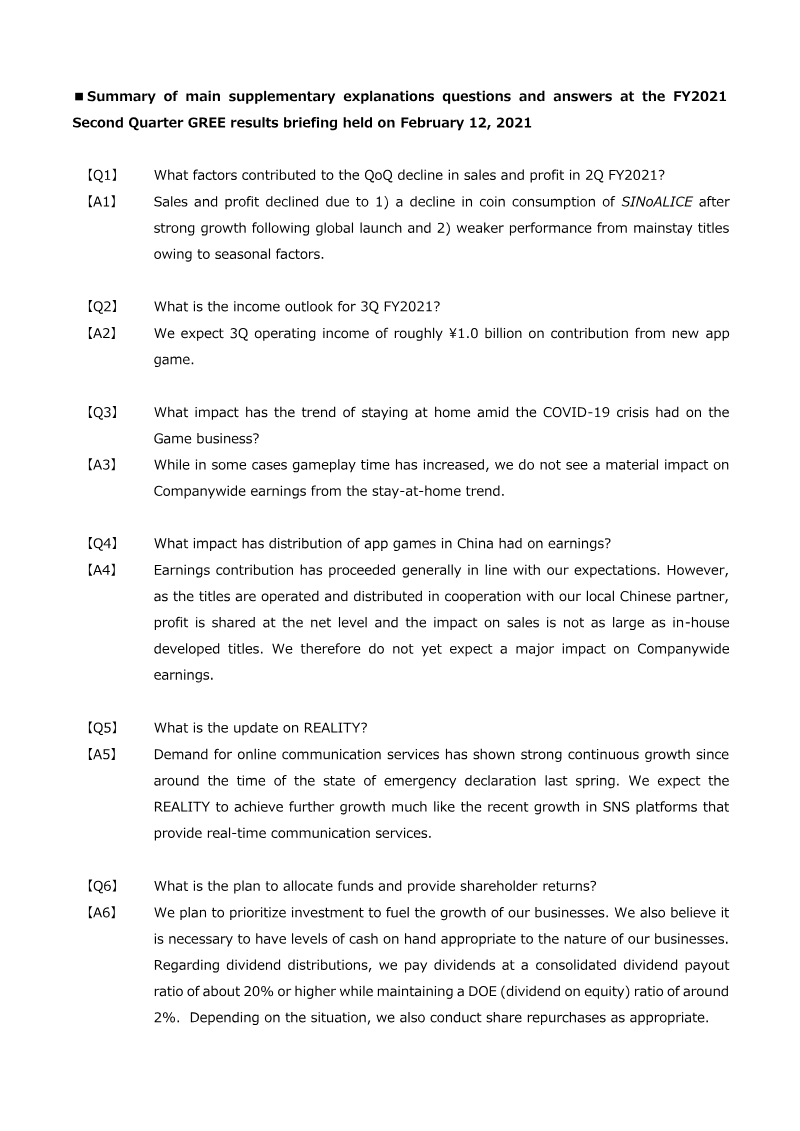
Summary of main supplementary explanations questions and answers at the FY2021 Second Quarter GREE results briefing held on February 12, 2021
The briefing clarified that the quarter‑over‑quarter drop in sales and operating income for FY2021 Q2 stemmed mainly from a slowdown in coin consumption of the mobile title SINoALICE after its strong global launch, coupled with seasonal weakness in other flagship games. Management projected operating income for Q3 FY2021 at approximately ¥1.0 billion, driven largely by a new app‑game launch.
The impact of the COVID‑19 stay‑at‑home trend was deemed limited; while overall playtime rose in some segments, companywide earnings were not materially affected. Distribution of app games in China was described as meeting expectations, though profit sharing with local partners reduces the net contribution relative to in‑house titles, leaving no significant effect on consolidated earnings.
Real‑time communication services under the REALITY brand have experienced sustained growth since the spring state of emergency, and management anticipates continued expansion comparable to that seen in social networking platforms offering real‑time interactions.
Capital allocation plans emphasize reinvestment into business growth and maintaining adequate liquidity. Dividend policy targets a consolidated payout ratio of at least 20 % with a dividend‑on‑equity (DOE) ratio around 2 %. Share repurchases may be undertaken as circumstances allow. The briefing covered domestic and international markets, focusing on mobile gaming and online communication services over the 2021 fiscal year.
- GREE projects Q3 FY2021 operating income at approximately ¥1.0 billion, primarily supported by the launch of a new app game.
- The quarter-over-quarter decline in FY2021 Q2 sales and operating income was driven by a slowdown in SINoALICE coin consumption and seasonal weakness in flagship titles.
- The REALITY brand for real-time communication services has seen sustained growth since the spring 2020 state of emergency, with management expecting continued expansion.
- COVID-19 stay-at-home trends had a limited impact on companywide earnings, despite increased playtime in specific segments.
- App game distribution in China is meeting expectations, though profit-sharing agreements with local partners limit the net contribution to consolidated earnings.
+1
GREE
Report2 pages
Summary of Main Supplementary Explanations Questions and Answers: FY2021 Fourth Quarter
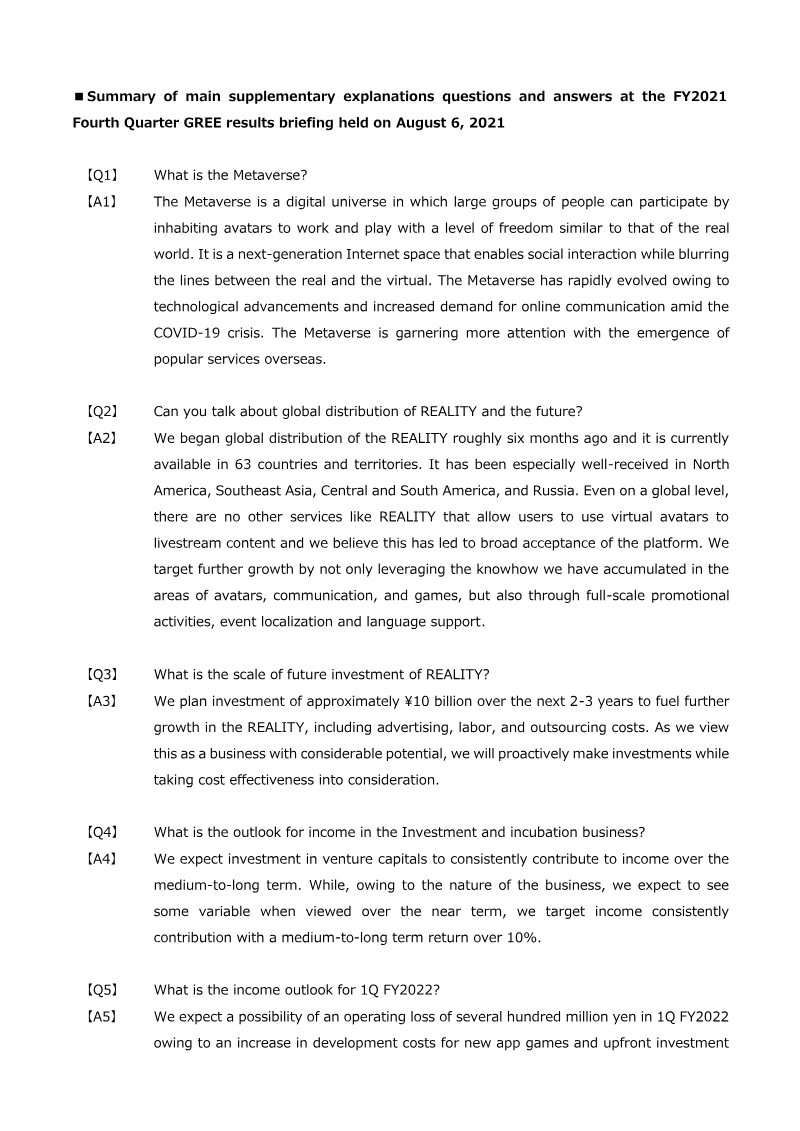
The briefing clarified GREE’s strategic focus on its Metaverse platform, REALITY, and financial outlook for the coming year. The company defined the Metaverse as a digital universe where users inhabit avatars to work and play, emphasizing its rapid growth driven by technology advances and heightened online interaction during the COVID‑19 pandemic. REALITY, launched globally six months prior to the briefing, is now available in 63 countries and territories, with strong reception in North America, Southeast Asia, Central and South America, and Russia. GREE highlighted the platform’s unique ability to livestream content with virtual avatars, a feature not offered by competitors, and outlined plans for further expansion through localized events, multilingual support, and extensive promotional activities.
Investment plans for REALITY are set at approximately ¥10 billion over the next two to three years, covering advertising, labor, and outsourcing costs. The company views this as a high‑potential business and aims to balance growth with cost efficiency. In its investment and incubation segment, GREE anticipates venture capital activities to provide consistent medium‑to‑long‑term income, targeting a return of at least 10 % despite short‑term volatility. For the first quarter of FY2022, GREE foresees a potential operating loss in the hundreds of millions of yen, attributed to increased development costs for new app games and upfront investments. The overall narrative positions REALITY as a central growth engine while acknowledging the financial risks associated with early‑stage expansion.
- GREE is committing approximately ¥10 billion over the next two to three years to scale its Metaverse platform, REALITY, focusing on advertising, labor, and outsourcing costs.
- REALITY has expanded to 63 countries and territories globally, with particularly strong market reception in North America, Southeast Asia, Central and South America, and Russia.
- GREE anticipates an operating loss in the hundreds of millions of yen for the first quarter of FY2022, driven by upfront investments and increased development costs for new app games.
- The company’s investment and incubation segment targets a minimum return of 10% on venture capital activities to ensure consistent medium-to-long-term income.
- REALITY differentiates itself from competitors through a unique livestreaming feature that allows users to broadcast content using virtual avatars.
+1
GREE
Report2 pages
Summary of Main Supplementary Explanations Questions and Answers: GREE FY2022 Second Quarter Results
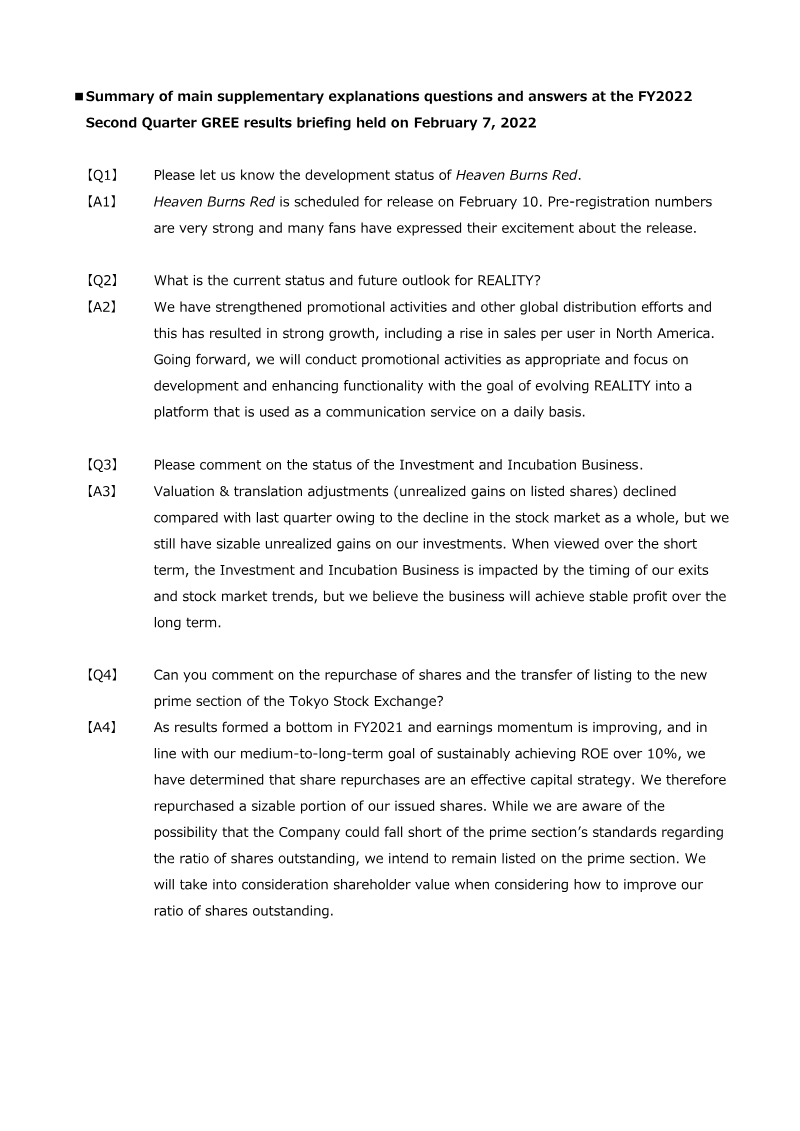
The briefing clarifies GREE’s strategic focus and financial outlook for the second quarter of FY2022. The company announces that “Heaven Burns Red” will launch on February 10, noting strong pre‑registration figures and fan enthusiasm. For the “REALITY” platform, GREE reports accelerated promotional efforts that have boosted North American sales per user; future plans emphasize continued marketing and feature development to position REALITY as a daily communication service. In the Investment and Incubation Business, unrealized gains on listed shares have fallen due to broader market declines, yet the firm maintains sizable gains and expects long‑term profitability despite short‑term exit timing effects.
Capital strategy is highlighted through a substantial share repurchase program aimed at sustaining an ROE above 10 % and maintaining listing status in the Tokyo Stock Exchange’s prime section, even as share‑outstanding ratios approach regulatory thresholds. The “Money held in trust” line item is explained as short‑term, low‑risk investments treated similarly to cash. Finally, the company projects third‑quarter operating income for its Internet and Entertainment segment between ¥1.5 billion and just under ¥2.0 billion, driven by contributions from new titles.
Overall, the presentation outlines GREE’s product rollout plans, market expansion tactics, investment portfolio resilience, capital allocation priorities, and near‑term earnings expectations within the broader context of a recovering market environment.
- GREE is launching the new title 'Heaven Burns Red' on February 10, 2022, supported by strong pre-registration figures.
- The company projects third-quarter operating income for its Internet and Entertainment segment to be between ¥1.5 billion and just under ¥2.0 billion, driven by new title contributions.
- GREE has initiated a substantial share repurchase program to maintain an ROE above 10% and ensure compliance with Tokyo Stock Exchange Prime section listing requirements.
- The 'REALITY' platform is undergoing accelerated promotional efforts in North America, resulting in increased sales per user as the company pivots toward a daily communication service model.
- Unrealized gains on listed shares within the Investment and Incubation Business have declined due to broader market conditions, though the firm maintains significant overall gains.
+3
GREE
Report2 pages
Summary of Main Supplementary Explanations Questions and Answers: FY2022 Third Quarter GREE Results Briefing
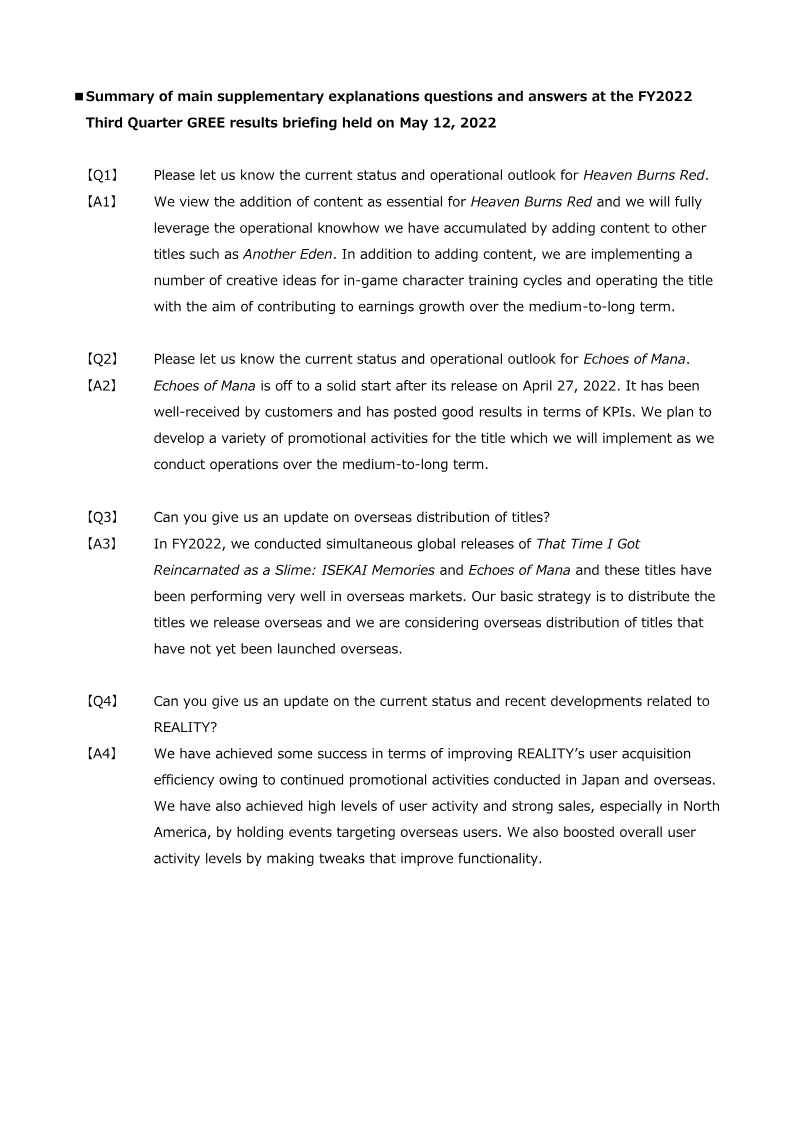
The briefing clarifies GREE’s operational status and financial outlook for FY2022 third quarter, focusing on game releases, overseas distribution, user acquisition, and investment performance. Heaven Burns Red is positioned as a long‑term growth engine; the company plans to add content and implement creative training cycles, leveraging experience from titles like Another Eden. Echoes of Mana, launched April 27, 2022, has already met key performance indicators and will receive ongoing promotional support. Simultaneous global releases of That Time I Got Reincarnated as a Slime: ISEKAI Memories and Echoes of Mana have performed strongly overseas, prompting consideration of further international launches for other titles.
User acquisition and engagement for the mobile title REALITY have improved through sustained promotional activities in Japan and abroad, with notable success in North America via targeted events and functional enhancements. Financially, the company experienced a cumulative loss for the third quarter; this is attributed to a decline in the Investment and Incubation Business relative to FY2021, despite steady growth in Internet and Entertainment operations driven by new hit titles. The Investment segment’s volatility over short periods is noted as a contributing factor.
Looking ahead to the fourth quarter, GREE projects operating income in the Internet and Entertainment Business between ¥2.5 billion and just under ¥3.0 billion, assuming continued strong sales of Heaven Burns Red and stable market trends for new releases. The outlook remains contingent on title performance dynamics.
- GREE projects Q4 operating income for its Internet and Entertainment Business to reach between ¥2.5 billion and just under ¥3.0 billion, driven by the performance of new titles.
- The company reported a cumulative loss for Q3 FY2022, primarily due to volatility and a year-over-year decline in the Investment and Incubation Business.
- Heaven Burns Red is being managed as a long-term growth engine, with the company applying operational experience from Another Eden to implement new content and training cycles.
- Simultaneous global releases of That Time I Got Reincarnated as a Slime: ISEKAI Memories and Echoes of Mana (launched April 27, 2022) have performed strongly, prompting plans for further international title launches.
- The mobile platform REALITY has seen improved user acquisition and engagement, particularly in North America, following targeted events and functional enhancements.
+2
GREE