1 free read left. Create a free account for unlimited reading + AI research.
Create free account
Using Narrative as Context - Balancing Gameplay and Story Elements - Extra Credits
Key insights
6 takeaways- 01Even minimalist narrative tropes, such as the rescue-the-princess motif in Super Mario, are sufficient to elevate simple gameplay loops into memorable experiences.
- 02Thematic storytelling acts as a necessary bridge to maintain player retention in repetitive genres, such as sports simulations or tile-matching games, by providing emotional stakes.
- 03Narrative serves as the initial hook for player engagement, grounding the experience by answering the fundamental question of why the player is performing specific actions.
- 04Narrative functions as a critical tool to provide context and meaning, transforming abstract mechanical obstacles into a cohesive player journey.
- 05Integrating narrative elements helps mask technical limitations by framing engine constraints as intentional, immersive world-building choices.
- 06Developers should avoid viewing narrative and mechanics as a binary choice, as narrative is essential for fostering the human connection to characters and settings that pure systems cannot replicate.
Ask AI about this video
Transcript
around the release of Paper Mario sticker star it was revealed that shuro mamoto had advised the developers to focus Less on story now we've talked a great deal on this show about how to craft compelling narratives for games but mamoto also had a point maybe putting tons of effort into story isn't always really necessary or incredibly beneficial because sometimes a light sprinkling of narrative is all a game really needs [Music] the story about Paper Mario sticker star caused a minor controversy and some debates about what place narrative has in games after all up to this point the Paper Mario series had been known mostly for its story at least among the Mario games and sticker star with its emphasis on mechanics rather than story certainly wasn't let's call it the Pinnacle of the series so it may not have quite been the correct game to apply this thinking to but are there places where this maximum makes sense not every single game really requires or has room for a sweep
narrative in fact the original Doom cut out almost its entire story because the game played better without it however it's also important to realize that the deemphasizing of the story of A game doesn't mean removing the narrative entirely parts of the Doom story Bible still influence the design of that game many games benefit from having the narrative not as the core reason to play but to give context for the Player's actions or to set the tone most people's first Spark of interest in a game doesn't often come from the mechanic but rather they're intrigued by The Game's aesthetic or setting and this context this explanation for what the player is doing and why can give meaning to the player's actions take a look at the mainline Super Mario games those games have about as simple a story as one can get the majority of them being rescue the princess but okay let's take Peach out let's take Bowser out let's take the whole Mushroom Kingdom aesthetic out and leave only a progression of monochrome disconnected obstacles built from geometric solids yeah that sounds super
fun The Narrative as thin as it may be turns those mechanics into a meaningful Journey it gives players a goal that's satisfying to complete but more importantly a reason why the players want to complete that goal just a little bit of story puts a nice bow on the whole package you didn't just press the correct inputs to complete all the goals you jumped through the Mushroom Kingdom and rescued the princess from the big bad Turtle Ox Dragon thing and this appeal for stories and Fant es can be especially powerful for games that rely on retaining long-term players majang crimes murder on the Orient Express is your basic maang tile matching game but they added a Suson of buo to keep the players coming back and it worked or think of all the Everquest and Skyrim stories we all tell each other about daring raids or hilarious dungeon hijinks those are the moments that stick with players and make their play experience memorable we don't usually regil our friends with epic stories about stat in increases and completion
percentages be impressed even Major League Sports have a small inherent narrative created around them most people who watch sports root for their favorite team or player and that's because if they win enough times they'll make it to the elite conference where if they beat all the teams there they'll play for the championship and do you want to know why that sounds like the exact story of Pokemon because drum roll please it is it's a story about hope and determination hard work and training all striving for a simple goal and if that goal is achieved then there's Jubilation celebration and the joy of a hard-earned victory and if it's missed there'll be heartbreak Pathos and hope for another year it's simple but it's compelling and it's why so many things borrow this easy to understand narrative to give meaning to an otherwise meaningless activity like moving a ball down a field and even if you're convinced that your game doesn't need a story don't be so quick to jettison all semblance of narrative
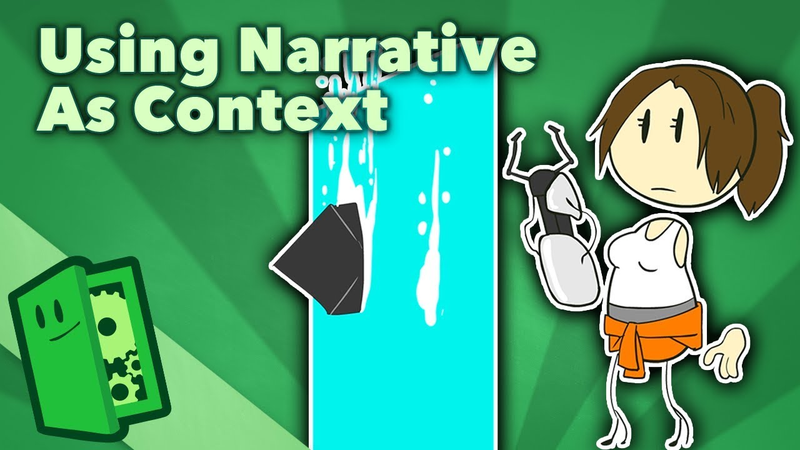
for the sake of pure gameplay because while narrative can sometimes develop out of the mechanics other times it works better the other way around even just picking a specific theme can help inspire all sorts of Mechanics for example a game set in Las Vegas will scream out for something involving gambling or heck go back and watch our mechanics of character design episode to see how even a match 3 game can use narrative to inspire a variety of gameplay mechanics narrative context is also a handy way to to cover up arbitrary technical limitations for instance what if your play testers keep asking why they can't bring objects into the elevators at the end of each level but give it a Sci-Fi theme and Bam you can add a vaporizing force field before each elevator like portal did and that little bit of narrative context makes the fact you can't bring objects to the next level feel like that's just how this world works and not a restriction that has to be done so the game's engine won't break certain game types lend themselves more to engrossing narratives than others do but even those games we
don't traditionally go to for story can still be enhanced by having some of it because all things said humans identify with characters and settings usually more than they do with abstract mechanics we connect with our fictional friends whether they're words on a page or squares moving across a screen so giving games that little bit of meaningful context even when integrated subtly is an effective tool to keep players interested not to mention it can help answer the question why do I want to play this game a [Music] [Applause] [Music]
Summary
Effective game design does not require a choice between deep narrative and mechanical focus; rather, narrative serves as a vital tool for providing context, setting tone, and fostering player engagement. While some titles prioritize mechanics over complex storytelling, removing narrative entirely risks stripping a game of its meaning. Even minimalist stories, such as the rescue-the-princess trope in the Super Mario series, transform abstract geometric obstacles into a cohesive, satisfying journey. By providing a reason for the player’s actions, developers can elevate simple gameplay loops into memorable experiences.
Narrative context acts as a bridge between the player and the game’s mechanics, often serving as the initial hook that draws users into a setting. This is particularly effective in genres that rely on repetitive tasks, such as tile-matching games or sports simulations, where a thin layer of thematic storytelling provides the emotional stakes necessary for long-term retention. By framing gameplay through the lens of competition, growth, or character-driven goals, developers create a sense of purpose that pure mechanics alone cannot replicate.
Beyond emotional engagement, narrative serves a practical function in masking technical limitations and guiding player expectations. By integrating constraints into the game’s world-building—such as using sci-fi force fields to explain why objects cannot be carried between levels—developers can turn arbitrary engine restrictions into immersive design choices. Ultimately, because human beings naturally connect with characters and settings more readily than abstract systems, even subtle narrative elements are essential for grounding the player experience and answering the fundamental question of why a game is worth playing.


















Comments