Updated Apr 30, 2026 by Devolver Digital
Financial
Published by Devolver Digital
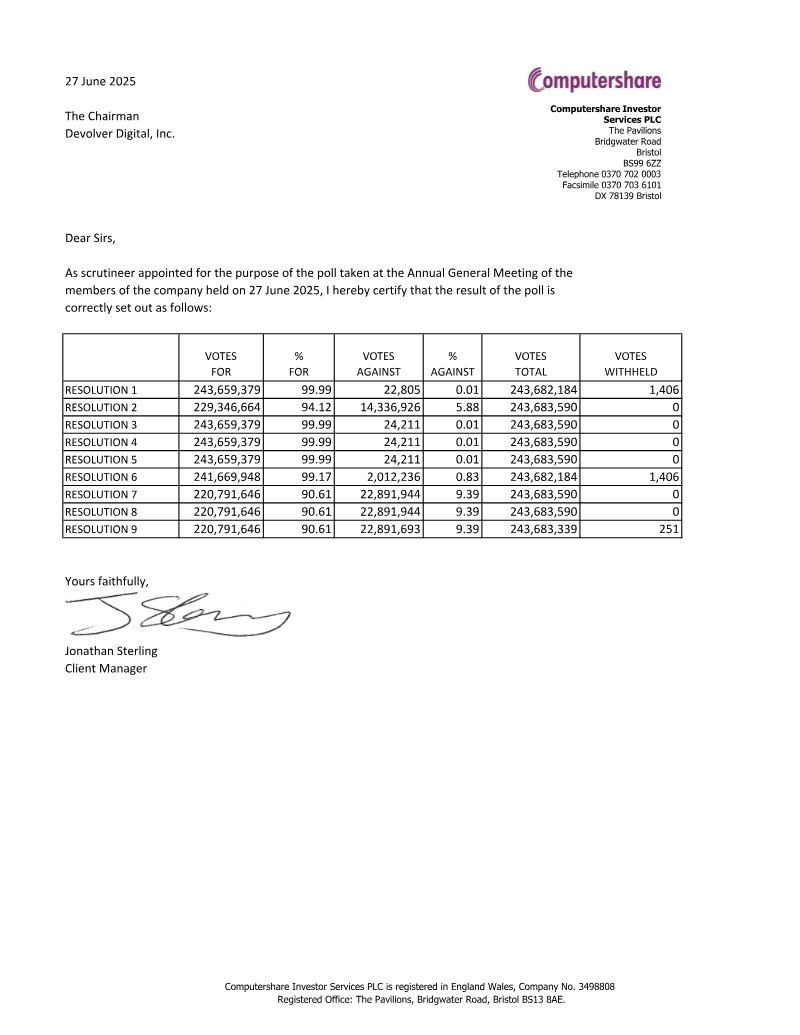
The 2025 Annual General Meeting for Devolver Digital, Inc. served as a formal venue for shareholder voting on nine distinct corporate resolutions. Held on June 27, 2025, the meeting facilitated a comprehensive poll of member sentiment regarding the company’s governance and strategic direction. Computershare Investor Services PLC acted as the independent scrutineer, ensuring the accuracy and integrity of the voting process for all participating shareholders. The voting results indicate overwhelming support for the majority of the proposed measures. Resolutions 1, 3, 4, and 5 achieved near-unanimous approval, with 99.99 percent of votes cast in favor. Resolution 6 also saw strong backing, with 99.17 percent of shareholders voting in favor. While all nine resolutions passed, a notable segment of the shareholder base expressed dissent regarding specific items. Resolutions 2, 7, 8, and 9 encountered higher levels of opposition, with approximately 5.88 percent and 9.39 percent of votes cast against these respective measures. Total participation remained consistent across the agenda, with approximately 243.68 million votes cast per resolution. The data reflects a high level of engagement from the investor base, with withheld votes remaining negligible, totaling no more than 1,406 for any single resolution. These results confirm that the company maintains strong shareholder alignment on its primary governance objectives, despite the presence of minority opposition on specific, more contentious proposals. The findings provide a clear mandate for the board of directors to proceed with the approved corporate actions as of the June 2025 meeting date.
> **[Chart page]** This page contains visual data — view in PDF for the best experience. 27 June 2025 Computershare Investor Services PLC The Chairman Computershare Investor Services PLC Devolver Digital, Inc. The Pavilions Bridgwater Road Bristol BS99 6ZZ Telephone 0370 702 0003 Facsimile 0370 703 6101 DX 78139 Bristol Dear Sirs, As scrutineer appointed for the purpose of the poll taken at the Annual General Meeting of the members of the company held on 27 June 2025, I hereby certify that the result of the poll is correctly set out as follows: VOTES % VOTES % VOTES VOTES FOR FOR AGAINST AGAINST TOTAL WITHHELD RESOLUTION 1 243,659,379 99.99 22,805 0.01 243,682,184 1,406 RESOLUTION 2 229,346,664 94.12 14,336,926 5.88 243,683,590 0 RESOLUTION 3 243,659,379 99.99 24,211 0.01 243,683,590 0 RESOLUTION 4 243,659,379 99.99 24,211 0.01 243,683,590 0 RESOLUTION 5 243,659,379 99.99 24,211 0.01 243,683,590 0 RESOLUTION 6 241,669,948 99.17 2,012,236 0.83 243,682,184 1,406 RESOLUTION 7 220,791,646 90.61 22,891,944 9.39 243,683,590 0 RESOLUTION 8 220,791,646 90.61 22,891,944 9.39 243,683,590 0 RESOLUTION 9 220,791,646 90.61 22,891,693 9.39 243,683,339 251 Yours faithfully, ns Tartrnamys Jonathan Sterling Client Manager Computershare Investor Services PLC is registered in England Wales, Company No. 3498808
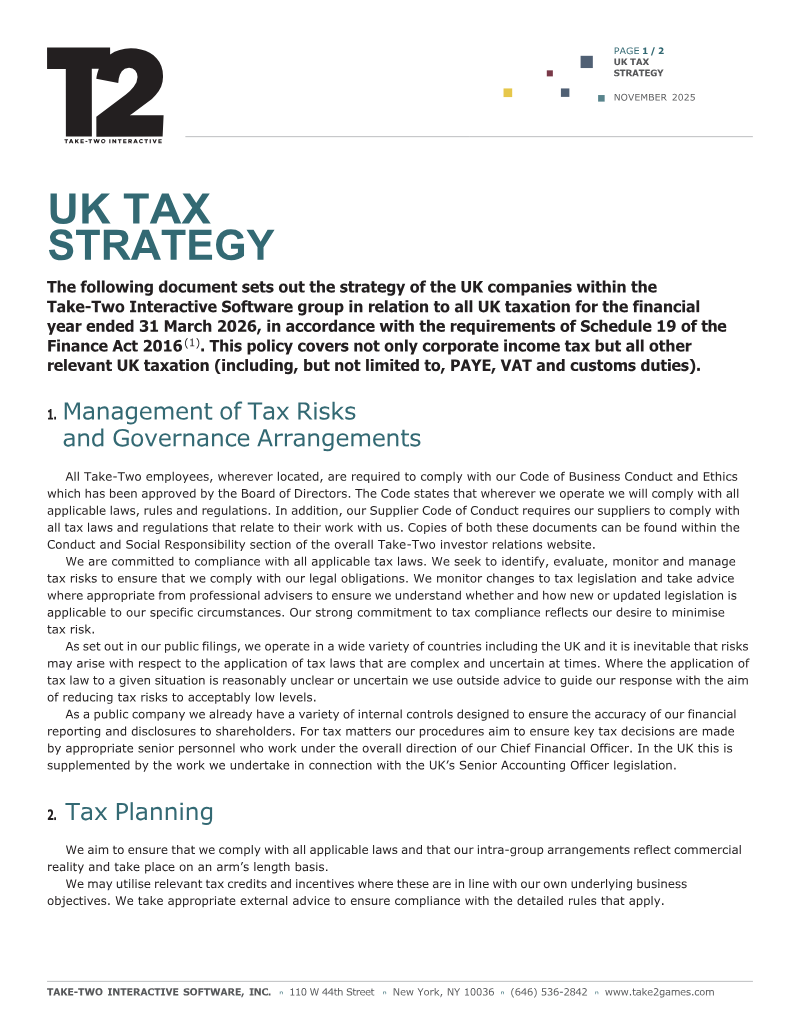
Take-Two Interactive Software maintains a comprehensive tax strategy for its UK subsidiaries for the fiscal year ending March 31, 2026, emphasizing full compliance with the Finance Act 2016. This policy encompasses all forms of UK taxation, including corporate income tax, PAYE, VAT, and customs duties. The core objective is to align tax practices with the company’s global Code of Business Conduct and Ethics, ensuring that all operations adhere to applicable laws, rules, and regulations while requiring similar compliance from third-party suppliers. The governance framework centralizes tax risk management under the direction of the Chief Financial Officer and senior personnel, supplemented by internal controls designed for financial reporting accuracy. To mitigate risks associated with complex or uncertain tax laws, the organization utilizes professional external advisors to maintain risk at acceptably low levels. This proactive monitoring extends to legislative changes, ensuring that the business remains compliant as regulatory environments evolve. Tax planning is strictly driven by commercial reality, with intra-group arrangements conducted on an arm’s length basis. While the company utilizes available tax credits and incentives, it does so only when they align with underlying business objectives and meet detailed regulatory requirements. Relationship management with HMRC is characterized by transparency and cooperation, involving proactive meetings to discuss business developments and resolve potential interpretative uncertainties through open dialogue. This strategy applies to a broad range of UK entities, including major development studios such as Rockstar, Hangar 13, Gram Games, and NaturalMotion.
The analysis quantifies how video‑game technology generates measurable economic benefits beyond the entertainment sector, arguing that spill‑over effects constitute a significant engine of growth for advanced‑technology economies. By applying the IMPLAN input‑output model to 2021 data, the study estimates that spill‑overs contributed roughly £1.3 billion of total output and £760 million of GDP to the United Kingdom, delivering £380 million of labour income and £250 million of government revenue while sustaining about 9,900 non‑gaming jobs. These positions are concentrated in information‑technology, business services and energy extraction, with average salaries 25 % above the national mean. In the Nordic region, comparable effects amounted to £190 million of output and £40 million of GDP, underscoring the broader relevance across Western Europe. The research situates these figures within the wider UK games ecosystem, which comprises approximately 2,600 firms and 71,400 jobs across direct, indirect and induced employment. Spill‑over activity accounts for roughly 13 % of the industry’s gross value added and 19 % of its employment, highlighting the sector’s pivotal role in supporting ancillary markets. Sectoral case studies illustrate how real‑time engines (Unreal, Unity), VR/AR headsets and haptic devices are reshaping healthcare, oil and gas, architecture, horticulture, furniture design and automotive safety, delivering faster, lower‑cost visualisation, enhanced training and new revenue streams. The findings extend to the United States, where about one‑fifth of software‑job growth in 2016 and $0.5 billion of software output are linked to game‑technology diffusion. Collectively, the evidence demonstrates that video‑game innovations act as a cross‑industry catalyst, generating substantial fiscal, employment and productivity gains across multiple high‑value sectors during the 2021‑2022 period.
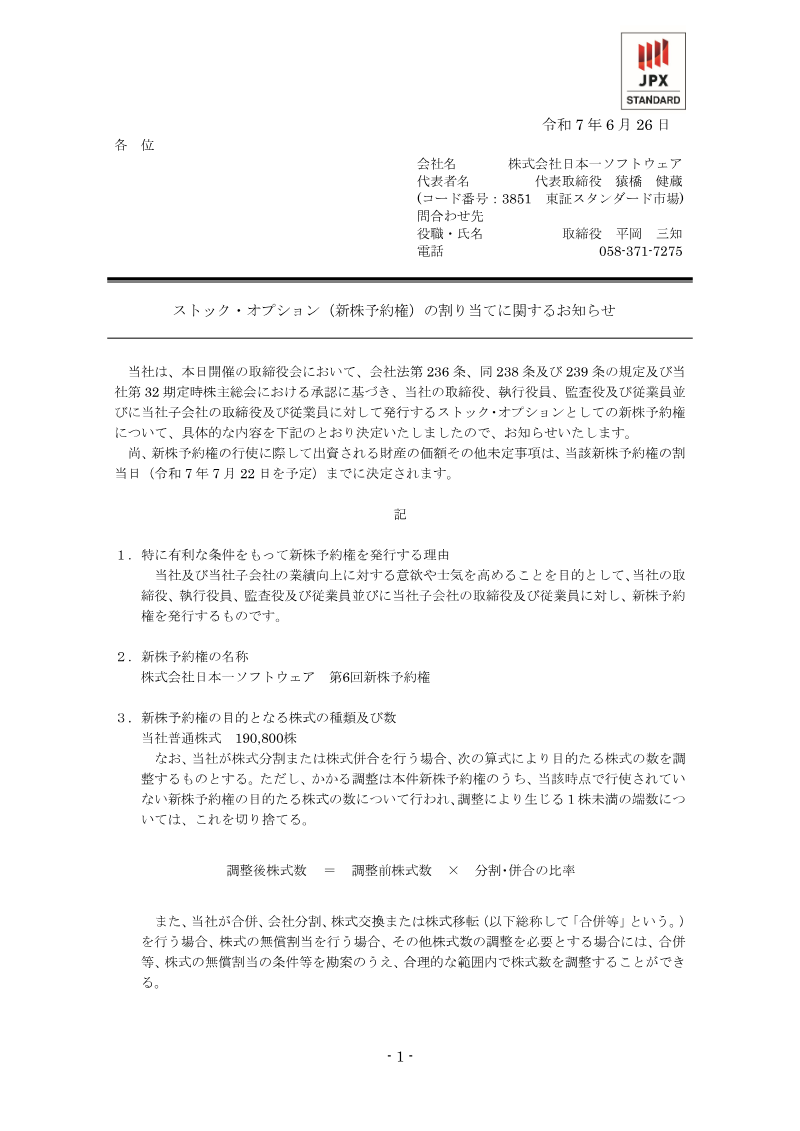
The announcement sets out the terms under which Nippon Ichi Software Co., Ltd. will issue new share subscription rights to its directors, executive officers, auditors, employees and the same categories at its subsidiaries. The primary aim is to boost motivation and morale and to align the interests of key personnel with the company’s performance, in accordance with the Companies Act and the approval obtained at the 32nd ordinary shareholders’ meeting. A total of 1,908 subscription rights will be granted, each covering 100 ordinary shares for a combined target of 190,800 shares. Allocation is divided among 560 rights for directors, 43 for executive officers, 70 for auditors, 1,123 for employees, 40 for subsidiary directors and 72 for subsidiary employees. Recipients comprise five directors, one executive officer, three auditors, 121 employees, three subsidiary directors and 23 subsidiary employees. No cash contribution is required at grant, and the exercise price will be calculated as the average closing price of the company’s ordinary shares for the month preceding the allocation date, multiplied by 1.05 and rounded up, with a floor at the allocation‑day closing price. The allocation date is set for 22 July 2025, and the exercise window runs from 1 August 2028 to 31 May 2035. Capital increases resulting from exercised rights are limited to half of the statutory increase ceiling, with the remainder allocated to capital reserves. Rights may be reclaimed free of charge if the holder ceases to meet the eligibility conditions or in the event of mergers, share exchanges or other reorganisations, and any transfer of rights requires board approval. The framework applies to the company’s listed shares on the Tokyo Stock Exchange and its subsidiaries, reflecting a corporate‑wide incentive program spanning the next decade.
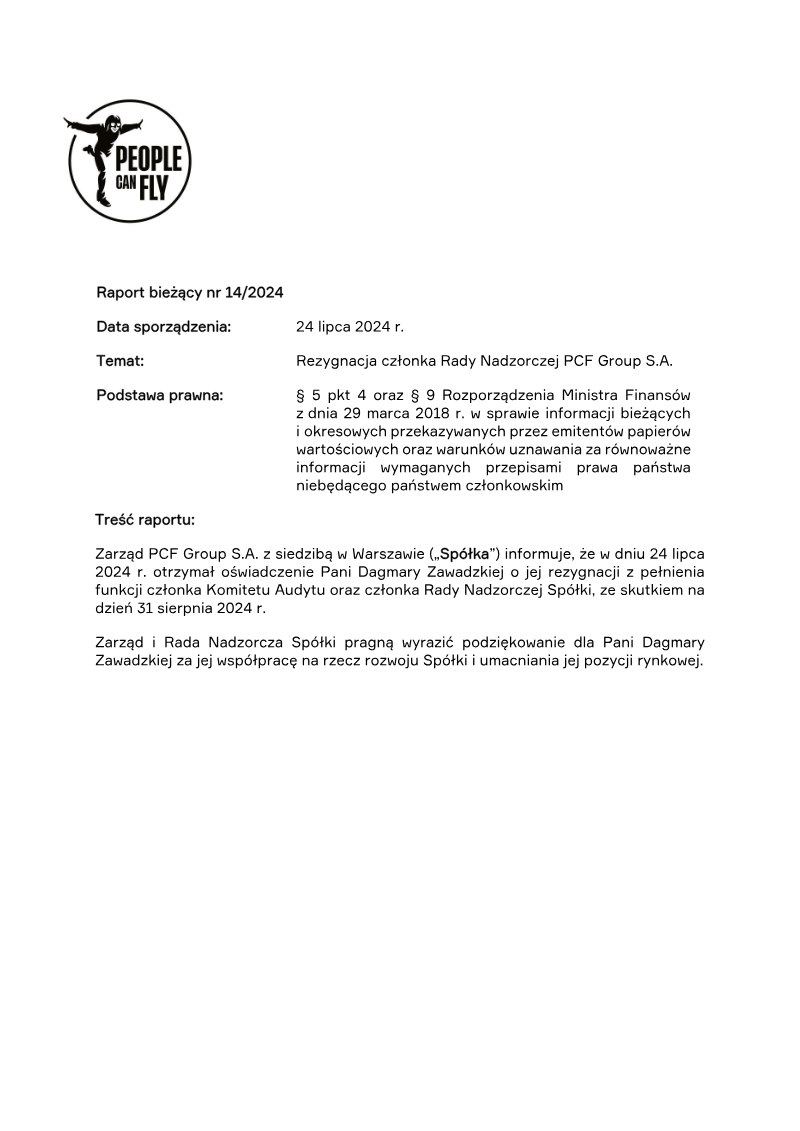
The filing serves to formally announce the resignation of Ms. Dagmara Zawadzka from her roles as a member of the Audit Committee and the Supervisory Board of PCF Group S.A., a publicly listed company headquartered in Warsaw. The resignation was submitted on 24 July 2024 and will become effective on 31 August 2024, in accordance with the provisions of § 5 point 4 and § 9 of the Minister of Finance’s Regulation dated 29 March 2018 governing continuous and periodic disclosures by securities issuers. The announcement underscores the company’s compliance with Polish regulatory requirements for timely communication of material governance changes to shareholders and market participants. It also conveys the Board’s appreciation for Ms. Zawadzka’s contributions to the firm’s development and market positioning during her tenure. No further details regarding the reasons for her departure, the composition of the remaining supervisory body, or succession plans are provided. The scope of the disclosure is limited to the corporate governance structure of PCF Group S.A. within the Polish jurisdiction, covering a specific personnel change effective in the latter half of 2024. No statistical data, survey methodology, or broader industry analysis is presented, reflecting the narrow, procedural nature of the communication.