1 free read left. Create a free account for unlimited reading + AI research.
Create free account
Don't Make Your Dream Game
Key insights
5 takeaways- 01Recognize that publishers prioritize stylized, budget-friendly, and hardware-accessible titles over high-fidelity projects that carry excessive development risk.
- 02Prioritize project scope over high-fidelity visuals to ensure the final product is cohesive and well-executed within available financial and technical constraints.
- 03Avoid the 'cohesion trap' where high-end graphics create an unsustainable expectation for design, animation, and coding quality that inexperienced teams often fail to meet.
- 04Focus on building a portfolio through smaller, polished prototypes rather than attempting high-risk, complex projects like survival sandboxes or open-world games as a first effort.
- 05Leverage modern tools and pre-made assets to prove technical capability and establish a community, rather than using them to mask a lack of production resources.
Ask AI about this video
Transcript
hey guys my name is felipe and i am the 3d artist at thomas studio so i heard you want to make your dream game and on top of it it's your very first game right well get in the line most passion game devs do by the way guys i'm going to be talking a little bit about the star wars scene i made inside unity a little bit down the video so just stick with me first thing you should ask yourself before trying to make your dream game is how deep is your wallet now of course there are people who are equally passionate about different things when it comes to what they call their dream project it is possible that you came up with an incredible smart new game mechanic that is on top of it something quote unquote cheap cool and marketable so it's not necessarily a rule that spending a lot will get you there but like most people you probably want to go all guns blazing just to show what you came for and that's fine too first thing you probably want to do is consider what you by yourself can bring to an idea meaning what are your fortes
and your technical skills then evaluate who you're gonna need to bring on board to make this vision come true unless you're planning on learning everything that there is to know starting with game design documentation the story the coding making the art the animations as well as level design and then of course you need some music and sound effects q a and optimization marketing and publishing sounds like a lot that's because it is now let's say you are a good programmer and you have that out of the way you will need to start considering your game graphics is it going to be 2d or 3d are you an artist killed on both of them or in only one of them or maybe you never even touched an art software or a game engine before well the good news is that if you're looking to try and getting a feel of it you can start learning today how to make your own 3d world with no modeling and even no knowledge of code
me and thomas have a phenomenal free course for you no gimmicks it will show you how to create the 3d world super fast inside unity just click below while you're watching the video and you're gonna be enrolled for free the reason why graphics are obviously important is because they are what make you money at least initially the look and the feel are the front cover of your book so to speak but that doesn't mean amazing graphics are the only thing that will drive people towards your idea well let's get into that in a little bit the thing about the game industry is that just like any other industry it is surprise surprise a business and dreams and businesses do tend to come as a package and that combination sometimes can be like water and oil we are surrounded by tales of amazing risk taking and pay off and infinitely more stories about failure and frustration i think people like to see success as a goal rather than seeing it as a path or a journey and not something that i'm
still learning about what drove me into what i do today were titles like half-life 2 far cry and prizes they all have amazing graphics for their time and they've certainly pushed the envelope in some way or another on how close we can get to higher fidelity regarding 3d graphics you know what these games also had in common well they had an astonishing budget and a team dedicated to cover different areas of development but here's what you have today that they didn't you got amazing graphics running on what's considered today a mid-range computer aaa engines that come with many built-in functions to save you a lot of time as well as some pretty decent open source softwares that will at least get you through the door you also have companies like quixo providing unparalleled 3d scans that were optimized to be used in your games so there shouldn't be any excuses anymore right well yes and no
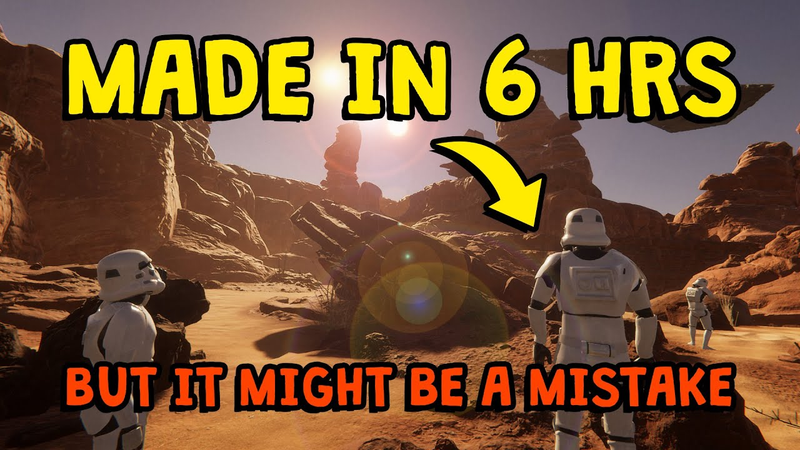
while it's true that i can take unity's hdrp pipeline and come up with a realistic star wars scene in a few hours one that could probably be a snapshot from battlefront 2 in fact let's take a look at that shall we so as you can see here a lot of it is basically copies of different scanned meshes rotated or scaled in a different way the ground is still using the terrain tool but it is a combination of really incredible hyper realistic textures from quixo as well as meshes that bring up some height variation all these little pebbles and rocks and you can kind of mask around it using similar or sometimes the same exact material and usually people can't tell when one starts and ends also these wonderful models here were made by various artists found in sketchfab which at the time of this video you can download for free obviously this is just an example and it's non-commercial so keep that in mind but with something like star wars you can obviously find a lot of cool things
anyway back to what i was saying before once you've made the decision to make a game like this using these types of assets you have now to consider making everything else match this level of quality i say this because eventually you will probably need to make custom models for things that speak about your game such as props characters or anything that has a specific make it up concept or design not only you have to now make sure that your 3d skills are up to this game but you will also have to be ready to face things that lie outside the art room one of these things is expectation once you have promoted your project as this colossal beast that will make even a 30-90 crying terror let's recall what i said in the beginning about everything that there is to know about a game production starting with the game design documentation a story the coding making the art the animations well i think you understand me your audience is going to
be expecting the same level of quality in everything else that involves your idea simply because that's where you said it to be it's like a statement this is what you're gonna be buying shortcomings from these other areas are usually what makes or breaks a titan from the aaa industry you will probably see the audience focusing way more on what went wrong with it rather than only praising how realistic the graphics are the other side of the expectation coin is how the publisher will look at your game because they're gonna be looking at it from a business perspective which as we mentioned before comes with your dream package they have to look at it as a product and see whether it's worth the risk or not of a failed investment to them it's choosing between a bloated project with much higher scope and audience expectations on top of being made by a small team also known as solo with possibly no track record or previous release titles in the same category or they can go with a more
budget-friendly version of the same idea but in a stylized form that can likely reach a bigger demographic and that can be ported to more hardware-friendly platforms the truth is there is an audience for both as we know well i happen to like both styles even if i tend to enjoy more realistic graphics from time to time but making something like this can be really rewarding as it allows for more freedom on how we explore visuals and concepts as well as making the production more agile and tweakable it also completely takes away your risk of being uncanny because now what's really expected of you is that you're gonna have a well-made and cohesive style and that your choices respect the box that you put yourself in with all that being said should you not make a realistic game the answer is ultimately do what you can afford doing but do it well whatever it is that you're looking for study hard spend the time planning things out so you can bring that dream
closer to reality so here's a good tip if you want to go down that path pay attention to your project scope there is nothing wrong with making a realistic indie game that is short in length and cheaper in price that's why i don't think you should be trying to make a gta style game or yet another survival sandbox game as your first project as much as your idea seems original and cool in your mind i say this because unless you already have a lot of industry experience you probably want to save your best ideas to your best execution if you can't afford making your concept reality now wait until you can do it in a more wholesome way there's no reason to waste your best ammunition if you can't reach your target yet you can also work on it as a passion project or even make something as a portfolio piece focus on making a very polished prototype that proves your concept and displays the value of what you and your team are capable of accomplishing even
with a very limited budget make good connections to audiences that usually like the type of game that you're making and create a community around it to support your idea in the future make sure you are able to deliver on your promises and that's it for today's topic and if you thought that we did a good job leave a like on the video and subscribe to the channel for more content and also let me know in the comments what you'd like to see next and i'll see you guys on the next one
Summary
The primary objective is to provide a strategic framework for aspiring game developers considering the development of their first project, specifically addressing the risks associated with pursuing a high-fidelity dream game. The central thesis posits that while modern tools and assets have lowered the barrier to entry for creating realistic visuals, the business realities of game development—including scope management, audience expectations, and technical requirements—often necessitate a more pragmatic approach to project planning.
The analysis highlights that while developers can now leverage high-end engines, 3D scans, and pre-made assets to achieve AAA-level aesthetics, these visual choices create a "cohesion trap." High-fidelity graphics set a standard that the rest of the game’s design, animation, and coding must meet to avoid negative player feedback. Furthermore, publishers evaluate projects through a business lens, often favoring stylized, budget-friendly, and hardware-accessible titles over bloated, high-risk projects from inexperienced teams.
The guidance emphasizes that developers should prioritize their technical fortes and carefully evaluate the scope of their production. Rather than attempting massive, complex projects like survival sandboxes or open-world games as a first effort, developers are encouraged to focus on polished, smaller-scale prototypes. This approach serves to build a portfolio, establish a community, and prove technical capability without wasting high-concept ideas on projects that lack the necessary resources for successful execution. Ultimately, the recommendation is to align project scope with available financial and technical resources, ensuring that the final product is cohesive and well-executed, regardless of the chosen visual style.




















Comments