1 free read left. Create a free account for unlimited reading + AI research.
Create free account
Differences in Scale vs Differences in Kind - Keeping Players Interested - Extra Credits
Key insights
6 takeaways- 01Relying exclusively on differences in scale creates a predictable interest curve that inevitably leads to player fatigue.
- 02Variety should be used to enhance the overall interest curve rather than acting as a superficial distraction from repetitive core systems.
- 03Successful design integrates varied experiences—such as stealth, tactical movement, and cinematic sequences—directly into the core gameplay loop to prevent repetition.
- 04The original Call of Duty: Modern Warfare serves as a benchmark for effectively cycling through diverse mission types without relying solely on increasing difficulty to maintain engagement.
- 05Designers must avoid forced or rapid shifts that make a game feel like a disjointed collection of mini-games rather than a cohesive experience.
- 06Sustaining long-term player engagement requires a balance between differences in scale, such as adjusting health or difficulty, and differences in kind, which involve fundamental shifts in mechanics and pacing.
Ask AI about this video
Transcript
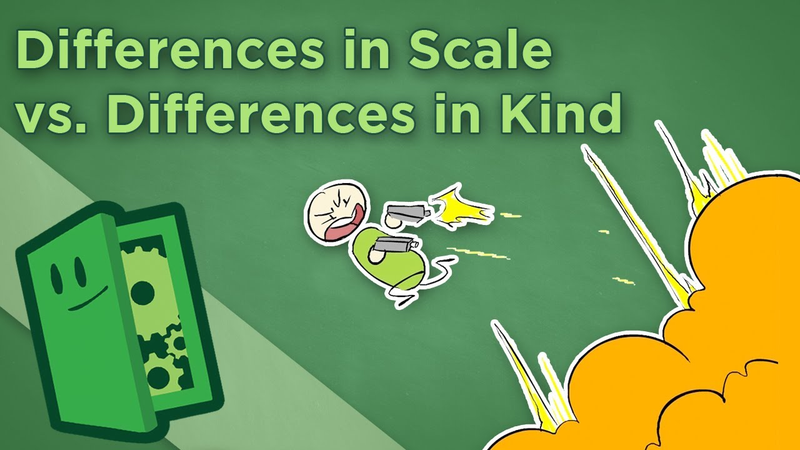
Today, we're going to be talking about one of the most fundamental, but also most difficult to discuss, topics in game design. Differences in scale and differences in kind. Often, you've heard us talk about game design as an alchemy, a discipline somewhere between an art and a science. Usually on this show, we like to talk about game design theory or the elements of game design that come closer to a science, parts that can be addressed rationally, logically, testably, and empirically. But today, we're going to be talking about something that's not theoretical, but also relies a great deal on trusting your gut, the concept that you can't describe exactly what makes it happen, but you know it when you see it. So, here we go. First, let's talk about differences in scale. Differences in scale are achieved by simply incrementing a variable. You've seen it time and again. A game throws more enemies at you, gives you more ammo, increases your health bars, or makes the enemies tougher. It's one of the most common ways we try to modulate interest in games. In fact, using this technique exclusively is one of the biggest
stumbling blocks I often see for young designers. We've talked about the interest curve in the past, and it's with relation to the interest curve that the problems with differences in scale become clear. You see, by throwing out more enemies, by simply making them stronger and tougher and better and faster, you can only drive interest linearly upwards. You can't create any of the curves or the shifts in tone that make the interest curve effective. To do that, we need differences in kind. Differences in kind are just that, differences in tone, parts of the game that feel different. Take, for example, your standard RPG. Your time in town feels different than your time spent wandering around the overworld or down in a dungeon. You can feel that shift. There's a total difference you can pick up on, and it's that difference, that interspersing of towns with other areas, that's a huge part of how the interest curve of many RPGs is defined. There's a number of mechanics that change. There are parts of the game that are almost unique to towns, shopping, talking to people, and parts that exist almost exclusively outside of towns, like combat, which is part of the aggregate for what makes for this difference in kind. But let's look at some other ways to deliver this. Cutscenes and quick time events are some of the most common ways we achieve this difference in kind.
You go from an action-heavy segment of something like Bayonetta to a cut scene and you can feel the difference. Things have just shifted. The interest curve has been turned. Of course, these are some of the most expensive ways to deliver on this. So, if you're a designer, they're not what I would recommend. But, from a design perspective, they are a way to break up your game a little. Another option is puzzle segments. Why does the God of War series have puzzles? Especially when a lot of people say that they're not all that great. Because the game would be worse if they weren't there. Imagine if God of War was just an endless stream of fights with nothing to break it up. Even though the fights might start out enjoyable, they'd rapidly lose their savor. You need to change things up. You need differences in kind in order to be able to sustain an experience. So, even though the puzzles might not have really been all that good, God of War is strictly better for having those bad puzzles. Because it's at least better than having no difference in kind at all. So, let me walk you through an example of differences in kind. The first Modern Warfare. In fact, I'm willing to go on record here and say that one of the major reasons Call of Duty succeeds on a broad level where so many other Modern Warfare first-person shooters fail is its use of differences in kind rather than differences in scale. So, let's talk about Crew Expendable, the first level after the training session in Modern Warfare.
We're just going to walk through and tick off all the differences in kind. First, you start off before the level on a pre-mission briefing. You have no control. It's very black and white. It's from a god's eye spy satellite view and it's filled with military intelligence sounding chatter. Next, you're in a helicopter. You have control of the camera, but nothing else. It's very up close and personal. You see the people you're with very distinctly. They're talking to you. Then, you hit the deck of the ship. You now have a weapon. You're in full control of your character. Your comrades take down the crew. You breach a door and go through a tight hallway doing elite military feeling stuff. But, there's no actual danger yet. Next, you're walking through the cargo crates on the top of the ship. You're in a much more open space. You're following your squadmates as they stealthily make their way forward. At the end, there's the illusion of danger before the helicopter sweeps in and wipes out the
enemy, giving you that powerful military feeling. Check your corners. Next, you're traversing a group of corridors. You're following your squadmates and are told to do military-sounding things like check your corners. Clear left. Clear right. Hallway clear. Move up. Then, you get in your first firefight. The enemy is directly ahead of you in a tight corridor with no cover. Tango down. Next, you do a firefight from a catwalk, where you have a broad view and are looking down at the enemy. It's almost like a shooting gallery. Catwalk clear. Then, you're in an ambush. Your vision's very constricted. You're hunkering down behind cover. Shots are coming from all sides. Then, you have the moment with the nuke, followed by a cutscene with a total palette shift. Bravo Six, come in. Bravo Six, what's your status? The ship's sinking. We've got TO GO NOW! AND THEN, the escape from the boat, where the guns gone again and the camera's shifting at unnatural angles.
Where the hell are you? Sandman, we're almost there. You see how even the firefights in that scene all felt different? Some of them were empowering, some of them were disempowering, some of them were simply to get you used to the combat. That's the power of the levels being crafted here. And if you go on to the next level, you'll see just how radically different it is. You go try it. See where the gameplay feels different to you. Actually, this is a great game design exercise in general. Maybe even try it with a friend. See where they feel the differences in kind. It's almost surprising how universal something that's really as gut-based as this can be. But, before we let Call of Duty off the hook, looking at the new Black Ops game is a great example of the flip side of differences in kind. While the first Modern Warfare built a multi-million dollar franchise on differences in kind, even in the multiplayer, think on that one for a minute, the newest Call of Duty is an example of this gone wild. Now, I'm throwing grenades from the side of a Humvee. Now I'm in a flying squirrel suit. Now I'm on a horse. It's almost as if they realized that these differences in kind were a core element of the series, but didn't understand the subtleties of how to deliver on it, and so threw money at the problem in order to make sure that rather than having
solid gameplay, they'd have something new for you to do every 30 seconds, so you never ever did anything for long enough to get bored. When used right, this technique can break up play and change the direction of your interest curve, but this here is just Call of WarioWare. All right, so before we go, I would just suggest that you think about how this is done in multiplayer games. What are the phases of StarCraft? Or what parts of League of Legends feel different? How do they build these differences in kind into the core mechanics and the maps themselves, rather than having to build fancy cutscenes or puzzles that remap what the controls do? Work through that and you will truly understand differences in kind. I'll see you next week.
Summary
Effective game design requires a balance between differences in scale and differences in kind to maintain player engagement. Differences in scale involve simple, linear adjustments to variables such as enemy health, ammunition counts, or difficulty levels. While these adjustments are common, relying on them exclusively creates a predictable, one-dimensional interest curve that eventually leads to player fatigue. To sustain long-term interest, designers must incorporate differences in kind, which involve fundamental shifts in tone, pacing, and gameplay mechanics that make distinct segments of a game feel unique.
The primary thesis posits that successful games utilize these shifts to modulate the player's experience, preventing repetition even when core mechanics remain consistent. Techniques for achieving this include interspersing action with puzzle segments, narrative cutscenes, or environmental changes. For instance, the original Call of Duty: Modern Warfare is cited as a benchmark for this approach; its early missions successfully cycle through diverse scenarios—ranging from stealth-based corridor navigation and tactical squad movements to high-intensity firefights and cinematic escapes—without relying solely on increased difficulty to keep the player engaged.
However, the application of these techniques requires nuance. When designers force constant, rapid changes in gameplay—such as frequently switching between disparate vehicle segments or gimmicks—the experience can become disjointed and superficial, resembling a collection of mini-games rather than a cohesive design. The most effective implementation integrates these differences into the core gameplay loop, allowing the player to experience varied phases of play naturally. Ultimately, designers are encouraged to analyze how successful titles build these shifts into their maps and mechanics, ensuring that variety serves the overall interest curve rather than merely acting as a distraction from repetitive core systems.













Comments