Nintendo Co.
Organization1 document
Documents
Financial16 pages
Consolidated Financial Statements: Nintendo
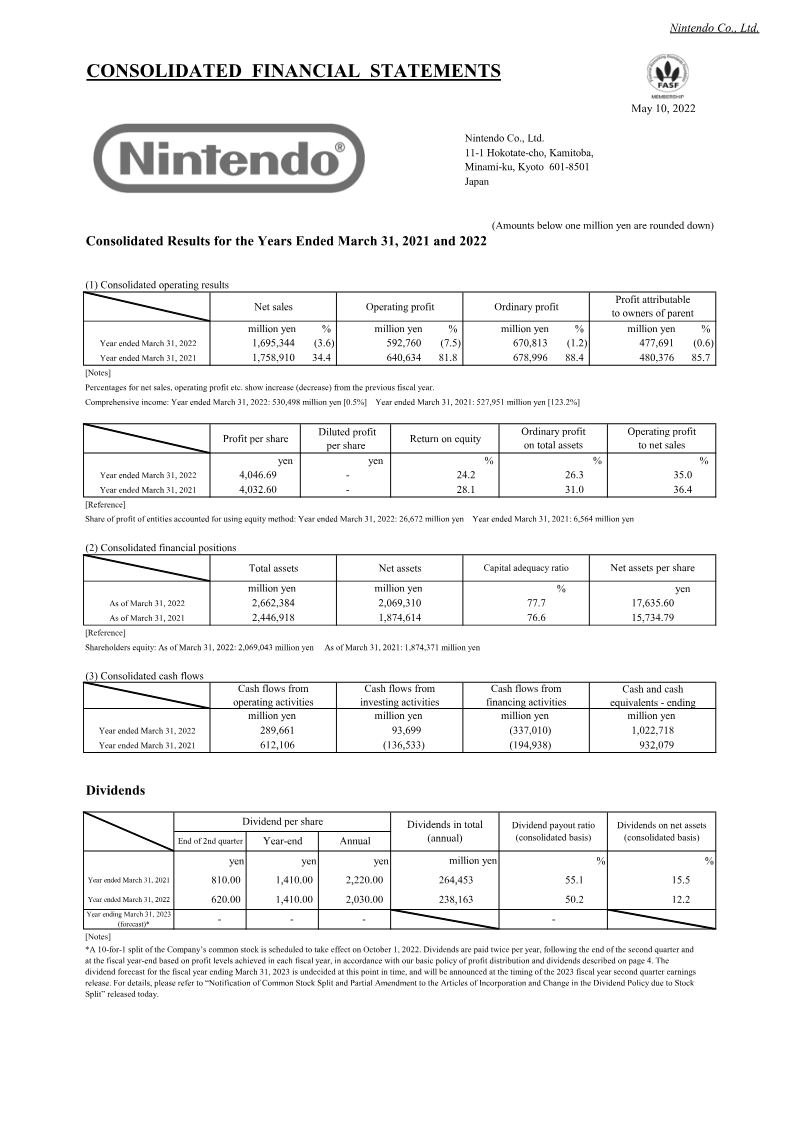
Nintendo experienced a period of financial stabilization during the fiscal year ending March 31, 2022, characterized by resilient software performance despite significant hardware production constraints. The company generated 1,695.3 billion yen in net sales and 592.7 billion yen in operating profit, reflecting a slight year-over-year decline attributed primarily to global semiconductor shortages. These supply chain disruptions caused Nintendo Switch hardware sales to contract from 28.83 million units in the previous period to 23.06 million units. However, software demand remained robust, reaching a record-high 235.07 million units sold, which helped sustain the company’s strong liquidity position, evidenced by 1,022.7 billion yen in cash and cash equivalents.
The company maintains a solid balance sheet, with total assets rising to 2,662.38 billion yen and net assets reaching 2,069.31 billion yen. Strategic adjustments for the coming year include the adoption of updated accounting standards for revenue recognition and fair value measurement, alongside corporate governance changes such as a planned stock split and the implementation of a restricted stock compensation plan. Leadership transitions are also underway, with new appointments to the board of directors intended to guide the company through the next fiscal cycle.
Looking toward the 2023 fiscal year, projections indicate a conservative outlook with anticipated net sales of 1,600 billion yen and operating profit of 500 billion yen. To support long-term growth, Nintendo is significantly increasing capital investments to 38 billion yen while maintaining consistent expenditure levels for research, development, and advertising. These strategic investments underscore a commitment to sustaining software momentum and navigating the ongoing challenges within the global hardware manufacturing landscape.
Nintendo Co.