Aalto University
Organization2 reports
2 reports, presentations and talks by Aalto University in the Game Industry Library, the newest “A Practical Guide to Using Digital Games as an Experiment Stimulus” (2014).
Documents
Whitepaper31 pages
A Practical Guide to Using Digital Games as an Experiment Stimulus
Digital games serve as highly effective experimental stimuli due to their capacity for high ecological validity, deep participant engagement, and the ability to simulate complex, real-world environments.
- Digital games serve as effective experimental stimuli because their engaging nature encourages participants to act naturally, though researchers must balance this ecological validity with the need for strict experimental control.
- Using commercial games offers high engagement and professional polish, but custom-developed games provide superior control over variables, albeit at the risk of experimenter bias and lower production quality.
- Participant skill level significantly impacts game content and experience; researchers should recruit experienced players or use games with built-in difficulty adjustments to ensure consistent conditions across the study group.
Aalto UniversityMar 2014
Whitepaper25 pages
Player Types: A Meta-synthesis
Modern game industry research is shifting away from traditional demographic segmentation toward sophisticated psychographic and behavioral models.
- Game industry segmentation is increasingly vital for monetizing virtual goods and applying gamification, moving beyond traditional retail models to target specific player needs.
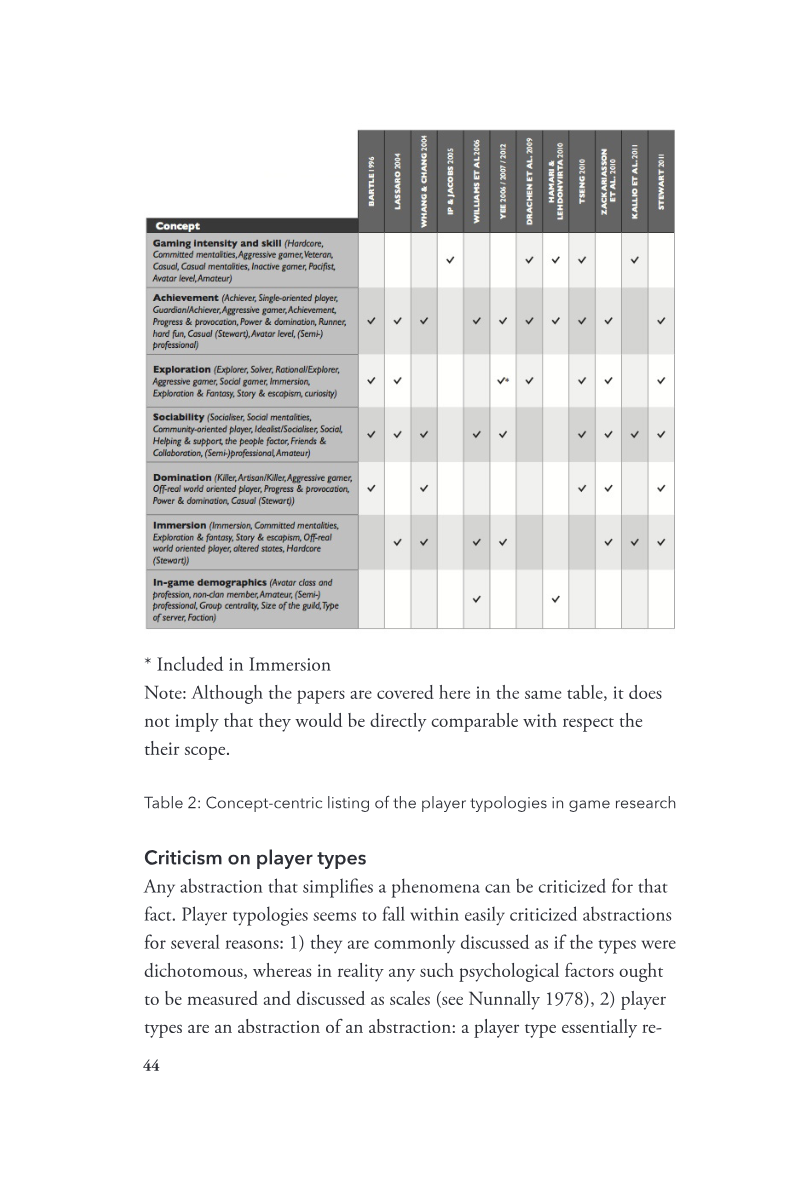
- Current research synthesizes player motivations into five core dimensions: Achievement, Exploration, Sociability, Domination, and Immersion.
- The 'hardcore vs. casual' dichotomy is a common but overly simplistic classification; player behavior is more accurately represented as a continuum influenced by context, time availability, and social environment.
Tampere UniversityMar 2014
Do you work at Aalto University? Get a free report of how these documents are read and cited here.