Report2 pages
Raport Bieżący Nr 5/2024: Podsumowanie Kosztów Subskrypcji Akcji Serii F
PCF Group S.A. has finalized the accounting of costs associated with the issuance of 3,343,037 series F ordinary bearer shares. The primary purpose of this disclosure is to provide transparency regarding the financial expenditures incurred during the subscription process, ensuring compliance with regulatory requirements for issuers of securities on the Warsaw Stock Exchange.
The total cost of the series F share issuance amounted to 2,323,824.52 PLN. These expenses are categorized into two main areas: the preparation and execution of the offer, which totaled 2,243,744.52 PLN, and promotional activities, which accounted for 80,080.00 PLN. Within the preparation category, transaction advisory services represented the largest expenditure at 1,747,018.88 PLN, followed by legal costs of 467,464.81 PLN and registration and admission fees of 29,260.83 PLN. The company did not utilize sub-underwriters, and the offer was conducted without the requirement of a prospectus.
On a per-unit basis, the average cost of the subscription amounted to approximately 0.70 PLN per share. In terms of accounting treatment, the total issuance costs were recognized by reducing the reserve capital created from the surplus of the issue price over the nominal value of the shares. This summary covers the financial activities related to the series F issuance as of February 2024, reflecting the final reconciliation of all associated transaction costs.
- PCF Group S.A. incurred total costs of 2,323,824.52 PLN for the issuance of 3,343,037 series F ordinary bearer shares.
- The average cost of the subscription was approximately 0.70 PLN per share.
- Preparation and execution of the offer accounted for 2,243,744.52 PLN, while promotional activities cost 80,080.00 PLN.
- Transaction advisory services were the largest expense at 1,747,018.88 PLN, followed by legal costs of 467,464.81 PLN.
- Issuance costs were accounted for by reducing the reserve capital created from the surplus of the issue price over the nominal share value.
PCF Group
Report4 pages
Current Report No. 4/2024: Summary of Series E Share Subscription
PCF Group S.A. provides a formal summary of the private subscription of Series E ordinary bearer shares, confirming the completion of the issuance process. The primary purpose of the transaction was to finalize the acquisition of shares in Incuvo S.A. through a non-cash contribution, thereby expanding the company's capital base. The subscription was conducted as a private placement, exempt from the requirement to publish a prospectus under European Union regulations.
The issuance involved 136,104 Series E shares, each with a nominal value of 0.02 PLN, issued at an issue price of 46.13 PLN per share. The total value of the offering reached 6,278,477.52 PLN. Two investors, Andrzej Wychowaniec and Radomir Kucharski, subscribed to the shares by contributing equity in Incuvo S.A. as an in-kind contribution, supplemented by minor cash payments to cover the difference between the issue price and the valuation of the aport.
Total costs associated with the subscription amounted to 20,659.72 PLN, resulting in an average cost of approximately 0.15 PLN per share. These expenses, which primarily comprised legal fees and costs related to the registration and admission of shares to the Warsaw Stock Exchange, were settled by reducing the company's supplementary capital from the share premium. The subscription process concluded with the full payment of contributions by February 17, 2023, and the formalization of the share subscription agreements on February 15, 2023.
- PCF Group S.A. completed the issuance of 136,104 Series E shares to finalize the acquisition of Incuvo S.A. through a non-cash contribution.
- The total value of the Series E share offering reached 6,278,477.52 PLN, with each share issued at a price of 46.13 PLN.
- Investors Andrzej Wychowaniec and Radomir Kucharski acquired the shares by contributing equity in Incuvo S.A., supplemented by minor cash payments.
- The subscription process was conducted as a private placement, exempt from the requirement to publish a prospectus under EU regulations.
- Total issuance costs amounted to 20,659.72 PLN, averaging approximately 0.15 PLN per share, which were covered by reducing supplementary capital.
PCF Group
Report2 pages
Current Report No. 20/2024: Decision to Discontinue Work on Project Red
PCF Group S.A. has officially terminated development of Project Red, a title previously intended for either external publishing or self-publishing. This strategic decision stems from the company’s inability to secure an external publishing partner and a lack of sufficient capital to sustain self-publishing efforts. Furthermore, the company has prioritized the allocation of its development resources toward a newly acquired project, designated as Project Echo, which necessitates the transfer of the team previously assigned to Project Red.
The cancellation of Project Red carries significant financial implications for the company’s 2024 fiscal reporting. As of June 30, 2024, the company will record a 100% impairment charge on all capitalized expenditures related to the project. This accounting action will result in an estimated reduction of 8.85 million PLN in the company’s standalone financial results and fixed assets, while the consolidated financial results and fixed assets for the group will decrease by approximately 7.72 million PLN.
These adjustments are classified as one-time, non-cash events and will not impact the company’s EBITDA. While these figures represent the current assessment of the financial impact, they remain subject to final auditor review and may be adjusted in the upcoming semi-annual financial statements. This shift in development focus reflects a broader realignment of the company’s portfolio, prioritizing projects with secured external funding over those requiring internal capital investment.
- PCF Group S.A. has officially terminated development of Project Red due to an inability to secure an external publishing partner and insufficient capital for self-publishing.
- The cancellation will result in a 100% impairment charge on all capitalized expenditures related to Project Red as of June 30, 2024.
- The impairment will reduce the company’s standalone financial results and fixed assets by approximately 8.85 million PLN.
- The consolidated financial results and fixed assets for the group will decrease by approximately 7.72 million PLN due to the project's termination.
- These financial adjustments are classified as one-time, non-cash events and will have no impact on the company’s EBITDA.
+2
PCF Group
Report3 pages
Aktualizacja ram czasowych realizacji Strategii
People Can Fly Group has updated its long-term strategic framework, maintaining core objectives while adjusting project timelines and financial targets for the 2024–2028 period. The company now plans to release its self-published project, Bison, in 2025, followed by early access launches for projects Bifrost and Victoria in 2026. To support these operations, the company aims to maintain a workforce of approximately 370 full-time equivalents for its work-for-hire segment through 2028.
The updated financial strategy targets at least 3.3 billion PLN in total revenue between 2024 and 2028, with a projected growth trajectory that scales from 5% of this total in 2025 to 33% by 2028. Management has suspended dividend recommendations until at least the 2026 fiscal year, contingent upon achieving positive financial results from self-publishing activities. Furthermore, the development of a previously proposed incentive program tied to 1.5 billion PLN in cumulative EBITDA has been paused pending the outcome of an ongoing strategic review.
Execution of these goals is strictly dependent on securing approximately 350 million PLN in new financing during 2025 and 2026. Should this funding not materialize, or if specific work-for-hire project conditions remain unmet, the company is evaluating alternative scenarios, including the potential transition of the Bifrost or Victoria projects into the work-for-hire model. These updates reflect a recalibration of the company’s operational roadmap as it navigates capital requirements and project development milestones.
- People Can Fly Group requires 350 million PLN in new financing during 2025–2026 to execute its updated strategic roadmap.
- The company targets at least 3.3 billion PLN in total revenue for the 2024–2028 period, with growth scaling from 5% in 2025 to 33% by 2028.
- The self-published project 'Bison' is scheduled for release in 2025, followed by early access launches for 'Bifrost' and 'Victoria' in 2026.
- Management has suspended dividend recommendations until at least the 2026 fiscal year, pending positive financial results from self-publishing activities.
- The company plans to maintain a workforce of approximately 370 full-time equivalents for its work-for-hire segment through 2028.
PCF Group
Report1 pages
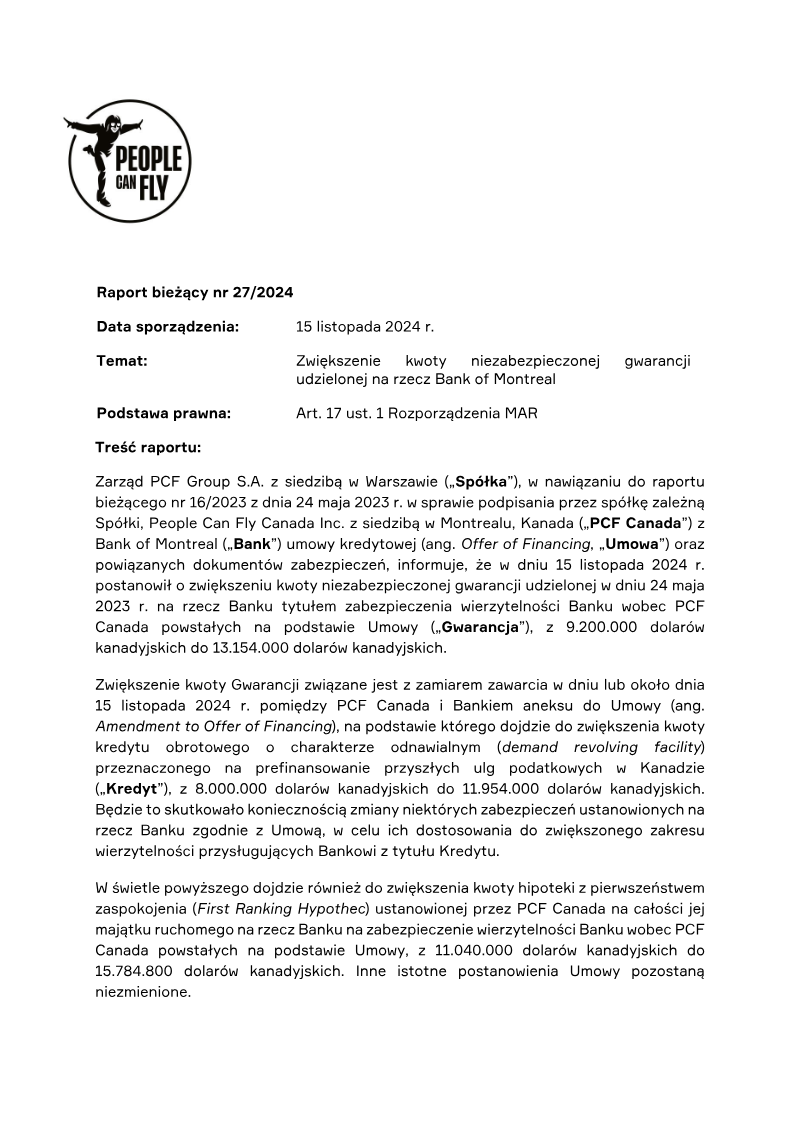
Raport Bieżący Nr 27/2024: Zwiększenie Kwoty Niezabezpieczonej Gwarancji
PCF Group S.A. has formally increased the financial guarantee provided to the Bank of Montreal to support the operations of its Canadian subsidiary, People Can Fly Canada Inc. This adjustment, finalized on November 15, 2024, raises the unsecured guarantee from 9.2 million Canadian dollars to 13.154 million Canadian dollars. The action serves to align the company’s credit support with an expanded revolving credit facility intended to pre-finance future tax credits within the Canadian market.
The underlying credit facility, which functions as a demand revolving facility, has been increased from 8 million to 11.954 million Canadian dollars. This expansion necessitates a corresponding adjustment to the collateral structure previously established in May 2023. Consequently, the first-ranking hypothec over the movable property of People Can Fly Canada Inc. has been raised from 11.04 million to 15.7848 million Canadian dollars. These modifications ensure that the security interests held by the bank remain commensurate with the increased credit exposure.
The scope of these financial adjustments is limited to the Canadian operations of the PCF Group and the specific credit arrangements with the Bank of Montreal. All other material terms and conditions governing the original financing agreement remain unchanged, maintaining the existing framework for the company’s debt obligations and security protocols. This strategic increase in liquidity support reflects the company's ongoing efforts to manage cash flow effectively through the utilization of regional tax incentive programs.
- PCF Group S.A. increased the unsecured guarantee for its subsidiary, People Can Fly Canada Inc., from 9.2 million to 13.154 million Canadian dollars as of November 15, 2024.
- The revolving credit facility for People Can Fly Canada Inc. with the Bank of Montreal was expanded from 8 million to 11.954 million Canadian dollars.
- To secure the increased credit exposure, the first-ranking hypothec over the movable property of the Canadian subsidiary was raised from 11.04 million to 15.7848 million Canadian dollars.
- The primary purpose of the increased credit facility is to pre-finance future tax credits within the Canadian market.
- These financial adjustments are limited to Canadian operations and do not alter the material terms or conditions of the original May 2023 financing agreement.
+1
PCF Group
Report1 pages
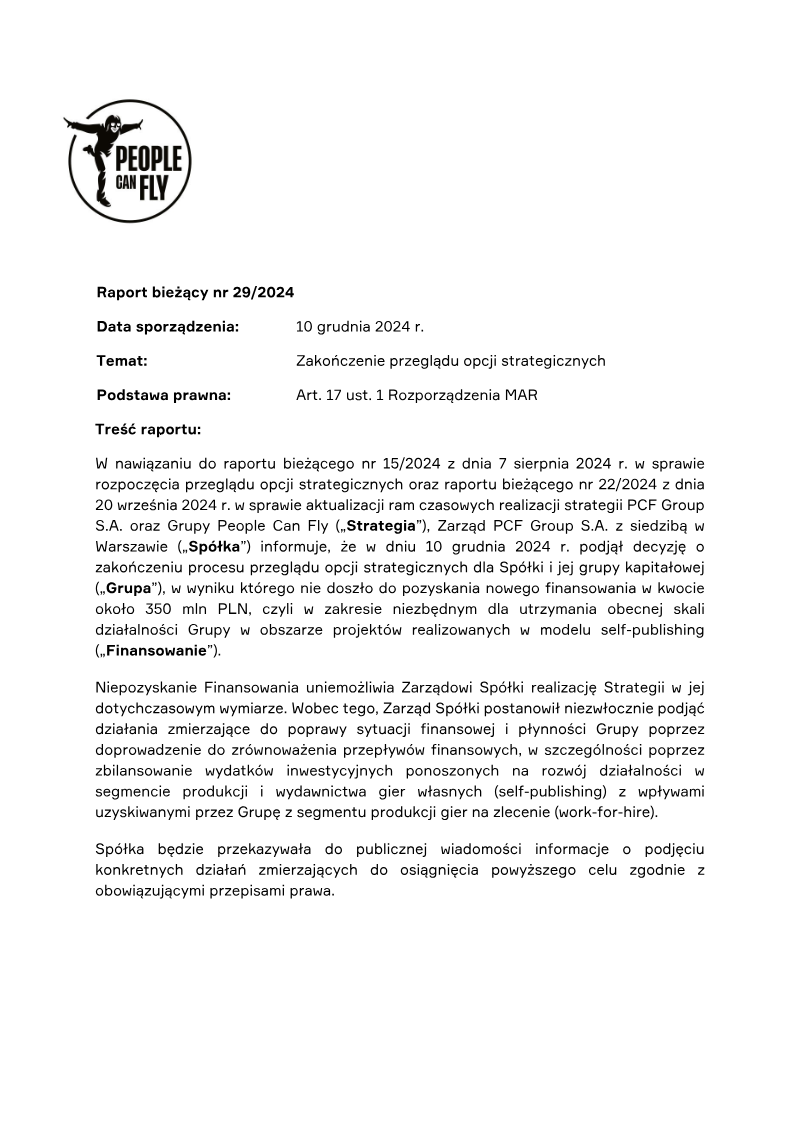
Current Report No. 29/2024: Conclusion of Strategic Options Review
People Can Fly Group has officially concluded its strategic options review process, initiated in August 2024, without securing the necessary capital to sustain its current operational trajectory. The company failed to obtain approximately 350 million PLN in external financing, a sum deemed essential for maintaining the existing scale of its self-publishing game development projects. Consequently, the organization is unable to execute its previously established corporate strategy in its current form.
To address the resulting financial constraints and ensure liquidity, the management board is shifting its focus toward stabilizing cash flows. The primary objective is to align capital expenditures within the self-publishing segment with the revenue generated from the company’s work-for-hire production services. By balancing these two business segments, the firm aims to achieve a sustainable financial equilibrium.
This strategic pivot marks a significant contraction in the company's growth ambitions, moving away from aggressive self-funded expansion toward a more conservative, revenue-dependent model. The company has committed to providing further updates as it implements specific measures to restructure its operations and restore financial stability. Future disclosures will detail the concrete steps taken to align the group’s cost structure with its incoming cash flows from external development contracts.
- People Can Fly Group has officially ended its strategic options review after failing to secure the 350 million PLN in external financing required to maintain its current self-publishing trajectory.
- The company is abandoning its previous growth strategy due to an inability to fund its existing scale of self-publishing game development projects.
- Management is shifting to a conservative financial model that prioritizes stabilizing cash flows over aggressive, self-funded expansion.
- Future capital expenditures in the self-publishing segment will be strictly limited to the revenue generated by the company's work-for-hire production services.
- The organization is currently undergoing a restructuring process to align its overall cost structure with the income derived from external development contracts.
+1
PCF Group
Report5 pages
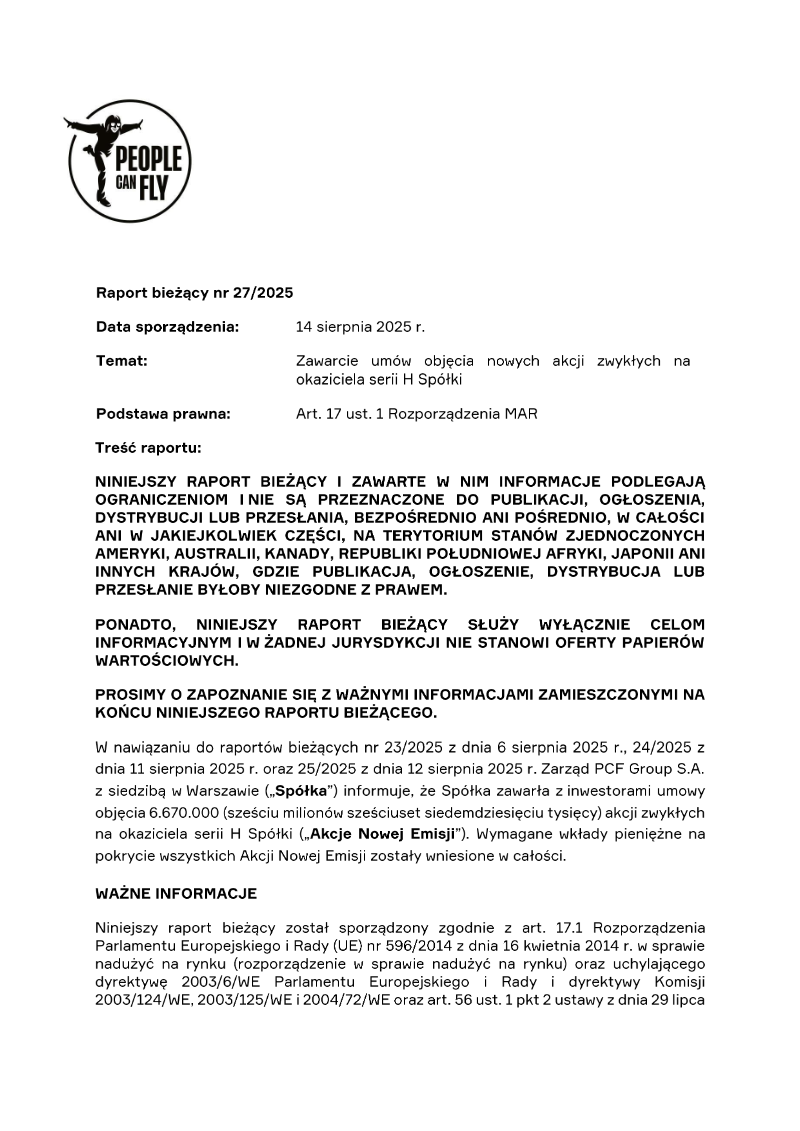
Raport bieżący nr 27/2025: Zawarcie umów objęcia nowych akcji serii H
PCF Group S.A. has formally announced the successful execution of agreements with investors regarding the subscription of 6,670,000 new series H ordinary bearer shares. This issuance follows a series of previous corporate communications issued in August 2025. The company confirms that the required monetary contributions for the full coverage of these newly issued shares have been received in their entirety.
The primary purpose of this disclosure is to fulfill regulatory obligations under the Market Abuse Regulation and Polish public offering laws. The issuance is restricted to qualified investors within the European Economic Area and specific categories of professional investors in the United Kingdom. The company explicitly states that this information does not constitute a public offering, advertisement, or promotional material for the new shares in any jurisdiction.
The scope of this transaction is limited to non-U.S. jurisdictions, adhering to Regulation S under the U.S. Securities Act of 1933. The shares have not been registered with the U.S. Securities and Exchange Commission or any other international regulatory body, and the company does not intend to register them. Consequently, the distribution of this information is strictly prohibited in the United States, Australia, Canada, Japan, South Africa, and any other region where such distribution would be unlawful. The company emphasizes that no prospectus is required for this issuance, and investors are expected to conduct their own independent analysis before making any investment decisions.
- PCF Group S.A. has successfully issued 6,670,000 new series H ordinary bearer shares to qualified investors.
- The company has confirmed the receipt of full monetary contributions for the entire issuance of the new series H shares.
- The share issuance was restricted to qualified investors within the European Economic Area and professional investors in the United Kingdom.
- The transaction was conducted under Regulation S of the U.S. Securities Act of 1933, meaning the shares are not registered with the U.S. SEC.
- The issuance does not constitute a public offering, and the company has confirmed that no prospectus is required for this transaction.
PCF Group
Report10 pages
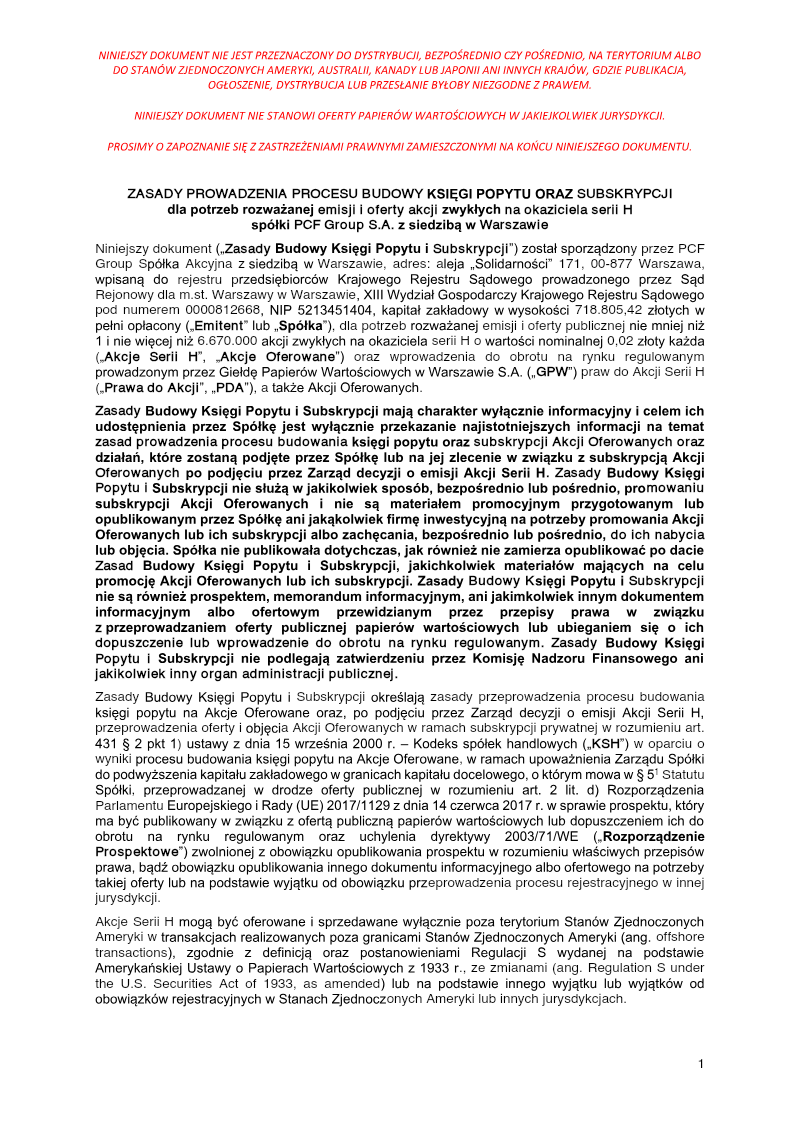
Zasady prowadzenia procesu budowy księgi popytu oraz subskrypcji: PCF Group S.A.
NINIEJSZY DOKUMENT NIE JEST PRZEZNACZONY DO DYSTRYBUCJI, BEZPOŚREDNIO CZY POŚREDNIO, NA TERYTORIUM ALBO DO STANÓW ZJEDNOCZONYCH AMERYKI, AUSTRALII, KANADY LUB JAPONII ANI INNYCH KRAJÓW, GDZIE PUBLIKACJA, OGŁOSZENIE, DYSTRYBUCJA LUB PRZESŁANIE BYŁOBY NIEZGODNE Z PRAWEM. NINIEJSZY DOKUMENT NIE STANOWI OFERTY PAPIERÓW WARTOŚCIOWYCH W JAKIEJKOLWIEK JURYSDYKCJI. PROSIMY O ZAPOZNANIE SIĘ Z ZASTRZEŻENIAMI PRAWNYMI ZAMIESZCZONYMI NA KOŃCU NINIEJSZEGO DOKUMENTU.
- PCF Group S.A. is conducting a book-building process and private subscription for 1 to 6,670,000 Series H ordinary bearer shares, each with a nominal value of PLN 0.02, to be listed on the Warsaw Stock Exchange.
- The offering aims to stabilize the company's short-term financial liquidity, secure working capital for 'work for hire' contracts, and enable orderly and predictable business expansion while maintaining operational flexibility.
- Sebastian Wojciechowski, a significant shareholder and CEO, intends to subscribe for up to PLN 5 million worth of Series H shares, provided his allocation does not exceed 50% of the total shares offered.
- The book-building process is scheduled to open on August 6, 2025, and close at 4:00 PM CEST on August 11, 2025.
- Eligible investors who held at least 0.25% of the company's share capital by the Preference Day will have a pre-emptive right to subscribe for Series H shares to maintain their proportional voting rights.
+1
PCF Group
Report6 pages
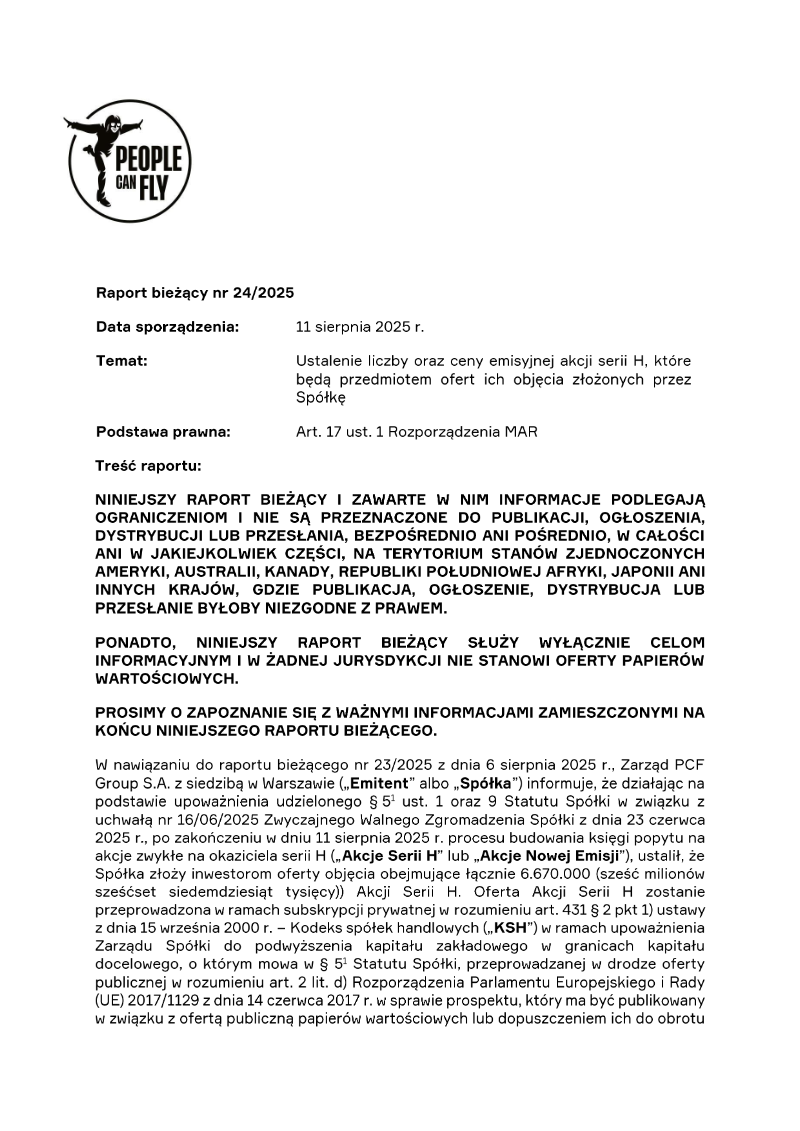
Current Report No. 24/2025: Determination of the Number and Issue Price of Series H Shares
PCF Group S.A., based in Warsaw, has formally determined the parameters for its Series H share issuance following the conclusion of a book-building process on August 11, 2025. The company will offer a total of 6,670,000 new ordinary bearer shares to investors. The issue price for these shares has been set at 3.00 PLN per share, a rate that will apply uniformly to all participating investors.
This issuance is being conducted as a private subscription under the Polish Commercial Companies Code, utilizing the company’s authorized capital. The offering is structured as a public offering that is exempt from the requirement to publish a prospectus or other formal information documents, in accordance with the European Union’s Prospectus Regulation. The decision to proceed with this capital increase, with the exclusion of existing shareholders' pre-emptive rights, was made with the approval of the company's Supervisory Board and follows authorization granted by the Ordinary General Meeting of Shareholders on June 23, 2025.
The offering is strictly limited to qualified investors and specific eligible parties in jurisdictions where such an offer is legally permissible. The company has explicitly restricted the distribution of information regarding this issuance in the United States, Australia, Canada, Japan, South Africa, and other regions where such actions would violate local securities laws. The shares have not been registered under the U.S. Securities Act of 1933 and are not intended for public offering outside of Poland. The company maintains that this disclosure is for informational purposes only and does not constitute a recommendation or solicitation to purchase securities.
- PCF Group S.A. will issue 6,670,000 new Series H ordinary bearer shares at a fixed price of 3.00 PLN per share.
- The issue price was finalized on August 11, 2025, following the conclusion of a formal book-building process.
- The capital increase is being executed as a private subscription, utilizing the company’s authorized capital and excluding existing shareholders' pre-emptive rights.
- The offering is structured as a public offering exempt from the requirement to publish a prospectus under European Union regulations.
- The issuance is restricted to qualified investors and specific eligible parties, with explicit prohibitions on distribution in the U.S., Australia, Canada, Japan, and South Africa.
PCF Group
Report6 pages
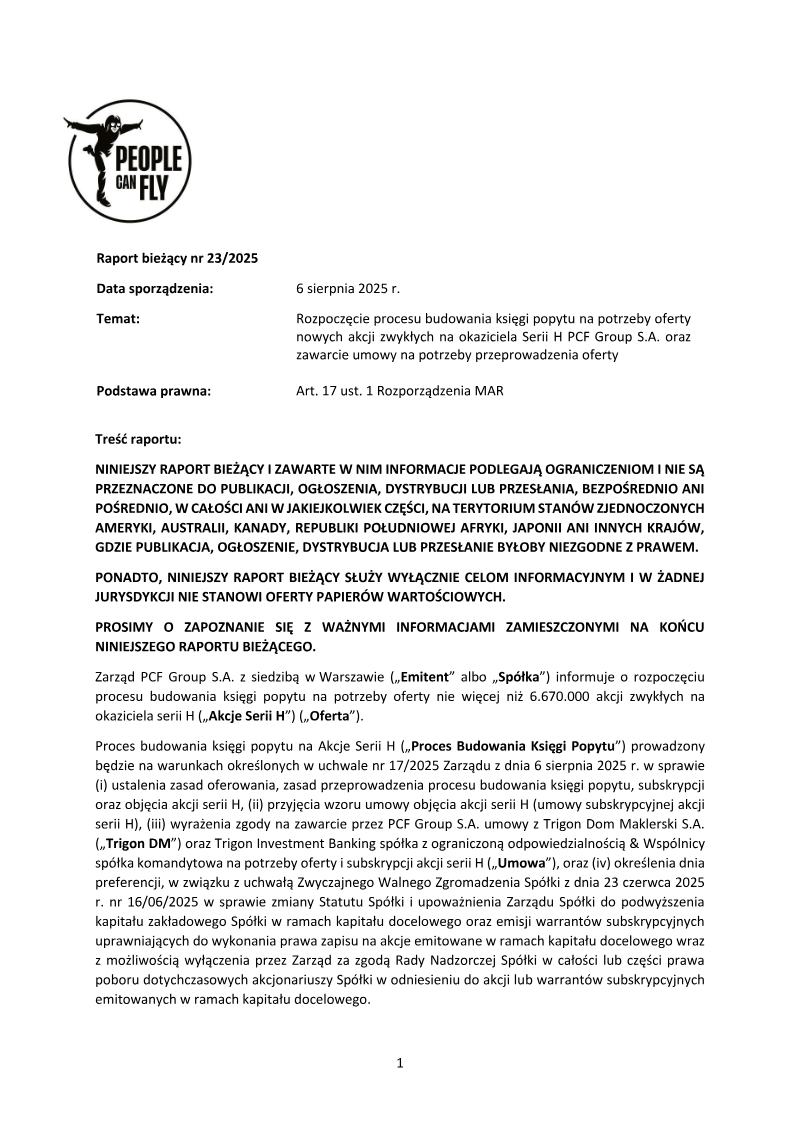
Current Report No. 23/2025: Commencement of Book Building Process
PCF Group S.A., a Warsaw-based entity, has officially initiated a book-building process for the issuance of up to 6,670,000 Series H ordinary bearer shares. The primary objective of this capital raise is to secure approximately 20 million PLN to stabilize the company’s short-term financial liquidity and provide necessary working capital. These funds are intended to support the ongoing execution of contracts within the company’s work-for-hire business model, facilitating a predictable and orderly scaling of operations while maintaining cost discipline to restore operational profitability.
The offering process is being conducted in accordance with resolutions adopted by the company’s management board on August 6, 2025, with Trigon Dom Maklerski S.A. and Trigon Investment Banking serving as the lead entities for the subscription. To support the offering, the company has established July 31, 2025, as the preference date for existing shareholders. Additionally, Sebastian Wojciechowski, the company’s President and a significant shareholder, has declared an intention to participate in the book-building process and subsequent offering, committing to acquire Series H shares for up to 5 million PLN, provided his allocation does not exceed 50% of the total shares issued in this offering.
The scope of this offering is restricted to jurisdictions where such activity is legally permissible, specifically excluding the United States, Australia, Canada, Japan, and South Africa. The shares are being offered exclusively to qualified investors in compliance with relevant European Union and local regulations, and no prospectus is required for this issuance. The company remains subject to existing lock-up agreements regarding its shares, which extend through December 31, 2027, with specific provisions for future long-term incentive programs involving call options.
- PCF Group S.A. has initiated a book-building process to issue up to 6,670,000 Series H ordinary bearer shares to raise approximately 20 million PLN.
- The capital raise is intended to stabilize short-term financial liquidity and provide working capital to support the company’s work-for-hire business model.
- President and significant shareholder Sebastian Wojciechowski has committed to purchasing up to 5 million PLN worth of the new shares, provided his allocation does not exceed 50% of the total issuance.
- Trigon Dom Maklerski S.A. and Trigon Investment Banking are managing the subscription process, which is restricted to qualified investors in permissible jurisdictions excluding the U.S., Australia, Canada, Japan, and South Africa.
- The offering is exempt from prospectus requirements and follows management board resolutions adopted on August 6, 2025, with a preference date for existing shareholders set for July 31, 2025.
+1
PCF Group
Report5 pages
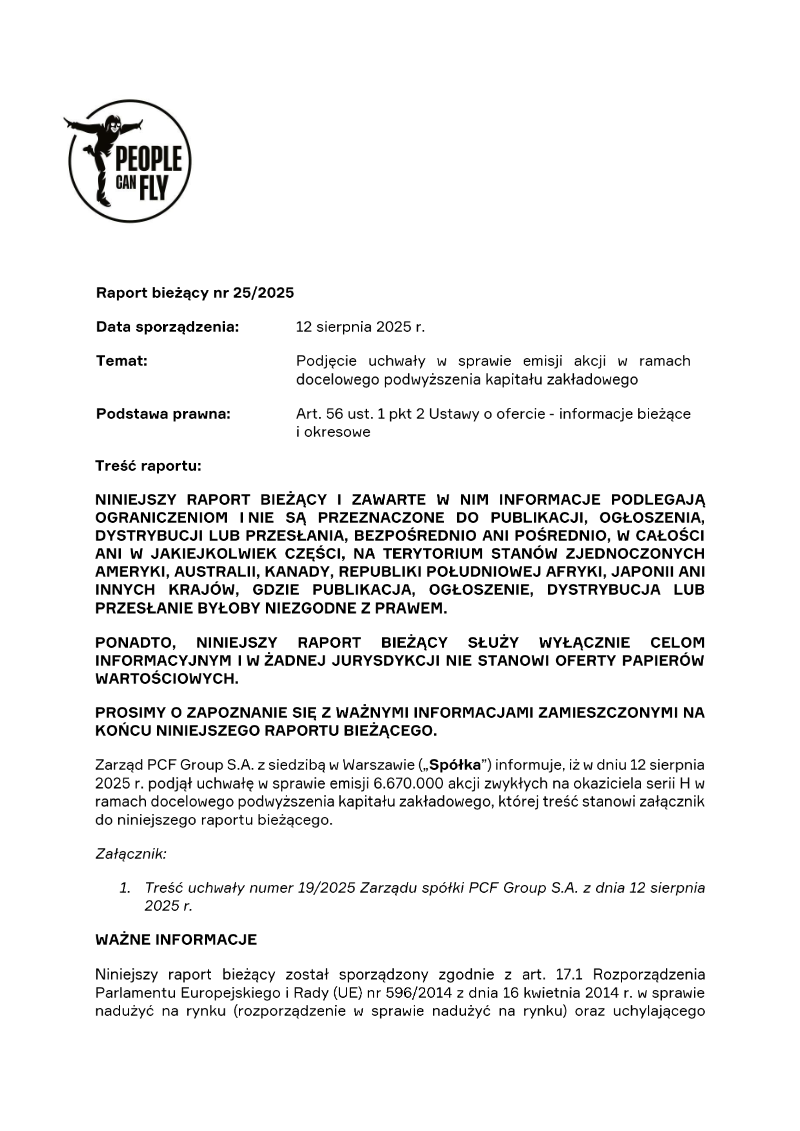
Raport Bieżący Nr 25/2025: Podjęcie Uchwały w Sprawie Emisji Akcji w Ramach Docelowego Podwyższenia Kapitału Zakładowego
PCF Group S.A. has formally announced the adoption of a resolution regarding the issuance of 6,670,000 ordinary bearer shares of Series H. This action is being executed as part of a targeted increase in the company’s share capital. The decision was finalized by the company’s management board on August 12, 2025, in accordance with regulatory requirements concerning market abuse and public offering procedures.
The scope of this announcement is strictly limited to providing information regarding the share issuance and does not constitute a public offer, advertisement, or promotional material for the new shares. The issuance is intended exclusively for qualified investors within the European Economic Area and specific professional categories in the United Kingdom. The company has explicitly stated that no prospectus is required for this transaction under current European regulations, as the offering is structured to qualify for exemptions from standard prospectus requirements.
Geographically, the distribution of this information is subject to significant legal restrictions. The announcement is not intended for publication, distribution, or transmission in the United States, Australia, Canada, Japan, South Africa, or any other jurisdiction where such actions would be unlawful. The new shares have not been registered under the U.S. Securities Act of 1933 and may not be offered or sold within the United States absent registration or an applicable exemption. The company and its designated manager disclaim all liability regarding the accuracy or completeness of the information provided, emphasizing that potential investors must conduct their own independent analysis before making any investment decisions.
- PCF Group S.A. has authorized the issuance of 6,670,000 new Series H ordinary bearer shares as part of a targeted capital increase.
- The management board finalized the resolution for the share issuance on August 12, 2025.
- The offering is restricted exclusively to qualified investors within the European Economic Area and specific professional categories in the United Kingdom.
- The transaction is structured to qualify for exemptions from standard prospectus requirements, meaning no formal prospectus will be published.
- The issuance is legally restricted from distribution in the United States, Australia, Canada, Japan, and South Africa.
PCF Group
Report7 pages
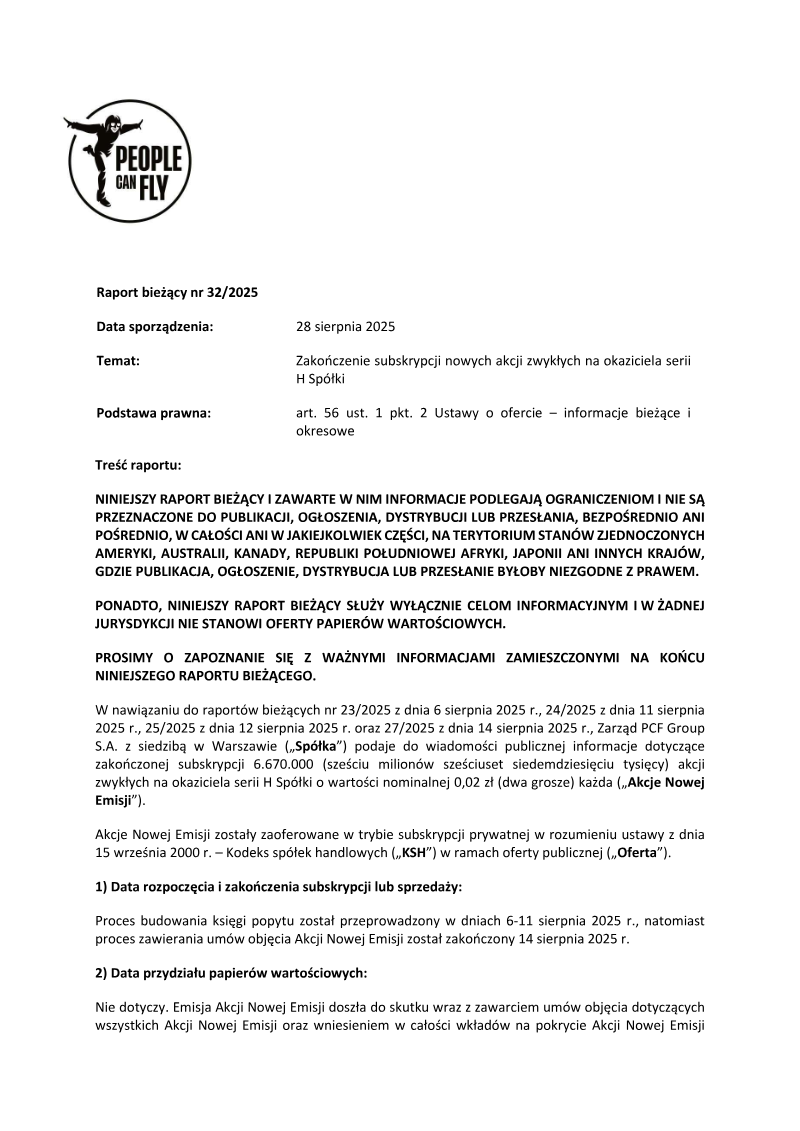
Raport Bieżący Nr 32/2025: Zakończenie Subskrypcji Nowych Akcji Zwykłych na Okaziciela Serii H Spółki
PCF Group S.A. has formally concluded the private subscription of 6,670,000 new series H ordinary bearer shares. The primary purpose of this announcement is to confirm the successful completion of the issuance process, which was conducted as a private subscription under the Polish Commercial Companies Code. The total value of the offering reached 20,010,000 PLN, with each share issued at a price of 3.00 PLN.
The subscription process involved a book-building phase held between August 6 and August 11, 2025, with all subscription agreements finalized by August 14, 2025. The shares were fully covered by cash contributions from 16 investors. Because the issuance was fully subscribed through these agreements, no formal allocation process or reduction in the number of shares was necessary. The company has noted that final costs associated with the offering are currently being reconciled and will be disclosed in a subsequent report once verified by the involved parties.
This transaction was restricted to qualified investors and was not subject to a public prospectus requirement under European Union regulations. The offering was limited to specific jurisdictions, explicitly excluding the United States, Australia, Canada, Japan, and South Africa, in compliance with international securities laws. The company maintains that this disclosure is for informational purposes only and does not constitute a recommendation or a public offer of securities in any jurisdiction where such action would be unlawful.
- PCF Group S.A. has successfully completed a private subscription of 6,670,000 new series H ordinary bearer shares.
- The offering raised a total of 20,010,000 PLN, with each share priced at 3.00 PLN.
- The issuance was fully subscribed by 16 investors, eliminating the need for a formal allocation process or share reduction.
- Subscription agreements were finalized by August 14, 2025, following a book-building phase that occurred between August 6 and August 11, 2025.
- The transaction was restricted to qualified investors and was exempt from public prospectus requirements under EU regulations.
+1
PCF Group
Report2 pages
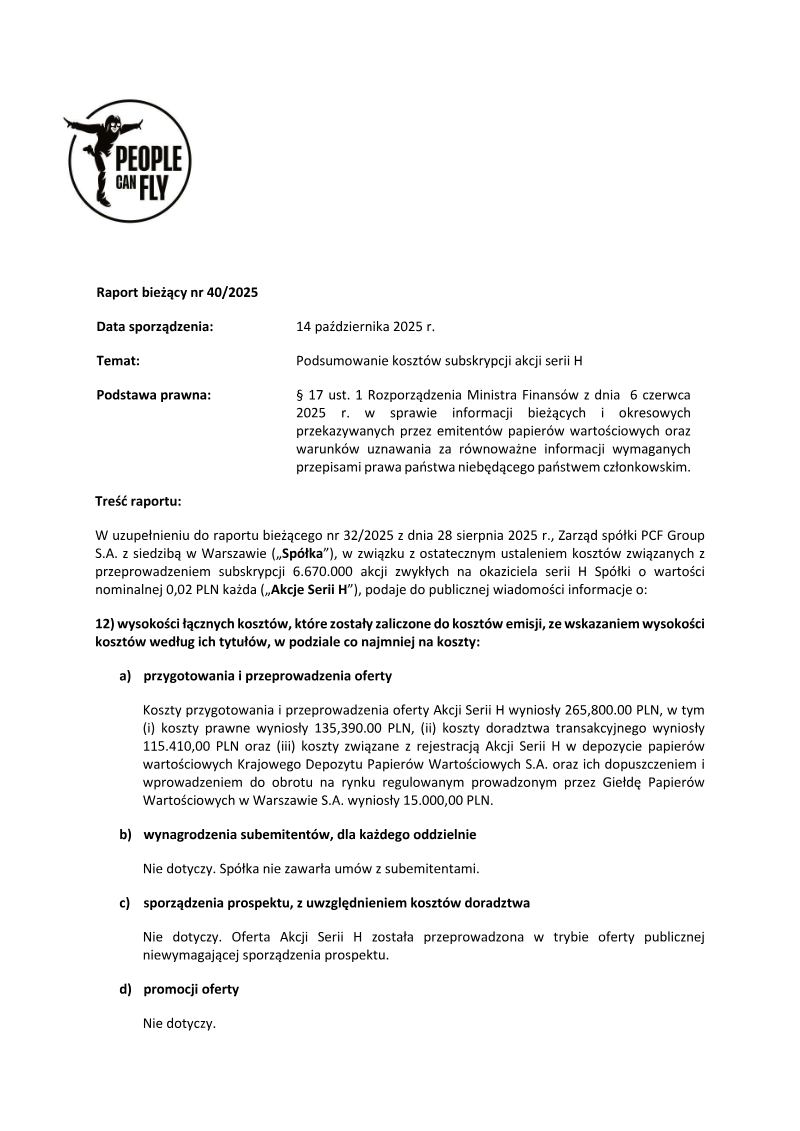
Podsumowanie kosztów subskrypcji akcji serii H
PCF Group S.A. has finalized the accounting for costs associated with the issuance of 6,670,000 series H ordinary bearer shares. The primary objective of this disclosure is to provide transparency regarding the financial expenditures incurred during the subscription process, ensuring compliance with regulatory requirements for public companies listed on the Warsaw Stock Exchange.
The total cost of the series H share issuance amounted to 265,800.00 PLN. These expenses were exclusively related to the preparation and execution of the offer, as the company did not utilize sub-underwriters, nor was a prospectus required for this specific offering. The breakdown of these costs includes 135,390.00 PLN for legal services, 115,410.00 PLN for transactional advisory services, and 15,000.00 PLN for registration and admission fees with the Central Securities Depository of Poland and the Warsaw Stock Exchange.
The average cost per unit for the subscription of series H shares is approximately 0.04 PLN. In terms of financial reporting, the company has accounted for these issuance costs by reducing the reserve capital derived from the surplus of the issue price over the nominal value of the shares. This summary reflects the final financial impact of the capital increase as of October 2025, confirming that no promotional or additional sub-underwriting costs were incurred during the transaction.
- PCF Group S.A. incurred total costs of 265,800.00 PLN for the issuance of 6,670,000 series H ordinary bearer shares.
- The average cost per share for the subscription process was approximately 0.04 PLN.
- Legal services accounted for the largest portion of expenses at 135,390.00 PLN, followed by 115,410.00 PLN for transactional advisory services.
- Registration and admission fees for the Warsaw Stock Exchange and the Central Securities Depository of Poland totaled 15,000.00 PLN.
- The company financed these issuance costs by reducing the reserve capital derived from the surplus of the issue price over the nominal share value.
PCF Group
Report114 pages
Vietnam Innovation and Private Capital Report: 2025
Vietnam’s 2025 Innovation and Private Capital Report positions the country as a rapidly ascending tech‑investment hub in Southeast Asia, underpinned by steady macro growth and decisive policy support. A 6 % annual real GDP expansion, a $36 B digital economy, and the landmark Resolution No. 57‑NQ/TW collectively create a macro‑environment that attracts both domestic and foreign capital. Private‑capital activity in 2024 totaled $2.3 B across 141 deals, with buyouts dominating but early‑stage venture capital rebounding sharply in the second half of the year. High‑tech sectors—particularly AI, AgriTech, Green Tech, semiconductors, and data centers—experienced multi‑fold funding surges, reflecting a shift toward technology‑driven value creation.
The labor market fuels consumer and industrial demand: Vietnam ranks second in Southeast Asia for workforce size, with a growing middle‑affluent class projected to exceed 45 % of the population by 2030. Strong education outcomes and a youthful, tech‑savvy demographic drive growth in retail, e‑commerce, digital health, and edtech. Tier‑2 cities such as Bac Ninh, Can Tho, and Da Nang emerge as new growth poles, supported by government investment in transportation, renewable energy, and digital infrastructure.
Resolution No. 57 sets ambitious 2030–2045 targets—30–50 % GDP share from digital and high‑tech exports, 80 % cashless transactions, and 2 % of GDP allocated to R&D (60 % private). It outlines strategic actions in AI, 6G, talent development, and digital governance to attract at least five global tech giants for R&D and manufacturing. Projected economic gains from AI alone could reach $120 B by 2040, while renewable energy and climate‑tech investments are already reshaping the power sector through flexible PPAs and green‑credit programs.
Overall, Vietnam’s coordinated policy framework, expanding talent pool, and maturing private‑capital ecosystem converge to make the country a compelling destination for long‑term value creation across high‑growth technology, green infrastructure, and consumer markets within Southeast Asia.
- Vietnam’s digital economy has reached a valuation of $36 billion, supported by a 6% annual real GDP growth rate.
- Private capital investment in 2024 totaled $2.3 billion across 141 deals, with a notable rebound in early-stage venture capital during the second half of the year.
- Resolution No. 57-NQ/TW mandates that by 2030–2045, digital and high-tech exports must account for 30–50% of GDP, with 2% of GDP allocated to R&D.
- The middle-affluent class is projected to exceed 45% of the total population by 2030, driving significant demand in retail, e-commerce, digital health, and edtech.
- AI integration is projected to generate $120 billion in economic gains for Vietnam by 2040, supported by strategic government initiatives in 6G and digital governance.
+1
Boston Consulting GroupFeb 2026
Report21 pages
2026 US Venture Capital Outlook
The 2026 US venture capital outlook projects a cautiously optimistic landscape, driven largely by an explosive surge in early‑stage activity and the continued dominance of artificial intelligence (AI) startups. AI firms now command 65 % of venture capital, fueling near‑record first‑financing counts and setting a high bar for late‑stage valuations. While liquidity remains the primary constraint—exit values are projected below $300 billion and limited LP enthusiasm persists—the emergence of improved secondary markets and a potential rebound in initial public offerings are expected to alleviate pressure. Multistage firms that focus on seed rounds are poised to sustain growth across both early and later stages, yet emerging managers may face fundraising challenges that could curtail diversification.
A widening gap between AI‑focused, high‑growth startups and their slower‑moving peers is evident. In Q3 2025 the United States hosted 830 active unicorns with a record $3.9 trillion post‑money valuation, yet many of these firms are liquidity‑constrained and struggle to secure follow‑on funding. AI companies dominate late‑stage deals, with median Series C and D+ valuations reaching $838 million; AI rounds exceed non‑AI deals by roughly 26 % at Series D+, underscoring investor confidence in the AI boom while highlighting potential risks if public AI valuations contract.
Fundraising is projected to rebound to $100‑$130 billion in 2026, largely driven by recycled distributions that are expected to account for roughly 70 % of new commitments. Strong exit activity through 2025 and renewed interest in AI‑focused funds—such as a $10 billion Andreessen Horowitz vehicle—underpin this outlook. However, risks remain: a potential liquidity reversal or recession‑induced sentiment decline could keep commitments below $100 billion, tempering the projected recovery.
- AI startups currently command 65% of all venture capital, driving record-high median valuations of $838 million for Series C and D+ rounds.
- The US venture capital market is projected to see a fundraising rebound to $100–$130 billion in 2026, with approximately 70% of new commitments expected to come from recycled distributions.
- As of Q3 2025, the US hosted 830 active unicorns with a combined post-money valuation of $3.9 trillion, though many face significant liquidity constraints and difficulties securing follow-on funding.
- AI-focused late-stage deals currently command a 26% valuation premium over non-AI counterparts, creating a widening performance gap between high-growth AI firms and slower-moving peers.
- Liquidity remains a primary market constraint, with total exit values for 2026 projected to remain below $300 billion despite anticipated improvements in secondary markets and IPO activity.
+2
PitchBookJan 2026

Report39 pages
Business Case for an Enhanced Video Games Expenditure Credit: UK
The analysis argues that a targeted increase in the Video Games Expenditure Credit (VGEC) would markedly strengthen the United Kingdom’s competitive position within the global video‑games sector. By raising the nominal rate to 53 % for projects up to £10 million and to 39 % for larger productions, the model predicts an additional £530 million in gross value added (GVA) and roughly 6,000 new full‑time jobs over five years. The return on investment is projected at £2.12 of GVA and tax revenue for every £1 spent, positioning the UK as one of the most attractive jurisdictions for game development.
Key findings highlight a worldwide contraction in employment, with 30 000 layoffs expected between 2023 and 2024, prompting a shift toward freelance and subcontracted talent. Venture‑capital funding has fallen sharply from $9 billion in 2020 to just over $3 billion by early 2024, while indie sales on platforms such as Steam now account for nearly 70 % of full‑game revenue. These trends underscore the need for flexible, cost‑efficient production models and a supportive fiscal environment.
Comparative analysis shows that the current UK VGEC effective rate of 14 % is lower than those in France (20.2 %) and Canada’s Quebec (18.2 %). The proposed tiered scheme would raise the UK rate to 20.6 %, matching or surpassing many international competitors and potentially adding an extra 5,000 full‑time equivalents over five years. Across all scenarios, the cost‑benefit profile remains favorable, with GVA returns of £1.3–£1.4 per £1 invested and tax returns of £0.4–£0.5 per £1.
In sum, the enhanced VGEC package delivers a superior economic return by stimulating export‑driven intellectual property creation and supporting both small studios and multinational operations. The model demonstrates that a carefully calibrated incentive structure can offset macro‑economic pressures, sustain employment growth, and secure the UK’s position as a global leader in video‑game development.
- Increasing the Video Games Expenditure Credit (VGEC) to a tiered rate of 53% for projects under £10 million and 39% for larger productions is projected to generate £530 million in additional gross value added (GVA) and 6,000 new full-time jobs over five years.
- The proposed fiscal enhancement would raise the UK’s effective VGEC rate to 20.6%, surpassing current rates in France (20.2%) and Quebec (18.2%) to improve international competitiveness.
- Every £1 of government investment in the enhanced VGEC is projected to yield a return of £2.12 in combined GVA and tax revenue.
- The global video game industry faces significant contraction, with 30,000 layoffs expected between 2023 and 2024 and venture capital funding dropping from $9 billion in 2020 to roughly $3 billion by early 2024.
- Indie game sales on platforms like Steam now represent nearly 70% of total full-game revenue, highlighting a market shift toward smaller, cost-efficient production models.
+1
UkieDec 2025
Report4 pages
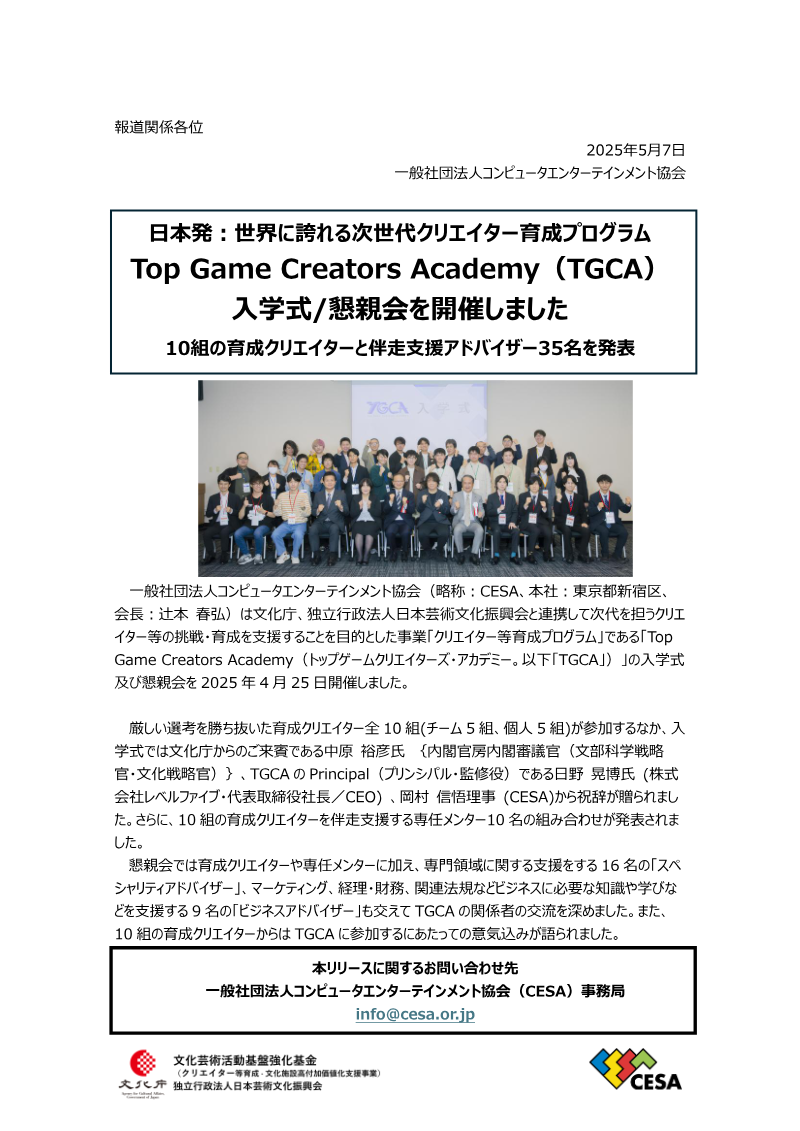
Top Game Creators Academy: 入学式/懇親会を開催しました
The Top Game Creators Academy (TGCA) was inaugurated on 25 April 2025 as a joint initiative of the Cultural Agency, the Japan Arts and Culture Promotion Agency, and the Computer Entertainment Association (CESA) to cultivate next‑generation game creators capable of delivering original IP that can compete globally. Ten selected teams—five groups and five individual creators—were formally admitted, accompanied by thirty‑five advisors who will provide ongoing mentorship, specialty guidance, and business support throughout a two‑year development cycle.
The program draws on the Cultural Arts Activity Strengthening Fund, allocating public resources to enable intensive, mentor‑driven training. Each creator cohort is paired with a dedicated mentor from leading studios such as Bandai Namco, Capcom, and Square Enix, while sixteen specialty advisors cover visual art, engineering, design, sound, and project management, and nine business advisors address marketing, finance, and legal matters. Progress meetings occur monthly, fostering collaborative feedback within multi‑person groups rather than one‑on‑one pairings.
Participants will showcase their work at major industry events, beginning with an online appearance at CEDEC in July 2025, a debut at Tokyo Game Show in September 2025, and subsequent exhibitions at the Taipei Game Show in January 2026, with potential expansion to international venues such as Gamescom in 2026. The cohort aims to graduate by March 2027, having refined both creative and commercial competencies to launch globally competitive titles.
- The Top Game Creators Academy (TGCA) launched on 25 April 2025 to develop globally competitive original IP through a two-year intensive mentorship program.
- The cohort consists of 10 teams—5 groups and 5 individuals—supported by a network of 35 advisors, including 16 specialty experts and 9 business consultants.
- Mentorship is provided by industry leaders from major studios, specifically Bandai Namco, Capcom, and Square Enix.
- The program is funded by the Cultural Arts Activity Strengthening Fund, a joint initiative involving the Cultural Agency, the Japan Arts and Culture Promotion Agency, and CESA.
- Participants will debut their projects at CEDEC in July 2025 and Tokyo Game Show in September 2025, followed by Taipei Game Show in January 2026.
+2
CESA – Computer Entertainment Supplier's AssociationMay 2025

Report67 pages
Studie Vlaams Gamebeleid: Eindrapport
The Flemish game industry stands at a critical juncture, requiring a strategic pivot from project-based support toward comprehensive business scaling and economic consolidation. While the sector has seen a rise in the number of studios between 2020 and 2024, growth remains heavily concentrated among a few major players, creating a fragile ecosystem characterized by a lack of mid-sized companies. To ensure long-term viability and competitiveness within the global market—which is currently valued at approximately 187.7 billion dollars—Flemish policy must evolve to address the "missing middle" by facilitating access to private capital and fostering entrepreneurial maturity.
Current support mechanisms, including the VAF/Gamefonds and the Tax Shelter, have been instrumental in initial development but are increasingly viewed as insufficient for the demands of international scaling. Global competition, driven by aggressive fiscal incentives in regions like Canada and France, necessitates a more robust and integrated financial instrumentarium. Stakeholders emphasize that while talent development remains a strength, the sector suffers from a lack of commercial focus, high production costs, and difficulties in retaining intellectual property. Consequently, there is a clear mandate to shift policy priorities toward attracting foreign investment, enhancing international promotion, and streamlining governance through a centralized strategic body.
Ultimately, the objective for the 2026–2030 period is to transition the Flemish games sector into a more stable, economically diverse industry. This requires a dual approach: optimizing existing public funding to better support commercial growth and implementing new, flexible economic tools that bridge the gap between early-stage prototyping and market-ready maturity. By aligning educational outputs with industry needs, fostering cross-sectoral collaboration, and prioritizing business development over isolated project subsidies, the region can mitigate the risks of brain drain and build a resilient, internationally recognized gaming hub.
- The Flemish game industry lacks a 'missing middle' of mid-sized companies, with growth concentrated among a few major players despite an increase in total studio numbers between 2020 and 2024.
- To compete in the $187.7 billion global market, Flemish policy must shift from project-based subsidies toward business scaling and private capital access for the 2026–2030 period.
- Existing support mechanisms like the VAF/Gamefonds and the Tax Shelter are currently insufficient to match the aggressive fiscal incentives offered by international competitors such as Canada and France.
- The sector faces structural challenges including high production costs, difficulties in retaining intellectual property, and a lack of commercial focus despite strong local talent development.
- Strategic priorities for the next five years include attracting foreign investment, enhancing international promotion, and establishing a centralized governance body to oversee industry development.
+1
Departement CultuurMay 2025
Report19 pages
Global Gaming M&A and Growth Financing Advisory: Q1 2025
The global gaming industry experienced a notable resurgence in early 2025, characterized by a rebound in merger and acquisition activity and sustained interest in private financing. During the first quarter, 48 announced acquisitions reached a total value of $4.4 billion, anchored by the significant $3.5 billion acquisition of Niantic’s games division by Scopely. Simultaneously, the private placement market remained active, recording 149 deals worth $3.5 billion. These investments were primarily concentrated in mobile-focused developers and companies integrating artificial intelligence into their entertainment platforms, with major strategic entities like Savvy Games Group and Tencent continuing to drive market momentum.
Despite this activity, the financial landscape remains bifurcated. While the broader sector shows signs of recovery, with the Drake Star Gaming Index posting a 16.37% gain, performance remains highly volatile across the top 35 public gaming companies. Valuation disparities are particularly pronounced; industry leaders such as NVIDIA and AppLovin command premium revenue multiples, while many other firms face a more challenging environment. Furthermore, while early-stage funding remains accessible, later-stage financing continues to present significant hurdles for companies seeking capital.
Looking forward, the industry is positioned for a gradual increase in consolidation as public markets stabilize. Strategic focus is shifting toward the integration of AI and advanced technological platforms, which are expected to serve as primary catalysts for future growth. As market conditions improve, the sector is likely to see a renewed pipeline of initial public offerings, signaling a transition toward a more mature and diversified investment climate for global gaming stakeholders.
- Q1 2025 saw 48 M&A deals totaling $4.4 billion, headlined by Scopely’s $3.5 billion acquisition of Niantic’s games division.
- The private placement market recorded 149 deals worth $3.5 billion, with capital primarily flowing into mobile developers and AI-integrated entertainment platforms.
- The Drake Star Gaming Index rose 16.37% in Q1 2025, though performance remains volatile across the top 35 public gaming companies.
- Valuation gaps are widening, with industry leaders like NVIDIA and AppLovin commanding premium revenue multiples while other firms face significant capital constraints.
- While early-stage funding remains accessible, companies seeking later-stage financing continue to face substantial hurdles.
+2
Drake StarJan 2025

Report8 pages
Dynamics of Gaming Deals
The analysis tracks global venture‑capital activity in the video‑game sector from the first quarter of 2019 through the second quarter of 2024, focusing on deals funded by VCs, strategic investors and publishers. It quantifies total capital deployed and deal counts, revealing a rapid expansion from $2 billion across 117 transactions in 2019 to a peak of $5.3 billion in 2021 (186 deals), followed by a sharp contraction in 2022 to $1.8 billion (126 deals) and a further dip to $874 million in 2023 (148 deals). Early‑stage financing remained relatively stable throughout, while the decline was driven primarily by fewer Series A‑plus rounds, creating a scarcity of growth‑stage capital. The report notes a modest rebound in 2024, with new funds entering the market and higher expected returns despite lingering marketing and user‑acquisition challenges.
Geographically, investors increasingly target emerging regions such as South America, Eastern Europe, Southeast Asia and China, seeking cost‑efficient teams and pre‑seed opportunities. Mobile games continue to dominate the funding landscape, yet interest in mid‑tier “AA” titles is growing, reflecting a shift toward projects that promise shorter payback periods and stronger ROI. The pandemic‑driven hyper‑casual boom accelerated user‑acquisition technology, while post‑pandemic privacy changes (e.g., Apple’s IDFA restrictions) and macro‑economic headwinds have dampened overall spend and slowed M&A and IPO activity.
Methodologically, the 2019 figures are derived from the Games Fund team’s synthesis of publicly available sources, while data for 2020‑2024 come from the investgame.net analytical platform. The combined dataset provides a comprehensive view of deal volume, value and regional distribution, supporting the conclusion that the gaming VC market exhibits pronounced cyclical dynamics, with early‑stage resilience and emerging‑region optimism offset by a constrained growth‑stage pipeline and broader economic uncertainty.
- Global gaming VC investment peaked at $5.3 billion across 186 deals in 2021 before contracting sharply to $874 million in 2023.
- The decline in total capital was primarily driven by a scarcity of Series A-plus growth-stage funding, even as early-stage financing remained relatively stable.
- A modest market rebound is underway in 2024, supported by the entry of new funds and expectations for higher returns despite ongoing user-acquisition challenges.
- Investors are shifting focus toward emerging regions including South America, Eastern Europe, Southeast Asia, and China to access cost-efficient development teams and pre-seed opportunities.
- While mobile games remain the dominant funding category, there is a growing investor preference for mid-tier 'AA' titles that offer shorter payback periods and stronger ROI.
+1
The Games FundJan 2025