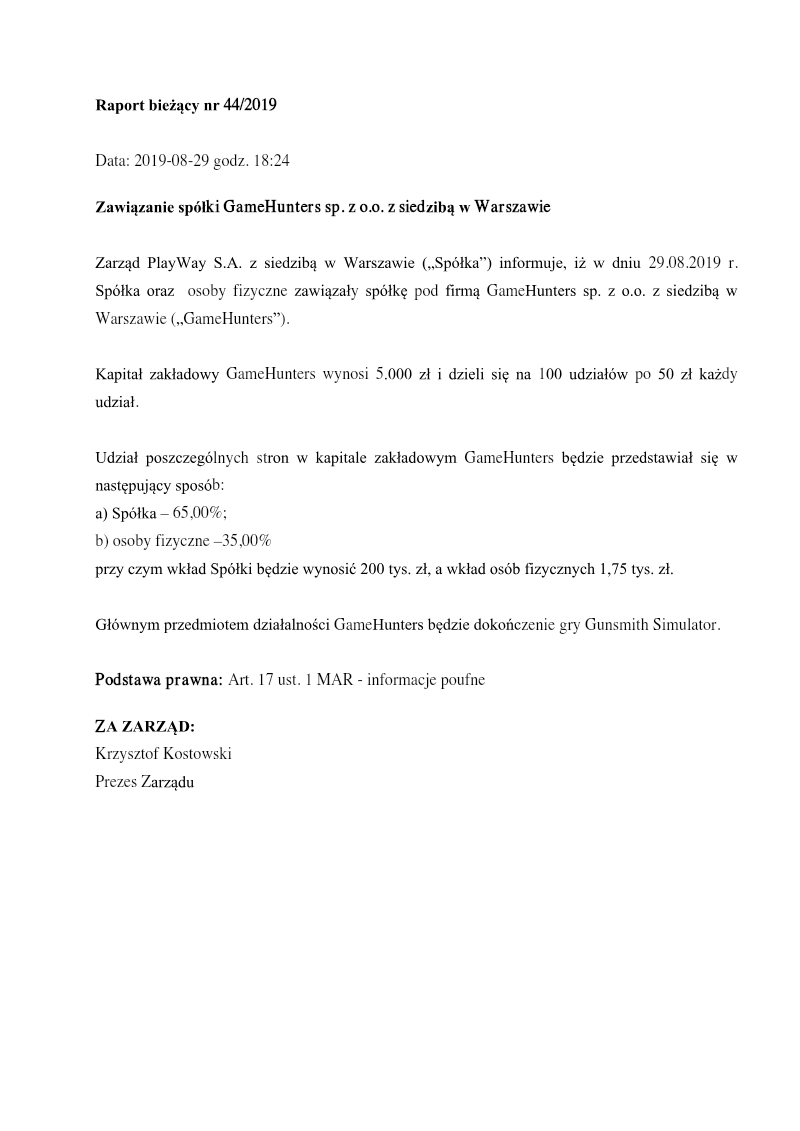
PlayWay S.A. has formally expanded its corporate structure through the establishment of a new subsidiary, GameHunters Sp. z o.o., based in Warsaw, Poland. This strategic move, finalized on August 29, 2019, involves a partnership between the parent company and private individuals to foster specialized game development. The primary operational objective for this new entity is the completion and delivery of the title Gunsmith Simulator, signaling a focused approach to niche simulation software within the broader gaming market.
The financial structure of GameHunters consists of a share capital of 5,000 PLN, divided into 100 shares with a nominal value of 50 PLN each. PlayWay S.A. maintains a controlling interest in the venture, holding 65% of the shares, while the remaining 35% is held by the participating natural persons. Despite the nominal share capital, the initial capital contributions reflect a significant disparity in investment, with PlayWay S.A. providing 200,000 PLN compared to the 1,750 PLN contributed by the individual partners.
This formation follows the standard regulatory requirements for public companies in Poland, specifically adhering to the Market Abuse Regulation regarding the disclosure of inside information. By establishing GameHunters as a dedicated vehicle for Gunsmith Simulator, PlayWay S.A. continues its established business model of incubating smaller development teams and specific intellectual properties under its corporate umbrella to diversify its portfolio and manage project-specific risks.
PlayWay · 2026
PlayWay · 2026
PlayWay · 2026
PCF Group · 2025
PlayWay · 2025
PlayWay · 2025
PlayWay · 2025
PlayWay · 2025
PlayWay · 2025
PlayWay · 2025
PlayWay · 2025
PlayWay · 2025
11 bit studios · 2025
11 bit studios · 2025
11 bit studios · 2025
PCF Group · 2024
PCF Group · 2024
PCF Group · 2023
PCF Group · 2023
PCF Group · 2023
PCF Group · 2023
PCF Group · 2023
PCF Group · 2023
PCF Group · 2023