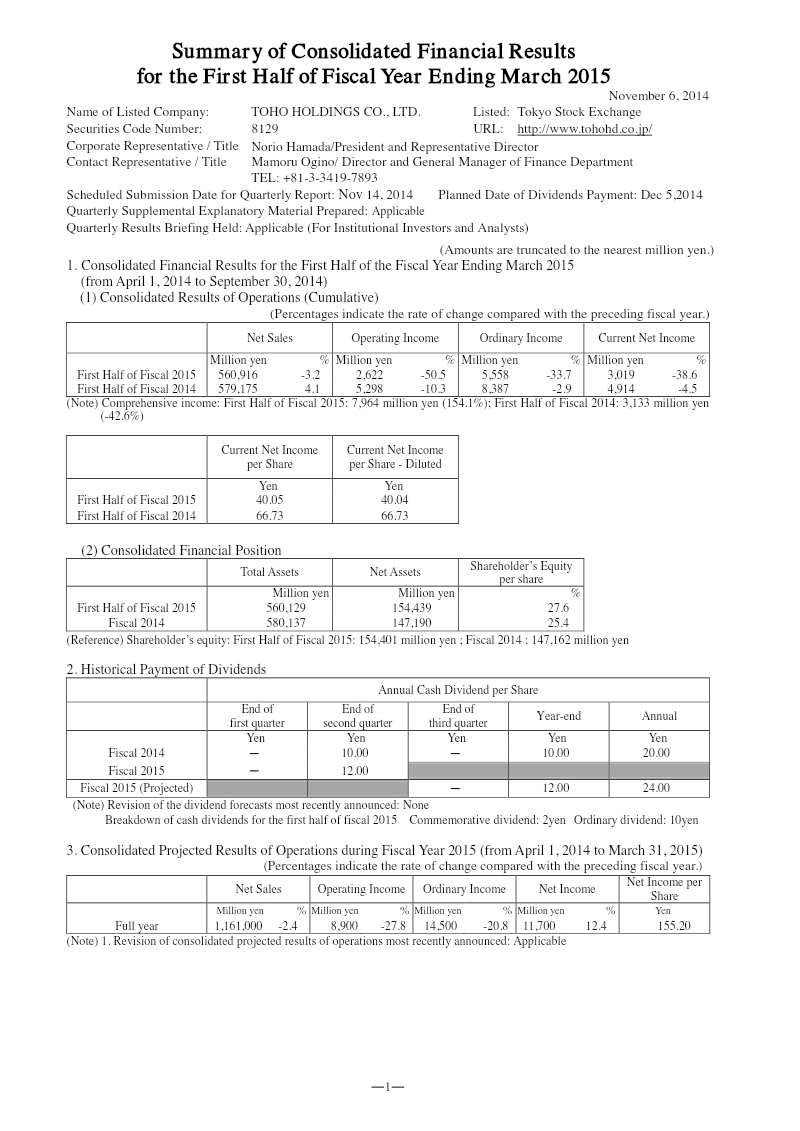
TOHO HOLDINGS reported a 50.5% decline in operating income to 2,622 million yen and a 3.2% decrease in net sales to 560,916 million yen for the first half of the fiscal year ending March 2015.
See it on page 1The primary pharmaceutical wholesaling segment experienced a 42.6% drop in segment income, driven by faster-than-expected transitions to generic drugs and national health insurance price reductions.
See it on page 4The dispensing pharmacy business saw an 86.7% collapse in segment income despite a 6.3% increase in sales, primarily due to elevated personnel and new pharmacy opening costs.
See it on page 4Ordinary income and net income fell by 33.7% and 38.6% respectively, prompting the company to revise its full-year earnings forecast for the fiscal year ending March 2015.
See it on page 1Operating cash flow improved to an inflow of 15,184 million yen, supported by a reduction in notes and accounts receivable, while total liabilities decreased by 6.3% to 405,690 million yen.
See it on page 5Market performance was negatively impacted by a combination of national health insurance drug price cuts, a shift toward generic pharmaceuticals, and a contraction following a consumption tax hike.
See it on page 4TOHO HOLDINGS CO., LTD. reported a challenging financial performance for the first half of the fiscal year ending March 2015, characterized by declines across all primary profitability metrics. The company recorded net sales of 560,916 million yen, representing a 3.2% decrease compared to the same period in the previous fiscal year. Operating income fell by 50.5% to 2,622 million yen, while ordinary income and net income declined by 33.7% and 38.6%, respectively. These results reflect a difficult operating environment influenced by national health insurance drug price reductions, a shift toward generic pharmaceuticals, and a market contraction following a consumption tax hike.
The pharmaceutical wholesaling business, the company’s primary segment, faced significant headwinds as the transition from long-listed drugs to generics occurred more rapidly than anticipated. While the company pursued a value-added service model, it struggled to achieve projected cost efficiencies, resulting in a 3.6% decrease in segment sales and a 42.6% drop in segment income. The dispensing pharmacy business saw a 6.3% increase in sales, yet segment income plummeted by 86.7% due to rising costs associated with new pharmacy openings and personnel expenses. Other segments, including SMO operations and information equipment sales, also experienced year-on-year declines in revenue.
Geographically focused on Japan, the company’s financial position remained stable in terms of assets, though total liabilities decreased by 6.3% to 405,690 million yen. Cash flow from operating activities improved significantly to an inflow of 15,184 million yen, largely due to changes in working capital, including a reduction in notes and accounts receivable. In response to these performance trends, the company revised its full-year earnings forecast for the fiscal year ending March 2015. The results were prepared in accordance with Japanese accounting standards, including a notable change in the calculation method for retirement benefit obligations.