Marketing & User Acquisition
Campaigns, ad creatives, app store optimization and the cost of a player.
271 documents
CyberAgent
ReportFY2024 Presentation Material: January to March 2024
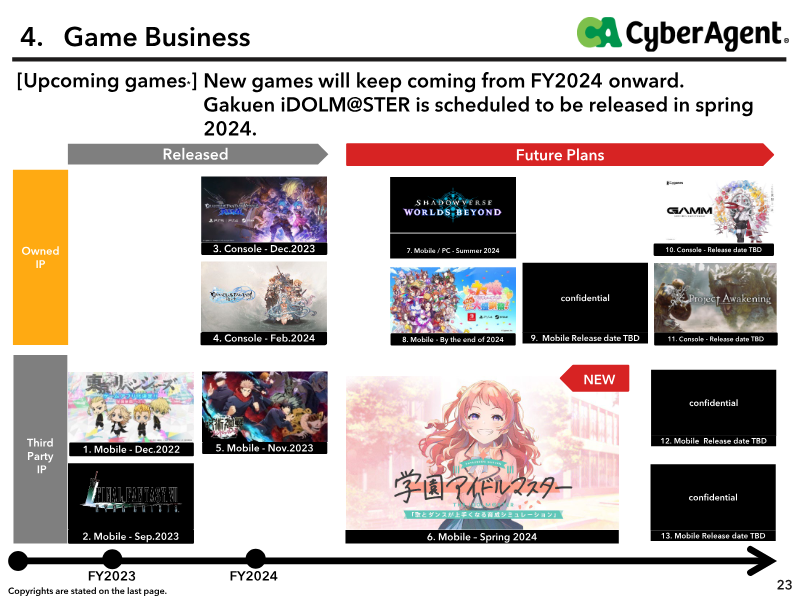
The presentation outlines CyberAgent’s FY2024 performance, emphasizing record sales and operating profit growth across its three core businesses—Internet Advertising, Media (ABEMA), and Game. Consolidated sales reached ¥215.1 billion in Q2, up 10.0% YoY, while operating profit rose to ¥21.0 billion, a 12.2% increase and the first time surpassing ¥20 billion in eight quarters. Internet Advertising sales climbed 7.1% YoY to ¥107.3 billion, with operating profit up 19.6%. The Media segment achieved a new high of ¥42.0 billion in sales, up 25.8% YoY, and turned profitable for the first time since Q2 2023; operating profit increased 0.7 billion yen. Game sales grew 8.1% YoY to ¥67.1 billion, driven by the launch of “Granblue Fantasy: Relink,” which sold one million units within eleven days, and by anniversary events for major titles; operating profit surged 19.8% YoY. Financially, SG&A expenses increased modestly by 2.9%, while cash deposits and fixed assets grew significantly, reflecting investment in technology and talent. Net income attributable to shareholders rose 30.8% YoY to ¥10.3 billion, offset by a temporary extraordinary loss. The company’s strategy focuses on leveraging generative AI and large‑language models (CyberAgentLM) to enhance ad creative, expand ABEMA’s sports content through partnerships with DAZN and WOWSPO, and sustain game revenue by launching new titles such as “Granblue Fantasy Versus” and “Umamusume Pretty Derby.” The overarching goal is to increase sales and profits, with FY2023 operating profit as a low point, and to position CyberAgent as a global digital media and technology leader.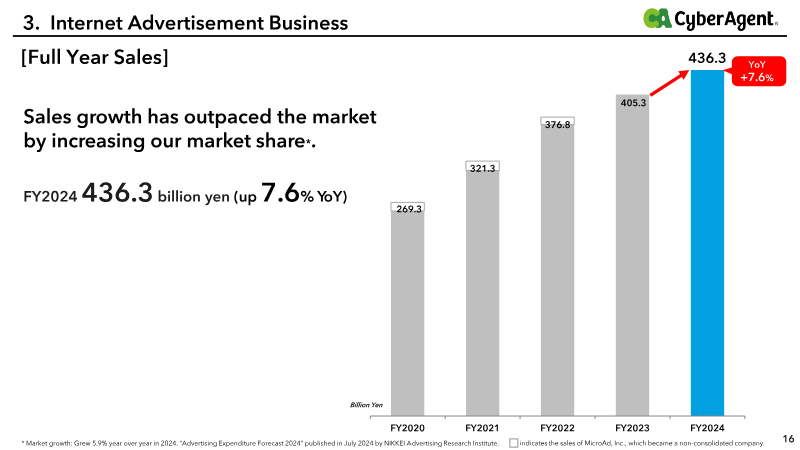

CyberAgent
ReportFY2024 Presentation Material: October 2023 to September 2024
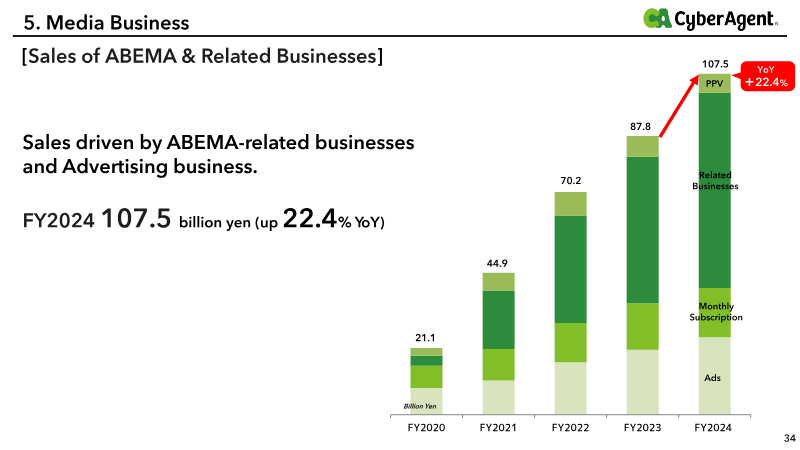
CyberAgent achieved significant financial expansion during the fiscal year ending September 2024, marking its 27th consecutive year of sales growth. Consolidated sales reached 802.9 billion yen, representing an 11.5% year-over-year increase, while operating income surged by 70.4% to 41.8 billion yen. This robust performance was underpinned by growth across all primary business segments, including a notable turnaround in the gaming division, which recorded its first year-over-year increase in three years. Looking toward fiscal year 2025, the company maintains a positive outlook, projecting continued growth in sales and operating income alongside a substantial 29.3% increase in net income. The company’s strategic focus centers on the aggressive integration of generative artificial intelligence and large language models to enhance advertising effectiveness and internal operational productivity. Simultaneously, the ABEMA media segment has emerged as a critical growth engine, reporting a 21% year-over-year sales increase and surpassing 30 million weekly active users. These results reflect a broader corporate strategy to evolve ABEMA into essential social infrastructure while leveraging group-wide synergies to foster intellectual property creation. By prioritizing long-term profitability through digital transformation and AI-driven margin improvements, the organization has successfully navigated a competitive landscape. The fourth quarter results, which saw consolidated sales reach 204.4 billion yen, underscore the effectiveness of these initiatives. Moving forward, the company remains committed to scaling its media and gaming divisions by embedding advanced technologies into its core business models, ensuring sustained value creation across its diverse portfolio of digital services.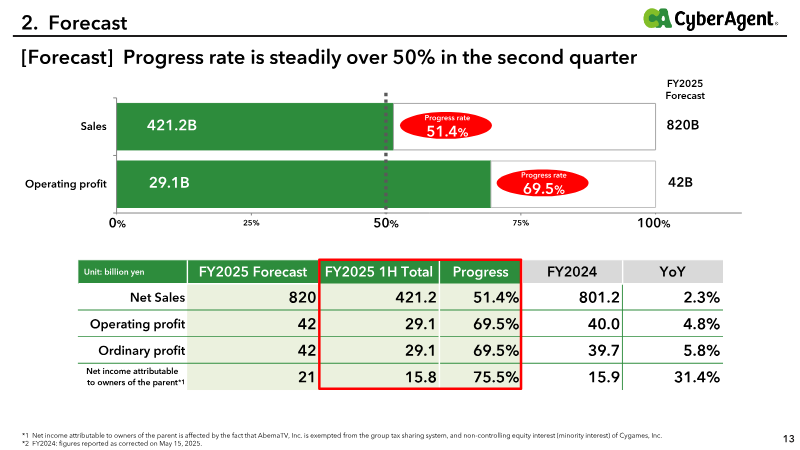
CyberAgent
Report2Q FY2025 Financial Presentation Material
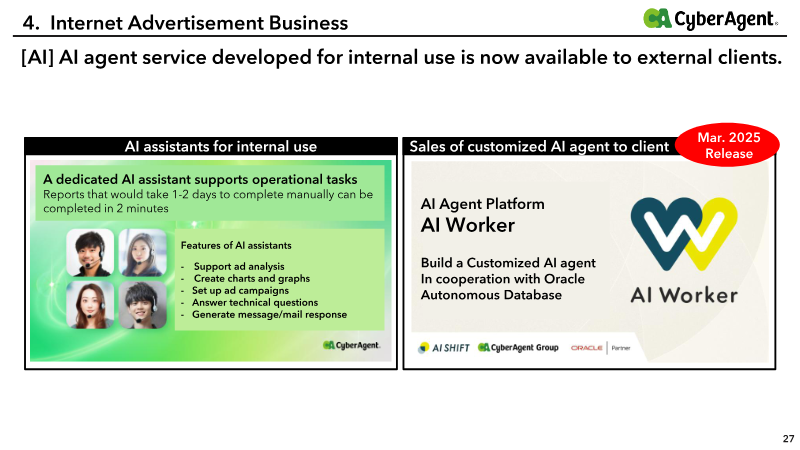
CyberAgent achieved record-high consolidated sales of 217.3 billion yen during the second quarter of fiscal year 2025, marking a 1.2 percent year-on-year increase and yielding an operating profit of 20.8 billion yen. While the Media and IP divisions and the Internet Advertisement segment demonstrated robust growth, the Game business faced a decline in both sales and profit compared to the previous year. This downturn is largely attributed to the absence of major console hits that bolstered performance in the prior period. Despite these challenges and the ongoing resolution of accounting irregularities at a consolidated subsidiary, the company maintains its full-year financial forecasts and remains committed to long-term growth. The company is currently pivoting toward a diversified business model that emphasizes a one-stop ecosystem for IP and anime, integrating content creation with global marketing and monetization strategies. Simultaneously, proprietary AI technology is being deployed to optimize advertising effectiveness and internal operational efficiency, with a strategic objective to commercialize these tools for external clients. This technological integration serves as a cornerstone for future scalability, complementing a pipeline of new game titles designed to stabilize the gaming segment. These strategic initiatives are supported by a broader corporate governance framework, as outlined in the CyberAgent Way 2024 integrated report. This framework prioritizes succession planning and comprehensive ESG commitments, ensuring organizational stability alongside market expansion. By leveraging its intellectual property portfolio and refining its digital advertising capabilities, the company aims to sustain its competitive position across the Japanese market and beyond. The focus remains on balancing immediate operational adjustments with the long-term integration of its media, advertising, and gaming segments to drive consistent shareholder value.
CyberAgent
Report1Q FY2025 Presentation Material
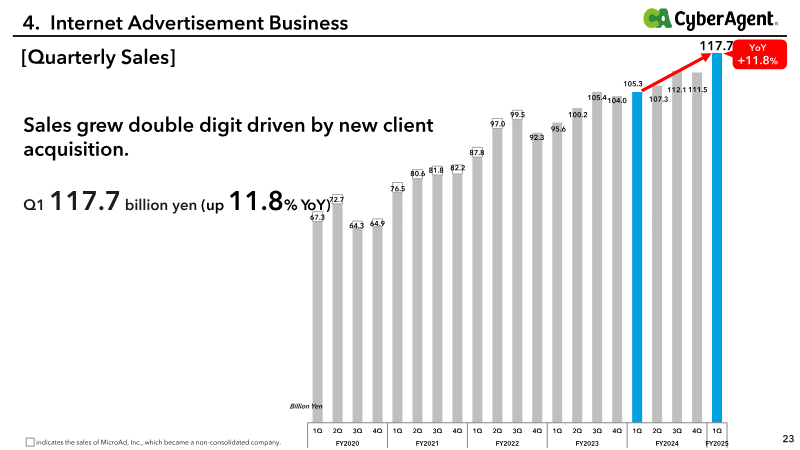
The presentation outlines CyberAgent’s FY 2025 financial outlook, operational highlights, and strategic priorities across its Media & IP, Internet Advertising, and Game divisions. FY 2025 revenue is projected at ¥820 billion with operating profit of ¥42 billion, representing 24.9 % and 19.8 % of the year‑to‑date targets, respectively. First‑quarter results show a 5.6 % YoY sales increase to ¥203.8 billion and a 32.1 % rise in operating profit to ¥8.3 billion, driven largely by a 10.5 % lift in Media & IP sales (¥55.6 billion) and an 11.8 % growth in Internet Advertising sales (¥117.7 billion). The Game segment, however, posted a 15.1 % YoY decline to ¥38.2 billion and a 4.1 % drop in operating profit, attributed to slower releases despite strong performance of new titles. Operating margins improved from 3.3 % in FY 2024 to 4.1 % in FY 2025, supported by a 32 % increase in operating income. SG&A expenses rose 4.4 % YoY to ¥45.7 billion, while cash deposits increased 11.3 % YoY to ¥205.6 billion, reflecting liquidity strengthening. Strategically, the company is shifting from a Media‑only model to an integrated Media & IP business, aiming to generate global IPs through ABEMA and new production units such as CA Soa Inc. The medium‑to‑long‑term plan emphasizes investment in high‑profit IP content, game development, and advertising technology leveraging AI to enhance ad effectiveness. The presentation also lists a pipeline of over six new games for FY 2025, including international releases, and outlines organizational changes to support the expanded IP focus.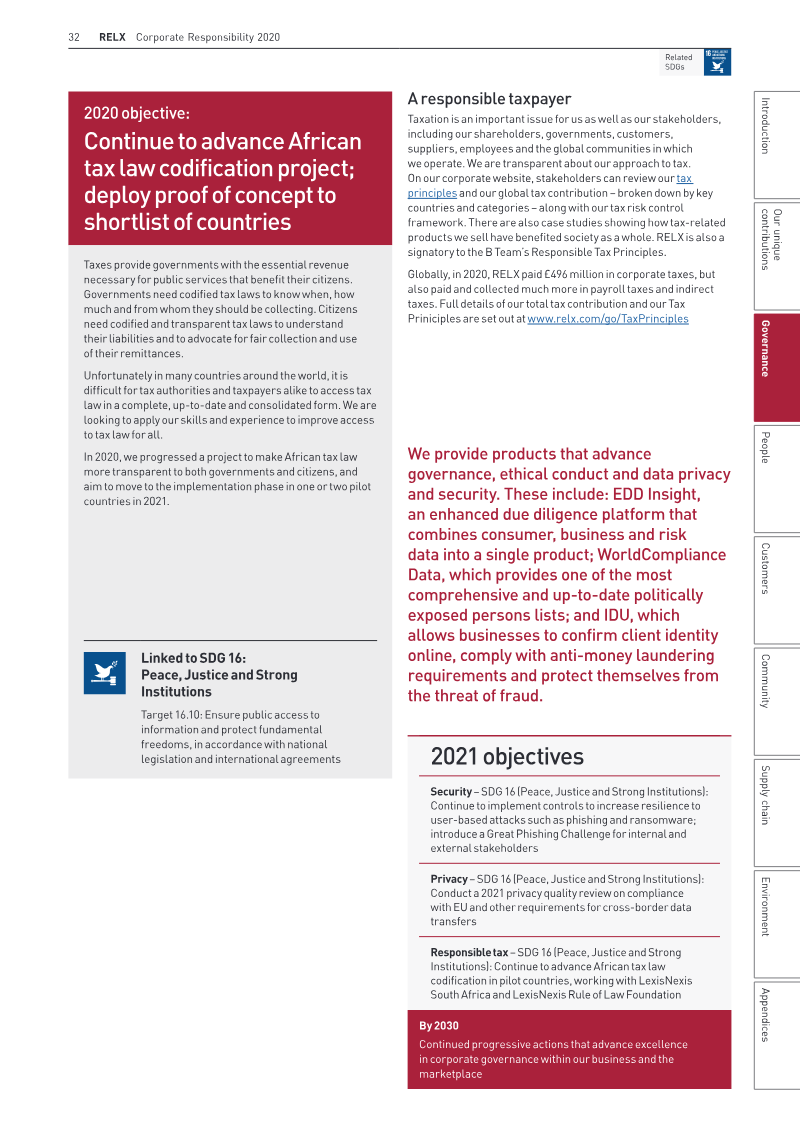

RELX
ReportCorporate Responsibility Report 2020
The 2020 Corporate Responsibility Report details how RELX integrated sustainability, ethical governance, and social impact into its global information-based analytics and decision-tool business. The primary thesis centers on the strategic alignment of core business capabilities—such as data dissemination, legal research, and scientific publishing—with the United Nations Sustainable Development Goals (SDGs). By leveraging its expertise in health, justice, and financial inclusion, the company sought to address systemic disparities while maintaining rigorous internal standards for data privacy, anti-corruption, and human rights. Key operational achievements in 2020 included reaching 100% renewable electricity usage and establishing new science-based targets to reduce Scope 1 and 2 carbon emissions by 46% by 2025. The company demonstrated significant social commitment through the "RELX Cares" program, which contributed £17.5 million in total value to community and educational initiatives, and by expanding its supply chain oversight, with 91% of tracked suppliers signing the company’s Code of Conduct. Furthermore, RELX prioritized workforce diversity and inclusion, reporting a 51% female workforce and launching extensive mental health and equity training programs to support employees during the COVID-19 pandemic. The report covers the company’s global operations throughout the 2020 fiscal year, emphasizing a transition toward digital-first products, which accounted for 87% of revenue. By utilizing frameworks such as the Taskforce on Climate-related Financial Disclosure (TCFD) and undergoing independent assurance by Ernst & Young, the company reinforced its commitment to transparency and accountability. Ultimately, the findings illustrate a comprehensive effort to embed environmental, social, and governance (ESG) priorities into the firm’s long-term business strategy, ensuring that technological innovation and corporate responsibility remain mutually reinforcing objectives.


AEVI
ReportPEGI: European Game Information
The text serves as an educational and promotional overview of the Pan‑European Game Information (PEGI) rating system, using a comic‑style narrative to capture the attention of younger gamers while delivering core information about age‑based content classification. Its central thesis is that PEGI provides the most comprehensive mechanism for informing consumers about video‑game suitability, thereby ensuring safe and informed purchasing decisions across Europe. Key points emphasize that PEGI operates in more than thirty countries and employs a traffic‑light colour scheme to convey age recommendations: green icons for games suitable for all audiences (ages 3 and 7), amber for intermediate levels, and red for titles restricted to adults (18+). The system also includes content descriptors that clarify specific elements that may affect suitability, reinforcing transparency for parents and players. The narrative illustrates the progression through various “worlds” representing age brackets—3, 7, 12, 16, and 18—highlighting that each tier is tailored to increasingly experienced gamers. The scope is continental, covering the European video‑game market and all major platforms, with references to the official website and downloadable applications for iPhone, Android, and Windows 7 Phone. No empirical methodology is presented; the piece relies on descriptive exposition and visual storytelling rather than survey data. Overall, the material positions PEGI as a reliable, universally adopted standard that guarantees 100 % informed choice for consumers.

Adjust
Report