University of California
Organization2 reports
2 reports, presentations and talks by University of California in the Game Industry Library, the newest “Cursed: A Ludic Genealogy of the Myth of El Dorado” (2024).
Documents
Whitepaper4 pages
Cursed: A Ludic Genealogy of the Myth of El Dorado
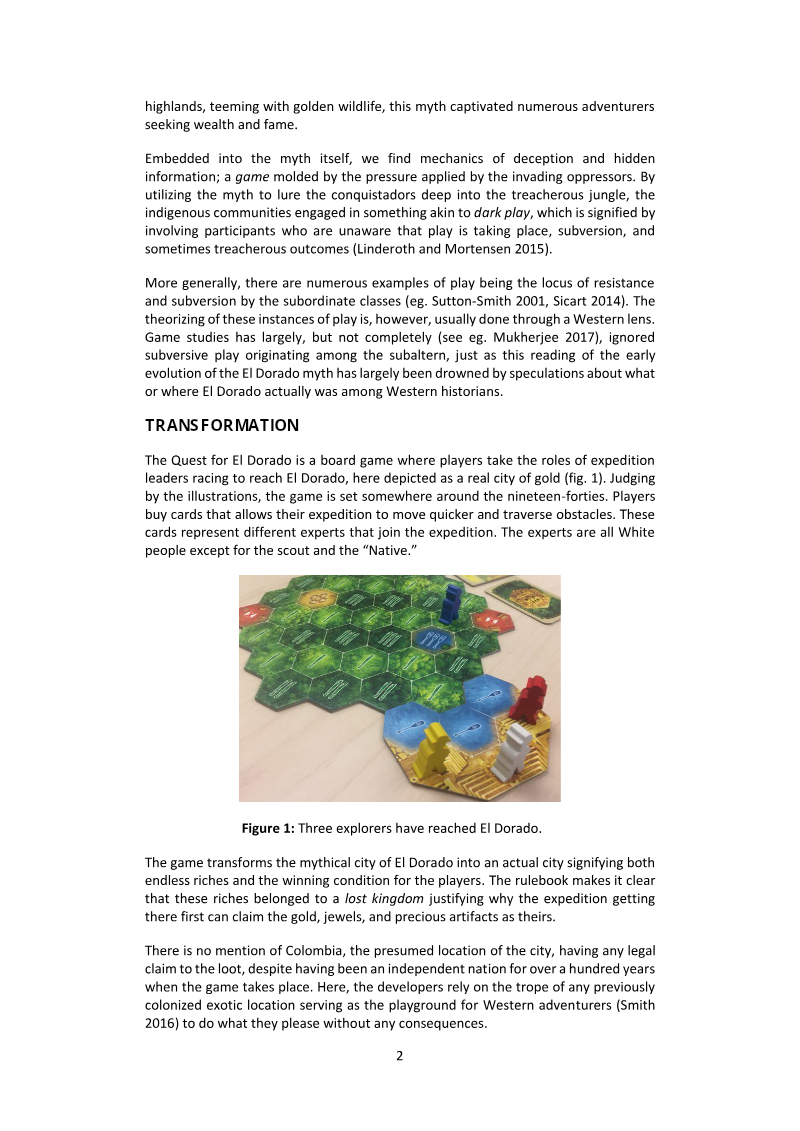
This paper offers a critical genealogy of the El Dorado myth as it has been remediated across board and video games, drawing on Foucault's approach to history as a series of interpretations shaped by power.
- The paper applies Foucault's view of history as power-shaped interpretation, using interaction criticism to trace how the El Dorado legend was reshaped by Spanish and Indigenous storytellers and later by contemporary tomb-raiding games.
- Close readings of The Quest for El Dorado and Uncharted: Drake's Fortune argue that games carry forward colonial assumptions, presenting El Dorado as a winnable city of gold and framing Western actors as heroes despite appearing to be neutral entertainment.
- The board game is criticized for casting predominantly White expert characters and for treating Colombia's sovereignty as irrelevant to the expedition's claim on the riches.
DiGRASep 2024
Whitepaper18 pages
One Size Does Not Fit All: A Smarter Way to Develop Computer Assisted Interventions for Children with ASD
Computer-assisted interventions for children with autism spectrum disorder often fail due to a reliance on standardized, one-size-fits-all designs that ignore the significant behavioral heterogeneity inherent in the population.
- Developers should abandon one-size-fits-all designs for autism interventions in favor of a four-step methodology that segments users based on specific behavioral phenotypes.
- Motion-sensing technology, such as the Microsoft Kinect, can be used to objectively categorize engagement levels and determine if a child is a suitable candidate for computer-assisted therapy.
- Children demonstrating medium-to-high engagement levels during orientation games are identified as primary targets for digital interventions, while those with low engagement levels require alternative therapeutic approaches.
West Health InstituteJun 2015