SAGE Publishing
8 reports, presentations and talks by SAGE Publishing in the Game Industry Library, the newest “To Ban or to Restore? A Systematic Review of Restorative Justice in Online Gaming Environments” (2026).
Documents
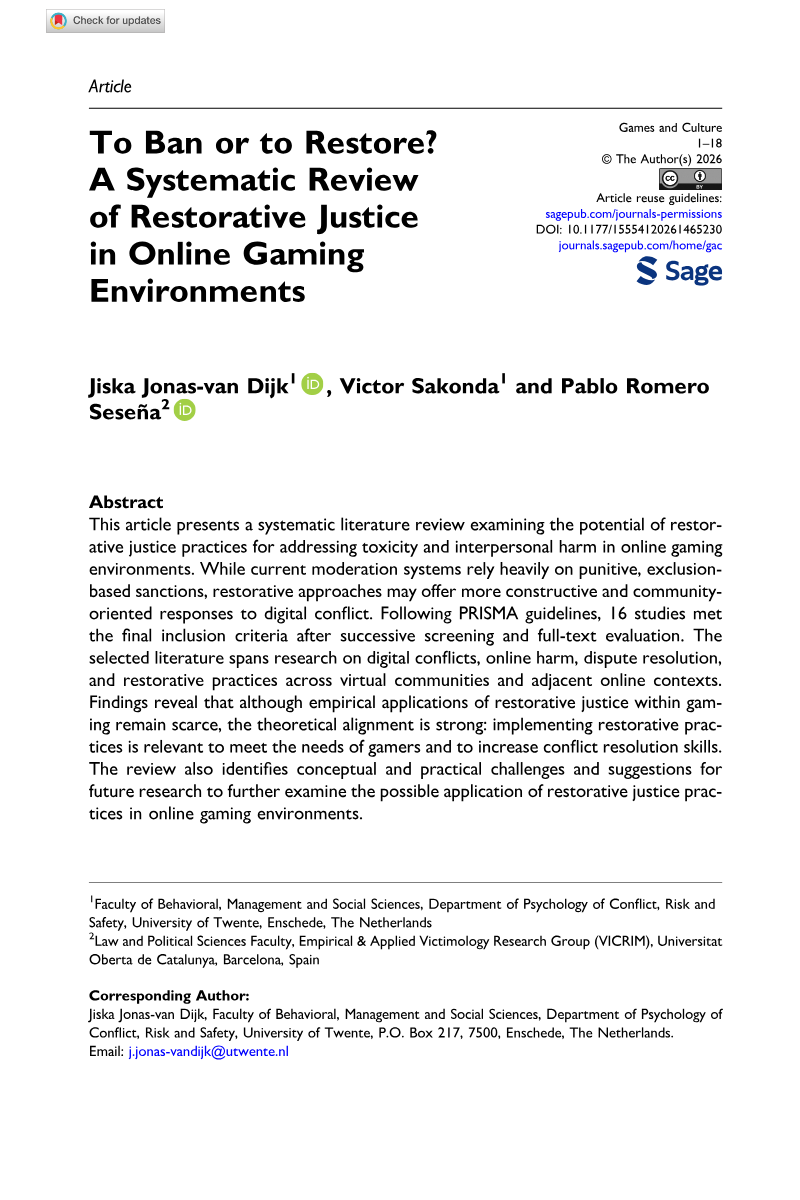
To Ban or to Restore? A Systematic Review of Restorative Justice in Online Gaming Environments
Traditional punitive moderation in online gaming, which relies heavily on exclusion and automated bans, often fails to address the underlying causes of toxicity or the needs of those harmed.
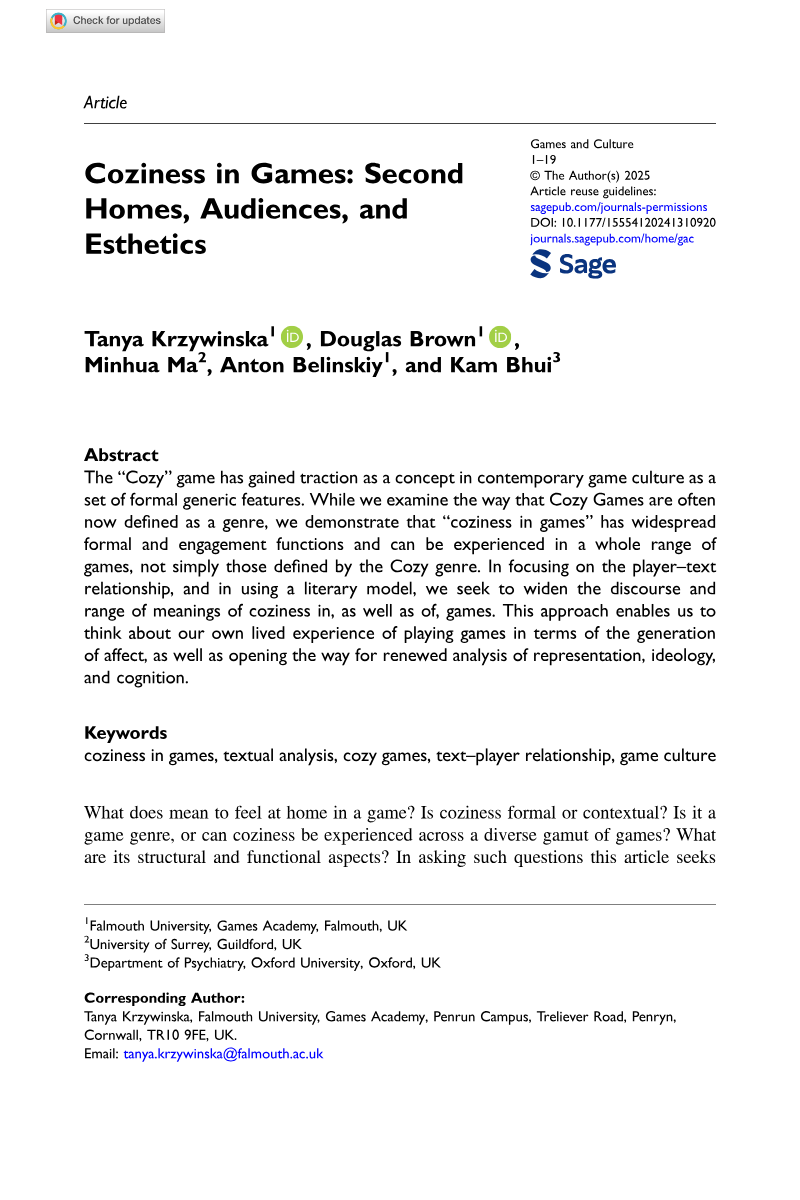
Coziness in Games: Homes, Audiences, and Esthetics
Coziness functions as a multifaceted structural and affective tool within the gaming landscape rather than a restrictive genre classification.
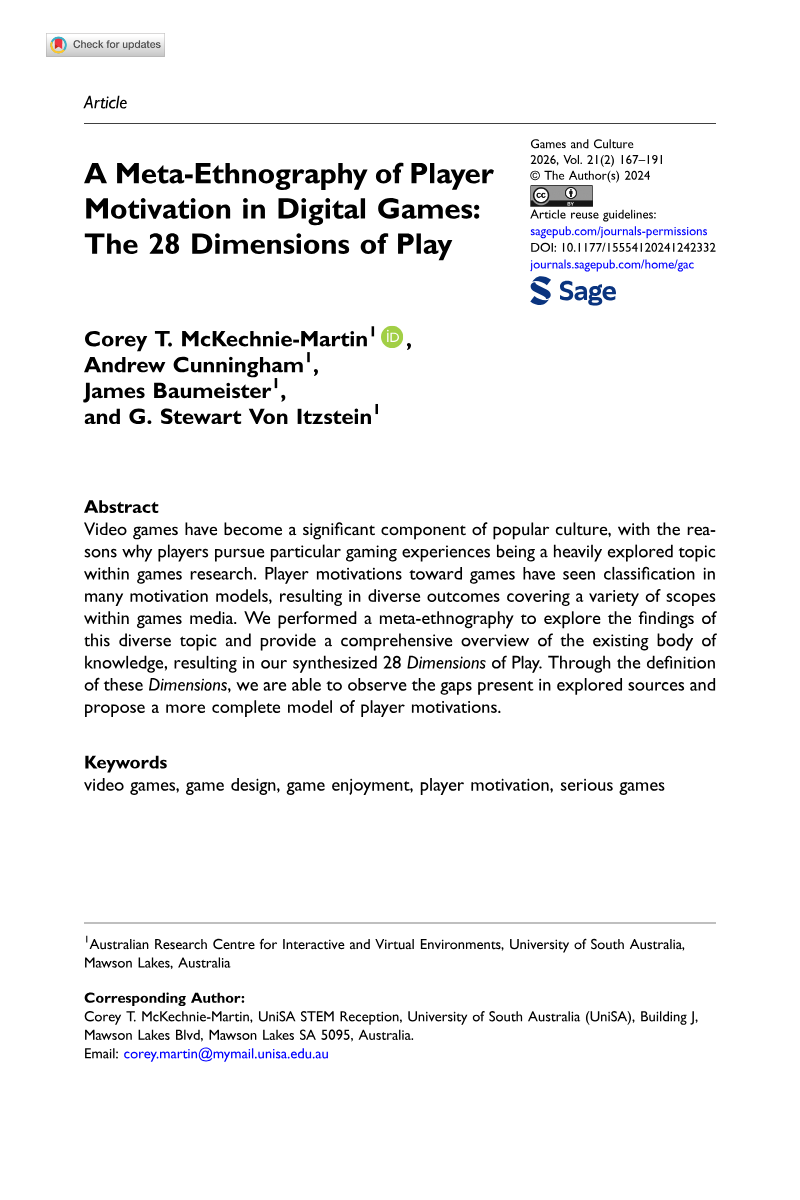
Motivation in Digital Games: The 28 Dimensions of Play
The study of digital game engagement has long suffered from fragmented research and overly simplistic player typologies that fail to capture the complexity of modern gaming experiences.
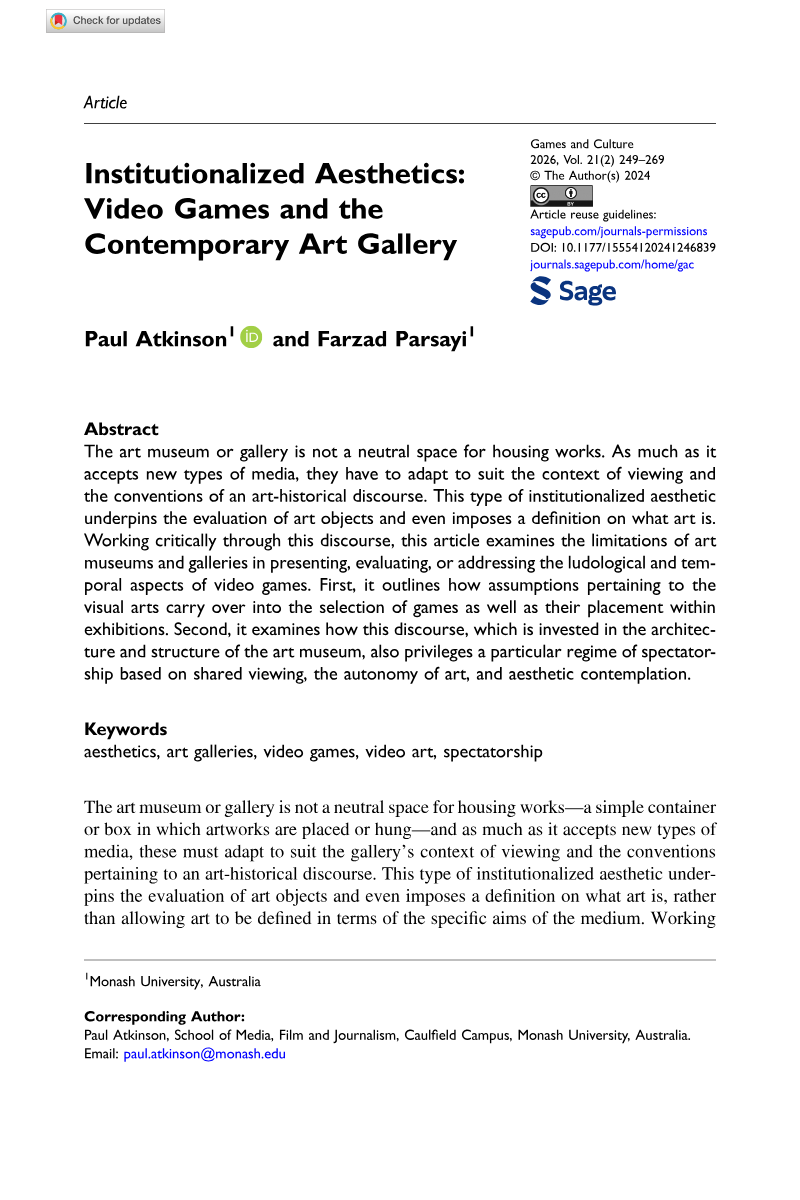
Video Games and the Contemporary Art Gallery
Contemporary art galleries face significant structural and conceptual challenges when attempting to integrate video games into the traditional white cube environment.
- The fundamental tension between video games and art galleries stems from a mismatch between the gallery's requirement for fragmented, self-directed viewing and the game's need for sustained, linear immersion.
- Curators often employ an 'aesthetics of reduction' by stripping away narrative and gameplay mechanics to force video games into traditional art-historical frameworks.
- Current exhibition strategies, such as large-scale projections and modified game states, frequently relegate games to the status of design artifacts rather than treating them as distinct, evolving forms of expression.
The Mukokuseki Strategy and the Application of Pivot Translation in the Localization of Japanese Games
The global distribution of Japanese video games increasingly relies on the mukokuseki strategy, a design philosophy that strips content of specific national markers to create a culturally odorless, universally appealing aesthetic.
- Japanese game developers are increasingly adopting the 'mukokuseki' strategy, which removes specific national markers to create a culturally odorless aesthetic designed for universal global appeal.
- The industry is shifting toward pivot translation, using English as an intermediate language rather than direct Japanese-to-target-language translation to streamline international distribution.
- Titles like Dark Souls 3 demonstrate the integration of European cultural motifs as a deliberate design choice to enhance marketability in Western regions.
Transfiguration for Quest Design
The prevailing industry standard of task-oriented quest design, which relies heavily on repetitive combat, collection, and transit objectives, fails to foster deep player engagement.
Poetics of Video Games in Contemporary Literary Culture
Machphrasis serves as a foundational theoretical framework designed to address the critical deficit in literary studies regarding the integration of video game aesthetics into contemporary prose.
Monsters: Investigating Parasocial Relationships with Non-Player Characters
The video game Undertale serves as a critical case study for understanding how interactive media fosters deep parasocial relationships between players and non-player characters.
- Players form meaningful, multifaceted parasocial bonds with virtual entities when game mechanics and narrative systems are tightly integrated to foster reciprocal-feeling engagement.
- The quality of player-character relationships is fundamentally determined by the game's structural design, which can function as a system of either coercion or collaboration.
- Reactive world states that respond to player choices between violence and empathy are the primary drivers for establishing deep emotional connections with non-player characters.
Do you work at SAGE Publishing? Get a free report of how these documents are read and cited here.